Qodo vs Greptile: What Actually Separates Two Nearly Identical Pitches
Qodo and Greptile are AI agents that review pull requests by indexing a whole codebase rather than just the diff, catching cross-file bugs before merge. Qodo also reviews code in the IDE and supports Bitbucket and Azure DevOps; Greptile works only at the pull request stage, on GitHub and GitLab.
The short version
Qodo and Greptile both review pull requests with full-codebase context instead of just the diff, but Qodo also reviews in the IDE, supports four git hosts, and prices by review volume, while Greptile stays GitHub- and GitLab-only, prices per seat, and keeps setup simpler.
Qodo raised $70 million in March 2026 by telling investors it reviews code with more context than a diff. Five months earlier, Greptile raised $25 million telling investors almost exactly the same thing.
Both companies build AI agents that index an entire codebase before reviewing a pull request, instead of judging only the lines that changed, and on that core claim Qodo and Greptile are nearly identical. Neither writes code itself; that job belongs to a different category of agent, like CodeGen, which reasons across a repo to open its own multi-file pull requests. Qodo and Greptile exist to check a diff, human or agent-written, before it merges.
Underneath the shared pitch, the two products diverge. Qodo now reaches into the IDE and prices by how many reviews a team runs; Greptile stays fixed at the pull request and prices by how many developers touch it. For an engineering lead choosing a first AI reviewer this quarter, that difference in shape, not the shared pitch, is what should decide the purchase.
Two startups, one pitch, two different products
Qodo started in Tel Aviv in 2022 as CodiumAI and took its current name in September 2024. It closed its Series B on March 30, 2026: $70 million, led by Qumra Capital, pushing total funding to $120 million, according to TechCrunch's report on the round. Founder Itamar Friedman told TechCrunch that "code generation companies are largely built around LLMs. But for code quality and governance, LLMs alone aren't enough." The company says its enterprise footprint grew 11x over the prior year, per its own Series B announcement.
Greptile raised a smaller $25 million Series A on September 23, 2025, led by Benchmark Capital with Cory Levy, Y Combinator, and Initialized Capital also participating. In the month around that raise, Greptile said it reviewed more than 500 million lines of code and prevented over 180,000 bugs, according to its own Series A post. Its customer list includes Brex, Substack, PostHog, and Bilt.
That funding gap, $120 million total for Qodo against roughly $30 million for Greptile, lines up with where each product has gone since. Qodo spent its round on governance features: SSO, audit logs, and air-gapped deployment. Greptile kept its round narrow, funding a rewrite of its review agent that it says catches three times more critical bugs than the previous version.
Qodo prices by review, Greptile prices by seat
The two pricing pages, both checked on August 19, 2026, describe opposite billing models under the same $30-a-month headline number.
Qodo's Pro Team tier costs $30 a month as a flat, pooled price covering up to 30 users. That base buys 2,500 credits at $0.012 each, good for roughly 18 reviews a month across the whole team, with larger packs at 5,000 credits (about 36 reviews) and 20,000 credits (about 144 reviews).
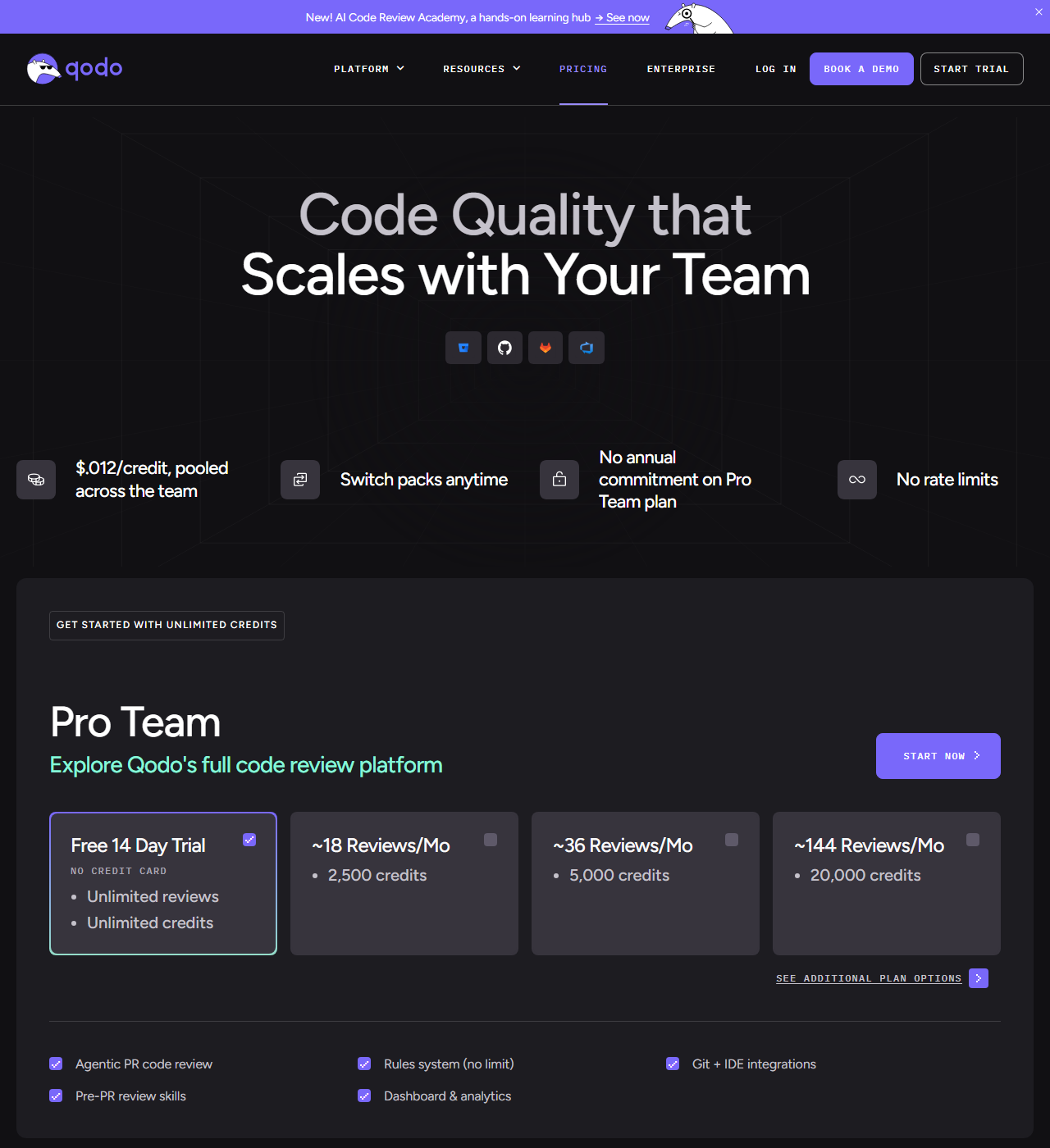 Qodo's pricing card, captured 19 Aug 2026. Pack sizes are listed; what a pack costs beyond the base $30 tier is not.
The pricing page does not state whether a larger pack costs more than $30 or simply replaces it. Qodo did not clarify this on the page itself, so treat the $30 figure as a starting price, not a ceiling.
Greptile prices by seat, and the math flips by team size
Greptile's Pro plan also costs $30, but per seat, with unlimited seats and 50 credits included per seat. One credit covers one standard review; extra credits cost $1 each. Greptile defines a seat as any developer who got a review done in that billing period, so cost tracks active reviewers rather than headcount on paper.
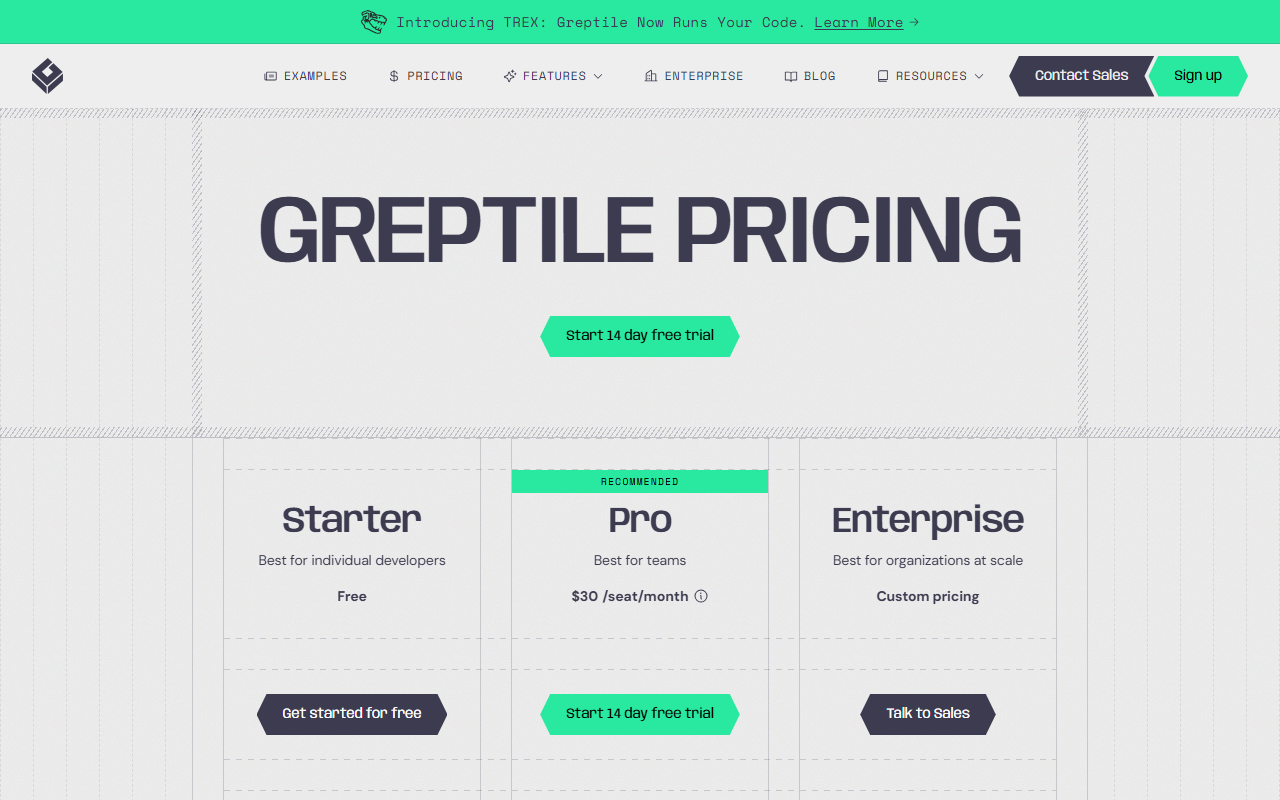 Greptile pricing, screenshotted 19 Aug 2026: a flat per-seat number next to Qodo's pooled, credit-metered one above.
Run the numbers against two shapes of team. A three-person team opening 15 pull requests a month fits entirely inside Qodo's $30 base tier, since 15 reviews use fewer than the roughly 18 included. The same team on Greptile pays $90 a month, three seats at $30 each, for far more headroom (150 pooled credits) than it needs.
Flip the team size. A twelve-person team running 400 reviews a month would burn through Qodo's largest published pack and need an unpriced upgrade, while the same team on Greptile pays $360 for 12 seats, with 600 credits pooled, comfortably inside plan.
Small teams with light review volume come out ahead on Qodo's flat pricing. Larger teams with heavy review volume come out ahead on Greptile's per-seat model, because pricing scales with people instead of usage. Neither vendor states an all-in overage rate for a team that blows past every published tier.
One rebuilds context every run, the other keeps it running
Qodo's own comparison post, published on its blog, describes Greptile as building "a repository graph each time a pull request is reviewed" and producing a single confidence score from 0 to 5 per review. That framing should be read as Qodo's characterization of a competitor, not a neutral summary, but it matches language on Greptile's own site describing a graph-based map of the whole codebase reviewed by a swarm of parallel agents.
Qodo describes its own approach as a persistent knowledge layer, built once from AST parsing, a graph database, a vector database, and commit history, then reused across the IDE, its Agent Skills product, and the pull request stage. Instead of one score, it routes a review through specialized agents that separately flag critical issues, breaking changes, and standards violations, according to the same post.
Greptile's public docs confirm a second layer on top of the graph review: a /greploop command for iterative agent fixes, an MCP server that connects the reviewer to Claude Code and Cursor, and rules that the system learns implicitly from how engineers react to past reviews. Qodo's rules system works differently. It mines standards from a team's PR history into what the company calls a living rules system, meant to stay current without a human rewriting a wiki page.
Greptile skips two of the four major git hosts
Greptile's own documentation lists exactly two supported platforms: GitHub Cloud and Enterprise Server, and GitLab Cloud and Self-Managed. There is no Bitbucket support and no Azure DevOps support anywhere in Greptile's docs or pricing pages.
Qodo supports all four: GitHub, GitLab, Bitbucket, and Azure DevOps, and offers three deployment models, SaaS, on-premises, and air-gapped, where air-gapped means zero outbound network dependencies. That last option matters specifically for regulated industries that cannot send code to a third-party cloud at all. Greptile's enterprise tier does offer self-hosting, per its pricing page, but self-hosted is not the same guarantee as air-gapped with no external calls.
If your team's pull requests live in Bitbucket or Azure DevOps, this section ends the comparison. Only Qodo is an option.
Where Greptile wins
A five-person team on GitHub, wanting one clear signal at the merge gate and nothing more complicated, is the case Greptile is built for. It does not try to sit in the IDE. It does not ask a developer to accept inline suggestions while typing. It reviews the pull request, scores it, and gets out of the way, which is also why its MCP server plugs cleanly into Claude Code and Cursor for teams already standardized on one of those editors.
Greptile also publishes a specific catch-rate claim: 82% in its own test run in July 2025. That number is self-reported and has not been independently audited, but it is at least a stated figure rather than a vague "best in class" claim. Combined with its lower headline price for small, light-usage teams, Greptile is the pragmatic pick for a startup that wants the cheapest working merge gate on GitHub or GitLab and does not plan to add IDE-level review later.
None of that reaches bugs that slip past review entirely. A team standardized on Greptile alone still needs something for defects a reviewer missed and a human only notices in staging or production, which is the gap tools like Jam fill: one click captures the console log, network requests, and repro steps, instead of a developer trying to reconstruct what happened from a Slack message.
Where Qodo wins
Any team on Bitbucket or Azure DevOps has already answered this question. So has any team in a regulated industry that needs air-gapped deployment with an auditable paper trail, since Greptile does not offer that option at all.
Qodo also fits a team that wants the same standards enforced before a pull request opens, not just at the merge gate, because its IDE agent and PR agent draw from the same persistent knowledge layer instead of two separate tools learning two separate sets of rules.
A team that pairs Qodo's review with TestMu AI for browser and device testing after merge gets coverage across the whole pipeline: static review before commit, PR review before merge, and runtime testing after deploy. Three different failure modes, caught by three different products.
On its own benchmark, relayed by TechCrunch at the time of its Series B, Qodo says it scored 25 points higher than Claude Code Review on Martian's Code Review Bench in February 2026. Like Greptile's number, this is a vendor-published result rather than an independently audited one, and Martian's own leaderboard should be checked directly before treating either score as final.
The turn: most teams never touch the IDE half
The obvious objection to recommending Qodo on its IDE-to-PR range is that most developers ignore IDE-level suggestions entirely. Inline lint-style nudges get dismissed in seconds; the pull request is the only stage with real teeth, because that is where a human reviewer or a merge rule actually blocks the code. If that is true, Qodo's three-entry-point pitch is solving a problem a five-person startup does not have.
That objection holds for teams under roughly 15 engineers without a dedicated platform or developer-experience role to enforce IDE-stage standards. Below that size, the real decision narrows to git provider and deployment constraints, not the multi-stage story either vendor tells.
Above that size, the calculus flips. Once a team has someone whose job is enforcing consistency across repos, the IDE layer stops being optional and starts being where standards get applied before a diff even reaches review, closer to how Dosu handles the maintenance work neither Qodo nor Greptile touches: triaging issues and syncing documentation after the code has already merged.
What actually changes the answer
Neither company runs a durable free tier for a team, only for an individual or a trial window. Greptile's Starter plan gives one developer unlimited repositories and 50 credits a month for free, indefinitely. Qodo's own pricing page, checked today, lists no permanent free plan for teams at all, only a 14-day trial that unlocks unlimited reviews and then ends.
Qodo did hand its older open-source reviewer, PR-Agent, over to independent community governance on April 23, 2026, moving the repository to a new organization and reverting its license to Apache 2.0, according to Qodo's own announcement. That tool still exists; it is simply no longer Qodo's to price.
The next thing worth watching is not which vendor wins the next self-published benchmark round. It is whether either one adds a real free tier back for small teams, or whether Greptile adds the two missing git hosts before Qodo undercuts it on price for the teams currently choosing on cost alone.
Frequently asked questions
Is Qodo or Greptile cheaper for a small team?
It depends on review volume, not just headcount. A three-person team running about 15 reviews a month fits inside Qodo's flat $30 Pro Team tier, while the same team on Greptile pays $30 per seat, or $90 total, for far more headroom than it needs. Larger teams with heavy review volume tend to come out ahead on Greptile's per-seat pricing instead.
Does Greptile support Bitbucket or Azure DevOps?
No. Greptile's own documentation lists only GitHub Cloud and Enterprise Server, and GitLab Cloud and Self-Managed, as supported platforms as of August 2026. Teams on Bitbucket or Azure DevOps need Qodo, which supports all four git hosts.
Does Qodo review code before a pull request is opened?
Yes. Qodo runs an agent in the IDE itself, alongside its pull-request reviewer, both drawing on the same persistent knowledge layer of AST parsing, graph and vector databases, and commit history. Greptile reviews only at the pull request stage and does not have an IDE-time product.
Does either Qodo or Greptile have a free plan?
Greptile's Starter plan is free indefinitely for one active developer, with unlimited repositories and 50 review credits a month. Qodo's pricing page, checked in August 2026, lists no permanent free plan for teams, only a 14-day trial that unlocks unlimited reviews before it ends.
Which tool catches more bugs, Qodo or Greptile?
Both publish self-reported numbers rather than independently audited ones: Greptile cites an 82% catch rate from its own July 2025 test, and Qodo cites a 25-point lead over Claude Code Review on Martian's Code Review Bench from February 2026. Check Martian's own published leaderboard directly before treating either figure as final.
Covered in this guide
- Qodo: AI code review and test generation platform with a multi-agent architecture that scores highest for real-bug detection among independently benchmarked code review tools.
- Greptile: AI code review agent that indexes your whole codebase, not just the diff, to catch cross-file bugs before merge; used by 22,000+ engineering teams.
- CodeGen: AI code agent reasons across full codebases, writes multi-file changes, runs tests, opens PRs with architectural awareness.
- Dosu: AI knowledge layer for coding agents. Captures what engineers and agents learn across GitHub, Slack and Notion, shares it via MCP, and auto-syncs docs. Free plan covers public repos only.
- Jam: Jam auto-captures console logs, network requests, and repro steps in 1 click, used by 170,000+ developers to cut bug reporting time by up to 60%.
- TestMu AI: Agentic AI quality engineering platform combining a cross-browser, cross-device testing cloud with AI-generated tests, free tier included. Recognized as a 2025 Gartner Magic Quadrant Challenger.
Sources
Still deciding?
This guide covers a handful of options. Smart Match checks every listing in the directory against how you actually work and what you can spend, then hands you the shortlist and the reason behind each pick.
Start Smart MatchRelated guides
- Four Lanes, 95 Guides, and Not One Outside Its BandInside HokAIHow the directory works, verified in the open
- We Opened Every Source Link HokAI Cites. 531 of 535 Answered.Inside HokAIHow the directory works, verified in the open
- Qodo Gave Away Its Free Tool the Same Month It Cut Its Free TierAnalysisWhat changed and who it affects
- Qodo vs TestMu AI: Which Should You Use in 2026?ComparisonHead-to-head, with a verdict
- Cursor Isn't Just an Editor AnymoreAnalysisWhat changed and who it affects
- Windsurf Is Now Devin Desktop: What Actually ChangedAnalysisWhat changed and who it affects