Qodo vs TestMu AI: Which Should You Use in 2026?
Qodo is a $30-a-month AI code-review platform with a self-reported 60.1% F1 score across eight tools; TestMu AI, formerly LambdaTest, is a cross-browser and device testing cloud with free entry tiers and six separately priced products, including its KaneAI test-authoring agent.
The short version
Qodo and TestMu AI both market themselves as AI testing tools, but they inspect different stages: Qodo reviews the pull request a developer just opened, while TestMu AI runs the finished build across thousands of real browsers and devices. Pick Qodo for review bottlenecks, TestMu AI for cross-browser gaps, and expect to need both past fifteen engineers.
Qodo raised a $70 million Series B on March 30, 2026, while TestMu AI spent the same year rebranding away from a name, LambdaTest, that had nine years of recognition behind it. Both companies now sell themselves as the AI answer to broken software, and both show up on the same shortlists under "AI testing tools." They test two completely different things.
Qodo reads the pull request a developer just opened: it reviews the diff, flags bugs, and writes the unit test that would have caught the gap. TestMu AI runs the application that diff produced, across thousands of real browsers and real devices, after the code has already shipped to a staging build.
A team evaluating "an AI testing tool" for its Q4 2026 budget is usually trying to fix one of two different failures, and picking the wrong product here means the actual bottleneck stays exactly where it was. This guide is for an engineering lead at a five-to-fifteen person startup without a dedicated QA hire, choosing a first purchase in this category.
Qodo reviews the diff; TestMu AI runs the finished app
Qodo was founded in Tel Aviv in 2022 as CodiumAI, rebranded to its current name in September 2024 alongside a $40 million Series A, and closed a $70 million Series B in March 2026, according to TechCrunch, bringing total funding to $120 million. Its customer list includes Nvidia, Walmart, Red Hat and Intuit.
TestMu AI has an older start: founded in 2017 as LambdaTest, it raised $108 million across eight rounds before renaming itself on January 12, 2026, a change the company says reflects a shift "from a cloud testing platform to a full-stack Agentic AI Quality Engineering platform," per its own rebrand announcement.
Neither company changed what it actually does. Qodo still lives inside the code-review step: open a pull request on GitHub, GitLab, Bitbucket, Azure DevOps, CodeCommit or Gitea, and its multi-agent system posts line comments and a generated test.
TestMu AI still lives in the execution step: point it at a URL or app build, and it runs that build across more than 3,000 browser and OS combinations plus 10,000 real mobile devices. One never touches source code. The other never opens a pull request.
The verdict, before the numbers
Pick Qodo if the actual pain is a PR review queue that a small team can't keep up with, and the codebase already lives on one of its six supported Git platforms. Pick TestMu AI if the pain is not knowing whether the shipped build actually works across the browsers and devices real users have, and there's no QA hire to run that matrix by hand.
Teams that grow past roughly fifteen engineers tend to need both, because by then code review and release testing have become separate jobs with separate owners, not one bottleneck with two names.
What each one actually costs
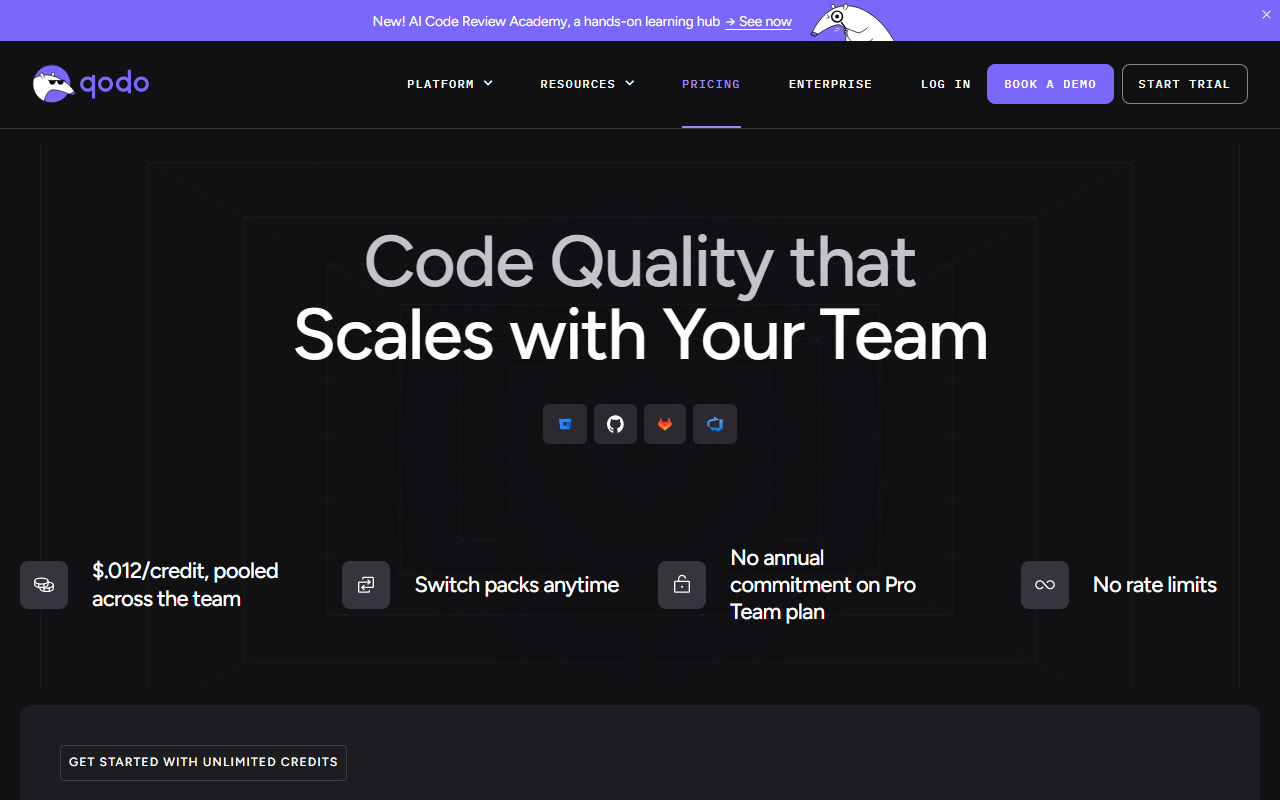 Qodo's pricing page, captured 18 Aug 2026. One paid tier, no per-product split.
Qodo's Pro Team plan has one paid tier that matters: a flat $30 a month covering up to 30 users, with 2,500 pooled credits (about 18 PR reviews) and additional credit packs at $0.012 each, per Qodo's pricing page. There is no permanent free tier, only a 14-day trial with unlimited credits and no card required.
TestMu AI splits its pricing across six separately billed products instead of one plan. Live Testing runs $15 to $39 a month per parallel session; Automation runs $29 to $199; HyperExecute runs $103 to $159; KaneAI, the natural-language test-authoring agent, runs $17 to $199 per agent per month depending on tier; Test Manager runs up to $59; Smart UI has its own volume pricing. Each product also ships a genuine $0 tier, according to TestMu AI's pricing page as of August 18, 2026.
A team that needs cross-browser testing, mobile automation, orchestrated parallel runs and AI test authoring together can end up paying more than $650 a month once those four products are stacked, though that combined figure is this guide's own estimate built from the listed per-product tiers, not a published bundle price.
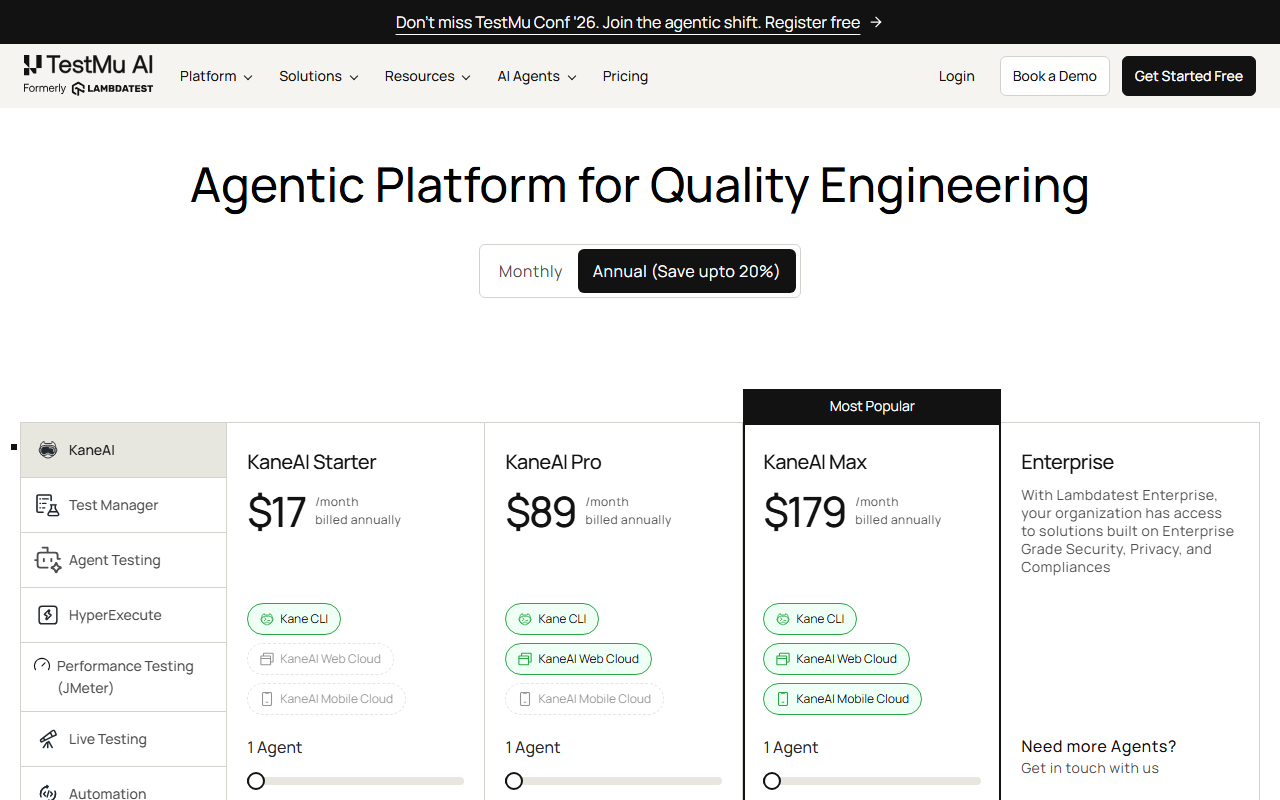 TestMu AI's pricing page, captured 18 Aug 2026. This is one of six separately priced products.
Qodo's multi-agent review, and the benchmark behind the number
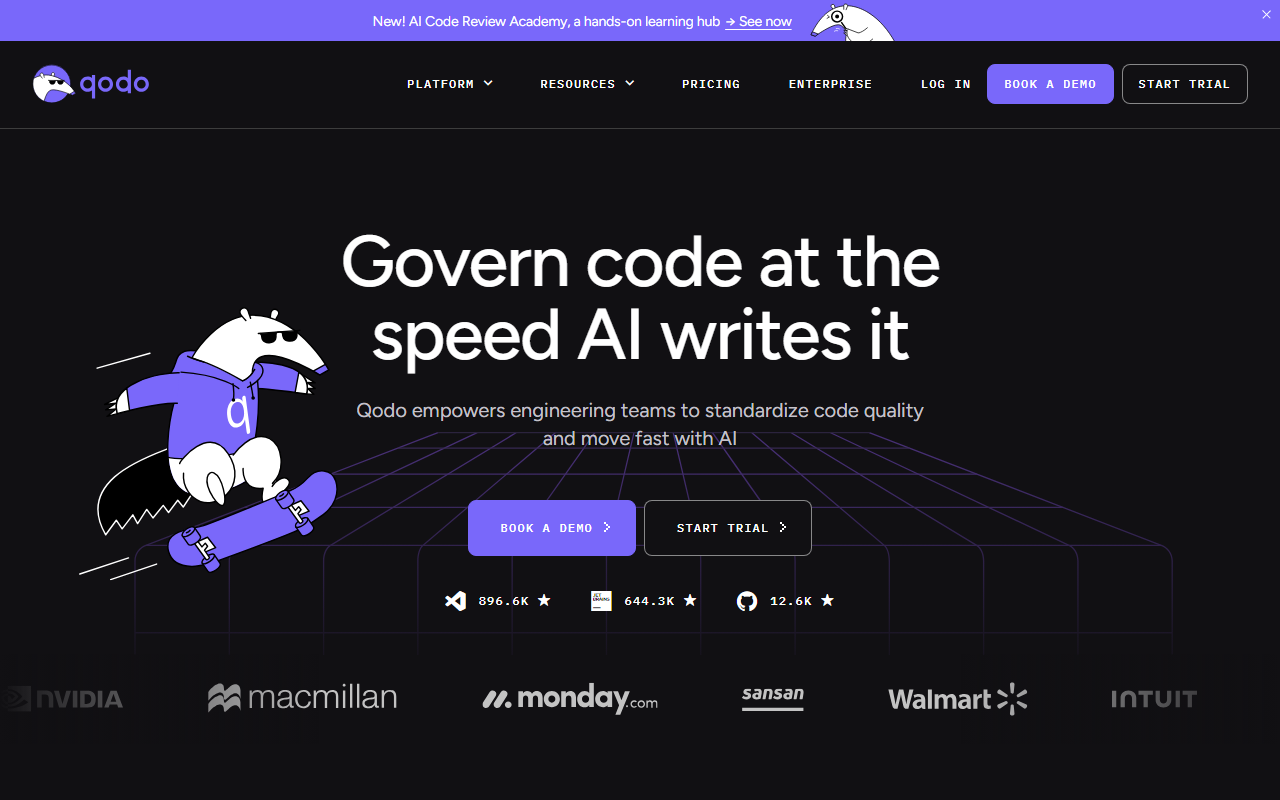 Qodo's homepage, captured 18 Aug 2026.
Qodo's core mechanism, introduced with Qodo 2.0 in February 2026, runs four specialized agents in parallel on every pull request: one for bug detection, one for code quality, one for security analysis, one for test coverage gaps. In its own published benchmark, Qodo injected 580 issues into 100 real pull requests pulled from production open-source repositories, then ran eight AI code review tools against them.
Qodo's own tool scored the highest F1 at 60.1%, with what the company describes as the highest recall by a significant margin. That number is worth repeating carefully: it is Qodo's own benchmark, administered by Qodo, not an independent lab, even though the methodology and results are published on Qodo's GitHub organization for anyone to re-run.
Later releases added a Findings page (Qodo 2.3, aggregating critical issues across every repository) and cross-repository review (Qodo 2.4, catching a breaking change in one repo before it silently breaks a dependent repo), a capability The New Stack covered as addressing the specific failure of a reviewer skimming a diff without knowing what else depends on it.
TestMu AI's KaneAI, and the testing cloud underneath it
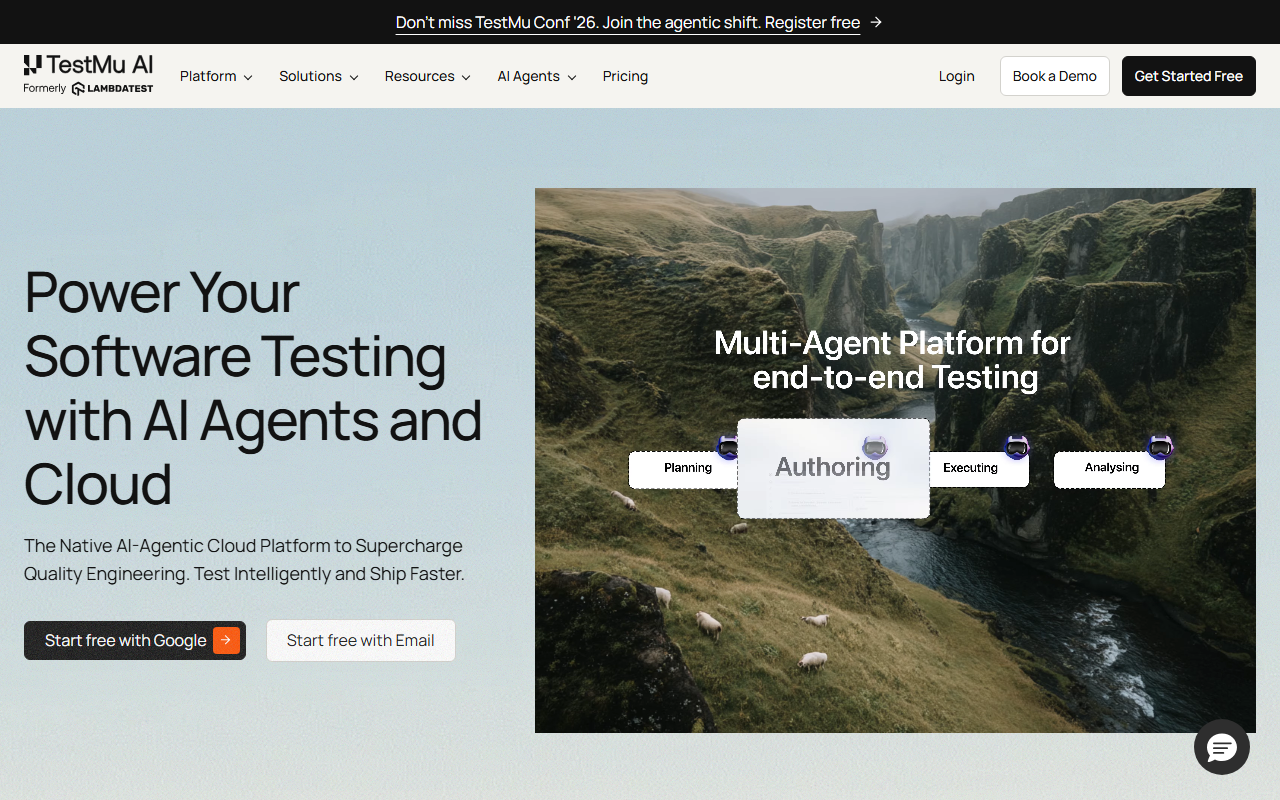 TestMu AI's homepage, captured 18 Aug 2026. Authoring is the KaneAI stage this section covers.
TestMu AI's agent layer is called KaneAI. It turns a plain-language request, a ticket, or a screenshot into a structured test plan and execution logic, removing the scripting expertise that test automation has traditionally required. That test then runs on HyperExecute, TestMu AI's orchestration engine, which the company says finishes suites roughly 70% faster than a traditional cloud grid through AI-driven grouping and retry logic.
Underneath both sits the same cloud that made LambdaTest's name: over 10,000 real mobile devices and a browser matrix spanning Chrome, Firefox, Safari and Edge across Windows, Mac, Linux, Android and iOS.
TestMu AI was named a Challenger in Gartner's 2025 Magic Quadrant for AI-augmented software testing tools and appeared in Forrester's Autonomous Testing Platforms Landscape report, third-party recognition Qodo has not (yet) received in the code-review category. Neither vendor publishes a standardized adoption number that would let a five-person team compare its exact peer group, so this guide does not claim either tool leads among startups specifically.
Where Qodo wins
A four-engineer SaaS team merging fifteen pull requests a week, already on GitHub, with no dedicated reviewer, is Qodo's clearest case: it plugs into the workflow that already exists, posts comments where the team already looks, and generates the test that closes the gap the review just found.
Kusho, a smaller AI tool that generates API and UI test suites directly from an existing codebase, sits in the same review-adjacent space as Qodo but skips the PR-comment layer entirely, worth a look if a team wants generated tests without the review workflow attached.
Where TestMu AI wins
A team shipping a consumer-facing web app that has to work on an iPhone in Safari, a five-year-old Android phone, and Chrome on a Chromebook, with nobody on staff who owns that matrix, is TestMu AI's clearest case. Its free Live Testing and Automation tiers let that team start validating real-device behavior before committing a dollar, something Qodo's trial-only free option does not offer.
Greptile, a code-review tool that indexes an entire repository and reports an 82% single-pass catch rate on its own benchmark, is the closer Qodo alternative for teams whose actual bottleneck turns out to be code review after all, not release testing.
The turn: the cheaper option isn't always the right first purchase
The obvious objection to a two-category framework is that a cash-strapped team should just buy whichever tool is cheaper to start, and on a strict per-dollar read TestMu AI wins that by default: it ships real $0 tiers on Live Testing, Automation and Test Manager, where Qodo's only free option is a 14-day trial before the $30-a-month Pro Team plan begins. But cost only decides a purchase when the two options are substitutes for each other, and they are not.
A free TestMu AI plan does nothing about a badly reviewed pull request sitting in the queue right now. A Qodo trial expires long before most five-person teams have worked out whether their actual bottleneck is even in code review rather than in what happens after code review. The category question has to get answered before the price question, not instead of it.
Switching cost, if the wrong one gets picked first
Qodo is close to reversible. It sits on top of an existing Git workflow, so removing it means turning off an integration, not re-architecting anything; a team that starts there and later realizes its real problem is cross-browser coverage loses roughly a month of credits, not months of engineering time.
TestMu AI is stickier once KaneAI has authored a real test suite in natural language, because those tests are written to run on TestMu AI's own execution engine, not as portable code a team can lift into a different runner without rewriting them. Starting with TestMu AI is the safer default when a team is genuinely unsure which category its bottleneck falls into, precisely because its entry tiers are free.
Qodo's roadmap has stayed inside the pull request since its 2022 founding as CodiumAI, and KaneAI still builds test plans from tickets and screenshots rather than reading a diff. Until one of them crosses into the other's territory, the real 2026 decision isn't Qodo versus TestMu AI. It's which stage of the pipeline, review or release, is costing the most engineering hours this quarter.
Frequently asked questions
Is TestMu AI the same company as LambdaTest?
Yes. LambdaTest, founded in 2017 by Asad Khan, Jay Singh and Mayank Bhola, rebranded to TestMu AI on January 12, 2026. The company says the name change reflects a shift from a cloud testing platform to a full-stack agentic AI quality engineering platform. All accounts, integrations and infrastructure carried over unchanged.
Does Qodo have a free tier?
No permanent free tier. Qodo offers a 14-day trial with unlimited credits and no credit card required, after which the Pro Team plan starts at $30 a month for up to 30 users. Qualified open-source projects can apply for free access through Qodo's open-source program.
How much does TestMu AI cost with all its products?
TestMu AI prices six products separately: Live Testing ($15-$39/month), Automation ($29-$199), HyperExecute ($103-$159), KaneAI ($17-$199 per agent), Test Manager (up to $59) and Smart UI (volume-based). A team running all of them together can exceed $650 a month combined, though TestMu AI does not publish a single bundled price for that stack.
Is Qodo's 60.1% F1 benchmark independently verified?
No. It is Qodo's own benchmark: the company injected 580 issues into 100 real pull requests and tested eight AI code review tools, including its own, scoring itself highest. The methodology and results are published on Qodo's GitHub organization for anyone to reproduce, but no independent lab has run the comparison.
Can a small team use just one of these tools?
Yes, and most five-to-fifteen person teams start with one. Pick Qodo if the bottleneck is a slow or inconsistent pull request review queue. Pick TestMu AI if the bottleneck is not knowing whether the shipped build works across real browsers and devices. Teams tend to add the second tool once they pass roughly fifteen engineers.
Covered in this guide
- Qodo: AI code review and test generation platform with a multi-agent architecture that scores highest for real-bug detection among independently benchmarked code review tools.
- TestMu AI: Agentic AI quality engineering platform combining a cross-browser, cross-device testing cloud with AI-generated tests, free tier included. Recognized as a 2025 Gartner Magic Quadrant Challenger.
- Greptile: AI code review agent that indexes your whole codebase, not just the diff, to catch cross-file bugs before merge; used by 22,000+ engineering teams.
- Kusho: AI test automation generates production-ready API and UI test suites in minutes with 100% backend coverage and security testing.
Sources
Still deciding?
This guide covers a handful of options. Smart Match checks every listing in the directory against how you actually work and what you can spend, then hands you the shortlist and the reason behind each pick.
Start Smart MatchRelated guides
- Four Lanes, 95 Guides, and Not One Outside Its BandInside HokAIHow the directory works, verified in the open
- We Opened Every Source Link HokAI Cites. 531 of 535 Answered.Inside HokAIHow the directory works, verified in the open
- Qodo Gave Away Its Free Tool the Same Month It Cut Its Free TierAnalysisWhat changed and who it affects
- Qodo vs Greptile: What Actually Separates Two Nearly Identical PitchesComparisonHead-to-head, with a verdict
- Windsurf Is Now Devin Desktop: What Actually ChangedAnalysisWhat changed and who it affects
- Meta Started Charging for Its AI Agents. The Framework Under Them Just Lost Its Creator to OpenAIBuyer's guideHow to pick, across a category