Best AI Game Makers in 2026: Make a Game Without Coding (Free and 3D Options)
An AI game maker turns a written description into a playable game without code. In November 2026 the free tiers differ more than the AI does: Rosebud gives 10,000 credits a week, GDevelop 40 AI credits a month, Summer Engine a one-off 6-dollar credit, while Astrocade charges nothing but forbids commercial use.
The short version
For a first game tonight, open Rosebud AI: its free credits cover about five AI edits a week. To keep and sell a game without paying, use GDevelop. Astrocade is free on a phone but bars selling; Nilo suits 3D with friends; Summer Engine is the adult route to Steam.
Not sure which one fits you? Describe your situation and Smart Match names three tools.Find my AI tools
In this guide13 sections
The second Google result for "ai game maker free" belongs to Gameer, and its own page says making a game there needs an approved creator application or a $49-a-month plan.
That gap between the word "free" and what it buys runs through this whole category. We read the pricing pages, terms of service and privacy policies of seven AI game makers on 15 November 2026, then played a public game made with each one we could open without an account. The question that separates them is not which AI is smartest. It is how many edits the free tier covers, whether you may keep and sell what you make, and whether it does 3D.
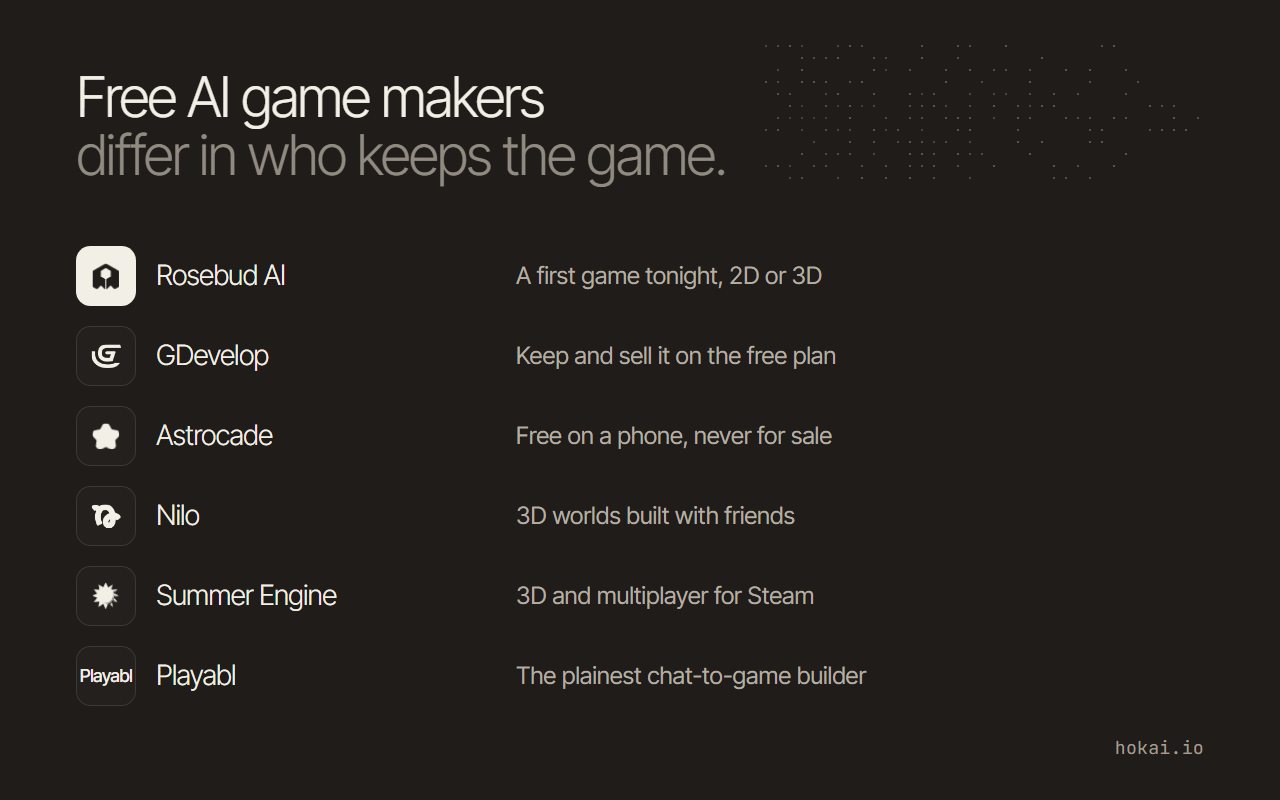 Hokai chart of which AI game maker suits which goal, from each vendor's pricing page and terms as read on 15 Nov 2026.
- Rosie edits a week on Rosebud's free credits
- 5
- 10,000 credits at about 2,000 an edit
- AI credits a month on GDevelop's free plan
- 40
- Silver gives 200 a week
- Summer Engine's one-off hosted-AI credit
- $6
- The engine itself stays free
- Gameer's Creator Pro, a month
- $49
- Playing is free, making is not
The shortlist: which AI game maker to open first
Each tool wins one job. Find yours in the left column: Rosebud AI and GDevelop cover the two most common ones, and the other four each own a narrower goal.
| Your goal | Pick | Free tier | The catch |
|---|---|---|---|
| A playable game tonight, 2D or 3D | Rosebud AI | 10,000 credits a week | Selling needs the $30 plan |
| Keep and sell it, pay nothing | GDevelop | Full engine, 40 AI credits a month | You learn its event sheets |
| A mini game on your phone | Astrocade | Everything, no paid plan | Non-commercial use only |
| 3D worlds built with friends | Nilo | Weekly capped allowance | No parental controls |
| A 3D or multiplayer game on Steam | Summer Engine | Engine, editor and export | Desktop install, adults only |
| The simplest chat-to-game builder | Playabl | Free tier, limit unpublished | Pricing page now offline |
If none of those goals is quite yours, Smart Match asks what you want to make and checks every listing on Hokai against it.
How to choose: four questions settle it
Every product here turns a description into something playable. These four questions are what actually differ, and they work on tools this guide does not cover.
- How many AI edits does free buy? A first game takes dozens of small fixes, so count edits, not features.
- Can you keep and sell the game? Read the terms, not the homepage.
- 2D, 3D or both? Some start from 3D, some add it, some barely touch it.
- Who is it for, by age? Two of these tools are for adults only and two start at 13.
Rosebud prices an edit with its default AI at about 2,000 credits, so its 10,000 weekly credits cover roughly five. GDevelop gives 40 credits a month. Astrocade's terms limit use to personal, non-commercial purposes, while GDevelop's plan table allows selling on every plan, the free one included.
A fifth question matters to some readers: whether your prompts train someone's model. That sits with the ages further down.
What it costs, and what free actually buys
Free means three different things here. Some tools give a weekly or monthly allowance of AI work, some give the software free and charge for the AI, and one gives everything away.
| Tool | Free allowance | Cheapest paid plan | Locked on free |
|---|---|---|---|
| Rosebud AI | 10,000 credits a week | Indie Dev, $15 a month | Private projects, code, selling |
| GDevelop | 40 AI credits a month | Silver, $6.49 a month | Logo removal, iOS builds |
| Astrocade | No published limit | None published | Selling is barred on every account |
| Nilo | Weekly capped usage | Builder, $29.99 list | Roblox character export |
| Summer Engine | One-off $6 AI credit | Pro, $20 a month | Ongoing hosted AI, privacy mode |
The full paid ladders, as each vendor priced them on 15 November 2026:
| Tool | Plan | Monthly price | What it adds |
|---|---|---|---|
| Rosebud AI | Indie Dev | $15 | 100,000 credits, private projects |
| Rosebud AI | 10x Dev | $30 | Commercial rights, no branding |
| Rosebud AI | Pro | $50 | Code download, Windows build |
| Rosebud AI | Scale | $100 | 2,000,000 credits |
| GDevelop | Silver | $6.49 | 200 AI credits a week |
| GDevelop | Gold | $10.99 | 1,000 a week, iOS builds |
| GDevelop | Pro | $32.99 | 3,000 a week, collaborators |
| Nilo | Builder | $29.99 list | 1.5x the free usage |
| Nilo | Pro | $74.99 list | 4x the free usage |
| Summer Engine | Pro | $20 | Full hosted AI |
| Summer Engine | Pro+ | $60 | 3x Pro's AI usage |
| Summer Engine | Ultra | $200 | 10x Pro's AI usage |
Rosebud's credit table puts an edit with a premium model at about 20,000 credits. One such edit uses two weeks of free credits.
GDevelop's comparison table says yearly billing saves up to 40 percent. Nilo showed both paid plans at half their list price on 15 November.
Read from each vendor's own pricing page. Nilo's list price was shown at 50 percent off that day.
Astrocade has no paid plan at all. Its iPhone App Store listing shows the app as free with no in-app purchase label, and its Google Play listing answers "Is Astrocade free?" with a yes.
Who owns the game, and can you sell it?
This question changes the answer more than any feature does. We read each tool's terms of service or pricing page on 15 November 2026.
| Tool | Who owns your game | Selling allowed? |
|---|---|---|
| GDevelop | You; the engine is MIT-licensed | Yes, on every plan |
| Summer Engine | You: code, scenes, assets, build | Yes, on every plan |
| Rosebud AI | You | From the 10x Dev plan ($30) |
| Nilo | You; Nilo gets a broad licence | Your job to clear rights |
| Astrocade | Your input; it owns its generic assets | No: personal use only |
| Playabl | You; it may use it to improve its AI | Terms cover business use only |
Summer Engine's source-status page puts it plainly: "You own your code, scenes, assets, and shipped build." Rosebud's pricing FAQ says the 10x Dev plan and above include full commercial rights and that it takes no commission. Putting a Rosebud game on Steam needs Pro, which adds code download and a Windows build export.
Astrocade is the outlier. Its terms license Astrocade's generated building blocks only for publishing on Astrocade, and limit the service to personal, non-commercial use. Creators are paid by plays instead, according to its creators page.
Playabl's terms, updated 25 October 2026, run the other way. They describe a service for business or commercial use rather than personal use, and give you ownership of your output subject to Playabl's licence to use it to improve its AI.
If you want 3D
"ai game maker 3d" is the next most searched version of this question, at about 880 searches a month against 1,600 for the free version. Four of the seven tools answer it.
- Nilo is 3D from the first prompt, with text-to-3D and image-to-3D across more than 20 generation models.
- Summer Engine builds 2D and 3D games in a desktop editor based on Godot, with Steam export.
- Rosebud AI makes 3D web games on Three.js, a widely used JavaScript library for 3D in the browser.
- GDevelop has a real-time 3D scene editor aimed, in its words, at "stylized low-poly 3D games."
Nilo's FAQ adds automatic rigging, so a generated character can be controlled with WASD, Shift and Space. Summer Engine adds managed multiplayer servers, and Rosebud also makes voxel worlds. The Astrocade game we played, Ladder Race 2, was a 3D runner, though Astrocade does not sell itself on 3D.
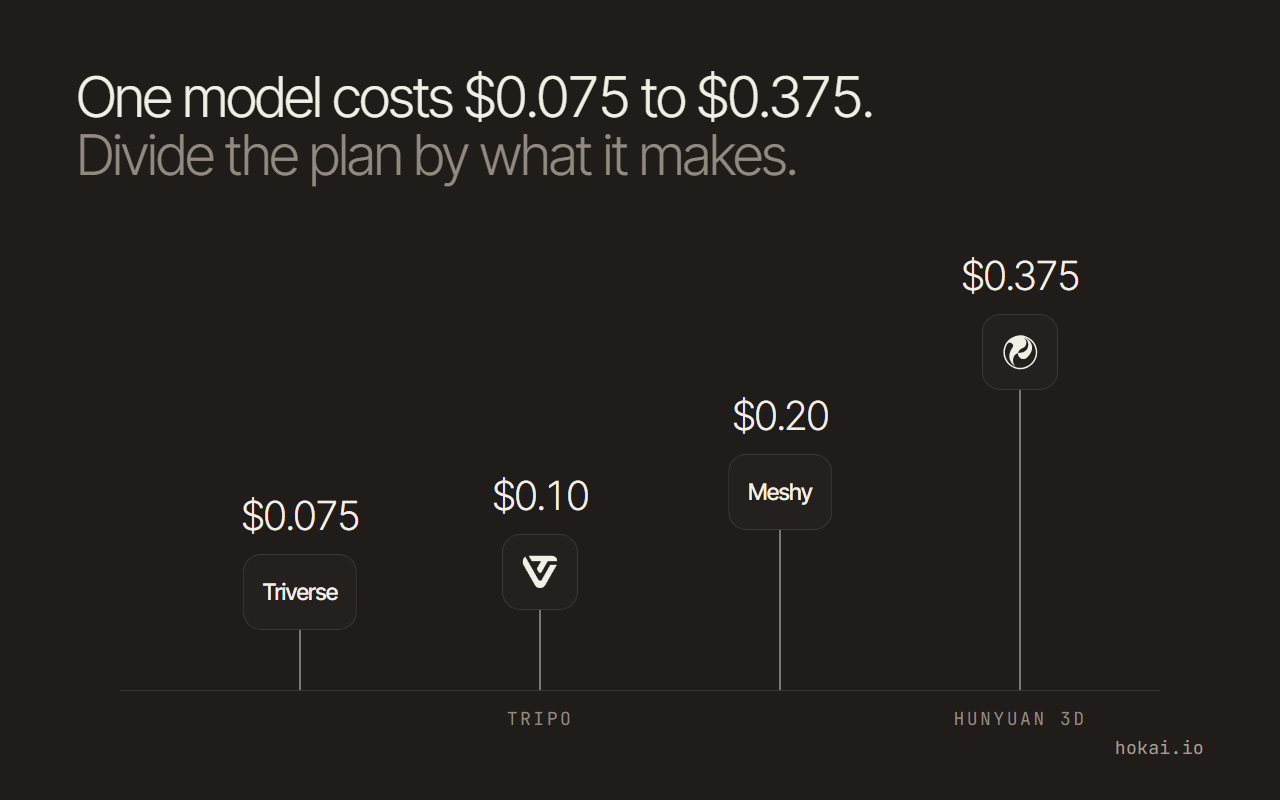
For 3D props rather than whole games, a model generator such as Meshy or Tripo goes further, and our 3D model generator guide compares them.
Rosebud AI is the fastest free start
Rosebud AI has you describe a game to Rosie, its AI designer, which asks a few questions and then writes the code, art and sound for a 2D, 3D or voxel web game that publishes to a link. Its company page counts more than 2.5 million games created.
On 15 November 2026 we opened rosebud.ai/play without an account and picked Silver Street, a community 3D car game. After a short loading screen it ran in the browser as a third-person drive with a minimap and on-screen pedals.
Where it falls short is the free credits. A Trustpilot reviewer, Eli J, wrote on 23 September 2026 that the free allowance ran out after one or two prompts and that projects failed to load after the seven-day wait. Its privacy policy also says anonymised user content may be licensed to AI labs for training, with no opt-out at present.
GDevelop is free, and the game is yours
GDevelop is an open-source engine where game logic is built from visual "when this, do that" events instead of code. Its AI agent, under Ask AI and then "Build for me", reads your project and adds objects, behaviours and events while you watch. Version 5.6.287 shipped on 4 November 2026.
On 15 November 2026 we opened gd.games, its game portal, as a guest and launched Powerline Guardians, a community multiplayer shooter. It loaded a low-poly 3D title screen in the browser.
Where it falls short: you still learn the event system. GDevelop's own guide to the agent says it is not an instant make-my-whole-game button and works best one system at a time, such as a coin pickup or a main menu. Free exports also keep the GDevelop logo, and iOS builds start at the $10.99 Gold plan.
Astrocade is free on your phone, with strings
Astrocade turns a one-line "wish" into a mini game built by a set of AI agents, then publishes it into a swipe feed. Its iPhone listing says more than 1,000 new games appear a day. Astroblox, the company behind it, announced $56 million in May 2026 in rounds led by Sequoia Capital and Sea.
On 15 November 2026 we opened astrocade.com without signing in and played Ladder Race 2. It ran in a portrait frame as a 3D runner steered with the A and D keys.
Where it falls short is the terms. Nothing made here can be sold or taken elsewhere, its privacy policy lists training its own AI models among the uses of your data, and anyone under 13 is barred.
Nilo builds 3D worlds with friends
Nilo runs in a browser tab. An agent builds the world from your prompts and writes a game design document so later changes stay consistent, while friends edit the same world in real time. Objects export as FBX, GLB or STL files, and a whole world can be imported into Roblox Studio. GamesBeat reported its $4 million seed round, led by Supercell and a16z speedrun, on 24 September 2025.
Where it falls short: its own Parents Guide says there are no built-in parental controls, and the product is still labelled Open Beta. On 15 November 2026 its Explore page at play.nilo.io listed featured worlds without an account, but opening one sent us to the login page.
Summer Engine is the route to Steam
Summer Engine is a desktop app for Windows and Apple-silicon Macs, built on Godot. Its hosted AI writes the code, builds scenes and generates 3D models, sound and music, then runs the game to fix its own errors. You can also drive it from a coding agent you already pay for, through its free MIT-licensed MCP server.
On 15 November 2026 we opened the Steam page of Don't Pray, a free PvP shooter Summer's own studio built in the engine. It showed Early Access since 9 February 2026 and six user reviews.
Where it falls short: it needs an install, the free hosted AI is a one-off credit, and its privacy policy says free accounts cannot switch on the Privacy Mode that stops prompts being used for training. It is not intended for anyone under 18.
Playabl and Google's Playground are simpler, with caveats
Playabl is a browser chat-to-game builder founded in 2025. Its free tier exists, but on 15 November 2026 the pricing page that its own terms point to showed "We couldn't find that page", and those terms describe a business service.
Google Labs Playground builds games from prompts in genres such as trivia, tower defence and racing. Google's page says it is available to users 18 and over, in select countries, and that a subscription may be required.
Age limits and what happens to your prompts
Many people searching "ai game maker free" are teenagers or their parents. These rules come from each tool's terms or privacy policy, read on 15 November 2026.
| Tool | Minimum age | Trains on what you make? |
|---|---|---|
| GDevelop | Under-13s via Education accounts | AI runs on third-party providers' terms |
| Astrocade | 13; under 18 needs a parent | Yes, its own models |
| Nilo | 13; under 18 needs permission | Third-party AI may keep rights |
| Rosebud AI | Not directed at under-13s | Licensed to AI labs, no opt-out |
| Summer Engine | 18 | Free accounts yes; paid can opt out |
| Google Labs Playground | 18 | Not stated on its page |
What that means in practice:
- Under 13: GDevelop is the only route. Its privacy policy says teachers can create student accounts that hold no personal information, with AI tools off until a teacher turns them on.
- 13 to 17: Astrocade and Nilo, with a parent's permission.
- Keeping prompts out of training: a paid Summer Engine plan with Privacy Mode switched on.
When an AI game maker is the wrong start
The strongest case against this category sits in its own fine print. GDevelop calls its agent a creative assistant that builds one system at a time, and Rosebud charges credits for every fix the AI needs. That is why two of the picks above are full engines you can keep working in by hand.
If you are willing to learn some code, an engine plus a coding assistant goes further:
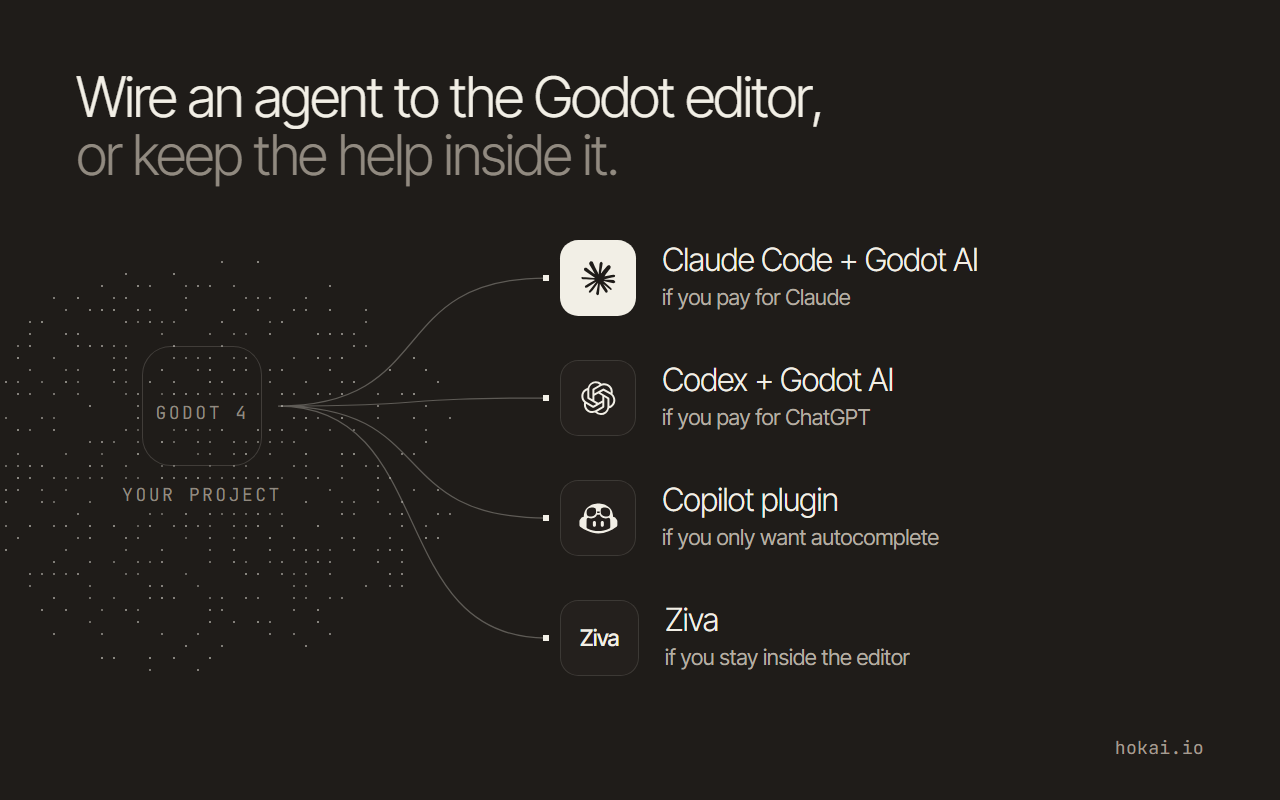
- Free engine, 2D and 3D: our Godot guide, where the in-editor Ziva plugin is one option.
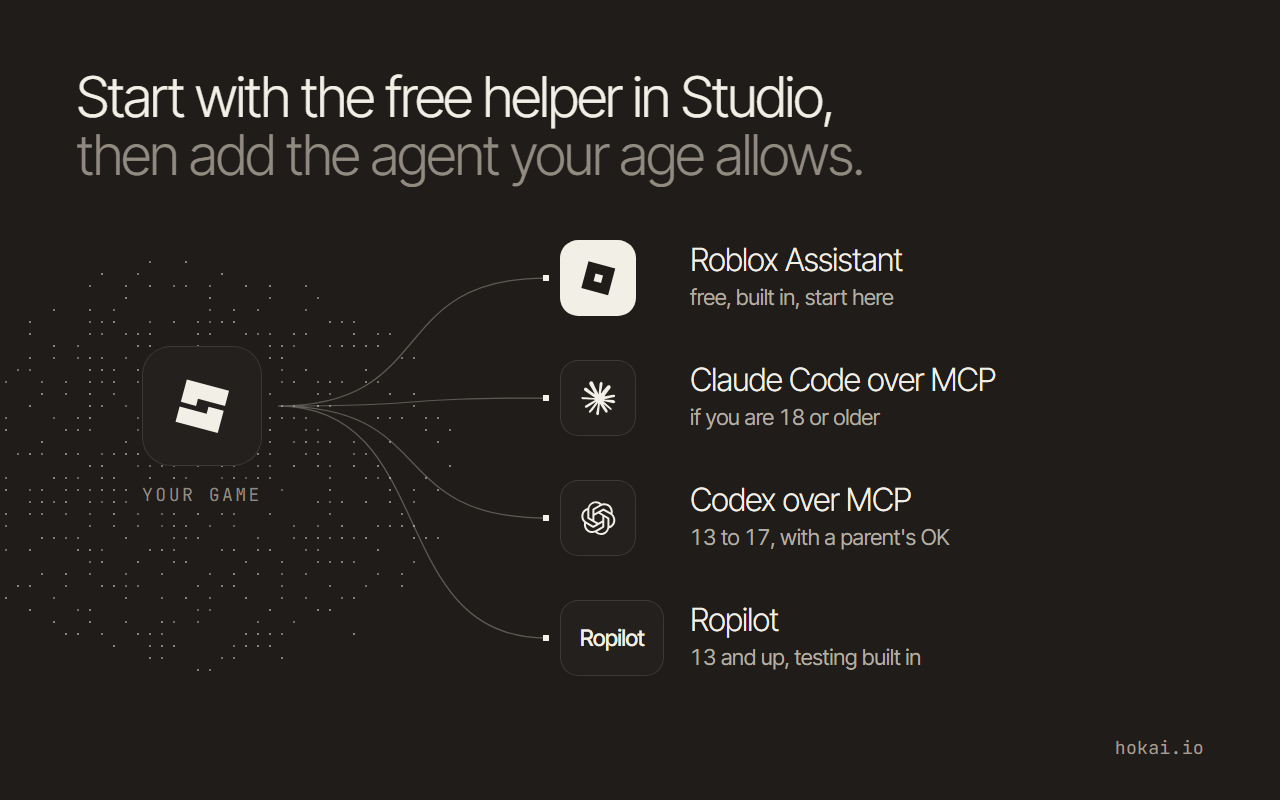
- Building for the Roblox platform: our Roblox Studio guide, which covers Roblox Assistant.
- Larger 3D projects: the Unity guide and the Unreal guide.
Three other products came up in the search results and did not make the list:
- Gameer ranks second for the search, but creating needs an approved application or Creator Pro at $49 a month.
- Max2D, from dreamloop.ai, says on its own page that creating is free and that games export as APK or AAB files for Google Play. It is 2D and Android-only, which keeps it off a list built around the browser and 3D.
- Buildbox sells AI asset tools inside a paid 2D engine; its Pro plan was $199.99 a year at a countdown sale price.
These game makers are filed with the AI app builders on Hokai, though the tools in our AI app builder guide make software rather than games.
Start with what the game is for. A game for your friends tonight is Rosebud or Astrocade; a game you might sell next year is GDevelop or Summer Engine, and that choice is easier to make before the first prompt than after the fiftieth.
Frequently asked questions
Is there a completely free AI game maker?
Astrocade publishes no paid plan at all, and its Google Play listing says playing and making games is free, but its terms forbid commercial use. GDevelop is free in a different way: the engine is open source and selling is allowed on its free plan, though AI help is capped at 40 credits a month.
Which AI game maker can make 3D games for free?
Nilo builds 3D worlds in a browser on its free Starter plan, within a weekly allowance. Rosebud AI makes 3D web games on Three.js with its free credits, and GDevelop and Summer Engine both include 3D editors at no cost, with AI help limited on their free tiers.
Can I sell a game I made with an AI game maker?
It depends on the terms. GDevelop and Summer Engine let you sell on every plan, Rosebud AI needs its 10x Dev plan or higher, and Astrocade allows only personal, non-commercial use. Read the terms before you build anything you hope to sell.
Is there an AI game maker for kids under 13?
Of the tools covered here, only GDevelop has a route: its Education plan lets teachers create anonymous student accounts with AI tools switched off until the teacher enables them. Astrocade and Nilo require users to be 13 or older, and Summer Engine and Google Labs Playground are for adults.
Do I need to download anything?
Not for Rosebud AI, Astrocade, Nilo or Playabl, which run in a browser, and Astrocade also has iPhone and Android apps. Summer Engine is a desktop app for Windows and Apple-silicon Macs. GDevelop runs in a browser or as a desktop and mobile app.
Covered in this guide
- GDevelop: Open-source no-code game engine for 2D and 3D games with a built-in AI agent that adds features from a prompt; 28,891 GitHub stars.
- Rosebud AI: Browser game maker, in Y Combinator's 2019 batch, where you describe a game to an AI designer and get a playable 2D or 3D web game.
- Astrocade: Free phone-first game maker and feed: describe a game, AI builds a playable mini game, and it joins more than 1,000 new games published each day.
- Google Labs Playground: Google Labs experiment that turns text prompts into playable browser games, open to US adults and bundled into Google AI plans.
- Meshy: Turns text, photos and sketches into textured 3D models with rigging, animation and 6 export formats, on web, iOS, Android and an API.
- Nilo: Browser 3D game maker where AI builds worlds, models and rigged characters you play and edit with friends; open beta with 150,000+ creators.
- Playabl: AI game builder from a Y Combinator Spring 2026 team, out of beta since September 2026 with a paid Pro tier and trial, a two-games-a-day free cap and ad revenue share for creators.
- Roblox Assistant: The AI chat panel built into Roblox Studio: writes Luau scripts, edits your place, inserts assets and playtests, with 9 Roblox-made skills preloaded.
- Summer Engine: Desktop game engine built on Godot where an AI agent builds 2D and 3D games from chat; you own the build, and a free tier includes export.
- Tripo: Text, image or multiview in, textured 3D out: HD and quad Smart Mesh models, auto-rigging, Blender and Unity plugins, and a REST API with a CLI.
- Ziva: AI agent that runs as a panel inside the Godot editor, reading your scene tree and errors and writing GDScript or C#, for Godot 4.2 and later.
Sources
Still deciding?
This guide covers a handful of options. Smart Match checks every listing in the directory against how you actually work and what you can spend, then hands you the shortlist and the reason behind each pick.
Find your tools