
Last updated: 2026-09-22
Zentio pairs a live digital model of a factory, every machine, person, material and process, with five AI agents that schedule, plan, analyze and answer questions about production in real time. The Berlin startup, founded in 2025, now plans schedules for 970+ machines daily across its manufacturing customers.
About Zentio
Zentio is a Berlin production-intelligence startup founded in 2025 by Julian Rose (CEO), Immo Polewka (CCO) and Christophe Kafrouni (CTO). The company raised EUR 1.4 million in pre-seed funding led by HTGF (High-Tech Grunderfonds) and SI Ventures in December 2025, and by its own account has grown to a nine-person team running live schedules for factory customers.
Since HokAI's last review the product has been repositioned around a named set of AI agents rather than a single scheduling engine, under the tagline "the agentic twin for high-mix manufacturing": a live digital model of every machine, person, material and process, paired with agents that decide and act on it. The individual agents (scheduling, planning, analytics and data quality) are detailed in the feature list below; the one genuinely new addition is Ask Zentio, a natural-language layer that lets a planner ask an operational question and get an answer with the source KPIs cited alongside it. Every agent's autonomy is adjustable per function, from fully automatic to requiring a person's sign-off, the same pick-the-job-not-the-generalist split HokAI's agentic AI roundup argues for.
Zentio targets discrete and process manufacturers now spanning automotive, aerospace and defense, machinery, electronics, food and beverage, and consumer goods, positioned against incumbents like Siemens Opcenter and SAP APO that digitize existing planning workflows rather than rebuild them, inside HokAI's AI agents for business operations category. Buyers comparing shop-floor AI often also look at Tractian's predictive-maintenance sensors, Overview AI's vision-based defect detection, or GanttAI's lighter, project-style scheduling board, each solving a narrower slice of the same factory floor than Zentio's full planning stack. ROK Solution covers broader no-code hyperautomation for enterprise process work outside manufacturing scheduling specifically. Configurable per-agent autonomy raises the same question HokAI's piece on the agentic AI governance gap covers, and buyers weighing agent-built tooling generally may also find HokAI's guide to AI agent builders useful background: how much decision-making a team is willing to hand over before a person needs to sign off.
The honest caveat is that Zentio remains unproven by outside measures: no independent reviews exist on G2, Capterra or Trustpilot as of September 2026 (Capterra lists the product with zero reviews filed), no named customers or public case studies back up its efficiency claims, and pricing stays entirely custom with no self-serve tier or public demo environment to try before a sales conversation. The Analytics Agent's KPI dashboards also sit in a crowded field; manufacturers already running a general BI layer like the platforms in HokAI's analytics tools roundup should check for overlap before adding a second one, and the "every number traceable to source data" claim is exactly the kind HokAI's piece on AI agent observability says to verify rather than take on faith. Teams that need finished governance audits today, not certifications still underway, might look at a platform like Openlayer instead; the specific standards Zentio is pursuing are in the compliance feature below.
Screenshots
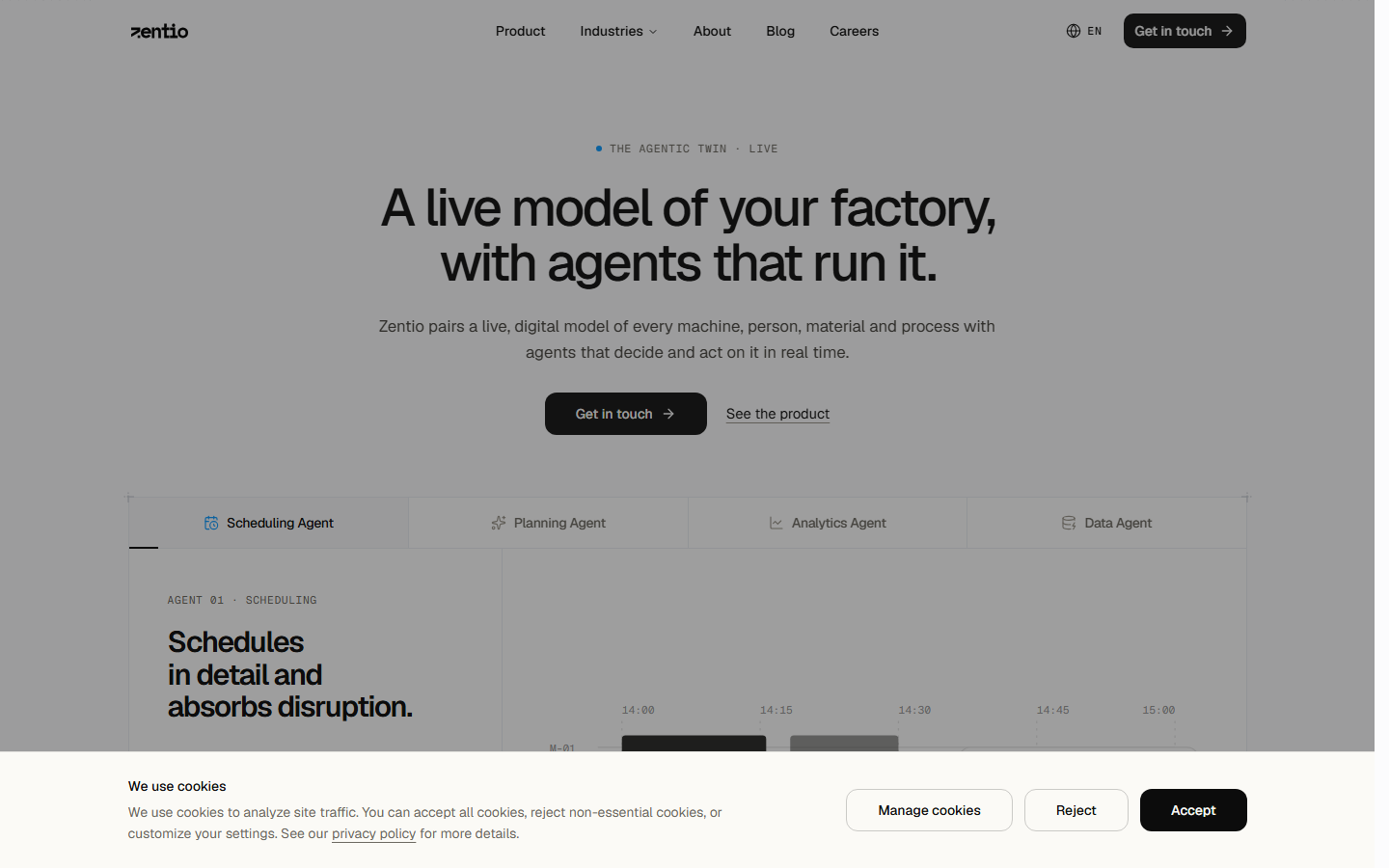
Pricing
Custom pricing only; Zentio publishes no tiers or list prices. Contact sales for a personalized demo and a quote scoped to plant size, integration complexity and deployment mode. The free Proof-of-Value-to-paid-Pilot rollout structure this page previously described is no longer detailed on Zentio's current site as of September 2026, so confirm directly what an evaluation looks like rather than assuming that path still applies.
Zentio's own materials claim up to 20% higher equipment effectiveness, 40% better on-time delivery, and 18% lower capital commitment, vendor-stated outcomes not yet corroborated by independent reviews. HokAI's guide to picking an AI agent by autonomy level is a useful frame for the human-in-the-loop-to-fully-autonomous dial Zentio offers per agent. Perceptron ML is a comparable example of an invite-only vertical AI platform that also keeps enterprise pricing off its site entirely.
Key Features
- Scheduling Agent: Models every machine, tool, operator, skill and material together, then generates shift and production schedules that re-optimize automatically within minutes of a machine failure, material delay or staff absence.
- Planning Agent: Stress-tests capacity decisions by simulating thousands of alternative scenarios in advance, surfacing concrete recommendations such as adding machinery or upskilling specific workers before a bottleneck hits.
- Analytics Agent: Builds custom KPI dashboards for on-time delivery, equipment effectiveness and lead time, with every number traceable back to the source production data behind it.
- Data Agent: Uses machine learning to detect drift in ERP and MES master data and proposes corrections with full transparency, keeping the unified data layer that feeds every other agent accurate.
- Ask Zentio: A natural-language interface, new since the previous review, that answers operational questions on demand and cites the underlying KPIs and source records behind every answer.
- Configurable Autonomy: Each agent's autonomy can be set anywhere from fully autonomous to human-in-the-loop, letting a plant delegate routine re-scheduling while keeping a person in the loop on higher-stakes calls.
- GDPR-Compliant, Germany-Hosted: Data is processed on infrastructure in Germany under GDPR; ISO 27001 and TISAX certifications are in progress as of September 2026, not yet completed.
Pros
- Rebuilds the planning layer around five purpose-built agents instead of retrofitting AI onto legacy ERP scheduling, the same rebuild-not-bolt-on bet the platform made at launch.
- Configurable per-agent autonomy lets cautious plants start human-in-the-loop and hand over more decision-making as trust builds, rather than an all-or-nothing automation switch.
- GDPR-compliant, Germany-hosted infrastructure removes a data-residency objection that stops some European manufacturers from evaluating US-hosted alternatives.
- Ask Zentio's cited-answer natural-language interface gives floor supervisors a way to query live KPIs without waiting on a dashboard build or a data team.
Cons
- No outside review platform carries a single rated customer yet, leaving buyers with only vendor-stated outcomes, like the claimed 20% OEE improvement, to evaluate against.
- No published pricing anywhere, and the earlier structured Proof-of-Value-to-Pilot rollout timeline is no longer described on Zentio's own site, so buyers cannot budget an evaluation without a sales call first.
- ISO 27001 and TISAX are both still in progress, not certified, which will stop procurement teams at larger manufacturers that require completed audits today.
- No self-serve trial or public demo environment; every evaluation starts by requesting a personalized demo.
Data Handling
- Training-data policy
- Zentio's published privacy policy covers only its marketing website (contact-form, analytics and session-replay data); it does not separately disclose whether customer production data is used to train its scheduling, planning, analytics or data-quality models. Not publicly documented as of September 2026.
- Compliance
- GDPR
Frequently Asked Questions
How much does Zentio cost in 2026?
Zentio publishes no self-serve pricing; every contract is custom-quoted. The free Proof-of-Value-to-Pilot rollout structure previously described on Zentio's materials is no longer detailed on its current site, so contacting sales for a personalized demo and quote is the only way to see numbers.
Does Zentio offer a free trial?
No self-serve trial is offered. Zentio's current site invites prospects to request a personalized demo rather than sign up directly, a shift from the free Proof-of-Value framing this page previously described.
What are Zentio's alternatives in 2026?
Siemens Opcenter and SAP APO are the established enterprise planning suites Zentio positions itself against, built around digitizing existing ERP workflows rather than replacing them with AI agents. On HokAI, Tractian covers predictive maintenance with sensor data rather than scheduling, Overview AI covers vision-based defect detection on the line, and ROK Solution covers broader no-code hyperautomation across the enterprise rather than manufacturing planning specifically.
Zentio or Siemens Opcenter: which should you pick?
Siemens Opcenter is an established enterprise suite with deep ERP integration built over years of deployments; Zentio rebuilds the scheduling logic around five AI agents from a blank slate, with no legacy configuration layer to maintain, but as a nine-person, pre-seed startup it lacks Opcenter's deployment track record and has zero independent reviews so far. Opcenter suits large manufacturers standardized on Siemens infrastructure; Zentio suits teams willing to trade that track record for an AI-native platform still building its public review history.
What does Zentio actually do?
It builds a live digital twin of a factory floor and runs five specialized agents on top of it: one reschedules and absorbs disruption, one plans capacity scenarios, one builds KPI dashboards, one keeps the underlying ERP and MES data clean, and one (Ask Zentio) answers operational questions in natural language with cited sources. Autonomy for each agent can be set from fully automatic to human-approved.
Top Alternatives
- Tractian: Pick Tractian if the job is predicting equipment failure from sensor data, not building the shift and production schedule around it.
- Overview AI: Choose Overview AI for vision-based defect detection on the line itself; Zentio schedules the line, it doesn't watch it.
- ROK Solution: Pick ROK Solution for broader no-code hyperautomation across the whole enterprise rather than a manufacturing-specific planning agent.
HokAI guides covering Zentio
- What Parcel Perform Is Actually For: Parcel Perform's AI Commerce Visibility launch shows who the platform really targets: enterprise brands with complex carriers, not small DTC shops on a budget.
- Best AI Agents for Business Ops in 2026: Buy the Job, Not the Platform: AI agents for business ops actually span five separate jobs, not one: calendar, inbox, project tracking, invoicing and vertical automation for 2026 buyers.