
Last updated: 2026-09-25
DeepL is an AI language platform that translates text, documents and live speech, with 134 languages listed in its API documentation. It sells a free plan, three self-serve Translator tiers and a quoted Enterprise tier. Every paid plan carries a no-data-training commitment, and DeepL's credentials include ISO 27001 certification, a SOC 2 Type II report, HIPAA and GDPR.
About DeepL
DeepL is an enterprise AI language platform founded in 2017 by Jaroslaw Kutylowski in Cologne, Germany, built on proprietary neural networks trained on Linguee's curated human-translated database. DeepL says it is trusted by over 200,000 businesses globally, and it reached a $2B valuation after a $300M investment round in May 2024. Its API documentation lists 134 supported languages for text translation.
The 2026 product suite spans well beyond text translation. DeepL Translator handles documents (DOCX, PPTX, PDF) with layout preservation, with a file-size cap that rises with the plan. DeepL Write improves monolingual writing without translating, and the Voice-to-Voice suite, launched on 16 April 2026, brings real-time spoken translation to virtual meetings, in-person conversations and customer-facing touchpoints via API, a different job from the AI meeting assistants that transcribe and summarise calls; the Individual, Team and Business plans now each carry a monthly allowance of DeepL Voice minutes per user. Translation Flow, sold as an add-on to Business and Enterprise, pulls content out of Google Drive, SharePoint, Adobe Experience Manager and Contentful and runs the localisation workflow end to end, the ground Crowdin covers for software strings. DeepL's own site also announces access through MCP inside Microsoft Copilot, ChatGPT and Claude. DeepL Agent, an autonomous assistant for the repetitive knowledge work our no-code automation guide describes, reached general availability on 5 November 2025.
DeepL's advantage rests on three pillars: a training-data quality edge from Linguee's human-curated translation archive, a transformer architecture tuned for nuance over raw speed, and enterprise compliance credentials that few competitors match. DeepL's pricing comparison lists no data training on all paid tiers, and DeepL's security page commits to never storing texts or using them for model training without consent, the distinction that matters in legal, healthcare and other regulated work.
The catch is the metering. Individual is not unlimited: it carries a monthly character cap, and only Business and Enterprise remove it, subject to a fair usage policy. On the API side, the free Developer plan is a one-off character credit rather than a recurring allowance, and usage beyond the Growth plan's yearly bundle is billed per million characters, the rate to model before committing to DeepL as a production translation backend.
Who should not buy it: someone who translates a few emails a week gets most of the value from the free tier or from ChatGPT in an ordinary chat, and a team that lives in Google Workspace can use Gemini inside Docs and Gmail without another per-seat bill. If the job is polishing English rather than crossing languages, Grammarly or QuillBot cover it for less than DeepL plus the Write Pro add-on. If the job is dubbing recorded video rather than live conversation, ElevenLabs and Translate.video are built for it, and our voice AI buyer's guide compares that field. Our guide to AI translation tools splits the field by job, and the AI writing assistant directory lists the rest of the category.
Screenshots
Pricing
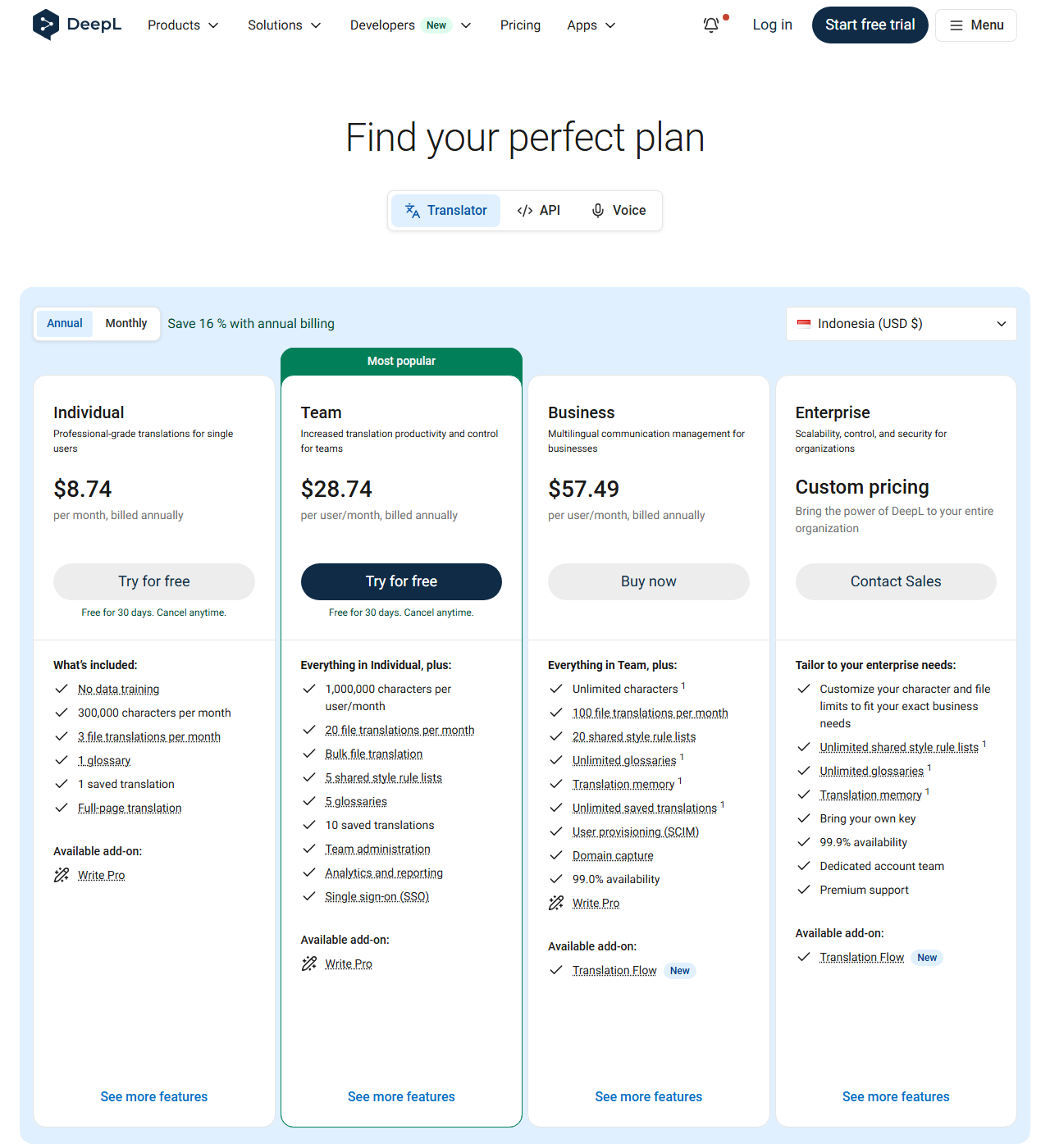
DeepL's paid Translator plans, billed annually in USD on DeepL's pricing page as checked on 4 September 2026: Individual $8.74/month, Team $28.74/user/month, Business $57.49/user/month, and Enterprise quoted by sales. A Free plan with 50,000 characters a month sits below them.
DeepL prices by region. Served to a German visitor on 25 September 2026, the same pricing page listed Individual at €7.49, Team at €24.99 per user and Business at €49.99 per user a month, billed annually with VAT included. The page advertises 16% savings on Translator plans against paying monthly, so month-to-month billing costs more; DeepL shows that rate only after switching the page's billing toggle. Individual and Team both come with a free 30-day trial that can be cancelled at any time.
What each tier buys: Free covers 50,000 characters a month, 1 file translation (5 MB cap) and 1 glossary. Individual covers 300,000 characters a month and 3 file translations (30 MB cap). Team covers 1,000,000 characters per user a month, 20 file translations, bulk file translation, 5 glossaries, team administration, analytics, and SSO for 50+ users. Business lifts the character cap under a fair usage policy and adds 100 file translations (100 MB cap), unlimited glossaries, translation memory, SCIM, domain capture and a 99.0% availability commitment. Individual, Team and Business each include 30 minutes of DeepL Voice per user a month.
Add-ons: DeepL Write Pro is $7.49/user/month billed annually on Individual and Team and is included on Business; Translation Flow is an add-on for Business and Enterprise. If the writing tool is the real need, Grammarly competes with Write Pro directly.
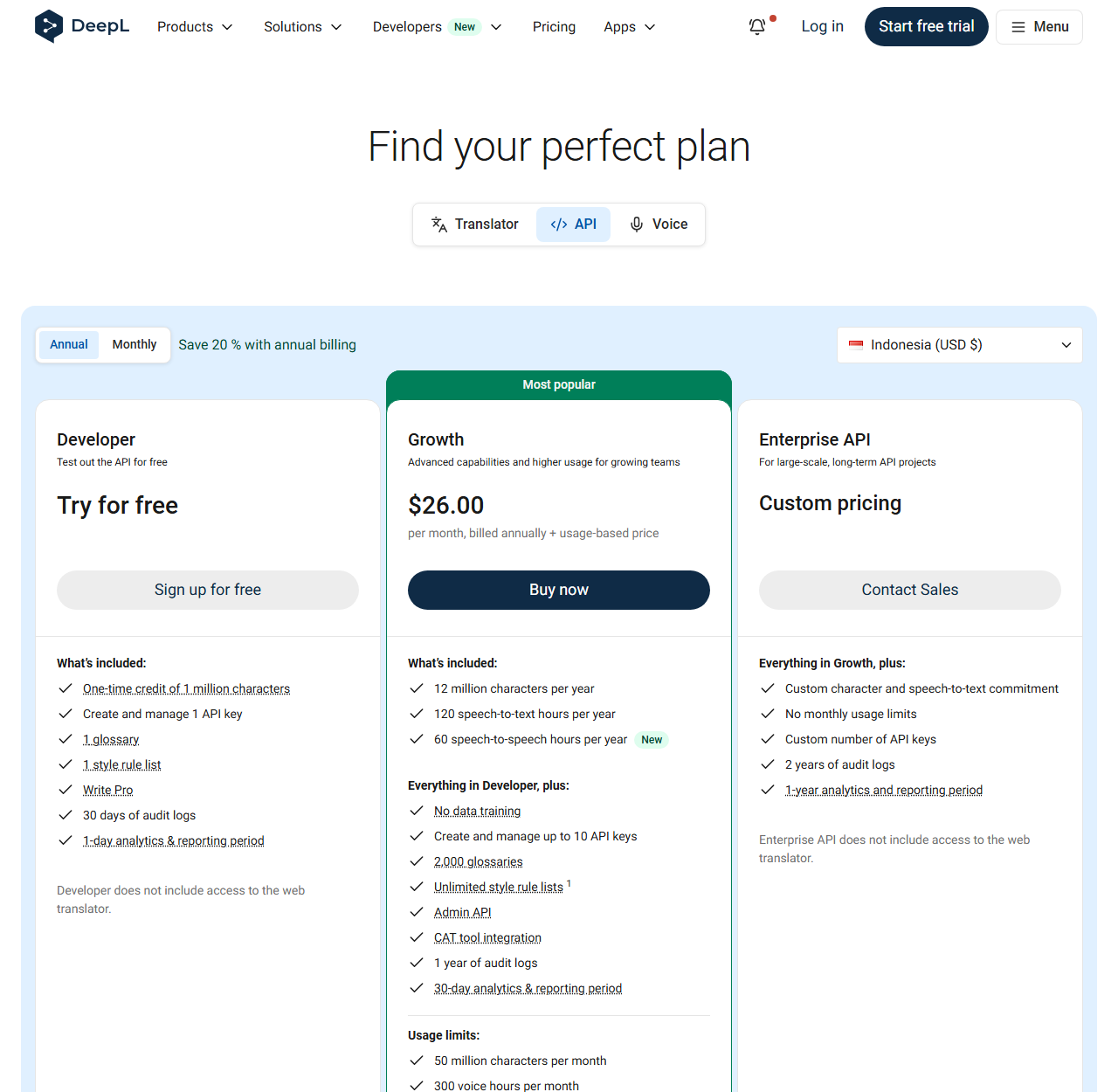
On the API side, Developer is free with a one-time 1,000,000-character credit; Growth is $26.00/month billed annually plus usage, bundling 12 million characters, 120 speech-to-text hours and 60 speech-to-speech hours a year, with extras at $27.50 per million characters, $1.85 per speech-to-text hour and $3.75 per speech-to-speech hour; Enterprise API is custom.
| Tier | Monthly price | What it includes |
|---|---|---|
| Free | Free | 50,000 characters/month, 1 file translation (5 MB cap), 1 glossary with 5 entries per language pair, 1 saved translation. The no-data-training promise does not extend to free-tier text. |
| API Developer | Free | Free. 1,000,000 characters granted once rather than monthly, plus 1 API key, 1 glossary, 1 style rule list and 30 days of audit logs. No access to the web translator. |
| Write Pro add-on | $7.49/mo | Added to an Individual or Team plan; included at no extra cost on Business and Enterprise. Billed annually at $7.49/user/month. |
| Individual | $8.74/mo | 300,000 characters/month, 3 file translations/month (30 MB cap), 1 glossary, 1 saved translation, no data training. Includes 30 minutes of DeepL Voice a month; try it free for 30 days. Billed annually at $8.74/month; Write Pro is a paid add-on. |
| API Growth | $26/mo | Yearly bundle: 12,000,000 characters, 120 hours of speech-to-text and 60 of speech-to-speech, capped at 50,000,000 characters and 300 voice hours per month. Adds no-data-training, 10 API keys, 2,000 glossaries, Admin API and CAT tool integration. Billed annually at $26.00/month plus usage. Extras: characters at $27.50 per million; speech-to-text at $1.85 an hour; speech-to-speech at $3.75 an hour. |
| Team | $28.74/mo | 1,000,000 characters/user/month, 20 file translations/month, bulk file translation, 5 glossaries (1,000 entries per language pair), 5 shared style rule lists, 10 saved translations. Team administration, analytics and reporting, SSO for 50+ users. Free 30-day trial; DeepL Voice allowance of 30 minutes per seat each month. Billed annually at $28.74/user/month. |
| Business | $57.49/mo | Unlimited characters under a fair usage policy, 100 file translations/month (100 MB cap), unlimited glossaries and saved translations, 20 shared style rule lists, translation memory, SCIM user provisioning, domain capture, Write Pro included. Each seat gets half an hour of DeepL Voice monthly; Translation Flow is sold on top. Availability commitment of 99.0%. Billed annually at $57.49/user/month. |
| Enterprise | Custom | Custom pricing. Negotiated character and file limits, unlimited glossaries and shared style rule lists, bring your own key, dedicated account team and premium support, with Translation Flow offered as an extra. 99.9% availability commitment. |
Feature Comparison by Tier
| Feature | Free | Individual | Team | Business | Enterprise |
|---|---|---|---|---|---|
| Price | $0 | $8.74/mo billed annually | $28.74/user/mo billed annually | $57.49/user/mo billed annually | Custom, quote only |
| Characters per user/month | 50,000 | 300,000 | 1,000,000 | Unlimited (fair use) | Unlimited (fair use) |
| File translations per user/month | 1 | 3 | 20 | 100 | Custom |
| Max file size | 5 MB | 30 MB | 30 MB | 100 MB | 100 MB |
| Bulk file translation | — | — | ✓ | ✓ | ✓ |
| Glossaries | 1 | 1 | 5 | Unlimited | Unlimited |
| Glossary entries per language pair | 5 | 5 | 1,000 | Unlimited | Unlimited |
| Shared style rule lists | — | — | 5 | 20 | Unlimited |
| Translation memory | — | — | — | ✓ | ✓ |
| Saved translations per user | 1 | 1 | 10 | Unlimited | Unlimited |
| Write Pro | — | Paid add-on | Paid add-on | ✓ | ✓ |
| DeepL Voice minutes per user/month | — | 30 | 30 | 30 | Custom |
| No data training | — | ✓ | ✓ | ✓ | ✓ |
| Single sign-on (SSO) | — | — | From 50 users | From 50 users | ✓ |
| User provisioning (SCIM) | — | — | — | ✓ | ✓ |
| Domain capture | — | — | — | ✓ | ✓ |
| Bring your own key | — | — | — | — | ✓ |
| Availability commitment | — | — | — | 99.0% | 99.9% |
| Analytics and reporting | — | — | ✓ | ✓ | ✓ |
Key Features
- Neural Text and Document Translation: Translates text and preserves layout across DOCX, PPTX and PDF files. The size cap is plan-dependent: 5 MB free, 30 MB on Individual and Team, 100 MB on Business and Enterprise.
- Voice-to-Voice Real-Time Translation: Real-time spoken translation for virtual meetings, in-person groups and enterprise applications, launched 16 April 2026, covering all 24 official EU languages plus Vietnamese, Thai, Arabic, Norwegian, Hebrew, Bengali and Tagalog.
- DeepL Write: Writing Improvement: Improves grammar, clarity, style and tone without translating, with adjustable formality. A paid add-on on Individual and Team, included on Business and Enterprise.
- DeepL Agent: Business Automation: An autonomous AI assistant that automates repetitive multilingual knowledge-work tasks from natural-language instructions. Reached general availability on 5 November 2025.
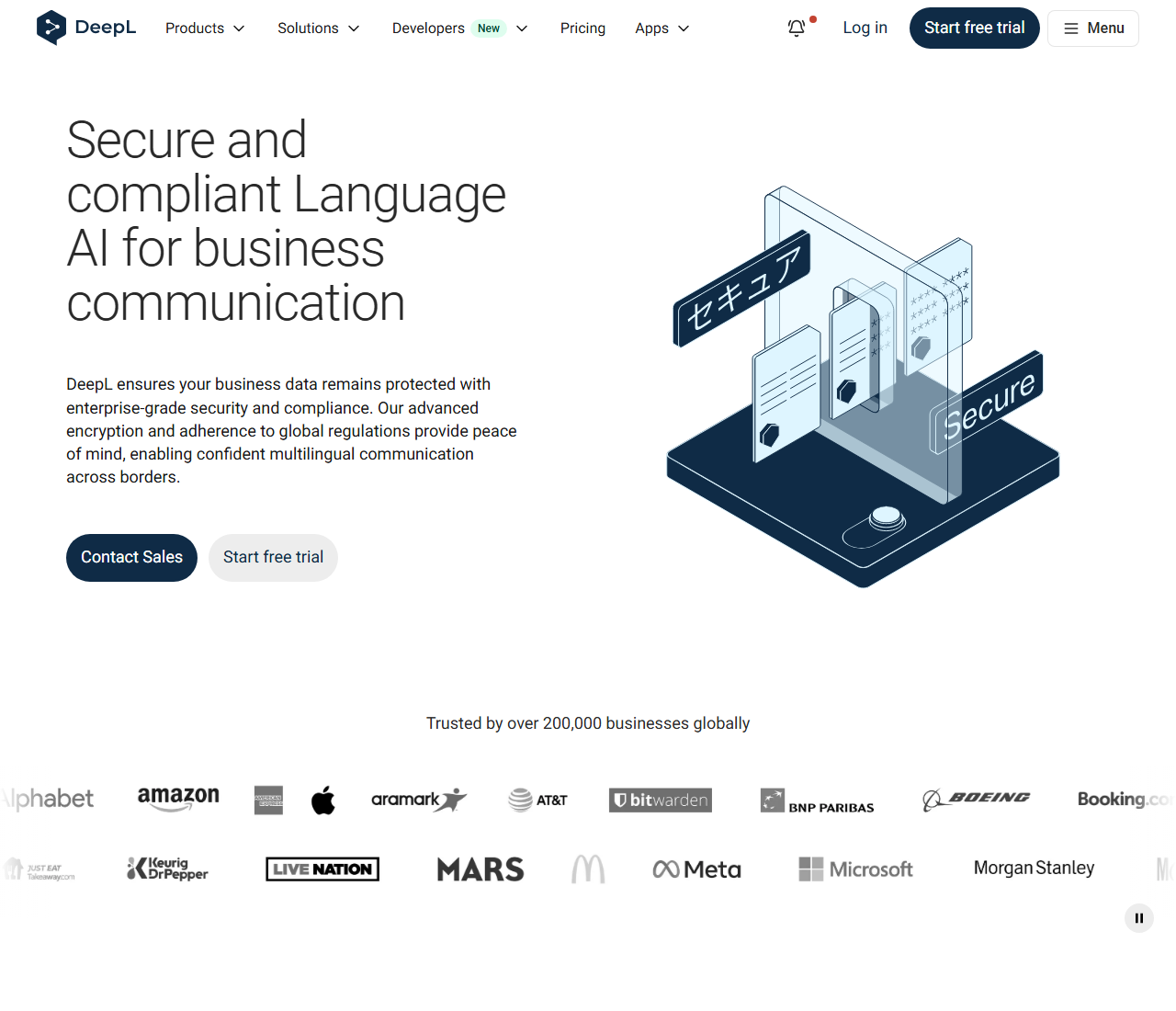
- Enterprise-Grade Compliance: SSO via OIDC and SAML, SCIM provisioning, bring-your-own-key encryption on Enterprise, and a no-training commitment for text sent on paid plans, backed by third-party audits listed on DeepL's trust pages.
- Developer API with Voice Streaming: REST API for text and document translation plus a Voice API for streaming speech-to-text and speech-to-speech. The Growth plan pairs its yearly character allowance with bundled voice hours, capped at 300 voice hours a month.
Pros
- Documented no-data-training on all paid tiers, and an independently audited security stack (SOC 2 Type II, HIPAA, GDPR), the strongest compliance set in the translation category.
- Language coverage in the API documentation now rivals the major general-purpose engines, so the older criticism that DeepL trades breadth for quality no longer holds.
- Voice-to-Voice, launched April 2026, delivers real-time spoken translation across all 24 official EU languages plus seven others, a capability few translation vendors ship at all.
- Business and Enterprise remove the character cap entirely and add translation memory, SCIM, domain capture and a written 99.0% or 99.9% availability commitment.
- Available on web, Windows, macOS, iOS and Android with Microsoft 365 and Google Workspace integrations, plus CAT tool integration on the API Growth plan.
Cons
- The entry paid plan is metered, not unlimited: Individual stops at a fixed character allowance each month, and Business is the first tier without one.
- The free tier is thin for evaluation, with one small file translation a month and a single short glossary, and free-tier text is not covered by the no-data-training commitment.
- The free API plan is a one-off credit, not a monthly allowance, so a prototype that keeps running has to move onto a paid plan quickly.
- API usage beyond the Growth bundle is billed per million characters, and that rate decides total cost for high-volume production use.
- SSO is gated to organisations of 50 or more users on Team and Business, and translation memory, SCIM and domain capture appear only at Business, pushing smaller compliance-driven teams to the top tier.
Data Handling
- Training-data policy
- Every paid plan is marked "no data training" on DeepL's pricing comparison, and DeepL's security page states texts are never stored or used for model training without consent. The privacy policy says free-version text is processed for a limited period to train and improve its neural networks, that texts and documents are deleted once the translation is delivered and not permanently stored, and that document metadata is deleted automatically after 14 days. Processing is in the EEA; named subprocessors include Stripe, Cloudflare, HubSpot, Riskified and Zendesk. Enterprise adds bring-your-own-key encryption.
- Data retention
- Zero retention
- Compliance
- ISO 27001 · SOC 2 Type II · BSI C5 Type 2 · HIPAA · GDPR
Frequently Asked Questions
What does DeepL actually cost?
DeepL costs nothing on its free plan, then $8.74 a month for Individual, $28.74 per user for Team and $57.49 per user for Business, billed annually in USD (DeepL pricing page, checked 4 September 2026), with Enterprise quoted by sales. Prices are set by region: a German visitor saw €7.49, €24.99 and €49.99 on 25 September 2026, and paying monthly instead of annually costs more. Write Pro adds $7.49 per user a month on Individual and Team. The API is billed separately: Growth is $26.00 a month billed annually plus usage, and characters beyond its 12-million-a-year bundle cost $27.50 per million.
What do you get on DeepL's free tier?
The free version covers 50,000 characters a month, one file translation up to 5 MB, one glossary with five entries per language pair and one saved translation, with no card at signup. It does not carry the no-data-training commitment that every paid plan does, and it excludes bulk file translation, shared style rule lists, SSO and translation memory. Developers get a separate free API plan, but that is a one-time credit of 1,000,000 characters rather than a monthly allowance.
Is DeepL's Individual plan unlimited?
No. Individual is capped at 300,000 characters a month for $8.74, which is the most common misreading of DeepL's pricing. Team raises that to 1,000,000 characters per user per month, and only Business at $57.49/user/month and Enterprise remove the character cap, and even then a fair usage policy applies. File translations are metered separately from characters on every plan.
How does DeepL handle your data?
Paid-plan text is not used to train DeepL's models, according to its pricing comparison and security page, and translated texts and documents are removed once the translation is delivered. Free-version text is the exception: DeepL may keep it for a limited time to improve its networks. Processing happens inside the European Economic Area, and the security credentials cover ISO 27001, HIPAA and GDPR, among others.
What should you use instead of DeepL?
If translation is one task among many rather than a pipeline, ChatGPT handles it in the same thread but gives you no glossary, translation memory or document-layout preservation. Teams already standardised on Google Workspace can reach for Gemini, which puts translation inside Docs and Gmail instead of a separate per-seat subscription. If the real need is polishing writing rather than crossing languages, Grammarly competes with DeepL Write directly and costs less than adding the $7.49 Write Pro add-on.
Top Alternatives
HokAI guides covering DeepL
- Best AI for Translation in 2026: Four Jobs, Not One Tool: AI translation is four real jobs: documents, live/visual, software localization, and video dubbing. See which tool fits, and which free tiers really work.
- Copy.ai vs JetWriter AI in 2026: They're Not Actually Competing: Fullcast bought Copy.ai in October 2025 and cut its free tier for $1,000-a-month GTM pricing. JetWriter AI stayed an $18 extension. See who each fits.
- The Top AI Tools in 2026: How to Actually Choose One: ChatGPT, Claude, Cursor, Gemini, and Perplexity all cap out near $200 a month in 2026. A practical framework for matching the right AI tool to your actual job.
- Best AI Writing Assistant in 2026: How to Actually Choose: Grammarly, Wordtune, QuillBot and 6 more AI writing assistants compared for 2026, with the criteria to use once you stop trusting the shortlist alone.