Semrush vs Ahrefs in 2026: Pricing, Keyword Data and AI Search Tracking
Semrush and Ahrefs are paid SEO suites priced from $139 and $129 a month for one user. Semrush tracks rankings daily and charges $45 per extra seat on its lower plans. Ahrefs updates Rank Tracker weekly, includes AI prompt tracking on every paid plan, and offers a permanent free account for verified sites.
The short version
Semrush suits teams that report rankings often: it tracks keywords daily, adds 50 AI prompts on its $199 Starter plan and offers a 7-day trial. Ahrefs suits solo SEOs and link work: Lite costs $129 with history and API access, but Rank Tracker updates weekly. AI mentions alone need neither.
Want this decided for your own case? Find your tools with Smart Match, starting from this guide's question.
Semrush's cheapest SEO plan costs $139 a month and Ahrefs' cheapest full plan costs $129, so on 19 October 2026 the two suites sit ten dollars apart for one person.
The list price is no longer the decision. What separates Semrush and Ahrefs now is buried in the plan tables: how often each one checks your rankings, what an extra seat costs, and which tier first lets you track the questions people ask AI assistants. This comparison is for a freelance SEO, an in-house marketer or a two-to-six person team picking one paid suite this quarter, and every price below was read on the vendors' own pricing pages that day.
The short answer: which one to pick
Pick Semrush if you report rankings to a client or a boss every week. Its plans track keywords daily, the Starter tier adds 50 AI prompts tracked daily, and you can trial any paid plan for seven days.
Pick Ahrefs if you work alone or your job is mostly links. Its $129 Lite plan includes API and MCP access plus five tracked AI prompts, and the free account covers your own verified sites with no time limit.
Pick neither, at least at first, if the only question is whether ChatGPT mentions your brand. A dedicated tracker starts at $29 a month, and the free tiers of both suites cover the basics for your own site.
| Your situation | Pick | Monthly cost | The one catch |
|---|---|---|---|
| Daily rank reports, 1-5 seats | Semrush Starter | $199 + $45 per extra seat | No historical data below Pro+ |
| Solo freelancer, backlink work | Ahrefs Lite | $129 | Capped at 1,000 credits and 3 users |
| Growing team, deep history | Ahrefs Standard | $249 + $60 per extra seat | Rank Tracker updates weekly |
| AI mentions only | A dedicated tracker | From $29 | No keyword or backlink data |
The rest of this piece shows the arithmetic behind each row, then argues against it.
What each plan costs in October 2026
Both vendors show monthly prices and offer a discount of up to 17% for paying a year upfront. One of them prints the annual figure first on its cards ($117.33 for the SEO plan), which is why so many comparisons quote a number nobody pays on a monthly card.
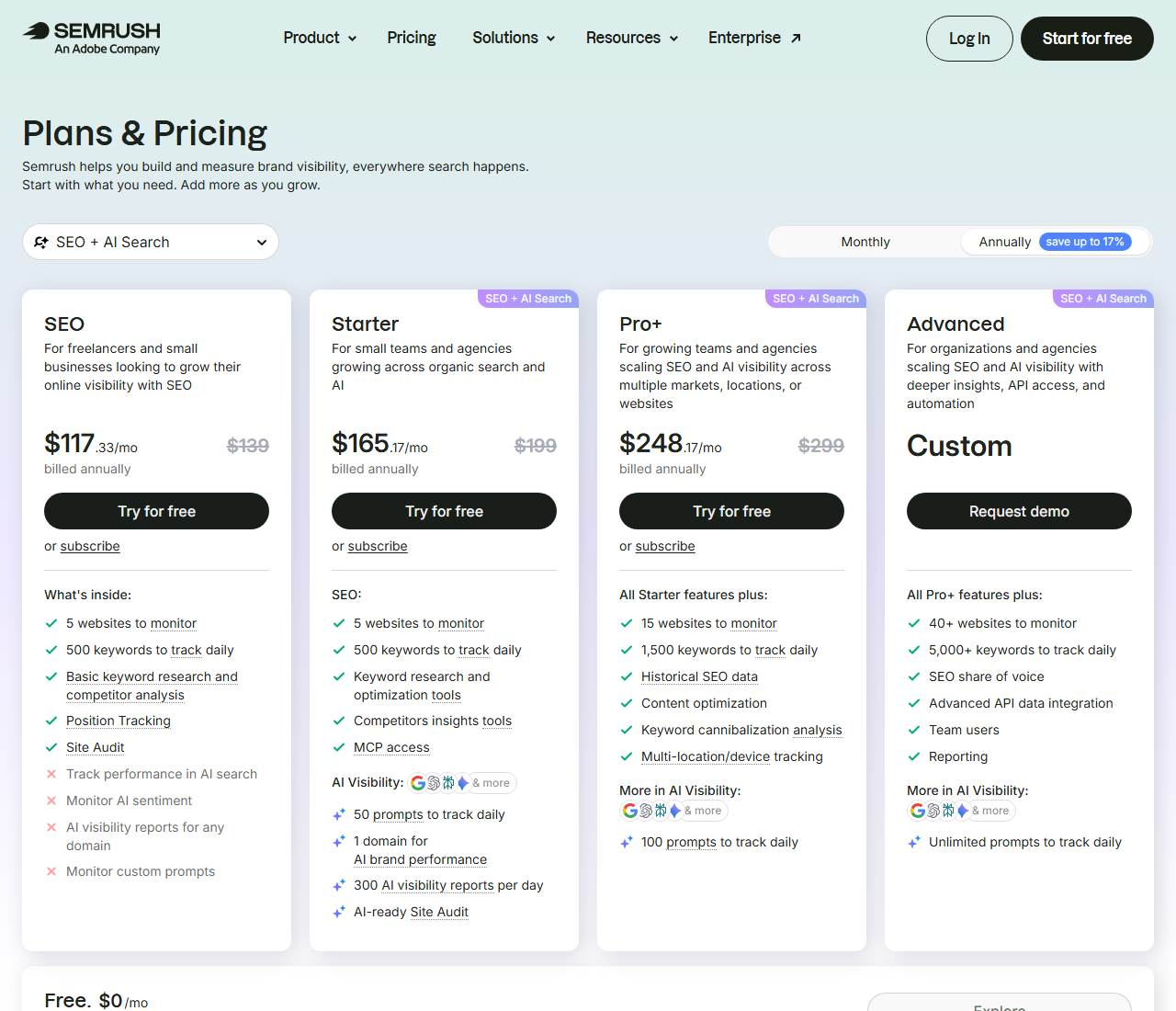 Semrush's SEO and AI Search plans, annual view, captured 19 Oct 2026. The logo now reads "An Adobe Company".
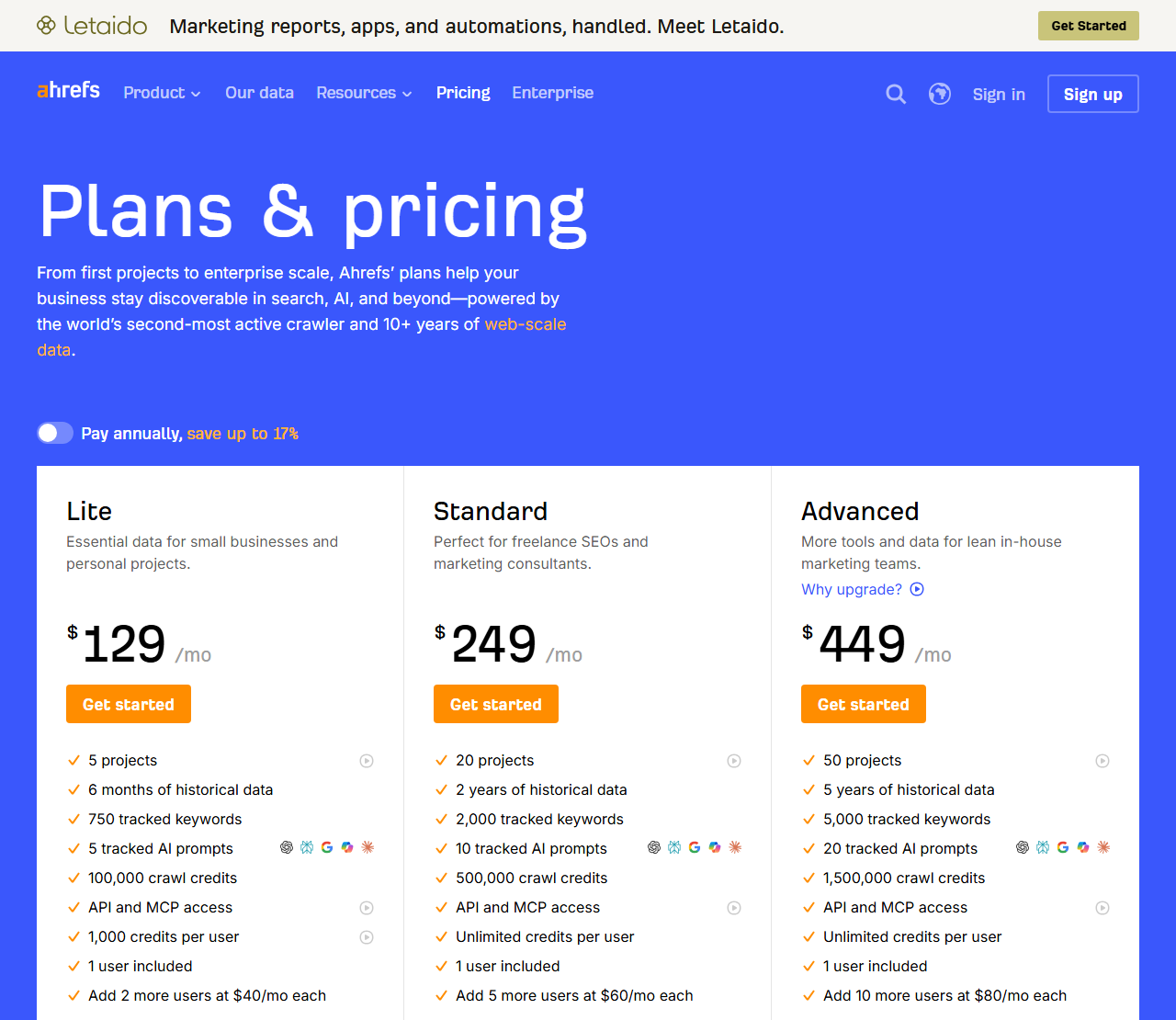 Ahrefs' pricing page, monthly billing, captured 19 Oct 2026. The last line of each card is the seat add-on used in the next section.
| Plan | Monthly price | Paid yearly, per month | Users included |
|---|---|---|---|
| Semrush SEO | $139 | $117.33 | 1 |
| Semrush Starter | $199 | $165.17 | 1 |
| Semrush Pro+ | $299 | $248.17 | 1 |
| Ahrefs Starter | $29 | Monthly only | 1 |
| Ahrefs Lite | $129 | Up to 17% less | 1 |
| Ahrefs Standard | $249 | Up to 17% less | 1 |
| Ahrefs Advanced | $449 | Up to 17% less | 1 |
| Ahrefs Enterprise | $1,499 | Annual commitment | From 3 |
The top Semrush tier, Advanced, has no list price. It is sold through a demo, as is the separate enterprise package.
Two lines on the other pricing page matter more than the headline numbers. The Ahrefs FAQ says "We never run discounts" and that refunds are generally not issued, so there is no trial to lean on. It also bills extra users and any pay-as-you-go credits automatically once they are switched on, which is how a $129 plan turns into a larger invoice.
The $29 Starter plan is a different product. The vendor's own post on it says it gives 200 credits a month, includes Keywords Explorer and Rank Tracker, renews monthly only, and cannot take extra users or add-ons. It suits a beginner testing the data, not a working team.
What a team of three or five pays
Seats are where the two price lists split apart. Every plan on both sides includes exactly one user, and the expanded comparison table on the Semrush pricing page prices each extra seat by tier. The Ahrefs page does the same, and it also caps how many you can add.
| Tier | Semrush extra seat | Ahrefs extra seat | Ahrefs seat cap |
|---|---|---|---|
| Entry (SEO, Starter / Lite) | $45 | $40 | 2 extra users |
| Middle (Pro+ / Standard) | $80 | $60 | 5 extra users |
| Top (Advanced / Advanced) | $100 | $80 | 10 extra users |
| Team size | Semrush Starter | Ahrefs Lite | Ahrefs Standard |
|---|---|---|---|
| 1 person | $199 | $129 | $249 |
| 3 people | $289 | $209 | $369 |
| 5 people | $379 | Not allowed | $489 |
| 6 people | $424 | Not allowed | $549 |
Those are monthly list prices with no annual discount. At three seats Ahrefs Lite stays the cheapest suite here, but Lite also limits each user to 1,000 report credits a month, and Standard is the first tier with unlimited credits.
For a five-person team the gap widens to $110 a month in favour of Starter over Standard. Pro+ at five seats costs $619, which is the fairer match if you need its historical data and content tools.
Daily or weekly: the rank-tracking gap
This is the line most comparisons miss. The Ahrefs pricing table lists the Rank Tracker update frequency as weekly on every plan, Enterprise included. Semrush describes its tracking as keywords "to track daily" on every plan, from the 500-keyword SEO tier up.
If you send a client a Monday report, a weekly refresh is fine. If you watch rankings move after a Google update or a site migration, a seven-day lag means you see the drop days after it happened.
Ahrefs gives you more keywords per dollar to compensate. Lite tracks 750 keywords against 500 on the first two Semrush tiers, and Standard tracks 2,000 against 1,500 on Pro+. The question is whether you want more keywords checked less often or fewer keywords checked every day.
It does refresh other data quickly. Its big-data page says the backlink index is updated every 15 to 30 minutes and that it crawls 5 million pages a minute. That speed shows up in Site Explorer, not in Rank Tracker.
Keyword and backlink data: what each vendor says it has
Both companies publish database sizes, and both are self-reported. The Semrush stats page, dated 18 October 2026, says its keyword tool holds 29.2 billion keywords across 142 geo databases. The Ahrefs page says 29 billion filtered keywords in 217 locations, out of 110 billion it has ever seen.
| Data point | Semrush says | Ahrefs says |
|---|---|---|
| Keywords | 29.2 billion | 29 billion filtered |
| Locations | 142 geo databases | 217 locations |
| United States keywords | 4 billion | 2.7 billion |
| Backlink figure published | 43 trillion links | 494 billion pages in index |
| Crawl rate published | 10 billion URLs a day | 5 million pages a minute |
The keyword totals are close enough that neither wins on size. The backlink rows cannot be compared at all. One counts links, the other reports pages in its index, and each defines and filters its count differently.
What you can compare is how much of that data you see. Semrush returns 10,000 results per report on its first two tiers and 30,000 on Pro+. Its rival shows 2,500 rows per report on Lite, 30,000 on Standard and 75,000 on Advanced.
For keyword research specifically, this guide's pick is Semrush Starter for volume of daily reports (3,000 a day) and Ahrefs Standard for depth per report. Our roundup of AI keyword research tools covers the cheaper single-purpose options if you only need ideas, not rankings.
Where Semrush wins
Semrush is better for a team that needs daily numbers and AI tracking in one bill. Semrush's Starter tier at $199 bundles:
- 500 keywords tracked daily across 5 websites
- 50 custom AI prompts tracked daily
- 300 AI visibility reports a day for any domain
- MCP access, so an AI assistant can query the data
- A seven-day free trial before the first charge
The AI part is also sold on its own. The AI Visibility Base plan costs $99 a month per domain on annual billing and tracks 25 custom prompts across ChatGPT, Google AI, Gemini and Perplexity.
Its seat price is the other win. An extra user costs $45 on Starter against $60 on Standard, and the pricing table shows no cap on how many you add.
The weak spot is history. Historical SEO data is marked "No" on the SEO and Starter plans and only arrives with Pro+ at $299. If you need to show a client where a domain ranked two years ago, budget for Pro+.
Where Ahrefs wins
Ahrefs is the stronger buy for one person on a budget, and for work built around links. Ahrefs Lite gives you:
- 750 tracked keywords and 5 projects
- 6 months of historical data, which Semrush withholds below $299
- 100,000 crawl credits a month for Site Audit
- API and MCP access on the cheapest full plan
- 5 tracked AI prompts with daily updates in Brand Radar
History is where Ahrefs pulls clearly ahead as you climb. Standard keeps 2 years and Advanced keeps 5, at $249 and $449.
The free account is also more useful. Ahrefs says its free plan is "Not a trial": it covers unlimited verified websites, shows up to 1,000 backlinks and keywords at once in Site Explorer, and gives Site Audit 5,000 crawl credits a month per project. Semrush's free account gives one demo project and 10 reports a day.
It also bundles AI prompt tracking into every paid plan instead of selling it as a tier. Lite includes 150 checks a month, Standard 300 and Advanced 600.
AI search visibility: Brand Radar against Semrush's AI toolkit
Both suites now answer the question "does an AI assistant mention us?", and they price it differently.
Ahrefs' Brand Radar splits it in two. Custom prompts, the questions you choose to track, come free with every paid plan, and extra prompt packages start at $50 a month for 2,500 checks. The AI Visibility Index, which lets you look up any brand without setup, starts at $199 a month.
The vendor says the index models prompts from real searches in its keyword database. The figure varies by page: its Brand Radar page says 481 million prompts, its big-data page 482 million, and its pricing page 492 million or more. Read that as roughly 480 to 490 million.
The platforms it lists are AI Overviews and AI Mode, Perplexity, Gemini, Copilot and ChatGPT. The Semrush stats page claims 317 million unique prompts across five major AI platforms, sourced from clickstream data and a keyword set for AI Overviews.
| AI tracking option | Price | Prompts tracked | Who it suits |
|---|---|---|---|
| Ahrefs Lite, included | $129 plan | 5 prompts, 150 checks | Teams already paying Ahrefs |
| Ahrefs prompt package | From $50 | About 80 daily on 1 platform | Ahrefs users who need more |
| Semrush Starter, included | $199 plan | 50 prompts daily | Teams already paying Semrush |
| Semrush AI Visibility Base | $99 per domain | 25 prompts daily | AI tracking without SEO tools |
Inside a suite, Semrush's AI toolkit gives more prompts for the money. On Starter you get 50 tracked daily, against 5 on Lite, and the gap only closes if you buy a package.
Read ChatGPT coverage claims carefully, because none of these tools sees every answer. They run fixed prompts on a schedule and record what came back, so a result is a sample, not a census. How each assistant picks its sources differs too, which our AI search engines guide breaks down.
Do you need either suite for AI visibility?
Probably not, if AI mentions are the only thing you track. Dedicated tools do that one job for less, and they include more seats. Our ranking of AI visibility trackers goes deeper on each.
| Dedicated tracker | Entry price | Prompts | Users |
|---|---|---|---|
| Otterly Lite | $29 a month | 15 | Unlimited |
| Peec AI Starter | $95 a month | 50 | Unlimited |
| Otterly Standard | $189 a month | 100 | Unlimited |
| Profound | Custom, free 7-day trial | 50 daily in trial | Not published |
Otterly is the cheapest way in. Its Lite plan covers ChatGPT, Google AI Overviews, Perplexity and Microsoft Copilot. Claude, AI Mode and Gemini cost extra.
Peec AI costs about the same as the standalone Semrush AI plan, but it allows unlimited users and lets you choose three models to track. Profound is the enterprise option: its pricing page lists a free trial and custom Enterprise packages covering up to nine answer engines, with SSO and SOC 2.
The AI search visibility directory lists the rest of the category, 19 tools at the time of writing.
What none of them gives you is the keyword and backlink data underneath. If the reason ChatGPT ignores you is that three competitors have stronger pages and more links, a prompt tracker reports the symptom and a suite shows the cause.
Who should pick which
Start from the person who will open the dashboard each week:
- A freelance SEO with a handful of clients. Ahrefs Lite at $129. You get history, API access and a larger rank list, and you can live with weekly updates.
- An in-house marketer reporting to a manager. Semrush Starter at $199. Daily rankings and 50 AI prompts in one login make the Monday report easy.
- An agency of four to six. Price both. Semrush Starter with five seats costs $379, Ahrefs Standard with five costs $489, and Standard gives you two years of history plus unlimited credits.
- A content team. Semrush Pro+ adds content optimization and keyword cannibalization analysis. Ahrefs sells its Content Kit from $99 a month as an add-on, and editors such as Clearscope do that job without an SEO suite. Our brief-to-published workflow shows where an editor fits.
- A founder with nobody to run SEO at all. Neither suite does the work for you. Revnu is the option built for that gap: its Pro plan costs $99 a month and its agent writes pages meant to rank in Google and AI answers and tracks you in ChatGPT, Claude, Gemini and Perplexity. It is new (a Y Combinator startup that disclosed a $3M raise on 1 October 2026) and has no independent customer reviews yet, so treat it as an experiment with a monthly exit.
If you are weighing more than these two, Smart Match asks about your team, budget and stack, then suggests a shortlist from the directory.
Moz and Ubersuggest appear in the same searches. We did not re-read their pricing for this piece, so they are left out rather than quoted from memory.
The case for skipping both
Most small sites, frankly, need neither suite. Google Search Console is free and shows the real queries your own pages rank for, with clicks. Pair it with Frase or a $29 Otterly plan and a founder covers content and AI mentions for well under $100 a month.
That holds for one site with no competitor work. It breaks the moment you need to see someone else's traffic, keywords or backlinks, which Search Console never shows and which is the core of both suites.
It also breaks on scale. Ahrefs Free and Semrush Free each cap you hard (one demo project and 10 reports a day on Semrush), so a free stack works for a single site and fails for an agency.
So the honest version of the verdict is this: start free, and pay for a suite on the day you need competitor data. For most teams that day comes with the first serious content plan.
What switching costs, and where you get locked in
Ahrefs makes leaving easy on paper. Its FAQ says there are no contracts or setup fees, and downgrades or cancellations take effect at the end of the billing period. The catch is the refund policy: Ahrefs says it generally does not refund, so an annual prepayment is money you will not see again.
Semrush gives you a seven-day trial before the first charge, which is the cheapest way to test it against your own site. Its Advanced plan lists "Migration from third-party tools" as a feature, which tells you Semrush expects buyers to arrive from somewhere else.
Plan for four things before you move:
- Export your tracked keyword list and tags; you will rebuild projects by hand.
- Save ranking history as CSV, because history rarely survives a move between vendors.
- Re-verify your sites on the new tool (Ahrefs Free needs verification for Site Explorer and Site Audit).
- Rewrite any AI prompt set, since each vendor counts prompts, checks and platforms differently.
The real lock-in is reporting. Once clients receive dashboards built in one suite, switching means rebuilding every report, and that cost grows with each client you add.
Data handling and who owns Semrush now
Semrush has a new owner. Adobe announced on 28 April 2026 that it had completed its acquisition of Semrush Holdings, and the press release calls it "Semrush, an Adobe company". Adobe said it plans to connect Semrush with Adobe Experience Manager and Adobe LLM Optimizer.
Nothing on Semrush's pricing page has changed because of that yet. Watch your renewal terms, though. If you already pay for Adobe's marketing products, a bundle may appear; if you do not, check whether new terms route your data through Adobe's agreements.
On security, both vendors keep the controls for their top tier. Semrush's Enterprise package lists SSO, team governance and audit logs. Ahrefs' Enterprise plan lists SSO, access management, an audit log and "No training on your data", and its lower plan cards say nothing either way on training.
If your contract needs that clause in writing, ask before you sign; on both sides it is an Enterprise conversation, not a checkbox on the $129 to $299 plans.
What would change this verdict
Any of these three moves would flip part of the picture:
- Ahrefs moving Rank Tracker to daily updates. That removes Semrush's clearest lead for reporting teams.
- Semrush adding tracked prompts to its $139 SEO plan. Today that card marks every AI feature as not included, while Ahrefs includes five prompts on Lite.
- Adobe repricing Semrush into an Adobe bundle. That could make Semrush cheap for Adobe customers and dearer for everyone else.
A smaller one to watch: Ahrefs' Lite credit cap. If heavy use keeps pushing small teams onto Standard, the real entry price for Ahrefs is $249, not $129.
The two lines worth checking each quarter are the Rank Tracker row on Ahrefs' pricing table and the word "Adobe" anywhere on Semrush's plan page. Either one moving would rewrite the first table of this piece.
Frequently asked questions
Is Semrush or Ahrefs cheaper in 2026?
For one user, Ahrefs Lite at $129 a month is cheaper than Semrush's $139 SEO plan. With three users Ahrefs Lite costs $209 against $289 for Semrush Starter, but Lite allows only three users in total, so a five-person team pays $379 on Semrush Starter or $489 on Ahrefs Standard at monthly list prices.
Which is better for keyword research, Semrush or Ahrefs?
Both report about 29 billion keywords, so database size does not decide it. Semrush allows 3,000 reports a day on its first two plans, while Ahrefs shows more rows per report from Standard upward. Pick Semrush for daily rank checks and Ahrefs for deep single reports and longer history.
Does Ahrefs have a free plan?
Yes. Ahrefs Free, formerly Ahrefs Webmaster Tools, is a permanent free account for websites you verify. It shows up to 1,000 backlinks and keywords at once and gives Site Audit 5,000 crawl credits a month per project, but it does not include Keywords Explorer.
Does Semrush have a free plan?
Yes. Semrush's free account needs no credit card and allows one demo project and 10 reports a day across its main tools. Paid plans also come with a seven-day free trial, which Ahrefs does not offer.
Can Semrush and Ahrefs track AI search visibility?
Both can. Ahrefs includes tracked AI prompts on every paid plan, starting at 5 prompts on Lite, and sells its AI Visibility Index from $199 a month. Semrush tracks 50 prompts daily on its $199 Starter plan or sells AI Visibility alone at $99 a month per domain on annual billing.
Covered in this guide
- Semrush: Adobe-owned SEO suite: keyword, backlink and rank data plus AI visibility tracking across 4 AI engines; a Free plan is available.
- Ahrefs: Own-crawler SEO platform (AhrefsBot since 2013) covering backlinks, keywords, rank tracking and AI-answer visibility, with a free tier for verified sites.
- Adobe: Adobe Inc., founded 1982, is a $78B public company (NASDAQ: ADBE) behind Creative Cloud, Firefly AI, and Document Cloud, generating $24.45B in trailing twelve-month revenue.
- ChatGPT: ChatGPT is OpenAI's AI assistant, with 1.2 billion weekly users by OpenAI's count, the GPT-6 model family and plans that run from a free tier to a premium Pro tier.
- Claude: Claude is Anthropic's AI assistant, with a free tier, paid personal plans, and Team and Enterprise seats. Opus access starts at the first paid plan.
- Clearscope: Discover, create, and optimize content for Google and AI search
- Frase: The agentic SEO & GEO platform to rank on Google and get cited by AI
- Gemini: Google's multimodal AI assistant and model family, sold as a free app, tiered subscriptions and a pay-per-token API
- Google: Google (Alphabet, NASDAQ: GOOGL), founded 1998, serves 8B+ monthly Search users with Gemini 3.5, 190,820 employees, and $402.84B FY2025 revenue.
- Microsoft Copilot: Your everyday AI companion powered by GPT-5.6 (preferred model July 2026), GPT-4o, and GPT-5 for productivity, creativity, and intelligent assistance
- Otterly: AI search monitoring tool that tracks brand mentions and citations on four engines by default, with three more as paid add-ons.
- Peec AI: Daily AI search tracker scoring brand visibility, position and sentiment across ChatGPT, Gemini and Copilot; Peec lists 3,500+ brands and agencies.
- Profound: Enterprise AI search visibility platform that tracks brand mentions in up to nine answer engines and adds agents to act on the gaps.
- Revnu: Y Combinator-backed AI growth agent that runs outbound, ads on Google, LinkedIn, Reddit, X and Microsoft, and SEO pages for software startups, with drafts held for approval.
Sources
Still deciding?
This guide covers a handful of options. Smart Match checks every listing in the directory against how you actually work and what you can spend, then hands you the shortlist and the reason behind each pick.
Find your toolsRelated guides
- The AI 80s Photo Trend: How to Make Yours (and Turn It Into a Video) in 2026AnalysisWhat changed and who it affects
- The AI Tools That Do One Microsoft Copilot Job, CheaperBuyer's guideHow to pick, across a category
- Apollo.io Alternatives in 2026: Pick by the Job You Hired Apollo ForBuyer's guideHow to pick, across a category
- Averi vs Balzac: Which Is the Best AI for SEO Content Writing in 2026?ComparisonHead-to-head, with a verdict
- Best Agentic AI in 2026: Pick the Job, Not the GeneralistBuyer's guideHow to pick, across a category
- Best AI Agent Builders in 2026: Automate, Build or Self-HostBuyer's guideHow to pick, across a category