Best AI for Coding Questions Free in 2026: 8 Real Options, Compared
The best free AI for coding questions in 2026 depends on the question asked. DeepSeek's free chat scores highest on hard technical problems in third-party tests. ChatGPT free is the most polished general option but added ads for US users in February 2026. Claude and Gemini suit explanation-first learning.
The short version
For free help with a coding question, not IDE autocomplete, DeepSeek's free chat beats ChatGPT on hard bugs, ChatGPT wins on polish but now shows ads to US free users, and aggregators like Overchat AI let you check several models without extra logins.
A developer on r/LocalLLaMA posted a stack trace last month, asked ChatGPT's free tier to fix it, and got a confident answer that referenced a function that does not exist in the library. The second answer, from DeepSeek's free chat, cited the actual method name on the first try. That gap, not a subscription price, is the real question behind "best AI for coding questions free": which free option actually gets the answer right, and which one just answers fastest.
Two different searches hide inside that phrase. One is "what's the best free AI coding TOOL," meaning an IDE plugin that autocompletes while you type: GitHub Copilot Free, Cursor's free tier, Amazon Q Developer. The other is "what's the best free AI for coding QUESTIONS," meaning a chat window you paste an error into, or ask to explain a concept you have not learned yet.
Every major roundup on page one answers the first question. This guide answers the second. The two follow-up searches attached to it, "what is the best free coding app" and "which app is best for learning coding free," are a beginner's questions, not a shopping list for an editor extension.
Eight free options are compared below: ChatGPT, DeepSeek, Claude, Gemini, Qwen, the aggregators Overchat AI and Ninja AI, and Pi for readers who are not ready for jargon yet. None require a card on file. The axis that actually separates them is not price, since all eight are free to start; it is how each one fails, and how loudly it tells you when it does not know.
How to choose: 4 criteria before you look at the list
Four criteria actually separate the eight options below, and none of them is "which one is smartest in general."
- Does it show its reasoning, or just the answer? A tool that walks through why a fix works teaches something; one that pastes a diff does not. This matters most for a reader trying to actually learn, not just unblock one line.
- What happens when it does not know? The best free tools say so. The worst invent a plausible-looking function name, which is worse than silence because it looks confident.
- What's the real daily cap, not the marketing one? "Free" ranges from truly unmetered to a handful of messages before a paywall interrupts you mid-debug.
- Does the free tier run the current model, or a downgraded one held back for paying users? Several vendors quietly route free traffic to a lighter model than the one in their launch announcement.
The shortlist, compared
| Tool | Real free-tier limit | Best for | The catch |
|---|---|---|---|
| ChatGPT free | Unmetered chat as of August 2026, but the default model is a lighter tier than Plus | The most polished single interface, and the one every tutorial assumes you already have | US free accounts have seen sponsored results below answers since February 2026 |
| DeepSeek free chat | Generous daily allowance on DeepSeek-V4.1-Flash, no card required | Pasting a real error and getting a technically specific answer | The chat interface itself returned a 403 to an automated fetch during this guide's research, a sign it rate-limits aggressively against bots, not humans |
| Claude free | Roughly 15 to 40 messages per rolling 5-hour window, metered by tokens, not message count | Getting a concept explained in plain language before you write any code | Claude Code and Claude Opus 5 are both Pro-only; free riders get Sonnet 5 |
| Gemini free | Standard access to Gemini 3.1 Pro, roughly half the request volume of the $4.99/month Google AI Plus tier | Anyone already living in Gmail and Docs who wants coding help in the same tab | The free/Plus split is measured in request multiples, not a published hard number |
| Qwen free chat | Free web chat, plus a 1 million token trial for 90 days on the developer API | Open-weight coding benchmarks and a vendor outside the US cloud stack | Fewer English-language tutorials assume you are using it |
| Overchat AI free | A capped number of questions per day across 50-plus models, including coding-tuned variants | Trying DeepSeek, Claude and GPT answers to the same question without three separate accounts | The free cap is not published as an exact number on the site |
| Ninja AI free | Basic access across 40-plus models; the paid $19/month tier adds agentic "SuperNinja" runs | Someone who wants one dashboard instead of five bookmarked chat tabs | The free tier is positioned as a taste of the paid product, not the main offering |
| Pi | Completely free, no tiers, no card, ever | A total beginner who is intimidated and needs patience more than precision | It is built for conversation, not technical depth, so treat its code answers as a starting point only |
ChatGPT's free tier: familiar, now with ads
ChatGPT is still the default pick for a beginner asking which app to learn coding on for free, simply because it is the first name they already know. That familiarity is now bundled with something new. Since February 2026, US free-tier and Go-tier users see sponsored results in a labeled section below the model's own answer, first reported by MacRumors.
OpenAI has said ads will not appear when a conversation touches sensitive topics. A coding question about, say, a personal side project is fair game for a "sponsored" row underneath the fix.
The free tier itself remains chat-unmetered as of August 2026, a real change from the message-capped free tier of a year earlier. The trade is quality, not quantity: free conversations default to a lighter model than the one behind ChatGPT Plus at $20 a month, and on a genuinely hard bug, that gap shows.
DeepSeek: the free model other reviewers keep naming
Three independent roundups published within the last month, covering felloai.com, tokenmix.ai and a wave of smaller trackers, converge on the same claim: DeepSeek's free chat interface returns stronger answers on hard coding problems than the free tiers of GPT-5 mini or Claude Haiku 4.5 running inside editor plugins like GitHub Copilot Free. DeepSeek's own site currently promotes DeepSeek-V4.1-Flash as its lead model, describing "stronger abilities, faster speed, and lower costs" over the prior release.
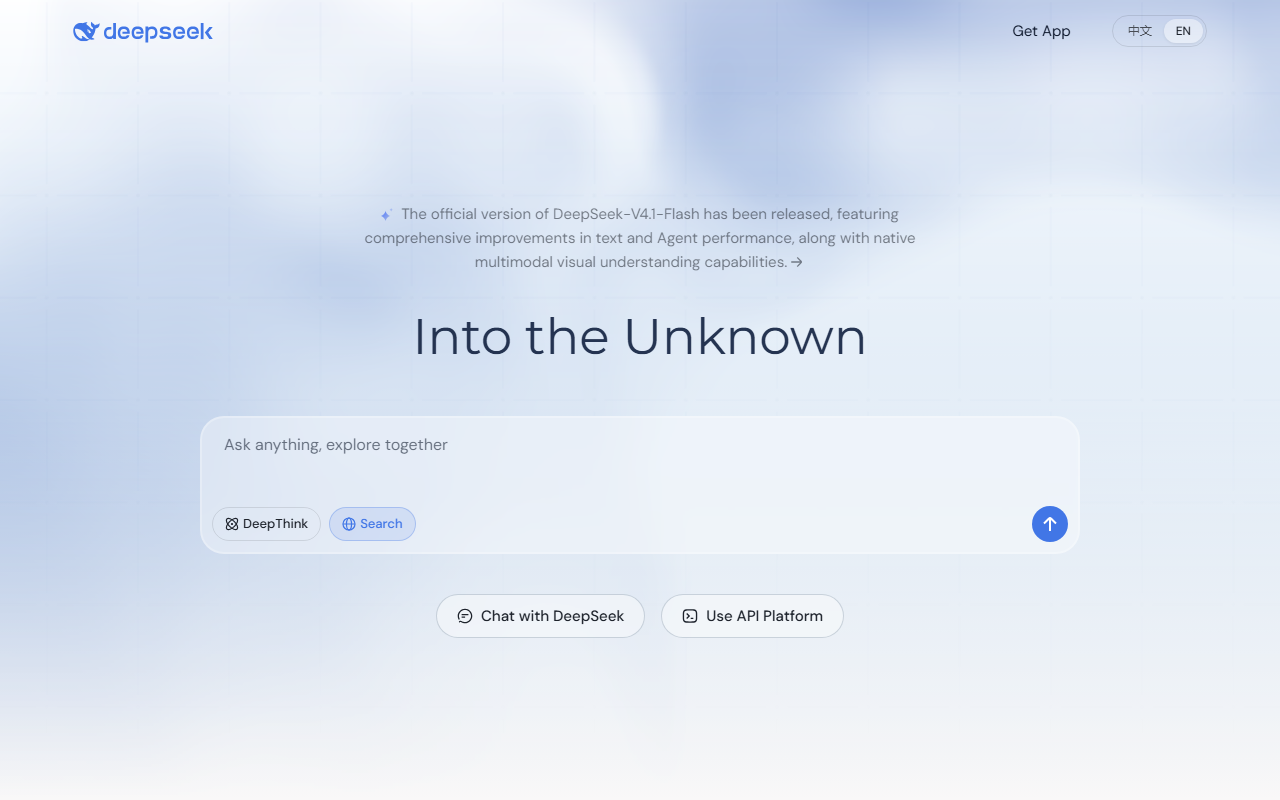 DeepSeek's homepage, captured 20 Sep 2026. The banner names DeepSeek-V4.1-Flash as the current lead model, above the free chat box.
The catch is not the answer quality. It is access. DeepSeek's chat interface returned an HTTP 403 to an automated request during this guide's own research in September 2026, a defensive measure against bot traffic. That does not affect a human typing into chat.deepseek.com, but it is worth knowing if you plan to script anything against it.
HokAI's own verification of DeepSeek's pricing, last confirmed 19 August 2026, lists API rates as low as $0.28 per million input tokens on the V3.2 line for anyone who outgrows the free chat and wants to wire it into an editor.
A separate, pricier reasoning-focused model exists for problems that need multi-step logic rather than a quick lookup. It runs $0.55 per million input tokens and $2.19 per million output tokens, roughly four to eight times the V3.2 rate depending on direction.
How this shortlist was actually checked
Every price and limit above was checked against the vendor's own site or a corroborating, dated news source in September 2026, not copied from an older roundup. That process is also what surfaced the DeepSeek access quirk above. A research fetch against chat.deepseek.com and pi.ai both returned blocked responses (403 Forbidden) during this guide's preparation, while the marketing pages for both products loaded normally.
Neither block affects a browser tab opened by a person. Both are consistent with rate-limiting aimed at automated traffic, and neither changes the free-tier terms published elsewhere on each vendor's own site.
Claude and Gemini: the polished defaults
Claude's free tier runs on Sonnet 5 by default, with a published context window of 200,000 tokens and access to web search and file uploads. Independent trackers this year converge on a rough allowance of 15 to 40 messages per rolling five-hour window, though Anthropic does not publish an exact daily figure.
The real number flexes with message length and attachments. A short back-and-forth about a syntax error might land near the top of that range, while pasting a long log file and asking for a full review can burn the whole window in five or six turns.
What Claude does well, more than raw problem-solving speed, is explain a concept in a tone a beginner can follow without feeling talked down to. That is exactly what someone hunting for a free app to actually learn on, not just to autocomplete a line, is usually after. Claude Opus 5, Anthropic's strongest model, is reserved for paying tiers.
Gemini's free tier gives standard access to Gemini 3.1 Pro, according to Google's own comparison page for Google AI Plus, which frames the $4.99-a-month Plus tier as roughly twice the usage ceiling of the free version rather than a different model entirely. For a reader already inside Gmail, Docs or Android, that is one less tab, and coding questions asked in the same window that holds an actual project's specs tend to get better-grounded answers.
Google's own page does not publish the free tier's exact request cap either. That is a pattern worth noticing: none of the three largest labs commit to a public daily number for their free product, only a paid tier described relative to it.
Qwen: coding strength without a US cloud
Qwen, built by Alibaba Cloud, shows up in the same free-tier roundups as DeepSeek for the same reason: open-weight models trained hard on code benchmarks, offered through a free web chat with no US-based account required. HokAI's own pricing verification from 8 September 2026 found a free web chat plus a 1-million-token trial window on the developer API for anyone who wants to build past the chat interface.
For a reader who cares where a query is routed, or who is outside the countries where OpenAI and Anthropic operate cleanly, Qwen is the shortlist's one option built entirely outside that stack. It is also the one with the thinnest English-language tutorial base, so expect to lean on its own documentation more than a Stack Overflow search.
The aggregators: Overchat AI and Ninja AI
Neither of these two options is the whole story, because neither Overchat AI nor Ninja AI makes you pick just one model. Overchat's own site lists more than 50 models behind a single subscription, including code-tuned variants like Kimi K2.7 Code alongside GPT-5.6, Claude and DeepSeek V4. Its free tier is described as "a limited number of questions per day" without a published exact cap.
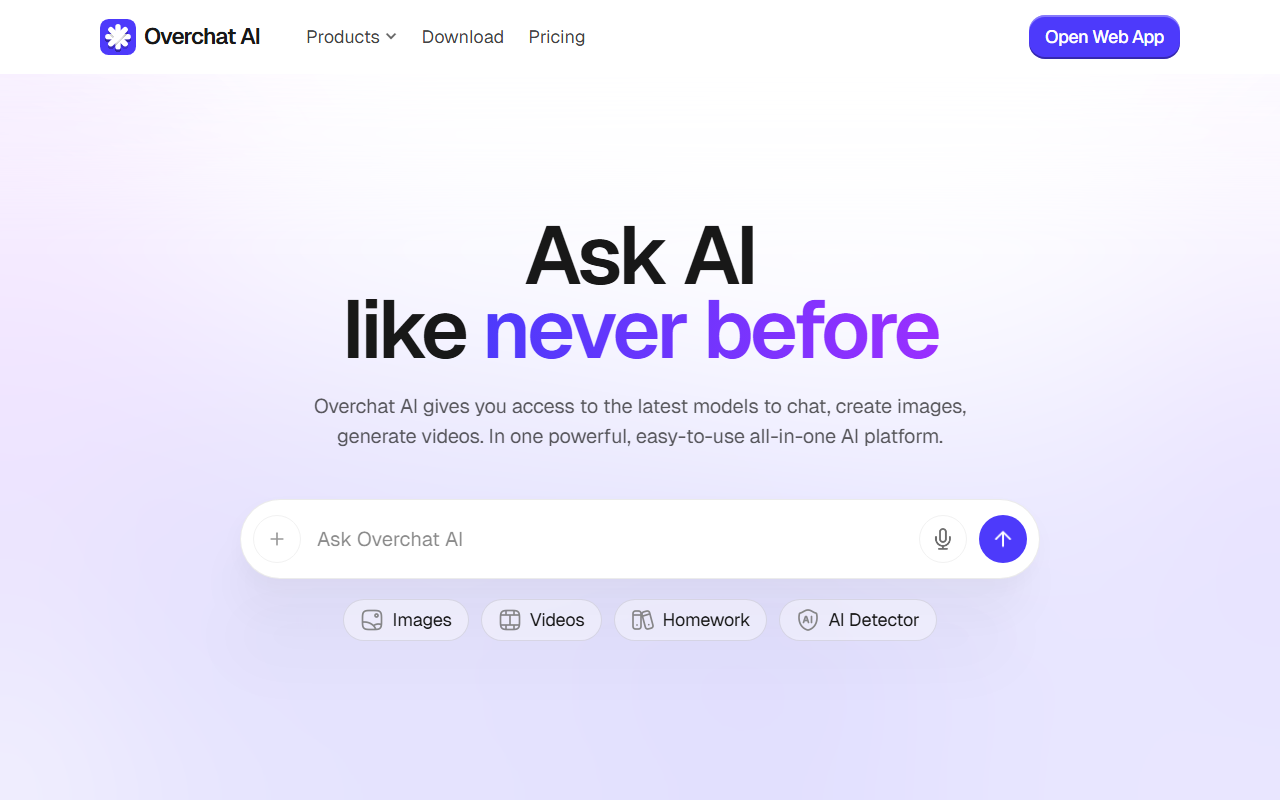 Overchat AI's homepage, captured 20 Sep 2026. The "Homework" quick-action sits next to the main prompt box, alongside the model-aggregation pitch.
Ninja AI positions itself similarly, with basic free access across more than 40 models. Its $19-a-month Standard plan unlocks an agentic "SuperNinja" mode, a 1-million-token context and 100 messages a day.
The honest pitch for either is not that they are better than DeepSeek or Claude individually. It is that a reader unsure which model handles their specific stack, a Rust question versus a Django one, can ask the same question across several without three separate logins, then keep whichever answer actually worked.
Pi: built for patience, not for hard problems
Pi, from Inflection AI, does not belong on a "best coding tool" list, and it does belong here. It remains, as of mid-2026, completely free with no subscription tier, no card, and no usage-based pricing, according to its own long-standing positioning and independent 2026 reviews.
Pi is built for conversation and patient explanation rather than technical throughput. For someone who has not written a line of code yet and needs a first explanation that does not assume prior vocabulary, that patience is worth more than raw technical depth. Treat anything it writes as a starting point, not a final answer, and move to DeepSeek or Claude once the question gets specific.
DeepSeek vs ChatGPT: the head-to-head most people actually face
For a reader choosing just one, it comes down to these two. ChatGPT wins on interface polish, on having the largest base of tutorials written against it, and on being unmetered rather than session-capped. DeepSeek wins, according to the current wave of third-party comparisons, on raw answer quality for a genuinely hard bug, and it does so without US ad-tier sponsorship inside the response.
If the question is a common one (how a loop works, what a null pointer error means) ChatGPT's polish and tutorial ecosystem make it the lower-friction pick. If the question is specific and the stack trace is real (a race condition, a dependency conflict, a genuinely obscure library method) DeepSeek's free tier is worth the extra step of opening a second tab. Neither replaces reading the AI model leaderboard, which tracks blended coding benchmark scores across every GA model, free and paid, for anyone comparing beyond this shortlist.
What it costs when free runs out
Every option above starts at $0, but "free" stops meaning the same thing the moment a question gets demanding. ChatGPT Plus is $20 a month for the full model and no ads, and Claude Pro matches that price for priority access and Opus.
Google AI Plus is the cheapest step up, at $4.99 a month, though it roughly doubles request volume rather than swapping models outright.
The two aggregators price differently. Ninja AI's Standard plan is $19 a month for 40 SuperNinja requests, one virtual machine and a 1-million-token context. Overchat AI does not publish its paid tier's price on the page checked for this guide, which is itself worth knowing before you commit a free-tier habit to a workflow you might outgrow in a month.
Data handling: what happens to the code you paste in
A coding question often means pasting real code, sometimes from a private or employer-owned repository, into a public chat product. None of the eight tools in this shortlist publish a coding-specific data policy distinct from their general chat terms, so the same privacy posture that applies to any conversation applies to a stack trace.
OpenAI and Anthropic both let free-tier users opt out of having conversations used for model training, though the exact toggle location has moved between redesigns. Qwen's data terms are governed from Singapore rather than the US or EU, a genuine difference for a reader with a data-residency requirement, not a marketing detail.
If a snippet is under an NDA or a client contract, the safe default is redacting identifiers before pasting it into any free chat tool on this list, aggregator or not. A free product is the one place a vendor has the least incentive to build a private-by-default workflow.
Who should skip this category entirely
None of the eight tools above autocomplete inside an editor while you type. If the actual need is IDE-level completion rather than a chat window, that is a different shortlist: GitHub Copilot Free, Cursor's free tier and Codeium's unlimited-completion plan are the names that keep showing up there. None of them belong on this list, because none of them answer a pasted question the way a chat interface does.
A reader who wants to run a coding model locally instead of trusting any vendor's free tier should read HokAI's guide to the best AI models for local coding instead. Anyone comparing ChatGPT specifically against a named alternative may also want the ChatGPT vs Kimi comparison for a narrower head-to-head. For picking a specific model under a hard constraint, price cap or open-weights requirement, the model recommender narrows the field faster than reading eight reviews.
The turn: free is a snapshot, not a promise
The obvious objection to all of this: free tiers change without warning, and a guide written in September 2026 is a photograph of a moving target. That is true, and it already happened once inside this guide's own research window: ChatGPT's free tier went from message-capped to functionally unmetered sometime in 2026, and picked up ads in the same window. A tool that is generous today can tighten its limits the moment its funding round closes, and one that is stingy today can loosen them to chase market share.
The defense is not picking harder. It is not depending on exactly one free tier. Two of the options on this list, Overchat AI and Ninja AI, exist specifically because "which single free AI should I trust forever" is the wrong question. If DeepSeek's limits tighten next quarter, having already asked Claude the same question once is worth more than having memorized which vendor used to be the generous one.
What would change this
Watch two things over the next two quarters. Whether OpenAI extends the sponsored-results format from the US into other markets would change the honest verdict on ChatGPT's free tier for readers outside it. Whether DeepSeek's rate-limiting against automated traffic tightens into something that also slows down real users during peak hours, the way several Chinese-lab free tiers did in prior product cycles, would change the head-to-head above.
Until then, the practical answer to "best AI for coding questions free" is not one tool. It is knowing which of these eight to open first for the specific question in front of you, and having a second one bookmarked for when the first one is confidently wrong.
Smart Match on HokAI can also narrow this by your actual stack and constraints rather than a generic ranking, if you would rather answer four questions than read eight reviews: try Smart Match.
Frequently asked questions
What is the best free AI for coding questions in 2026?
There is no single winner. DeepSeek's free chat is the pick third-party reviewers most often name for hard technical problems, because its answers reference real method names rather than plausible-sounding invented ones. ChatGPT's free tier remains the most polished general option and has the largest base of tutorials written against it, but US free accounts have carried ads since February 2026.
Is ChatGPT still free for coding help in 2026?
Yes. ChatGPT's free tier is chat-unmetered as of August 2026, meaning there is no hard message cap for most users. The trade is that free conversations default to a lighter model than ChatGPT Plus, and US free and Go-tier accounts now see sponsored results in a labeled section below the model's answer, a change OpenAI introduced in February 2026.
Which free AI is best for a beginner learning to code?
Claude's free tier is a strong pick for concept explanations in plain language, and Pi, from Inflection AI, is a genuinely patient option with zero technical assumptions for someone who has not written code before. Neither replaces a dedicated tutorial, but both are free with no card required, and Pi carries no usage-based pricing at all.
Do free AI coding tools give worse answers than paid ones?
Sometimes, but not always in the way people expect. Free tiers usually route to a lighter model than the paid version, which can matter on a genuinely hard bug. But DeepSeek's free chat has out-performed some editor-embedded paid assistants on technical accuracy in third-party comparisons, so the free-versus-paid gap depends more on which specific model you land on than on price alone.
What's the difference between a free AI coding tool and a free AI for coding questions?
A coding tool, like GitHub Copilot Free or Cursor's free tier, autocompletes code inside an editor as you type. A tool for coding questions is a chat interface you paste an error into or ask to explain something, such as ChatGPT, DeepSeek, Claude, Gemini or Qwen. The two categories solve different problems and this guide covers only the second.
Covered in this guide
- ChatGPT: ChatGPT is OpenAI's AI assistant with 900 million weekly users and GPT-5.6 Sol, covering writing, coding, image generation, and web search with a free plan and Plus at $20/month.
- DeepSeek: Advanced open-source and API-based large language models with cost-effective pricing and superior reasoning capabilities.
- Claude: Claude API with Sonnet 5 (agentic, near-Opus performance at half the cost) and Claude Science (auditable research workbench). Free to Pro.
- Gemini: Google's multimodal AI model family for reasoning, coding, and creative tasks
- Ninja AI: All-in-one AI agent platform giving access to 40+ models including GPT-4.1 and Claude Sonnet, with unlimited image generation and SuperNinja agentic mode; free tier included.
- Overchat AI: Overchat AI consolidates ChatGPT, Claude, Gemini, and 10+ other AI models into one chat interface, used by 610,000 people monthly.
- Pi: A personal AI built for conversation rather than tasks: supportive, memory-enabled, and free.
- Qwen: Alibaba's AI assistant with 203M monthly active users, supporting 119+ languages, multimodal input, and models up to 1M token context windows.
- Alibaba Cloud: Alibaba Cloud, founded 2009, is China's top cloud provider (35% share) and builds the Qwen AI models, which passed 1 billion Hugging Face downloads in 2026.
- Anthropic: Anthropic, founded 2021 by 7 ex-OpenAI researchers, builds Claude and was valued near $965B after its May 2026 Series H round.
- Claude Opus 5: Anthropic's July 2026 flagship LLM, with a 1M token context window by default and a new xhigh reasoning-effort mode for long agentic runs.
- Sonnet 5: Claude Sonnet 5, released by Anthropic on June 30, 2026, hits 82.1% SWE-bench Verified with a 1M-token context window.
- V3.2 line: DeepSeek V4-Pro reached GA in August 2026 under MIT, matching frontier models on agentic coding. Open-source MoE, 1M-token context, peak/off-peak API pricing.
- Gemini 3.1 Pro: Gemini 3.1 Pro hits 94.3% GPQA Diamond and 80.6% SWE-bench Verified with a 1M-token context window and sparse MoE architecture.
- Google: Google (Alphabet, NASDAQ: GOOGL), founded 1998, serves 8B+ monthly Search users with Gemini 3.5, 190,820 employees, and $402.84B FY2025 revenue.
- OpenAI: OpenAI builds the GPT-5.6 model family (Sol, Terra, Luna), o3, ChatGPT (900M+ weekly users), and the OpenAI API. Closed a $122B round at an $852B valuation in March 2026, the largest private funding round in history.
Sources
Still deciding?
This guide covers a handful of options. Smart Match checks every listing in the directory against how you actually work and what you can spend, then hands you the shortlist and the reason behind each pick.
Start Smart MatchRelated guides
- What Happened When 7 AI Agents Got Real Bank Accounts and No SupervisionAnalysisWhat changed and who it affects
- Best AI Assistant Apps for Android in 2026, Now That Google Assistant Is DeadBuyer's guideHow to pick, across a category
- Best AI Chatbots in 2026: Pick by the Job, Not the LeaderboardBuyer's guideHow to pick, across a category
- Best AI Companies in 2026: Who Is Actually LeadingBuyer's guideHow to pick, across a category
- Best AI Tools for Writing Excel Formulas and Data Analysis in 2026Buyer's guideHow to pick, across a category
- The Best AI for Qualitative Data Analysis in 2026 Depends on What You Already HaveBuyer's guideHow to pick, across a category