ChatGPT vs Kimi: Which Should You Use in 2026?
ChatGPT and Kimi are general-purpose AI chat assistants. ChatGPT, from OpenAI, runs GPT-5.6 Sol on its $20-a-month Plus plan and leads on coding benchmarks and multimodal features. Kimi, from Moonshot AI, runs Kimi K3, scores higher on GPQA Diamond reasoning tests, and costs a fraction of ChatGPT's price per API token, though Moonshot paused new paid sign-ups in July 2026.
The short version
ChatGPT Plus, $20 a month on GPT-5.6 Sol, is the safer all-around pick for writing, coding and image generation. Kimi K3 scores higher on GPQA Diamond and costs far less per API token, but Moonshot paused new consumer subscriptions in July 2026 with no reopening date, so the API is the reliable way in.
OpenAI charges $200 a month for its top ChatGPT tier, and Moonshot AI has not sold a single new Kimi subscription since July 19, 2026.
That gap is not about ChatGPT winning the argument on merit. Kimi K3, the flagship model Moonshot released the same week it paused sign-ups, beat GPT-5.6 Sol on GPQA Diamond and costs a fraction of OpenAI's per-token rate. What actually stopped people switching was capacity, not quality: demand for K3 outran Moonshot's GPU forecast, and the company still has not said when membership spots reopen.
For a team picking one AI subscription, the real question is not which model is smarter. It is which one you can actually buy, and for what.
The verdict
Pick ChatGPT if you want one assistant that is good at writing, coding, image generation and voice, backed by the widest set of third-party integrations, and you do not want to think about which underlying model answered your prompt. The Plus tier at $20 a month already covers that for one person, according to OpenAI's pricing breakdown reviewed by The AI Career Lab on 6 September 2026.
Pick Kimi if your daily work is reading or generating very long documents (legal filings, research papers, full codebases) or you are calling a model through an API often enough that per-token cost matters more than a flat monthly fee. Kimi K3 runs a 1-million-token context window and Moonshot's own benchmark table puts it ahead of GPT-5.6 Sol on GPQA Diamond, a graduate-level reasoning test.
Neither pick is close to free of caveats. ChatGPT's cheapest useful tier is $12 more than Kimi's, and Kimi's consumer app has not accepted a new paying subscriber in almost two months. Read the next two sections before you commit a seat count to either one.
Both sit in HokAI's AI chatbots category alongside dozens of general-purpose alternatives, and if what you actually want is a phone-first assistant rather than a browser tab, that is a narrower question than this guide answers: see Gemini vs ChatGPT as your Android assistant for that specific comparison.
What ChatGPT costs right now
Comparing "ChatGPT" and "Kimi" as single products is where most write-ups go wrong. Both companies sell a ladder of tiers, and the model you get changes as you climb it.
OpenAI runs six ChatGPT plans as of September 2026, confirmed by The AI Career Lab's pricing breakdown, last reviewed 6 September 2026:
| Plan | Price | Model you get | Notes |
|---|---|---|---|
| Free | $0 | GPT-5.6 Luna | Heavily rate-limited |
| Go | $8/month | GPT-5.6 Luna | Roughly 10x Free's usage |
| Plus | $20/month | GPT-5.6 Sol | The baseline most people mean by "ChatGPT" |
| Pro | $100 or $200/month | GPT-5.6 Sol Pro, plus GPT-6 Astra in regular chat | 5x or 20x Plus's usage, depending on the price paid |
| Business | $25/seat/month (Standard) or $125/seat (Premium) | GPT-5.6 Sol; Astra limited on Standard, full on Premium | Annual billing runs cheaper per seat |
Annual billing changes the ChatGPT math too. Both Business tiers drop by roughly 20% a seat when paid yearly instead of monthly, the same discount shape OpenAI applies across its whole Business ladder rather than a one-off promotion.
What Kimi costs right now
Kimi sells five tiers, per Moonshot's own current notice and a pricing breakdown updated 5 September 2026:
| Plan | Price | Credits/month | Status as of this guide |
|---|---|---|---|
| Adagio | $0 | 6 agent credits, no K3 in Kimi Code | Open |
| Moderato | $19/month | 60 credits, K3 in chat | Paused, no new sign-ups |
| Allegretto | $39/month | 150 credits, Kimi Claw included | Paused |
| Allegro | $99/month | 360 credits | Paused |
| Vivace | $199/month | 720 credits, priority model access | Paused |
Moonshot's own notice on plan adjustments, published 20 July 2026 and still the latest public word on the subject, says existing subscribers keep their access unchanged but that new plans are "not yet available" with "the exact launch time still to be determined," citing computing capacity. Two independent trackers (thevibefather.com and Coursiv) reported the same pause was still active through August 2026. HokAI could not confirm the status changed since.
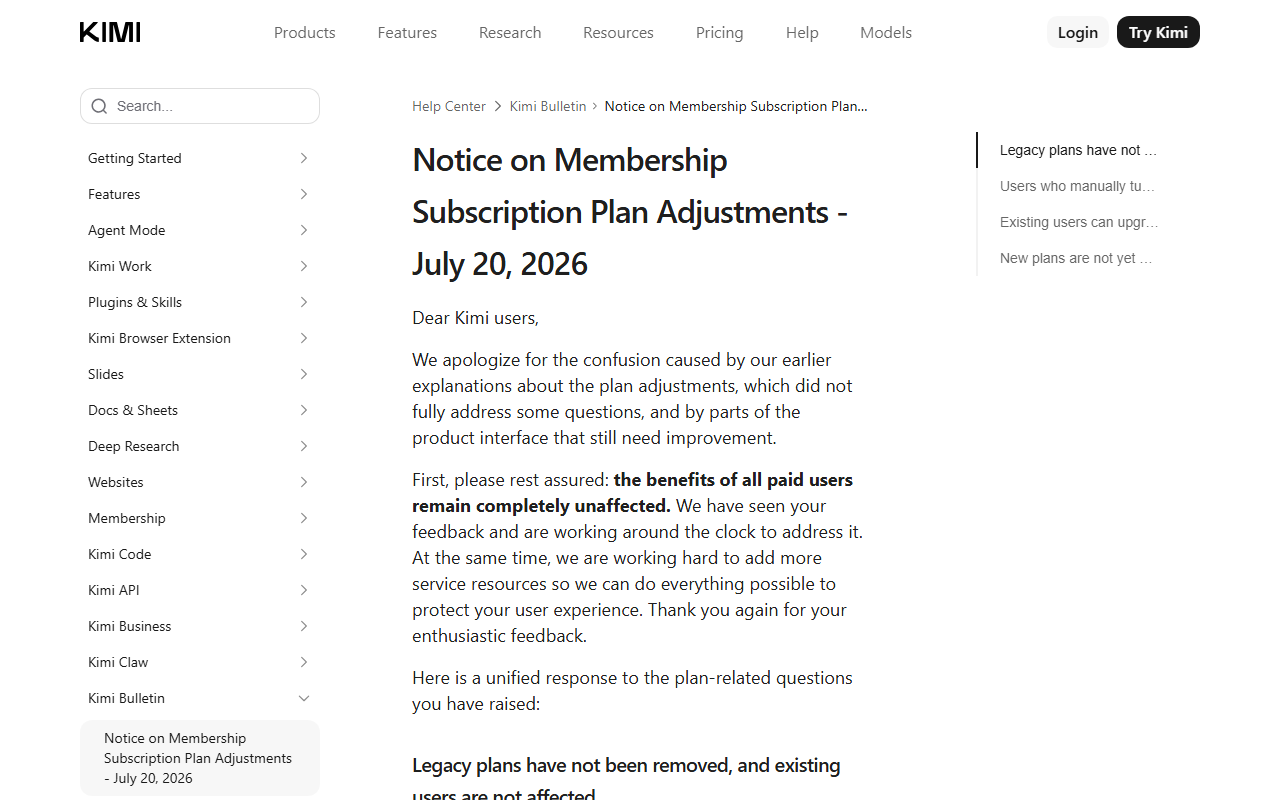 Moonshot's plan-adjustment notice, captured 15 Sep 2026. Existing subscribers keep their access; the launch date for new plans is still listed as undetermined.
The one door that has stayed open the whole time is the developer API. Kimi K3 costs $0.94 per million tokens blended, less than a sixteenth of what GPT-5.6 Sol charges per token and under an eighth of the newer GPT-6 Astra's rate, by HokAI's own tracked pricing (see the full benchmark table below). That price gap holds regardless of whether Moonshot is accepting new consumer subscribers.
Kimi's paid tiers, when they were still on sale, offered a comparable annual cut: Moderato's $19 monthly rate fell to $180 a year, close to a 21% discount. HokAI did not verify what happens to either product's consumer plan once a monthly credit or usage cap is hit. Check each vendor's own limits page directly before assuming unlimited use at any price point, since neither company publishes consumer overage pricing anywhere this guide's research turned up.
Where ChatGPT wins
ChatGPT is not just cheaper to start with. It is the more finished product across three specific things.
Coding, on the model most people actually use. GPT-5.6 Sol, the model behind ChatGPT Plus, scores 78.5 on SWE-bench Verified against K3's 67.5, an 11-point gap on real GitHub issue resolution rather than a synthetic benchmark.
Multimodal range. ChatGPT generates images and video, transcribes and speaks in voice mode, and reads screenshots inside the same thread. Kimi's multimodal support centers on document and vision understanding rather than image or video generation.
Integration depth. ChatGPT ships MCP support on Plus and above, letting it call external tools and codebases directly, plus a mature third-party plugin and connector ecosystem that Kimi's chat product has not matched yet.
For a reader who wants a single assistant that writes the email, drafts the pull request, and generates the slide deck without leaving one tab, ChatGPT Plus is the correct default and the one this guide names as the winner for that use case. HokAI's own breakdown of what ChatGPT is actually used for goes further into which of those jobs the free tier can and cannot cover.
Where Kimi wins
Kimi is not trying to be the same product. Two things it does better are specific enough to name.
Reasoning benchmarks and price, together. Kimi K3 scores 93.5 on GPQA Diamond, a graduate-level science reasoning test, against GPT-5.6 Sol's 72.1 and even GPT-6 Astra's 96 comes at more than 8 times K3's blended API price. If your workload is research synthesis or technical Q&A rather than agentic coding, K3 answers harder questions for less money per token.
Long-document work. K3's context window runs to 1 million tokens, roughly the length of a 750,000-word manuscript, and Moonshot built it on a hybrid attention design (Kimi Delta Attention plus Attention Residuals) specifically to keep recall stable at that length rather than degrading past the first third of the document, per Moonshot's own architecture notes as reported by Northflank's technical breakdown of the release.
Moonshot also ships a dedicated model for the narrower case: Kimi K2.7-Code, a coding specialist released 12 June 2026 that posts a 21.8% improvement over its predecessor on Moonshot's internal coding benchmark while using 30% fewer reasoning tokens per task. It is a different model from K3, aimed specifically at teams who want Kimi's architecture without paying for general-purpose reasoning they will not use.
| Benchmark | GPT-5.6 Sol (ChatGPT Plus) | GPT-6 Astra (ChatGPT Pro, preview) | Kimi K3 |
|---|---|---|---|
| Released | 9 Jul 2026 | 3 Sep 2026 | 16 Jul 2026 |
| SWE-bench Verified | 78.5 | not published | 67.5 |
| GPQA Diamond | 72.1 | 96 | 93.5 |
| Blended API price / million tokens | $17.50 | $7.70 | $0.94 |
Who should pick which
Run through this list before you buy a seat for a team:
- General knowledge work, small team: ChatGPT Plus.
- Long reports and research, daily: Kimi's API, or a reseller.
- Production code, tight token budget: both, split by task.
- Not sure which column you're in: ChatGPT, the safer default.
- Testing before committing a budget: both free tiers first.
The four-person startup doing general work is the easy case: ChatGPT Plus at $20 a seat, because the integration depth and image generation earn the extra cost for a team that is not specialized in one thing. The solo researcher reading long reports daily is almost as easy, just in the other direction: go through Kimi's API if the consumer app is still paused, or through AIML API, which resells K3 and 400-plus other models through one key if you would rather not open a Moonshot account at all.
The harder case is a team shipping production code on a tight token budget. Neither model alone is the right answer there: run GPT-5.6 Sol for the work that needs the highest SWE-bench score, and Kimi K3's API for everything else, since the price gap between them is large enough to justify paying two providers instead of one.
Testing before you commit costs nothing either way. ChatGPT's Free plan runs on GPT-5.6 Luna with heavy rate limits, and Kimi's Adagio plan is genuinely unlimited for basic chat, just without K3 or Kimi Code access, and both are open to new users right now regardless of Kimi's paid-tier pause.
Data handling: where your prompts actually go
This is the question most comparison posts skip, and it matters more for Kimi than for ChatGPT.
OpenAI operates under US data governance, and enterprise and Business tiers carry contractual terms that exclude prompt data from model training by default. OpenAI's own SOC 2 Type II scope, last reviewed 6 July 2026, names the API Platform, ChatGPT Enterprise, Edu and Team as covered; Free, Plus and Pro are not named in that scope. A four-person startup on Plus is buying the product, not the audited version of it.
Claude, Gemini and ChatGPT all compete on broadly similar Western compliance postures at this point, which is part of why none of them differentiates much on this axis anymore.
Kimi is built by a Chinese company and operates under Chinese data regulation. HokAI could not verify Moonshot's current data-residency or retention policy against a primary source this run. Moonshot's terms page was not part of this guide's research and should not be assumed from the general reputation of Chinese AI labs.
If your work involves regulated client data, confidential source material, or anything with an explicit data-residency requirement, that is a question to answer directly with Moonshot's own terms before sending anything sensitive through Kimi, not a detail to infer from where the K3 benchmarks landed. This is the single fact most likely to make the decision for you before price or benchmark scores enter the picture at all.
A four-person startup with no regulated data can treat this section as background reading. A team under HIPAA, GDPR, or a client contract with a data-location clause should treat it as the actual first question, ahead of everything in the pricing table above.
The case for going around the waitlist entirely
The strongest objection to everything above is simple: why write 3,000 words about a product you cannot currently buy?
Because the part that is paused is only the consumer subscription. Moonshot's API, billed pay-as-you-go per token, was not mentioned anywhere in the July 20 notice that froze new memberships. Third-party resellers like AIML API, which offers K3 as one of over 400 models behind a single OpenAI-compatible key according to its own public documentation, have continued selling access the entire time.
A developer who is comfortable writing against an API instead of a chat window gets K3's steep per-token discount today, with no waitlist, no membership tier, and no dependency on Moonshot's consumer capacity at all. The chat app being sold out is a real inconvenience for a non-technical buyer choosing between two subscriptions. It is not a blocker for anyone willing to point a script at an endpoint instead.
It is also worth remembering that Kimi is not the only Chinese lab shipping a capable, cheap open-weight model this year. DeepSeek V4 and Z.ai's GLM-5.2 both compete on the same price-per-token axis without Moonshot's capacity problem attached. If K3's specific reasoning scores are not the reason you picked it, those two are worth pricing out before you build a workflow around a model whose consumer front door is closed.
What switching actually costs
If you are already paying for ChatGPT Plus and considering adding or moving to Kimi, the practical cost is smaller than most vendor switches:
- Chat history: does not move. Start fresh threads.
- Custom instructions: rewrite by hand, roughly an hour.
- API integrations: new key, one test pass before production.
- Team habits: the real cost is retraining, not the technical step.
None of it is a large lift on its own. Neither product locks chat history into a format the other reads, so plan to start fresh conversations rather than migrating threads. ChatGPT's custom instructions and Kimi's system prompts use different fields, and porting the ones you actually rely on by hand is closer to an afternoon task than a project.
The API side is the one place real engineering time goes. Kimi's API is OpenAI-compatible at the request level, which cuts most of the integration work, but rate limits and context handling differ enough that a test pass belongs before any production traffic moves over. Budget more time for people relearning where things live in the interface than for any of the technical steps above: that is consistently where switching projects actually run long.
The switching cost here is closer to changing a subscription than to a platform migration, which is exactly why price and capability, not lock-in, should drive the decision. Comparing raw model scores across benchmarks is a moving target month to month, since both companies ship new model versions every few weeks. HokAI's model leaderboard tracks those changes as new releases land, which a single article published on one date cannot.
The one asymmetry worth planning around is Kimi's own: Moonshot's notice protects subscribers who are already paying, but it says nothing about what happens if you cancel and later want back in while new sign-ups are still paused. HokAI could not verify whether a lapsed subscriber gets any priority over a brand-new signup, so treat an active Kimi membership as something you keep rather than something you can casually pause and resume.
What would change this answer
Two things would flip this comparison, and both are watchable.
First, if Moonshot reopens Vivace and Allegro sign-ups at scale with reliable throughput, Kimi's price advantage stops being a niche pick for document-heavy teams and becomes a mainstream argument for anyone price-sensitive. Moonshot has given no date for that.
Second, if OpenAI's broader GPT-6 Astra rollout, currently a $200-tier preview, reaches the $20 Plus tier the way GPT-5.6 Sol eventually did, ChatGPT's benchmark gap on reasoning tasks narrows or closes even as Kimi's price stays where it is. Watch ChatGPT's own tier page for that move rather than this guide, since a pricing ladder this active changes faster than any single article can track it.
A third, smaller signal worth watching: whether Moonshot splits its offer the way one of its own notices hinted, into a separate Kimi Membership and Kimi Code Membership. If coding access becomes its own cheaper tier, the calculus for the "team shipping production code" bullet above changes again, since paying for reasoning you do not use is exactly the inefficiency K2.7-Code was built to avoid.
If none of those things happen by early 2026, the answer above holds: ChatGPT for the team that wants one good-enough assistant, Kimi's API for anyone whose bill is the deciding factor. Neither company has shown any sign of slowing its release schedule, and both shipped a major model inside the same eight-week window this guide draws on, so treat every number above as current for September 2026 and nothing further out.
For everything in between, HokAI's Smart Match will ask about your actual workload and point at whichever one fits it, rather than whichever one this guide picked for the average reader.
Frequently asked questions
Is Kimi actually cheaper than ChatGPT?
Yes, on a per-token API basis. Kimi K3 costs about $0.94 per million tokens blended against $17.50 for GPT-5.6 Sol, the model behind ChatGPT Plus. The consumer subscriptions are closer: Kimi's Moderato tier was $19 a month against ChatGPT Plus's $20, but Moderato and every other paid Kimi tier stopped accepting new subscribers in July 2026.
Why can't I sign up for a paid Kimi plan?
Moonshot paused new membership sign-ups on July 19, 2026, after demand for its Kimi K3 model outran its GPU capacity. A notice on Moonshot's own help center, last updated July 20, 2026, says existing subscribers are unaffected but gives no date for when new plans reopen. The developer API was not part of the pause and remains open.
Which is better for coding, ChatGPT or Kimi?
ChatGPT, on the specific benchmark that measures it best. GPT-5.6 Sol scores 78.5 on SWE-bench Verified against Kimi K3's 67.5. Moonshot also sells a separate coding-specialist model, Kimi K2.7-Code, for teams that want Kimi's architecture without paying for general reasoning they will not use.
Does Kimi support a longer context window than ChatGPT?
Kimi K3 runs a 1-million-token context window built on a hybrid attention design meant to keep recall stable at that length. ChatGPT's Pro tier also supports a 1-million-token window through GPT-6 Astra, but the $20 Plus tier most people use runs on GPT-5.6 Sol at a smaller window, so the comparison depends on which ChatGPT tier you are actually paying for.
Is Kimi safe to use with sensitive company data?
HokAI could not verify Moonshot's current data-residency or retention policy against a primary source. Kimi is built by a Chinese company and operates under Chinese data regulation, which is a real difference from OpenAI's US-based governance. Teams with regulated client data or a contractual data-location requirement should confirm Moonshot's terms directly before sending anything sensitive through Kimi.
Covered in this guide
- ChatGPT: ChatGPT is OpenAI's AI assistant with 900 million weekly users and GPT-5.6 Sol, covering writing, coding, image generation, and web search with a free plan and Plus at $20/month.
- Kimi: Native multimodal AI assistant with Agent Swarm capabilities and 256K context window
- AIML API: Unified gateway to 1000+ AI models from one OpenAI-compatible endpoint. Access GPT-5, Claude Sonnet 5, Sora 2, and Flux. No free plan — pay-as-you-go from a $20 prepaid credit.
- Claude: Claude API with Sonnet 5 (agentic, near-Opus performance at half the cost) and Claude Science (auditable research workbench). Free to Pro.
- DeepSeek V4: DeepSeek V4-Pro reached GA in August 2026 under MIT, matching frontier models on agentic coding. Open-source MoE, 1M-token context, peak/off-peak API pricing.
- Gemini: Google's multimodal AI model family for reasoning, coding, and creative tasks
- GLM-5.2: GLM-5.2 is Z.ai's June 2026 open-source 744B MoE model with a 1M-token context window, 80.3% GPQA Diamond, and MIT license at $1.40/1M input tokens.
- GPT-5.6 Sol: GPT-5.6 Sol by OpenAI (July 2026): flagship-tier pricing, 2x token efficiency vs peers, ultra multi-agent coordination, programmatic tool calling. Microsoft 365 Copilot preferred model.
- GPT-6 Astra: OpenAI's flagship model, launched September 2026 as the first ever rated at the Preparedness Framework's Critical cybersecurity level.
- Kimi K2.7-Code: Open-weight 1T/32B-active MoE coding model from Moonshot AI (June 2026) with a 256K-token context window and a Modified MIT license.
- Kimi K3: 2.8T-parameter open-weight MoE model from Moonshot AI (July 2026) with a 1M-token context window and 93.5% GPQA Diamond, the top open score.
- Moonshot AI: Beijing AI lab founded in 2023 by Yang Zhilin, maker of Kimi and the open-weight Kimi K2 models, valued at $20B in 2026.
- OpenAI: OpenAI builds the GPT-5.6 model family (Sol, Terra, Luna), o3, ChatGPT (900M+ weekly users), and the OpenAI API. Closed a $122B round at an $852B valuation in March 2026, the largest private funding round in history.
Sources
Still deciding?
This guide covers a handful of options. Smart Match checks every listing in the directory against how you actually work and what you can spend, then hands you the shortlist and the reason behind each pick.
Start Smart MatchRelated guides
- What Happened When 7 AI Agents Got Real Bank Accounts and No SupervisionAnalysisWhat changed and who it affects
- AIML API vs OpenRouter: Which AI Gateway Should You Use in 2026?ComparisonHead-to-head, with a verdict
- Best AI Assistant Apps for Android in 2026, Now That Google Assistant Is DeadBuyer's guideHow to pick, across a category
- Best AI Chatbots in 2026: Pick by the Job, Not the LeaderboardBuyer's guideHow to pick, across a category
- Best AI Companies in 2026: Who Is Actually LeadingBuyer's guideHow to pick, across a category
- Best AI Tools for Writing Excel Formulas and Data Analysis in 2026Buyer's guideHow to pick, across a category