
Last updated: 2026-09-04
Sync Labs is a developer API for lip sync and video dubbing, offering five models that range from a fast general-purpose default to sync-3, its 4K-native flagship that auto-detects hands, microphones, and glasses blocking the mouth. It targets developers wiring dubbing into apps via REST and SDKs, not end-user video editors.
About Sync Labs
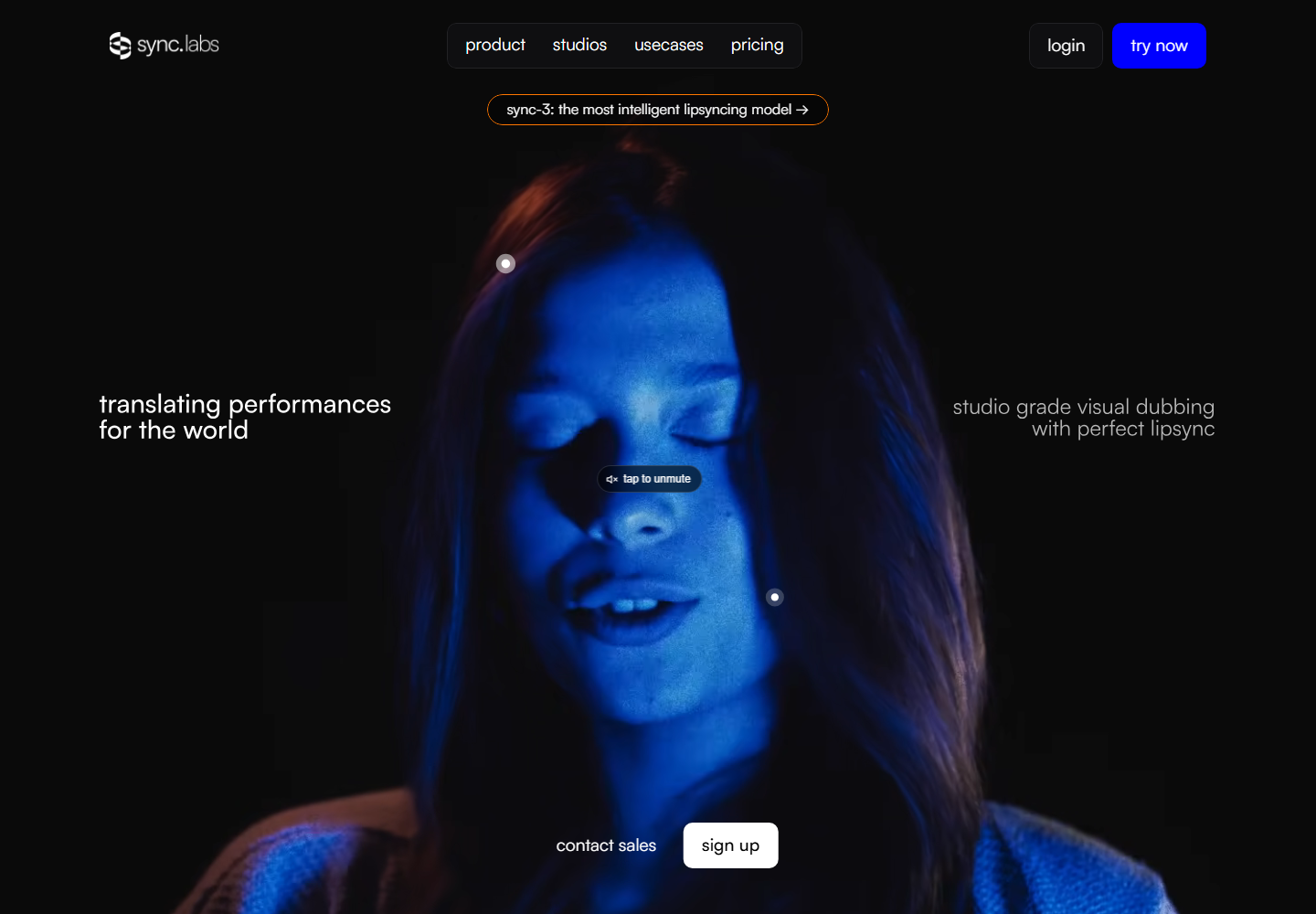
Sync Labs (sync.so) is a lip sync and visual dubbing API built by Synchronicity Labs Inc. for developers, giving programmatic access to lip sync models through a REST API and Python/TypeScript SDKs, plus a web-based Studio playground for testing before writing code. The company positions it as "studio grade visual dubbing with perfect lipsync".
The platform offers five lip sync models spanning a quality and speed trade-off. sync-3 is the flagship, badged 4K and "intelligent": native 4K output with built-in obstruction detection for hands, microphones and glasses, handling extreme camera angles and full-shot processing without manual masking. lipsync-2-pro adds diffusion-based super-resolution for fine facial detail like beards and teeth. lipsync-2 is the fast, general-purpose HD default, and lipsync-1.9.0 is the legacy budget option. react-1, badged expressive and experimental, layers facial expression and head motion on top of standard lip movement, capped to short clips per generation.
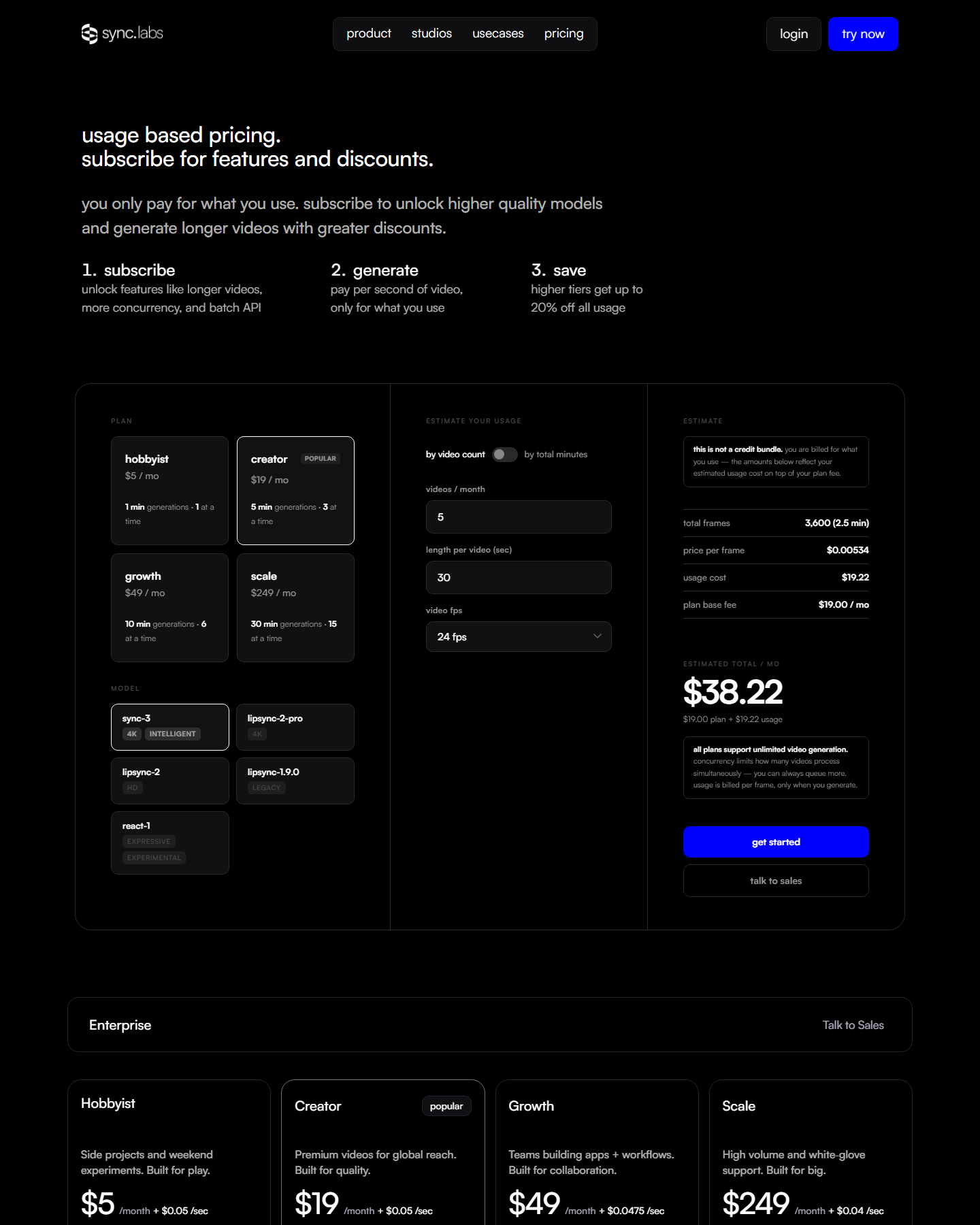
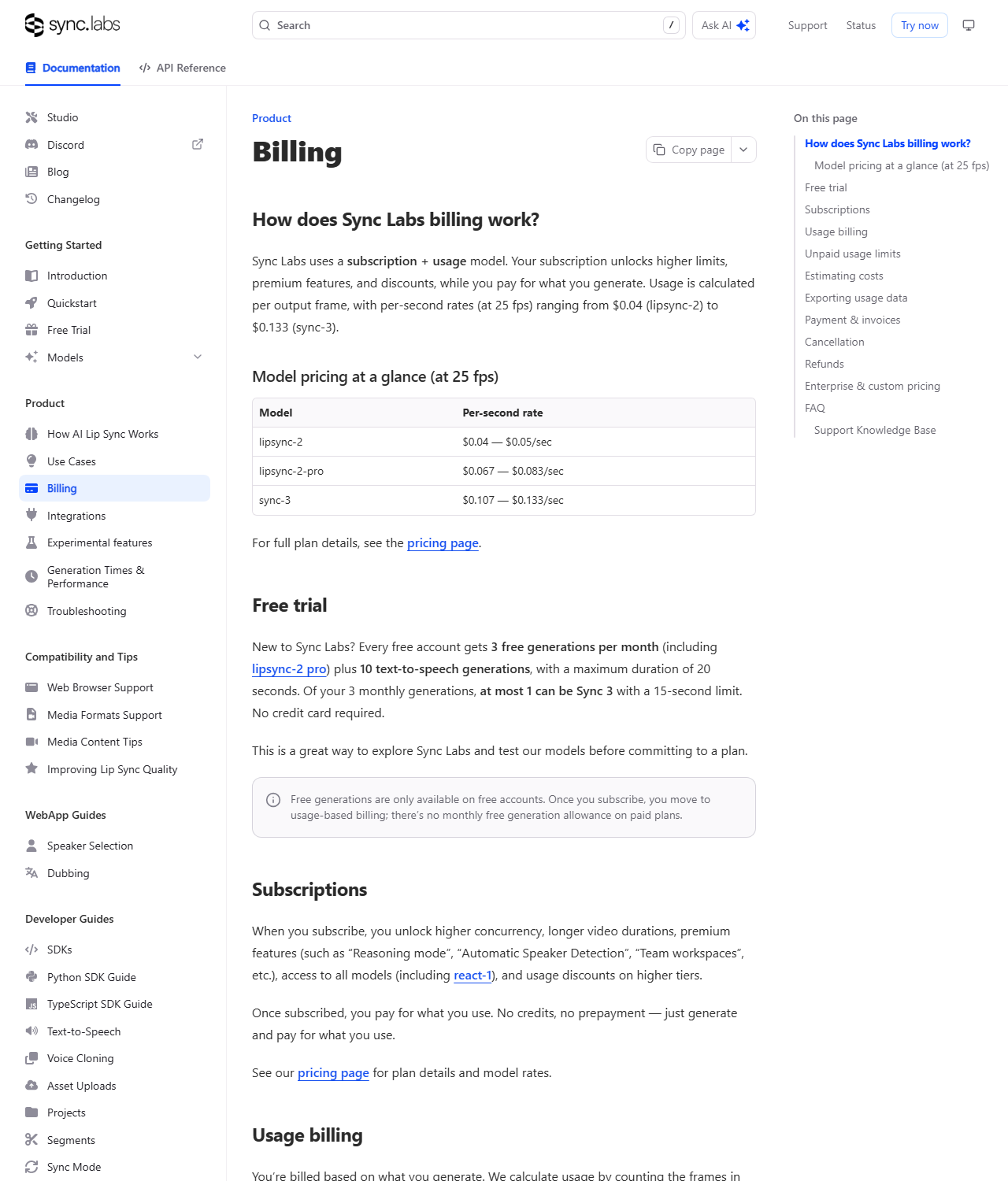
Billing is the part worth reading twice. Sync Labs describes it as "subscription + usage": the subscription unlocks duration, concurrency, voice-clone slots and premium features, and usage is charged separately. The unit is not the second — it is the output frame. Sync Labs states that it counts the frames in the output video and multiplies by the model's per-frame price, that the published per-second rates are quoted at a 25 fps reference, and that "actual billing is per output frame regardless of the input frame rate". A 30 fps render therefore costs about 20% more per second of finished video than the quoted rate. Charges are invoiced once they cross a plan-specific threshold ($6 Hobbyist, $20 Creator, $50 Growth, $250 Scale), so no prepaid credits are involved.
The free tier is a trial, not a permanent allowance. New accounts get 3 free generations per month plus 10 text-to-speech generations with no credit card, capped at 20 seconds each, and at most one of the three may use sync-3 at a 15-second limit. Sync Labs states plainly that "free generations are only available on free accounts. Once you subscribe, you move to usage-based billing; there's no monthly free generation allowance on paid plans." The pricing page's plan selector starts at Hobbyist and does not show the free tier at all, which only the FAQ and the billing docs describe.
Developer tooling includes a REST API at api.sync.so, a Python SDK (pip install syncsdk), a TypeScript SDK (npm i @sync.so/sdk), a documented OpenAPI 3.1 spec and a ComfyUI plugin. Subscription-gated features named in the docs include reasoning mode, automatic speaker detection, bring-your-own TTS key, the Batch API and team workspaces.
Screenshots
Pricing
Subscription plus usage, billed per output frame. Free tier: 3 generations/month (which may include lipsync-2-pro) plus 10 text-to-speech generations, 20-second maximum, at most one of the three on sync-3 at a 15-second limit, watermarked, no credit card — and it disappears the moment you subscribe, since Sync Labs states there is no monthly free generation allowance on paid plans. Hobbyist $5/mo (1 min max, 1 concurrent, 3 voice clones, watermark).
Creator $19/mo (5 min, 3 concurrent, 5 voice clones, no watermark, own TTS API key, automatic speaker detection, react-1). Growth $49/mo (10 min, 6 concurrent, 15 voice clones, 5% usage discount, Batch API, 3 seats). Scale $249/mo (30 min, 15 concurrent, 50 voice clones, 20% usage discount, Batch API, 5 seats, delegated support).
Enterprise custom. 167/sec. Because billing counts output frames rather than seconds, rendering above 25 fps costs proportionally more than the quoted per-second figure.
Usage is invoiced at plan thresholds of $6, $20, $50 and $250 — no credits, no prepayment.
| Tier | Monthly price | What it includes |
|---|---|---|
| Free | Free | 3 generations/month, 20s max (lipsync), 15s max (sync-3), 1 concurrent job, Watermark on all outputs, API access + all models |
| Hobbyist | $5/mo | 1 minute max duration, 1 concurrent job, 3 voice clones, Watermark on outputs, API access + all models |
| Creator | $19/mo | 5 minutes max duration, 3 concurrent jobs, 5 voice clones, No watermark, Own TTS API key, Active speaker detection |
| Growth | $49/mo | 10 minutes max duration, 6 concurrent jobs, 15 voice clones, 5% usage discount, Batch API, Team workspaces (3 seats) |
| Scale | $249/mo | 30 minutes max duration, 15 concurrent jobs, 50 voice clones, 20% usage discount, Batch API, Team workspaces (5 seats) |
Feature Comparison by Tier
| Feature | Free | Scale | Growth | Creator | Hobbyist |
|---|---|---|---|---|---|
| Subscription | $0 | $249/mo | $49/mo | $19/mo | $5/mo |
| Usage rate (lipsync-2, at 25 fps) | 3 generations/mo included | $0.04/sec (20% off) | $0.0475/sec (5% off) | $0.05/sec | $0.05/sec |
| Max duration per generation | 20s (15s on sync-3) | 30 min | 10 min | 5 min | 1 min |
| Concurrent jobs | 1 | 15 | 6 | 3 | 1 |
| Voice clones | — | 50 | 15 | 5 | 3 |
| Watermark | Yes | No | No | No | Yes |
| react-1 access | — | ✓ | ✓ | ✓ | — |
| Own TTS key, speaker detection | — | ✓ | ✓ | ✓ | — |
| Batch API | — | ✓ | ✓ | — | — |
| Team workspace seats | — | 5 | 3 | — | — |
| Invoice threshold | — | $250 | $50 | $20 | $6 |
| Monthly free generations after upgrading | 3/mo + 10 TTS | None | None | None | None |
Key Features
- Five-model lip sync family: sync-3 (4K, obstruction-aware, badged intelligent), lipsync-2-pro (4K, diffusion super-resolution), lipsync-2 (HD general-purpose default), lipsync-1.9.0 (legacy budget) and react-1 (expressive, badged experimental) — each at its own per-frame rate so the quality/cost trade-off is a per-job choice.
- 4K native output with obstruction detection: sync-3 outputs native 4K and automatically detects hands, microphones and glasses blocking the mouth, handling extreme angles and full shots without manual masking. On lipsync-2 and lipsync-2-pro obstruction detection is optional rather than built in.
- Per-frame usage billing with invoice thresholds: Sync Labs counts frames in the output video and multiplies by the model's per-frame price; the published per-second rates are quoted at 25 fps, and billing is "per output frame regardless of the input frame rate". Charges invoice at $6/$20/$50/$250 by plan — no credits, no prepayment.
- Developer-first: API, SDKs, OpenAPI spec, ComfyUI: REST API at api.sync.so, typed Python (syncsdk) and TypeScript (@sync.so/sdk) SDKs, a published OpenAPI 3.1 spec, a ComfyUI plugin and a Studio playground for testing before writing code.
- Visual dubbing, voice cloning and speaker detection: react-1 layers facial expression and head motion; voice cloning scales from 3 slots on Hobbyist to 50 on Scale; automatic speaker detection, reasoning mode and bring-your-own TTS key unlock from Creator upward, with team workspaces on Growth and Scale.
- Unlimited generation, gated by concurrency: Sync Labs states all plans support unlimited video generation — concurrency limits how many render simultaneously, from 1 job on Hobbyist to 15 on Scale, and anything else queues.
Pros
- Five models at five different rates put the quality/cost trade-off in the caller's hands per job — $0.02/sec on the legacy model up to $0.167/sec on react-1, rather than one price for everything
- No credits and no prepayment: usage accrues and invoices at a plan threshold ($6 to $250), so an idle month costs only the subscription and a busy one does not require topping up a balance mid-render
- Developer-first in a category that mostly is not: typed Python and TypeScript SDKs, a published OpenAPI 3.1 spec, a ComfyUI plugin and a Studio playground for testing before writing code
- sync-3's obstruction detection handles hands, microphones and glasses over the mouth without manual masking — something competing lip-sync APIs generally leave to post-processing
- Unlimited generation on every plan, with concurrency rather than a monthly cap as the limiter, so a burst of work queues instead of being refused
Cons
- Billing is per output frame, not per second, and the published rates are quoted at a 25 fps reference. Render at 30 fps and the same finished minute costs about 20% more than the headline figure implies — the pricing page's own estimator makes fps an input for exactly this reason
- The free tier is a trial that vanishes on upgrade: Sync Labs states "free generations are only available on free accounts... there's no monthly free generation allowance on paid plans", and the pricing page's plan selector does not show the free tier at all, so only the FAQ and billing docs describe it
- Sync Labs' privacy policy says personal information is used "for developing, training, and fine-tuning the AI models we use to support the Services", and it does not separately state whether uploaded video and audio are excluded from that — an absence, not an assurance, on a product whose input is people's faces and voices
- No published compliance posture: no SOC 2, ISO or trust centre is claimed anywhere on the site, and the privacy policy offers only that Sync Labs uses "security measures that are designed to protect against unauthorized access"
- Two charges rather than one: the subscription sets the limits and the usage sets the bill, so total cost is less predictable than a flat price, and the cheapest paid tier still watermarks output — removing it requires stepping up to Creator
Data Handling
- Training-data policy
- Sync Labs' privacy policy states that it uses personal information "for developing, training, and fine-tuning the AI models we use to support the Services". It does not separately address whether uploaded video and audio are used for training, so on a product whose input is a person's face and voice this is an absence rather than an exclusion. Retention is open-ended: personal information is kept "only for as long as is necessary to fulfill the purposes for which it was collected", with no published period, and the policy warns that "deactivating your account may not cause us to fully delete all of your personal information". Deletion is available on request for personal information Sync Labs no longer needs. Data is provided to Sync Labs in the United States and may be transferred "to other parties in the United States and other jurisdictions"; service providers are described by category — hosting, IT, customer support, ecommerce, email delivery, website analytics, AI service providers, and AI photo and video technology providers — but none are named. No security certification is claimed. Legal contact is legal@sync.so.
- Compliance
- None published. Sync Labs claims no SOC 2 · ISO or other certification on its site · and operates no public trust centre; the privacy policy states only that it uses "security measures that are designed to protect against unauthorized access".
Frequently Asked Questions
What does Sync Labs actually cost?
Sync Labs uses a subscription plus usage model. Subscriptions run Free ($0, 3 gens/mo), Hobbyist $5/mo, Creator $19/mo, Growth $49/mo, Scale $249/mo, and custom Enterprise. Usage is billed per second of output at model-specific rates ranging $0.02-$0.167/sec, with Growth getting 5% off and Scale 20% off. There's no credit prepay; you're invoiced once usage crosses your tier's threshold.
What do you get on Sync Labs's free tier?
Three generations a month come free, capped at 20 seconds for lipsync models or 15 seconds for sync-3, running on a single concurrent job with a watermark on every output. No payment details are required, though the allowance is built for testing quality rather than production use.
Which tools compete with Sync Labs in 2026?
Vidu and Runway Gen-3 are full video-generation platforms worth it if you need more than lip sync: Vidu for reference-to-video consistency with native audio, Runway Gen-3 for camera control and broader creative tools. HeyGen and Synthesia are avatar-video platforms with templates and per-video pricing, a better fit if you don't want to touch an API.
Is Sync Labs better than HeyGen?
HeyGen is a template-driven avatar platform billed per finished video; Sync Labs is a raw API billed per second of processed output across five lip-sync models, including a 4K obstruction-aware model HeyGen doesn't offer. Pick HeyGen for ready-made avatars with no code; pick Sync Labs to integrate lip-sync into your own app or pipeline.
What does it take to start using Sync Labs?
Sign up free at sync.so, no credit card required, to test model quality on the free tier first. From there, grab an API key and call the REST endpoint directly, or install the Python SDK (pip install syncsdk) or TypeScript SDK (npm i @sync.so/sdk) to integrate programmatically. The Studio playground at sync.so/studio lets you preview results before writing any code.
Top Alternatives
- Vidu: A programmatic lip-sync API with multiple models and pay-per-second billing is Sync Labs' territory; end-user video generation with reference-to-video consistency and native audio co-generation is Vidu's.
- HeyGen: A developer API with pay-per-second billing and model choice is Sync Labs' pitch; avatar-based video with template workflows and per-video pricing is HeyGen's.
- Synthesia: A raw lip-sync API with model choice and pay-per-second billing describes Sync Labs; a full avatar video platform with templates, SCORM export, and LMS integrations describes Synthesia.
- Runway Gen-3: A specialized lip-sync API with model choice keeps Sync Labs focused; general video generation with camera control, Act-One, and broader creative tools is Runway Gen-3's scope.