What Asana Is Actually For
Asana is a work management platform whose 2026 Agentic Work Management suite adds 30 prebuilt AI agents (AI Teammates), an automation builder (AI Studio) and a coordination layer (Dash) directly into its Starter, Advanced and Enterprise plans, metered by shared monthly credit pools instead of per-seat AI pricing.
The short version
Asana's June 2026 Agentic Work Management bundles 30 prebuilt AI teammates into Starter, Advanced and Enterprise plans, metered through shared monthly credit pools rather than per-seat pricing. It rewards teams already committed to Asana and squeezes point-solution agents like Motion and Clockwise, while some existing customers say they never wanted the feature at all.
On June 4, 2026, Asana told a room of operations leaders in London that the project tracker they already pay for now runs 30 AI agents inside the task list, not next to it.
The announcement, called Agentic Work Management, bundles AI Teammates, an automation builder named AI Studio, and a coordination layer called Dash into the same Starter, Advanced and Enterprise plans Asana already sells, starting at $10.99 a seat a month billed annually. Nine months earlier, Asana's own chief information officer had said publicly that agentic AI was "not ready for autonomous" work.
For an operations lead running forty people on Asana Advanced, the question this June answer raises is not whether to add an AI agent to the stack. It is whether the one already sitting inside the tool you pay for is worth using before you go buy a separate one.
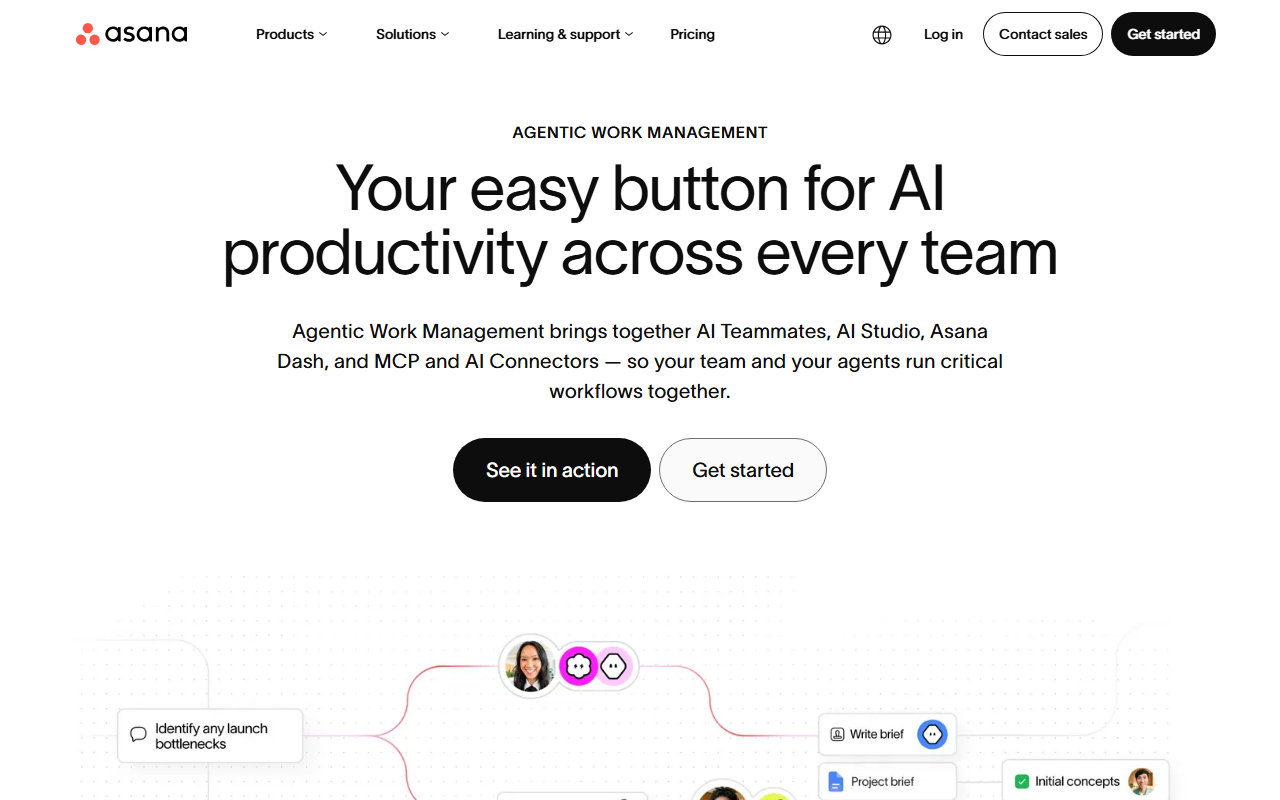 Asana's Agentic Work Management page, captured 26 Aug 2026. The pitch folds four previously separate AI features into one suite.
What actually changed
Asana's AI Teammates started small: a June 2024 launch, a wider beta that September, and a fuller relaunch on September 25, 2025 pitched around 2,000 US and UK knowledge workers Asana had surveyed. General availability landed in the first quarter of 2026. The June 4 event was the point where the pieces became one product: 30 prebuilt teammates for marketing, ops and IT, described on Asana's own product page as "preapproved, preauthorized, ready to work," plus more than ten new integrations covering tools like Gmail, Slack and HubSpot.
The part the pricing round-ups skip is how the AI is metered. AI Studio credits are not per seat. They are pooled per billing account: 50,000 credits a month on Starter, 75,000 on Advanced, 200,000 on Enterprise, shared across however many people are logged in. A 40-person Advanced team is not getting 75,000 credits each. It is splitting one pool of 75,000 across the whole company, which turns "how much AI can we use" into a capacity-planning question rather than a per-user toggle.
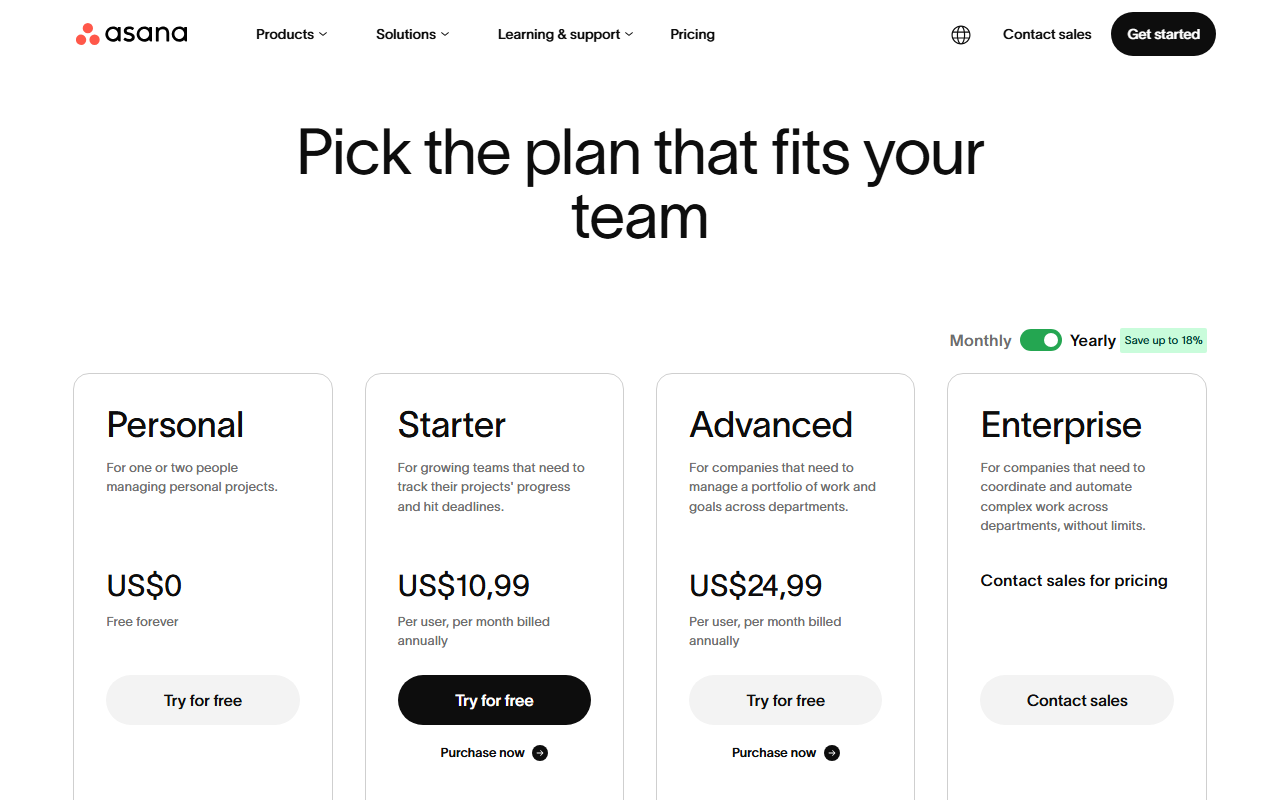 Asana's pricing page, captured 26 Aug 2026. Most teams weighing the credit pool land on Starter or Advanced, at $10.99 or $24.99 a seat a month billed annually.
That is a different structure than monday.com or ClickUp have shipped so far, and both are still racing to answer it with agent features of their own rather than a company-wide credit pool.
Who it helps
The clearest winner is the team that was already going to use AI at work whether Asana built anything or not. Before Agentic Work Management, that usage was invisible: an employee pasting a client brief into ChatGPT, a manager running a spreadsheet through an outside tool nobody on the security team had approved. Folding the agent into the platform that already holds the task, the assignee and the deadline means the output lands inside the same audit trail as a human teammate's, not in a separate tab.
That argument only pays off for teams already spending enough on Asana for the credit pool to matter. Whether that math works for your team is closer to a Smart Match question than a pricing-page one: run your actual seat count and workflow through it before renewing.
Who it hurts
Two groups take the hit. The first is the point-solution vendors selling exactly the jobs Dash now claims to fold in for the price of a credit allotment: Motion and Clockwise both built entire products around scheduling and prioritization, the same job Dash pitches as one of its default skills.
The second group is existing Asana customers who did not ask for any of this. "I find the AI bots that Asana creates to be more trouble than they are worth," a user named Andrew_Hoy_Mades wrote on Asana's own community forum on July 30, 2026, describing new navigation built around a feature he did not want.
Three weeks later, another user, Tim_Davis4, raised a narrower complaint: turning the agent features off also disabled AI functionality the team was already relying on, with no middle setting. Neither complaint is about the technology failing. Both are about a platform changing shape under a customer's feet.
monday.com, ClickUp and Writer, each selling its own version of an "agentic work platform," now have to match a bundled suite instead of a single feature, which raises the production cost of staying competitive for all three.
The catch Asana admitted to first
The strongest case against Asana's own bet is Asana's own data. In the September 2025 survey it cited when relaunching AI Teammates, 62% of the 2,000 knowledge workers polled called AI agents unreliable, and respondents said they wanted to hand only 27% of their work to AI today, rising to 43% within three years. Asana's chief information officer, Saket Shrivastava, said at the time: "Agentic AI is not ready for autonomous at this point. It's human and AI." Eight months later, the company shipped 30 pre-approved agents anyway.
That is not a contradiction so much as a different bet than it looks like. Asana is not asking a customer to trust an agent's judgment unsupervised. It is capping the blast radius with a shared credit ceiling and making every teammate's steps visible in the same task history a human's work would leave.
A bad output costs credits and shows up in an audit log. It does not cost nothing and disappear into a Slack thread. Whether that is enough to move HokAI's own working rule, that an all-in-one platform only beats buying point solutions for teams under roughly ten people, is the open question Asana has bet a launch event on.
What to watch
Asana reports second-quarter fiscal 2027 results on September 3, 2026. Watch whether the company discloses AI Teammates or AI Studio as a distinct driver of seat growth or expansion revenue, the way a vendor does when a paid add-on is actually converting. If the call passes without that breakout, the credit-pool model has not yet cleared procurement as something customers pay extra for, and "agentic work management" is still a retention feature bundled in to stop a renewal conversation, not a new line of revenue.
Until that call, treat the 30 teammates the way you would treat any other feature a vendor adds to keep you from leaving. Worth testing against the job it claims to do. Not yet a reason to switch platforms if you were not already one.
Frequently asked questions
What is Asana's Agentic Work Management?
It is the product suite Asana announced on June 4, 2026, combining AI Teammates, AI Studio and Dash into one bundle available on Starter, Advanced and Enterprise plans. It ships with 30 prebuilt AI agents for marketing, ops and IT that Asana describes as preapproved and ready to use without separate configuration.
How is Asana's AI usage priced?
AI Studio credits are pooled per billing account rather than assigned per seat: 50,000 credits a month on Starter, 75,000 on Advanced and 200,000 on Enterprise. A team splits that pool across every user, so usage becomes a shared capacity question rather than an individual allowance.
Does Asana's AI replace tools like Motion or Clockwise?
It targets the same jobs those tools are built around, scheduling and prioritization, by folding an agent into the project tracker itself. Whether it replaces a dedicated point solution depends on whether your team's credit pool covers the volume those specialist tools were handling separately.
Have Asana customers pushed back on AI Teammates?
Yes. On Asana's own community forum, users have complained about unwanted interface changes built around the feature and about permission settings that disable AI functionality they already relied on when trying to turn off the new agents. The complaints are about control and disruption, not agent output quality.
Is Asana's AI Teammates approach considered reliable?
Asana's own September 2025 survey of 2,000 US and UK knowledge workers found 62% considered AI agents unreliable, and its chief information officer said at the time that agentic AI was not ready to run autonomously. The June 2026 launch answers that by capping usage through credits and logging every agent step, rather than by claiming the reliability problem is solved.
Covered in this guide
- AI Teammates: The platform for human + AI collaboration that gets work done
- ClickUp: The world's first Converged AI Workspace with unlimited AI Agents for every team
- Clockwise: AI-powered calendar assistant that creates focus time and optimizes team schedules
- monday.com: The AI work platform that outpaces everyone with exponential execution
- Motion: Motion is an AI-powered scheduling and productivity platform used by 1M+ professionals that automates calendar management, task prioritization, and project planning with AI Employees.
- Writer: Enterprise AI platform for building, activating, and supervising AI agents at scale
Sources
Still deciding?
This guide covers a handful of options. Smart Match checks every listing in the directory against how you actually work and what you can spend, then hands you the shortlist and the reason behind each pick.
Start Smart MatchRelated guides
- Best AI Agents for Business Ops in 2026: Buy the Job, Not the PlatformBuyer's guideHow to pick, across a category
- ChatGPT Use Cases in 2026: What It's Actually For NowAnalysisWhat changed and who it affects
- monday.com vs Notion: Which Should You Use in 2026?ComparisonHead-to-head, with a verdict
- Is Notion AI Worth It? The $10 Add-On Is GoneAnalysisWhat changed and who it affects