Is Notion AI Worth It? The $10 Add-On Is Gone
Notion discontinued its standalone AI add-on on 13 May 2025, bundling full AI, including Notion Agent and AI Meeting Notes, exclusively into the $20-per-seat Business and Enterprise plans. Since May 2026 that bundle also includes a Developer Platform: Workers for custom code, External Agent support for tools like Cursor and Claude Code, and pay-as-you-go Custom Agent credits.
The short version
Notion killed its $8-10 AI add-on in May 2025 and now sells full AI only inside its $20-a-seat Business plan. What that buys in 2026 isn't a writing assistant: it's an agent platform with external-agent support, custom code sandboxes and metered Custom Agent credits. Plus subscribers get a limited trial and nothing more.
Want this decided for your own case? Find your tools with Smart Match, starting from this guide's question.
Notion's pricing page listed exactly one plan with full AI on 4 September 2026: Business, at $20 a seat, bundling the writing assistant, an autonomous agent and a sandbox for custom code into one line item.
That single line is the whole point. A year earlier, Notion sold AI as an $8 to $10 add-on any Plus subscriber could bolt onto an existing plan; that option disappeared on 13 May 2025, when the company folded full AI into its priciest tier instead. For a team still paying $10 a seat, the 2026 question isn't whether to spend an extra $10 a month. It's whether the whole workspace is worth doubling in price for what got built next.
What actually changed
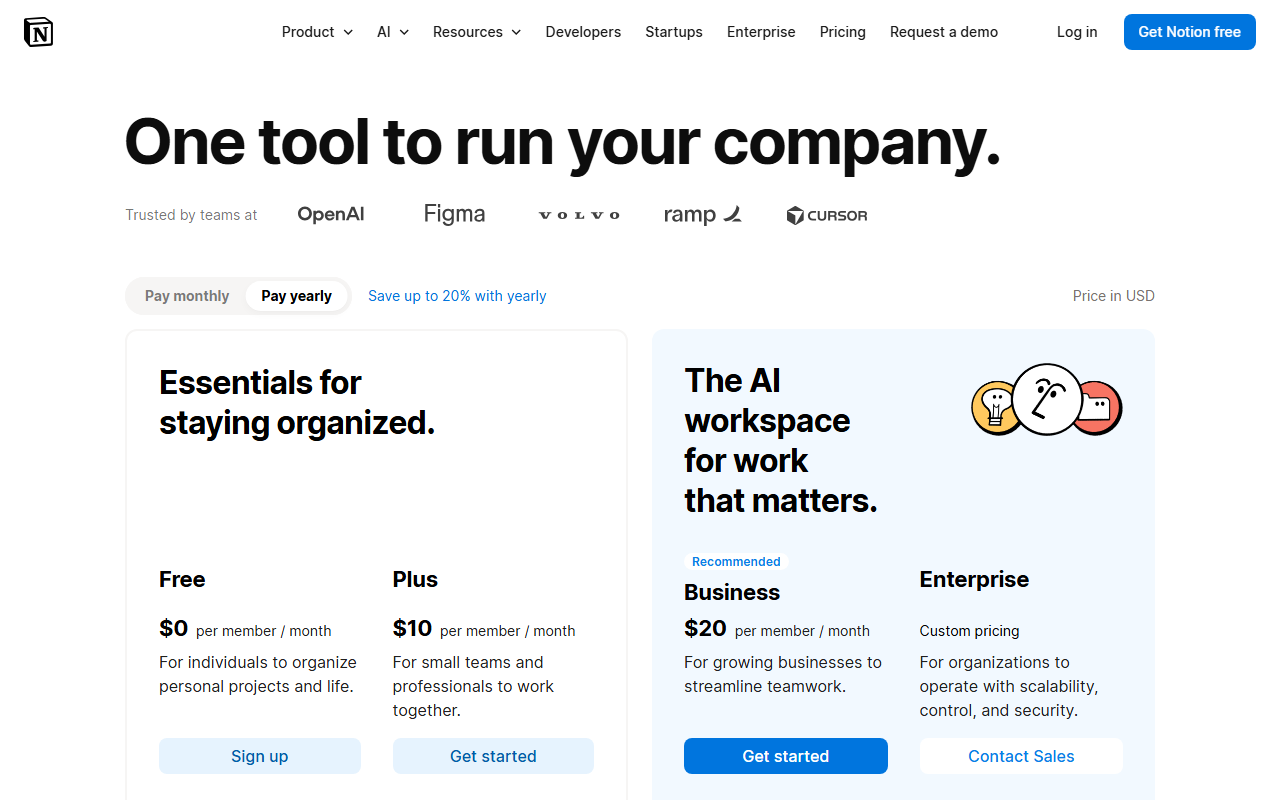 Notion's live pricing page, captured 4 September 2026. Business is the only tier badged Recommended, and the only one framed around AI.
Before that cutoff, Notion AI was a subscription add-on: roughly $8 to $10 per member per month, stackable on either of the cheaper tiers, unlocking writing help, Q&A and translation inside any workspace. The company discontinued that add-on and rebuilt its AI stack around Business instead. Free and Plus workspaces kept a limited trial; everything else moved behind the $20-a-seat wall.
The bigger shift came later. In September 2025, an update called Notion 3.0 introduced agents that could work unsupervised across hundreds of pages for up to 20 minutes at a stretch, helping push annual revenue past $500 million, according to CNBC. Then, eight months on, a public Developer Platform arrived.
Workers, its sandboxed environment for running custom code, launched free through August. External Agents let a workspace assign tasks to outside tools instead of relying only on the built-in assistant: the launch lineup named four, including Cursor and the customer-support specialist Decagon. A companion feature, Database Sync, pulls live records from systems like Zendesk straight into a database.
None of it stayed free for long. Building a custom agent now costs credits on any paid plan, priced at $10 per 1,000, a second usage-based bill sitting on top of the seat price.
Who it helps
The platform is built for a specific kind of team: one already paying for Business that wants a single control panel for every agent doing work on its behalf, instead of logging into five separate tools. Chief executive Ivan Zhao described the goal to TechCrunch in May 2026 as "any data, any tool, any agent," framing the workspace as a coordination layer rather than the source of the intelligence itself.
That framing has traction. Since custom agents launched in February, customers have built more than 1 million of them, Zhao said, a figure that only makes sense if the audience is people already inside the app daily. Support teams triaging tickets lean on a bot like Decagon. The same category is filling up fast. Sierra is one new entrant chasing the same enterprise budgets. So is Parahelp. Pylon is a third.
Engineers get a different use case entirely. A team that wants one place to supervise a Cursor session, instead of a separate terminal window, is exactly who this was built for. For that reader, $20 a seat buys infrastructure a smaller vendor would charge separately for.
Who it hurts
Everyone below Business gets the limited trial and nothing more. That's most of the historical user base: the company built its early growth on cheap, well-loved tiers for individuals and small teams, and none of them get the writing assistant, the agent, or automated meeting notes past a taste of it.
A ten-person team that wants AI without doubling its bill has two real options: pay for ten seats at $20 each, or look elsewhere. ClickUp, which still sells its AI features as an add-on rather than forcing a tier jump, is the obvious landing spot for anyone priced out specifically to keep AI. Nobody has published how many subscribers have made that switch.
The turn
The easy objection is that every SaaS company now gates AI behind its most expensive tier, so none of this is unique to one vendor. That's true as far as it goes. But the pricing change didn't just raise the cost of AI. It also reopened a cheaper door for a narrower use case.
Custom agent credits are pay-as-you-go and available on any paid plan, no tier upgrade required, so a smaller team can still try one automation without moving a single seat. What actually closed is the always-on writing assistant for casual use. What stayed open, at a metered price, is occasional automation.
Which one you need depends less on a pricing page than on your own workflow, and that's a fit question a matching tool answers faster than a spreadsheet of plans. For a broader comparison across AI workspace and agent tools, HokAI's Smart Match is built for exactly that.
What to watch
The company is privately held and doesn't break out seat counts by plan. The clean test is whether the premium tier grows faster than the cheaper ones over its next two public updates on revenue or users. If it does, the agent-hub bet is converting whole workspaces, not just adding a feature nobody upgrades for. If that adoption stalls while the cheaper tiers keep growing instead, expect a lower-cost AI option to reappear within the next twelve months rather than lose the smaller accounts entirely.
For now, the workspace app that made its name letting anyone build a wiki without an IT department has turned its most expensive tier into the thing IT departments actually buy: a metered platform, with credits, sandboxes and someone else's agents running inside it.
Frequently asked questions
Is Notion AI still worth the extra cost in 2026?
There's no longer a small extra cost to weigh. Since May 2025, getting full Notion AI means moving your whole team to the Business plan at $20 a seat, not adding $10 to your existing plan. Whether that's worth it now depends on whether you'll use the agent and developer features, not just AI writing help.
How much does Notion AI cost per user?
Notion AI is included at no extra per-seat charge on the Business plan ($20/member/month annually) and Enterprise (custom pricing), according to Notion's pricing page. Free and Plus ($10/member/month) get only a limited trial. Building Custom Agents costs Notion Credits separately, at $10 per 1,000 credits.
What happened to the Notion AI add-on?
Notion discontinued the standalone $8 to $10 per month AI add-on on 13 May 2025 and folded its capabilities into the Business plan instead. Subscribers who already had the add-on kept access, but it stopped being available to new customers.
What is Notion's Developer Platform?
Launched in May 2026, it lets a Notion workspace run custom code in a sandbox called Workers, sync live data in from tools like Salesforce and Zendesk, and connect to external AI agents such as Cursor, Claude Code and Decagon. Notion positions it as coordination infrastructure for agents rather than a single AI feature.
Are there cheaper alternatives to Notion AI?
Yes. Tools like ClickUp still sell AI as an add-on rather than requiring a jump to their top-priced plan, which suits a small team that wants AI without doubling its per-seat cost. The tradeoff is that Notion's Business tier bundles agent and developer features that a cheaper add-on typically doesn't include.
Covered in this guide
- Notion: Your AI everything app: All your tools and work in one unified workspace.
- ClickUp: The world's first Converged AI Workspace with unlimited AI Agents for every team
- Decagon: Decagon is a $4.5B-valued AI concierge that automates chat, voice, email and SMS support for enterprises, with contracts typically starting near $95K/year.
- Parahelp: AI support agent from an 11-person YC-backed team that resolves complex tickets end-to-end via email, chat, and Slack for Perplexity, Framer, and Replit.
- Pylon: Pylon is a B2B customer support platform where AI agents pre-investigate every ticket across Slack, email, and chat; trusted by 1,500+ companies.
- Sierra: Enterprise AI agent platform from Bret Taylor valued at $15.8B in 2026, used by 40% of the Fortune 50 for customer service across chat, voice, and email.
- Zendesk: Omnichannel customer support platform with AI agents, ticket management, and 1000+ integrations for 100,000+ businesses.
Sources
Still deciding?
This guide covers a handful of options. Smart Match checks every listing in the directory against how you actually work and what you can spend, then hands you the shortlist and the reason behind each pick.
Find your toolsRelated guides
- Best AI Agents for Business Ops in 2026: Buy the Job, Not the PlatformBuyer's guideHow to pick, across a category
- Best AI Customer Support Software in 2026: What Per-Resolution Pricing Actually CostsBuyer's guideHow to pick, across a category
- Best AI for Writing a Business Plan in 2026: Tested Picks and a VerdictBuyer's guideHow to pick, across a category
- Best AI Note-Taking Tools in 2026: Brain2, Glasp, Mem, and Gemini Notebook ComparedBuyer's guideHow to pick, across a category
- Is Budy Worth It If You Already Pay for Notion?ComparisonHead-to-head, with a verdict
- Fireworks AI vs Together AI (2026): Managed Platform or Neocloud?ComparisonHead-to-head, with a verdict