Is Budy Worth It If You Already Pay for Notion?
Budy Board, from $0 a month, digitizes SMB customer and vendor onboarding with branded pages and approval workflows. Budy Collect, from $30 a month, automates invoice reminders, dispute tracking and per-agent collection dashboards. Notion, from $0 a seat, is a general workspace that can replicate simple onboarding for free but ships no native collections automation.
The short version
Budy is two apps, not one: Board handles onboarding and Collect chases invoices, priced separately. Notion covers simple onboarding well if you already pay for it, but has no native payment-reminder automation, dispute tracking or per-agent collection dashboards, which is where Budy Collect's $30 to $90 a month earns its keep.
Budy carries no G2 rating, no Capterra listing and no Trustpilot score as of September 2026, and its top collections tier still costs more than two Notion Business seats. That gap is the whole story here.
Nobody has actually published a Budy versus Notion comparison. The reason turns out to matter: Budy is not one product weighed against Notion. It is two separately billed apps, and Notion is a real substitute for only one of them.
Budy Board handles customer and vendor onboarding. Budy Collect chases overdue invoices. Both come from Avaniko, a Chennai-based SAP Business One implementer with more than 15 years in enterprise software, and each app is priced on its own schedule.
This piece is for an operations or finance manager at a 10 to 50 person company who already pays for Notion and is deciding whether either Budy app is worth adding on top.
The verdict
Skip Budy Board if your onboarding is a short checklist and your team already knows Notion. Build it there instead. It costs nothing extra.
Pay for Budy Collect regardless of what else you run. Collections is the one job Notion was never built to do, and every real alternative to Budy Collect costs far more or is not sized for a company this size at all.
Budy Board vs a Notion onboarding database
Budy Board replaces the email thread and the spreadsheet: a one-click branded onboarding page, NDA and agreement attachments at signup, and, on paid tiers, GST validation with connector hooks into an existing ERP. The free tier ships 200MB of storage and five branded templates, according to Budy's own product page. Essential runs $19.77 a month; Standard is $49.77 a month, adding more storage, custom branding and approval workflows.
Onboarding requests also route through configurable approval steps before a customer or vendor record is finalized, a small detail that matters once more than one person signs off on a new account. Replicating an approval chain in a Notion database means adding a status property and trusting everyone to update it, rather than a workflow the tool enforces.
A Notion database can copy the same shape of workflow for free: a status property, a form-based intake view, one template filled in once. Teams have been doing exactly this for years, which is why a small industry of "client onboarding" templates already exists for the platform.
What a plain database will not do on its own is generate the branded onboarding page Budy Board produces in one click, or validate a GST number. For a team whose onboarding is a handful of fields and a signature, that gap rarely justifies a second subscription.
What Budy Collect does that Notion cannot
Collections is where the comparison flips. Budy Collect schedules payment reminders, logs every collection attempt with a timestamp, tracks each agent's target against their actual recovery rate, rates customers and agents, and carries disputes through to resolution.
None of that exists in Notion by default. You can build a database of overdue invoices in an afternoon. Automated reminders, dispute workflows and per-agent scoring are logic a general workspace has to be wired up to run. That is not a template problem, and wiring it costs real time someone still has to spend, even if Notion itself does not charge for the hours.
Budy Collect's cheapest tier is labeled "Free" on Budy's own pricing page, which is misleading. It costs $30 a month for up to 10 users and 5,000 invoices. Essential runs $60 a month for up to 30 users with unlimited invoices. Professional is $90 a month for up to 50 users with the agent-rating dashboards, per Budy's own product page for Collect.
There is no genuinely free tier on this half of the product, unlike Board.
What all five tiers actually cost
Every price below was checked against each vendor's own page in September 2026.
Product · Tier · Price · What you get
Budy Board · Free · $0 · 200MB storage, 5 templates
Budy Board · Essential · $19.77/mo · Custom branding, GST validation
Budy Board · Standard · $49.77/mo · Vendor bills, mobile app
Budy Collect · Entry · $30/mo · Up to 10 users, 5,000 invoices
Budy Collect · Essential · $60/mo · Up to 30 users, unlimited invoices
Budy Collect · Professional · $90/mo · Up to 50 users, agent ratings
Notion · Free · $0/seat · Unlimited blocks, single user
Notion · Plus · $10/seat/mo · Small-team collaboration
Notion · Business · $20/seat/mo · AI agents, enterprise search
Run Budy Board and Budy Collect at their mid tiers and the bill comes to $109.77 a month total. Five Notion Business seats cost $100 a month at the annual billing rate. That is before anyone has built a single collections workflow inside it.
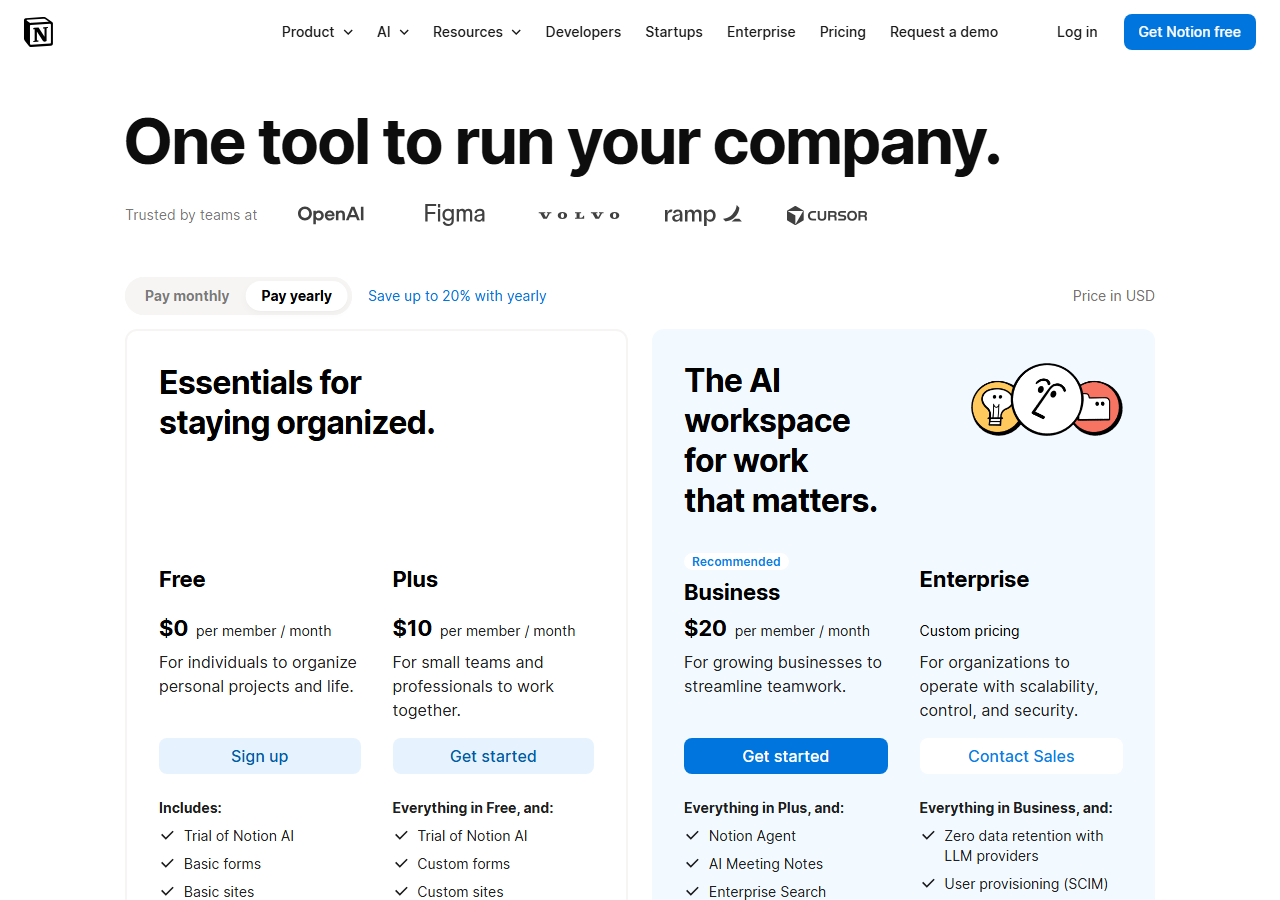
The vendor's own pricing page, captured 15 September 2026.
Where Notion wins
Pick Notion outright, and skip Budy Board entirely, if onboarding at your company is simple and you are already paying for Notion Business seats. You get unlimited blocks and a workspace your team already knows how to use.
You also get, according to Notion's own pricing page, SOC 2, ISO 27001 and HIPAA compliance support built into the plan you are already on. Budy publishes none of those certifications for either app. If a customer's procurement team ever asks for a security questionnaire, Notion has a documented answer today and Budy does not.
The same Business tier that carries those certifications also ships Notion Agents, AI meeting notes and an enterprise search feature the vendor says returns results across connected tools like Slack and Google Drive, not only Notion pages. None of that is onboarding-specific, but it means the $20-a-month seat already doing your team's documents and wikis is also the one that can be pointed at a new customer's folder without opening a second app.
Where Budy wins
Pick Budy Collect once invoices start going unpaid past terms, no matter what else you run. The alternative inside a comparable price range barely exists.
GuideCX, the onboarding specialist Budy's own FAQ names as a direct competitor, starts at $143 a month per seat with a four-seat minimum. That is $572 a month before a single invoice gets chased, according to a 2026 pricing breakdown from GetCor.
Vic.ai, the enterprise accounts-payable platform, requires a discovery call and a custom quote. It typically lands at a six-figure annual commitment aimed at teams running NetSuite or SAP, not a 30-person business collecting its first overdue invoice.
Against either of those, Budy Collect's $30 to $90 a month is the only offer actually sized for a company that has outgrown a spreadsheet but has not built a finance department yet.
If the only job is turning a scanned invoice into structured data, rather than running the collections process around it, Mindee's document-extraction API handles that narrower piece alone. It skips the reminders and dashboards Budy Collect builds on top.
The turn
The obvious objection: at 10 to 50 employees, is either of these the right call? Or is the honest advice to wait until the company is big enough to justify GuideCX's per-seat pricing and skip Budy Board altogether?
That holds up for onboarding. A Notion template genuinely lasts longer than most teams expect before it breaks.
It holds up less well for collections. Unpaid invoices cost money every month they sit open, and Budy Collect's $30 entry tier is cheap enough that waiting rarely pays off. Anyone testing whether a purpose-built workflow beats a spreadsheet is exactly the kind of decision Smart Match is built to shortcut, surfacing tools in a specific price band that a keyword search alone tends to miss.
Switching cost
Moving onboarding out of Notion into Budy Board costs almost nothing beyond the subscription. Rebuild the intake form once, and the branded page generates itself after that.
Moving collections the other direction, out of Budy Collect and into a spreadsheet or a Notion database, costs more than it looks. Every logged collection attempt, every dispute note and every agent's rating history has to be exported and rebuilt by hand, because none of that structure exists as a native Notion object.
That asymmetry is itself a reason to start with Budy Collect rather than try Notion first and migrate later if it does not work out. A team that builds six months of collection notes in a Notion database before hitting the same wall everyone else does will redo that work twice: once inside Notion, and again inside whatever actually replaces it.
What would change this
Two things would flip this verdict. If Notion ships native automated payment reminders with per-agent tracking, Budy Collect's reason to exist narrows considerably.
If Budy publishes a SOC 2 or ISO 27001 attestation and independent reviews start landing on G2 or Capterra, the compliance gap that currently favors Notion closes. Budy Board becomes a much harder case to dismiss at that point.
Neither has happened yet. Budy is a two-year-old product from a services company, not a funded AI startup, and its own listing discloses no funding round and no public API documentation. Whether it grows past being a two-app niche tool depends less on new features than on whether it ever publishes the trust page a 50-person customer's own procurement team will eventually ask for.
Frequently asked questions
Is Budy free?
Budy Board has a free-forever tier with 200MB of storage and five branded templates, no card required. Budy Collect has no free tier: its cheapest plan is $30 a month for up to 10 users and 5,000 invoices.
Can I just build Budy's features in Notion instead?
Onboarding, largely yes: a Notion database with a status property and an intake form covers most simple onboarding needs for free. Collections is harder, because Notion has no native payment-reminder automation, dispute tracking or per-agent performance dashboards, the features Budy Collect is built around.
What does Notion Business cost compared to Budy?
Notion Business is $20 per seat a month at the annual rate, so five seats cost $100 a month. That is close to running both Budy apps at their mid tiers, which together cost $109.77 a month, according to each vendor's own pricing page.
Is Budy a legitimate company?
Budy is made by Avaniko, a Chennai-based SAP Business One implementer with more than 15 years in enterprise software, and Budy Board launched in 2024. It carries no G2, Capterra or Trustpilot rating and publishes no SOC 2 or ISO 27001 certification as of September 2026.
What's the alternative to Budy Collect if a team outgrows it?
GuideCX and Vic.ai sit at the other end of the market. GuideCX starts at $143 a seat with a four-seat minimum, and Vic.ai's enterprise pricing typically runs into six figures a year, both aimed at teams larger than the 10 to 50 person companies Budy targets.
Covered in this guide
- Budy: Budy is a 2-app suite (Board + Collect) that automates SMB customer onboarding and invoice collection, with a free-forever tier and paid plans for growing teams.
- Notion: Your AI everything app: All your tools and work in one unified workspace.
- GuideCX: GuideCX is an AI-powered customer onboarding platform used by 500,000+ projects that automates implementation workflows, resource allocation, and risk detection for CS teams.
- Mindee: Mindee is a document-data extraction API that turns invoices, receipts, IDs and 15+ document types into structured JSON, founded 2018.
- Vic.ai: AI-powered accounts payable automation for 10,000+ customers. Processes 500M+ invoices with 99% accuracy.
Sources
Still deciding?
This guide covers a handful of options. Smart Match checks every listing in the directory against how you actually work and what you can spend, then hands you the shortlist and the reason behind each pick.
Start Smart MatchRelated guides
- Best AI Agents for Business Ops in 2026: Buy the Job, Not the PlatformBuyer's guideHow to pick, across a category
- Best AI Note-Taking Tools in 2026: Brain2, Glasp, Mem, and Gemini Notebook ComparedBuyer's guideHow to pick, across a category
- HokAI vs Insidr.ai: The Sponsorship Price Insidr Never PublishesInside HokAIHow the directory works, verified in the open
- How to Automate Repetitive Work With AI (Without Writing Code)Buyer's guideHow to pick, across a category
- How to Build an AI-Powered App Without Being a DeveloperBuyer's guideHow to pick, across a category
- How to Build an AI Content Workflow: From Brief to Published PostBuyer's guideHow to pick, across a category