Stripe Didn't Just Buy OpenRouter. It Already Owned the Money Underneath It.
Stripe is reportedly acquiring the AI model gateway OpenRouter for more than $7 billion, per an August 2026 Bloomberg report. Stripe had already supplied OpenRouter's billing, tax and fraud-detection infrastructure since a January 2026 partnership, making the deal a conversion of an existing vendor relationship into ownership rather than a first-time entry into AI infrastructure.
The short version
Stripe is reportedly paying over $7 billion for OpenRouter, but Stripe had already become OpenRouter's payments, tax and fraud infrastructure seven months earlier, in January 2026. The acquisition price matters less than that existing dependency. Teams routing model calls through OpenRouter should treat a second gateway as a fallback to test now, not a decision to make later.
Stripe agreed to pay more than $7 billion for OpenRouter this month, according to an August 16 Bloomberg report, months after it quietly became the plumbing behind every dollar the AI gateway collects.
That plumbing is not a rumor. A January announcement already put OpenRouter's billing, tax collection and fraud screening on Stripe's own tools, seven months before word of an outright purchase broke. For a team routing model calls through OpenRouter today, the acquisition price is the least useful number in this story. The one that matters is how long the buyer has already been sitting inside the account.
What Actually Changed on Paper
Bloomberg reported the deal at more than $7 billion, a figure TechCrunch and several other outlets matched through their own sourcing on August 16 and 17. That price sits roughly 5.4 times above the $1.3 billion valuation OpenRouter set in May, when it raised $113 million in a Series B led by Sequoia and other investors.
A separate report had already placed the two sides in talks the previous month. Neither company has confirmed the deal on the record. A spokesperson told TechCrunch that Stripe "does not comment on rumors or speculation," the standard line right up until the press release exists.
OpenRouter started in early 2023 as, by its own description, the first LLM marketplace. Its own site counted more than 500 models from over 80 providers as of August 19, plus upward of 200 trillion tokens processed a month and more than 10 million users. Chief executive Alex Atallah has described the pitch to TechCrunch as building the equivalent of a payments processor for AI models: one account, no favorites, whichever provider is cheapest or fastest wins the request.
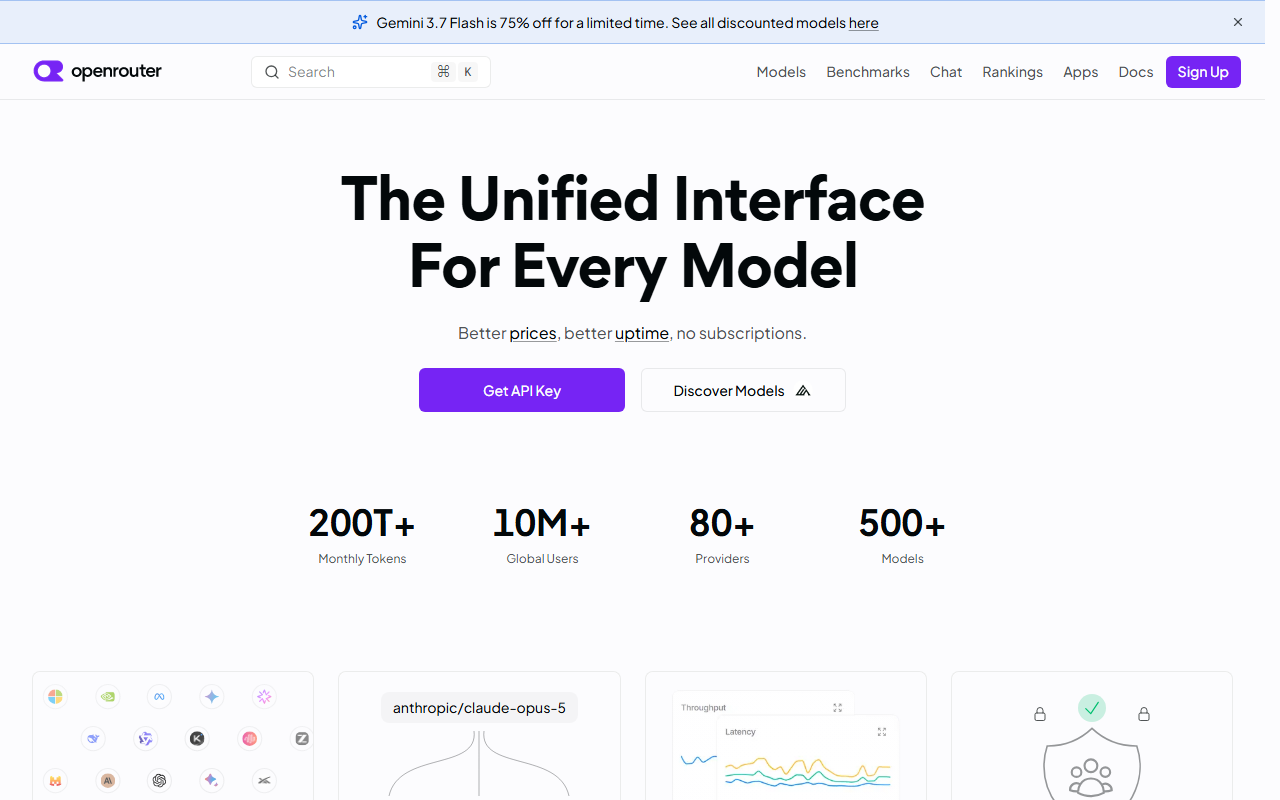 OpenRouter's homepage, captured 19 August 2026. These are the numbers Stripe is reportedly paying $7 billion to own.
The Partnership the Acquisition Didn't Start
Here is what none of the coverage of the $7 billion figure mentions. A newsroom post on January 29 announced that OpenRouter had adopted Stripe Invoicing and Stripe Tax to run its billing and tax operations worldwide, months before any acquisition talk surfaced publicly. "Stripe handles payment complexity elegantly so we can focus on making AI models accessible for developers everywhere," Atallah said at the time, five months before the acquisition reports.
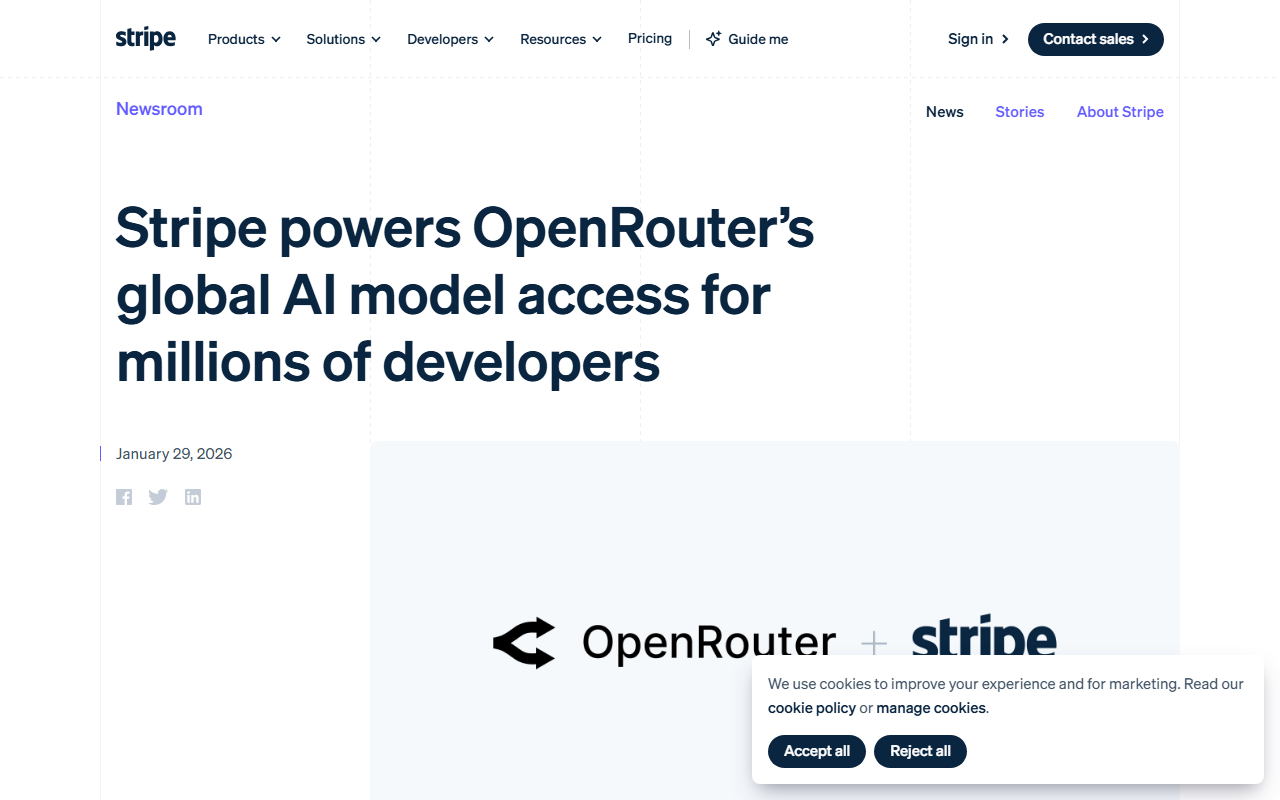 Stripe's own newsroom post, dated January 29, 2026 and still live as of this writing, seven months before the acquisition made headlines.
OpenRouter's own documentation goes further. It lists itself as a launch partner in Stripe Projects, a CLI-based marketplace where a developer can provision access with one command and let an encrypted vault store and rotate the API key. That is not two companies meeting for the first time inside an acquisition filing. That is a conversion: a vendor whose money already flowed through one pipe now belongs to the pipe.
Who Gets a New Pitch
Gateways that were never part of that arrangement now have a clean sentence to sell with. CometAPI routes to more than 500 models on a pure pay-as-you-go basis, no monthly subscription, no minimum spend, and prices itself 20 to 40 percent under official provider rates: Gemini 3.7 Flash runs $0.60 per million tokens there against the vendor's own $0.75.
AI/ML API covers more than 1,000 models for a $20 minimum prepaid balance and no subscription either. Neither has a payments company as a parent, at least not yet, and both can now say so out loud to any team nervous about the OpenRouter news.
The pitch is not that either alternative wins on every feature. It is narrower than that: a second, already-tested account that does not answer to the same balance sheet as the first one, ready before a migration is forced rather than during one.
Who It Hurts
Anyone selling infrastructure trust on the promise of staying independent just watched independence get bought for eight figures a point. Together AI closed an $800 million Series C at an $8.3 billion valuation on July 1, led by Aramco Ventures. It chases a different buyer, teams renting capacity for open models rather than routing between closed ones, but leans on the same pitch: trust us because nobody owns us.
Orthogonal, a smaller product that hands agents pay-per-call access to outside tools rather than models, sits one step removed from this specific deal. Even so, anything wearing the word gateway now has to answer the same question, deal or no deal.
The Case Against Overreacting
The strongest objection here is that revenue comes from payment volume, not from which model wins a request. A dollar processed for one provider's call and a dollar processed for a rival's call are worth the same to a payments company. By that logic, ownership changes nothing about routing incentives, because there was never a reason to care which name got picked.
That argument holds only if no product of the owner's own ever enters the race. Stripe Projects already runs as a curated catalog with a named seat for OpenRouter as launch partner. A curated catalog is a list somebody controls the order of. Neutral routing was supposed to mean nobody controls that order.
What to Watch
Watch OpenRouter's default provider ordering and its published pricing rules over the next two quarters, through roughly the end of Q1 2027. If routing defaults and provider-inclusion policy are unchanged a year after the January partnership post, the neutrality worry was noise. If a favored product gets preferential catalog placement, or fees quietly shift toward transactions the new owner processes, the worry was the whole story.
The figure worth remembering out of all of this was never $7 billion. It is one: the single account that now sits behind both the payment and the model choice, for anyone who has not opened a second one yet.
Frequently asked questions
Has Stripe officially confirmed it is buying OpenRouter?
No. Bloomberg reported the deal was finalized on August 16, 2026, and other outlets matched the reporting, but a Stripe spokesperson told TechCrunch the company does not comment on rumors or speculation. As of this writing there is no official joint announcement or confirmed closing date.
Did Stripe and OpenRouter have a relationship before this deal?
Yes. Stripe's newsroom announced on January 29, 2026 that OpenRouter had adopted Stripe Invoicing, Stripe Tax and Radar for Fraud Teams to handle its billing, tax and fraud operations. OpenRouter is also listed as a launch partner in Stripe Projects, Stripe's developer provisioning marketplace.
What is OpenRouter's reported valuation history?
OpenRouter raised a $113 million Series B in May 2026 at a $1.3 billion valuation, led by Sequoia, Andreessen Horowitz and Menlo Ventures. The reported $7 billion-plus acquisition price is roughly 5.4 times that valuation, set only about three months earlier.
What are the alternatives to OpenRouter if a team wants a gateway that isn't Stripe-owned?
CometAPI and AI/ML API are the closest direct alternatives on hokai's own directory. CometAPI routes to more than 500 models on pay-as-you-go pricing with no subscription, and AI/ML API covers more than 1,000 models for a $20 minimum prepaid balance. Neither currently has a payments company as its parent.
Does this deal change what OpenRouter costs today?
No pricing change has been announced. OpenRouter's routing defaults and fee structure are unchanged as of this writing, and any shift would need to be watched for in the months following the reported deal, not assumed from the acquisition price alone.
Covered in this guide
- OpenRouter: Single API endpoint for 300+ AI models from OpenAI, Anthropic, Google, and other providers, with one bill and no vendor lock-in.
- AI/ML API: Unified gateway to 1000+ AI models from one OpenAI-compatible endpoint. Access GPT-5, Claude Sonnet 5, Sora 2, and Flux. No free plan — pay-as-you-go from a $20 prepaid credit.
- CometAPI: CometAPI is a unified API gateway giving one key and one OpenAI-compatible endpoint to 500+ AI models at roughly 20% below official provider rates.
- Orthogonal: Unified API gateway for AI agents giving access to 30+ APIs via one key and MCP server, with $10 free credits and pay-per-call billing.
- Together AI: The AI Native Cloud: a full-stack platform for training, fine-tuning, and deploying open-source AI models
Sources
Still deciding?
This guide covers a handful of options. Smart Match checks every listing in the directory against how you actually work and what you can spend, then hands you the shortlist and the reason behind each pick.
Start Smart MatchRelated guides
- The AI Tool Ecosystem in 2026: Buy the Meter, Not the CategoryBuyer's guideHow to pick, across a category
- AIML API vs OpenRouter: Which AI Gateway Should You Use in 2026?ComparisonHead-to-head, with a verdict
- Best Generative AI Infrastructure in 2026: 7 Platforms, Three Separate DecisionsBuyer's guideHow to pick, across a category
- Cast.ai vs Together AI: One Rents You GPUs, the Other Makes Yours CheaperComparisonHead-to-head, with a verdict
- ChatGPT vs Kimi: Which Should You Use in 2026?ComparisonHead-to-head, with a verdict
- CometAPI vs Orthogonal: Same Gateway Label, Two Different JobsComparisonHead-to-head, with a verdict