Hugging Face vs OpenPipe: Which Should You Use in 2026?
OpenPipe's fine-tuning SaaS was absorbed into CoreWeave after a September 2025 acquisition; its open-source ART library now points to CoreWeave's W&B Training instead. Hugging Face separately retired its own no-code tool, AutoTrain, in favor of TRL. For self-serve fine-tuning today, Hugging Face's free TRL plus rented GPU compute is the active option.
The short version
OpenPipe's independent fine-tuning SaaS was folded into CoreWeave after a September 2025 acquisition, and Hugging Face separately retired its own no-code tool, AutoTrain. The real 2026 choice is Hugging Face's free, self-serve TRL library plus rented GPUs, versus CoreWeave's W&B Training, a managed but still-preview service with unpublished GA pricing.
Want this decided for your own case? Find your tools with Smart Match, starting from this guide's question.
CoreWeave announced a definitive agreement to acquire OpenPipe on 3 September 2025, and the product most 2024 and 2025 roundups still describe as an independent, pay-as-you-go fine-tuning service no longer exists in that form. Visit openpipe.ai today and there is no signup flow, no pricing page: just a notice that reads, "Following our acquisition by CoreWeave in 2025, we successfully migrated OpenPipe's core functionality, including model distillation, to the CoreWeave platform."
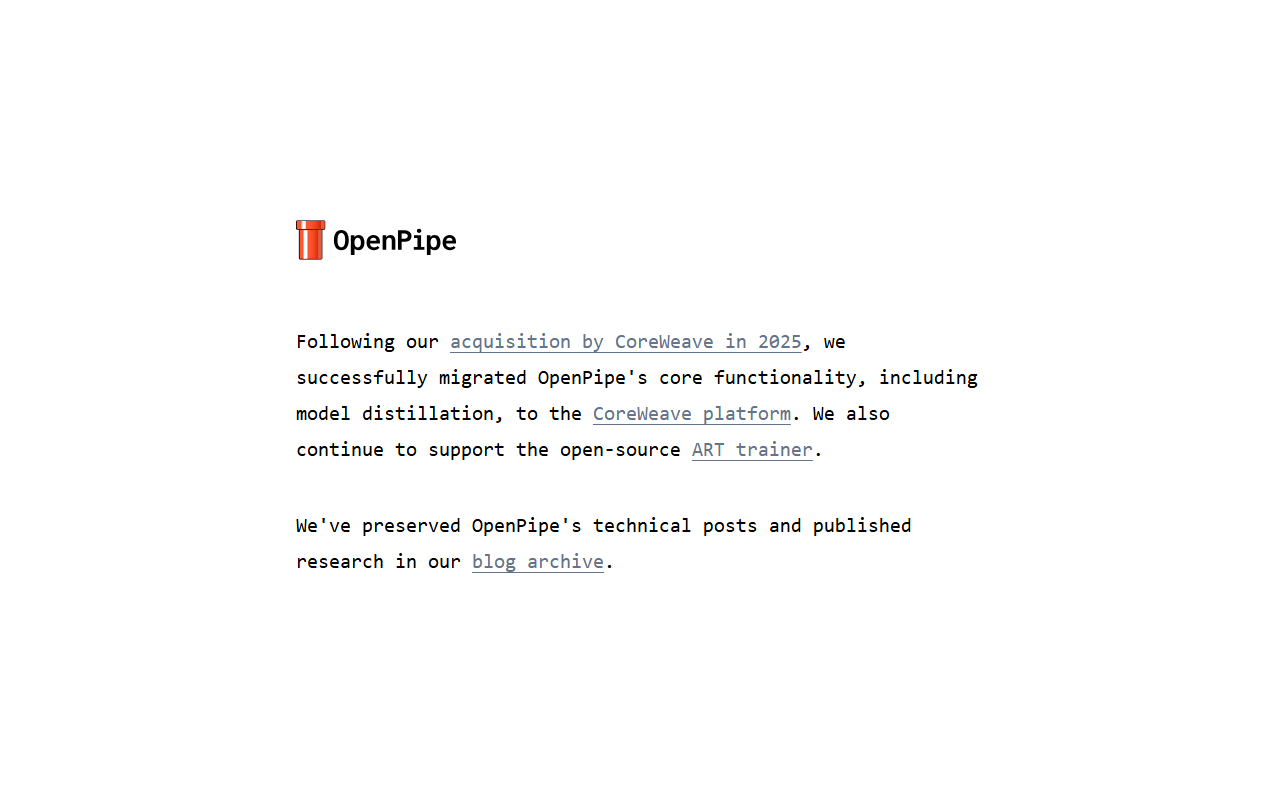 openpipe.ai as it renders today, captured 27 August 2026. This is the entire page.
That single sentence changes what this comparison actually is. A search for "Hugging Face vs OpenPipe" in 2026 is not a choice between two self-serve platforms. It is a choice between Hugging Face, which is still self-serve, and the enterprise-track service that inherited OpenPipe's technology, which is not. If your team can turn a stack of production prompt logs into a cheaper fine-tuned model without a sales call, it will be Hugging Face doing the work, not the brand that used to own this exact pitch.
What OpenPipe actually is in August 2026
OpenPipe's original product automatically captured a team's live prompts and completions, then used that data to train a smaller, cheaper model that matched the original's outputs; a workflow generally called model distillation. The acquisition announcement described OpenPipe as training agents "more reliable, with lower latency and greater cost efficiency than traditional prompted models," and pointed to ART, its own open-source reinforcement learning library, as "the most widely used open-source library for training agents with RL."
ART is still alive. Its GitHub repository carries an Apache 2.0 license, 10,700 stars and 982 forks as of this month, and supports most vLLM and Transformers-compatible causal language models, including Qwen 2.5 and 3, and Llama, though not Gemma 3.
What did not survive as a standalone product is the managed SaaS. ART's own README now points teams toward W&B Training, marketed as "Serverless RL," as the supported way to run its training loop without managing GPUs directly. W&B was itself acquired by CoreWeave in March 2025, so the workflow OpenPipe pioneered now lives inside the same buyer from two separate deals.
W&B Training's own site shows live per-token inference pricing for at least one model, Qwen3 30B A3B, at $0.10 per million input tokens and $0.30 per million output tokens. Training itself is described as free during the current public preview, with a note that GA pricing has not yet been set. That is a real, current data point, not a settled one: nobody, including CoreWeave, has published the number that will eventually decide whether this path is cheap or expensive.
Hugging Face killed its own version of the same idea
The fair comparison is not Hugging Face's whole platform against OpenPipe's old SaaS. It is Hugging Face's no-code fine-tuning tool, AutoTrain, against OpenPipe's no-code fine-tuning tool. Hugging Face's own documentation carries a warning banner on the AutoTrain page: "This project is no longer maintained. No new features will be added and bugs will not be fixed." The same page recommends three replacements: Axolotl, TRL, or the plain transformers.Trainer class.
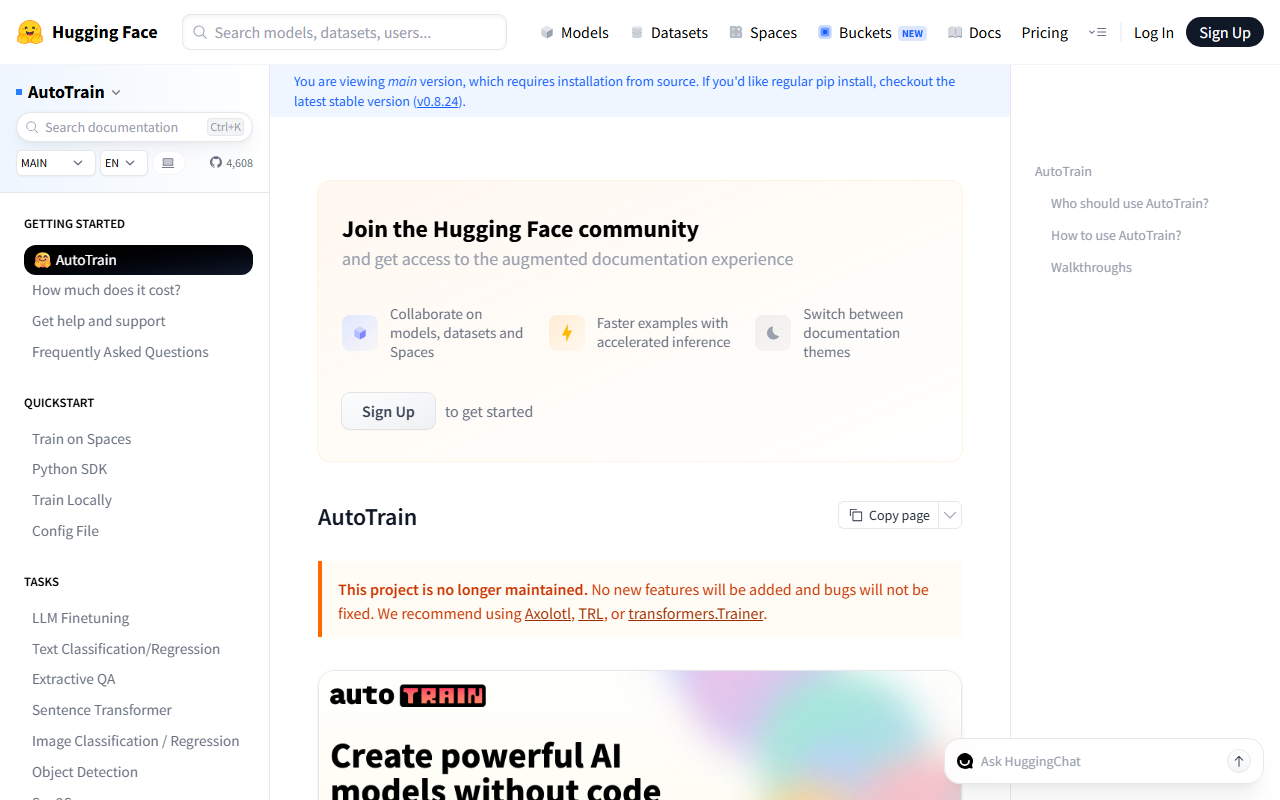 AutoTrain's own docs page, captured 27 August 2026. This is the retirement notice for the tool most directly comparable to what OpenPipe used to sell.
TRL is the one Hugging Face is actively developing; a March 2026 release notes post describes TRL v1 as a library meant to hold "when the field invalidates its own assumptions," and its trainer list now covers supervised fine-tuning, DPO, GRPO and a stable DistillationTrainer for exactly the prompt-to-smaller-model workflow OpenPipe used to sell. TRL is free and open source, the same as ART. The difference is what you run it on.
A third free option, fast.ai's course and library, suits a team still building fine-tuning literacy from scratch better than one already routing production traffic.
The verdict
Pick Hugging Face if you want to start fine-tuning this week with a credit card, not a sales conversation: TRL is free, and Hugging Face's own Inference Endpoints or Spaces GPUs will run it, priced from $0.033 an hour on the low end up to $74 an hour for an Nvidia B200 instance, according to Hugging Face's pricing page.
Pick the managed path only if reinforcement-learning-trained agents specifically, not plain supervised fine-tuning, are the actual goal, and your team is large enough that a managed, still-in-preview service with unpublished GA pricing is an acceptable bet. For a small team that just wants a cheaper model quickly, that trade does not clear.
What each path costs
Its own numbers, from Hugging Face's pricing page: a PRO account is $9 a month per person, with 10 times the private storage and priority ZeroGPU access. A Team plan is $20 per user per month, adding SSO and audit logs; Enterprise starts at $50 per user per month with SCIM provisioning and annual billing. None of that is required to use TRL itself, only to get faster shared compute.
The GPU hours have to come from somewhere. Renting them through Modal runs $0.001097 per second for an H100, close to $3.95 an hour, with $30 a month in free credits on its Starter tier, both figures confirmed on its own pricing page this week. That is the honest all-in cost of the Hugging Face path: a $9 to $50 monthly seat, plus GPU time bought elsewhere, because Hugging Face's own library assumes you bring the hardware.
The CoreWeave path has one number and one blank. The number is W&B Training's $0.10/$0.30 per-million-token inference rate quoted above. The blank is training pricing at general availability, which W&B's own site says will be announced later, not now.
Where Hugging Face wins
A four-person team fine-tuning a Llama or Qwen checkpoint on a few thousand labeled examples, with an engineer comfortable running a Python training script, is the clearest case for Hugging Face. TRL ships trainers for the exact distillation and DPO workflows OpenPipe used to market, at zero licensing cost, on infrastructure you can price today rather than infrastructure whose real cost is still unannounced.
It also wins on portability. A model trained with TRL lands as an ordinary Hugging Face Hub repository, deployable on Hugging Face's own Inference Endpoints or handed off to a third-party host like Fireworks AI, without touching CoreWeave's stack at all. That portability holds regardless of the base model: TRL trains through the standard Transformers integration, so a checkpoint built on Mistral AI's open-weight releases moves through the same pipeline as one built on Qwen or Llama.
Where the managed path wins
If what a team actually wants is multi-step agents that improve from real interaction, not a single supervised fine-tune, that is OpenPipe's ART and W&B Training's specific territory, and it is the one workflow Hugging Face does not offer a first-party equivalent for. A team already running production workloads on CoreWeave's GPU cloud, with an existing sales relationship, also has less reason to stitch together a second vendor for training.
The counterargument
The obvious rebuttal is that this whole comparison stops mattering once a team is training models routinely at real scale. At that point nobody is choosing between a $9 PRO plan and a Modal bill; they are negotiating a GPU cluster contract directly, and the vendor that used to be called OpenPipe is irrelevant to the decision. That is true.
It is exactly why this piece is written for the team still small enough that a monthly seat price and a sales call are meaningfully different outcomes, not the team that has already outgrown either option. A team of two engineers deciding whether to sign up for anything this month is not the same reader as an infrastructure lead already running eight-figure GPU spend, and conflating them is how a comparison ends up recommending nothing useful to either.
What switching actually costs
A team that already signed up for OpenPipe before September 2025 has the most concrete decision to make: the product they onboarded onto no longer takes new usage, so any active workload has to move regardless of preference. Moving to Hugging Face means re-pointing data pipelines at TRL's training scripts and picking a GPU host; moving to W&B Training means accepting the current preview pricing with no guarantee of what it costs after general availability. Neither is free, but only one of them has a published bill today.
For a team that has not signed up for either yet and is not sure which training workflow fits its stack, running the specifics past HokAI's Smart Match is a faster way to narrow the field than testing both by hand.
What comes next
W&B Training's pricing page says GA pricing "will be announced." It has not been, as of this article. Until it is, the number that would settle whether CoreWeave's inherited OpenPipe workflow is a bargain or a costly detour for a small team simply does not exist yet, and Hugging Face's published, unchanged-since-preview pricing is the only side of this comparison a team can budget against today.
Frequently asked questions
Is OpenPipe still a standalone product in 2026?
No. CoreWeave announced a definitive agreement to acquire OpenPipe on 3 September 2025, and OpenPipe's own site now states its core functionality, including model distillation, was migrated to the CoreWeave platform. Its open-source ART library is still maintained separately.
What replaced Hugging Face's AutoTrain?
Hugging Face's own documentation marks AutoTrain as no longer maintained and recommends three alternatives: Axolotl, the transformers.Trainer class, or TRL. TRL is Hugging Face's actively developed library for supervised fine-tuning and reinforcement learning methods like GRPO and DPO, and it ships a stable DistillationTrainer for the same prompt-to-smaller-model workflow OpenPipe used to sell.
How much does fine-tuning with Hugging Face's TRL actually cost?
TRL itself is free and open source. The cost is the GPU compute to run it: Hugging Face's own Inference Endpoints range from $0.033 to $74 an hour depending on hardware, and third-party GPU rental such as Modal runs about $3.95 an hour for an H100, plus $30 a month in free starter credits.
What does CoreWeave's W&B Training charge for the workflow OpenPipe used to offer?
Inference on W&B Training's Serverless RL is priced per token; for example, Qwen3 30B A3B runs $0.10 per million input tokens and $0.30 per million output tokens. Training itself is free during the current public preview, and W&B's own pricing page states that general-availability training pricing has not yet been announced.
Which one should a small AI team actually pick?
For a team of three to ten that wants to fine-tune a model this week without a sales call, Hugging Face's TRL plus a GPU rental host is the only side of this comparison with published, usable pricing today. The CoreWeave path fits teams specifically after managed reinforcement-learning agent training who can accept pricing that is not yet public.
Covered in this guide
- Hugging Face: The AI community building the future. Platform for discovering, sharing and collaborating on machine learning models, datasets and applications.
- OpenPipe: LLM fine-tuning and reinforcement learning platform for AI agents; turns production prompt logs into cheaper specialist models, acquired by CoreWeave in 2025.
- fast.ai: fast.ai is a free nonprofit deep learning course reaching 500,000+ students with practical top-down teaching and open-source fastai library.
- Fireworks AI: Enterprise inference platform for open models: serverless tokens from $0.10 per 1M, managed fine-tuning per training token, and dedicated NVIDIA GPUs from $8.00/hr. $1 free credits, self-serve, no cold starts.
- Mistral AI: Paris lab behind Mistral Large 4 (1T parameters, preview Oct 2026) and Vibe, Studio, Forge and Compute. Raised a €3B Series D at over €21B in Sept 2026.
- Modal: AI infrastructure that developers love: serverless compute for ML inference, training, and batch processing
Sources
Still deciding?
This guide covers a handful of options. Smart Match checks every listing in the directory against how you actually work and what you can spend, then hands you the shortlist and the reason behind each pick.
Find your toolsRelated guides
- The AI Tool Ecosystem in 2026: Buy the Meter, Not the CategoryBuyer's guideHow to pick, across a category
- Best AI Companies in 2026: Who Is Actually LeadingBuyer's guideHow to pick, across a category
- Best Generative AI Infrastructure in 2026: 7 Platforms, Three Separate DecisionsBuyer's guideHow to pick, across a category
- The Cheapest LLM APIs in 2026, and What Each Cheap Price Leaves OutBuyer's guideHow to pick, across a category
- Fireworks AI vs Together AI: Which Should You Use in 2026?ComparisonHead-to-head, with a verdict
- Grok 4.7 vs Claude Opus 5 vs GPT-6 Astra vs Gemini 3.8 Flash: What the Launch Numbers Don't Tell YouComparisonHead-to-head, with a verdict