Creatify vs Kling AI: Which Is Better for AI Video Ads in 2026?
Creatify is an AI platform that converts product URLs and photos into finished video ads with built-in Meta/TikTok performance tracking, starting at $39/month. Kling AI is a text-and-image-to-video generation model priced per second of output, starting near $8.80/month, with no ad-assembly or ad-account tools of its own.
The short version
Creatify turns product pages and photos into finished, trackable video ads (from $39/month); Kling AI generates original footage from a text prompt or image (from $8.80/month) but has no ad-platform tools. Pick Creatify if you have product assets and need volume; pick Kling if the shot does not exist yet.
Want this decided for your own case? Find your tools with Smart Match, starting from this guide's question.
Creatify turned 200,000 of Alibaba's product listings into video ads and grew the retailer's use of the platform 669% in the process. Kling AI cannot do that job at all: point it at a URL and it has nothing to generate from.
That is the actual split between these two tools, and it gets buried every time someone ranks the "best AI video ad generators of 2026" in one long list. Creatify and Kling AI both make video that ends up in a Meta or TikTok ad account, and that is where the resemblance stops. One assembles ads from what you already have. The other invents footage from a text prompt or a single reference image.
A small team weighing which platform to subscribe to first needs that distinction more than a features table. That difference decides the outcome before price ever enters the conversation.
The verdict, fast
Pick Creatify's ad assembly if you are selling physical or digital products with existing photos or a live product page, and you need volume: dozens of ad variants a week, tested against Meta and TikTok performance data, without touching an editing timeline. Pick Kling AI's generation engine if the ad concept does not exist as footage yet: a scene, an environment, a character doing something no product photo shows, and you need Kling to originate it before anything else can happen.
Neither substitutes for the other. Creatify has no scene-generation engine, so if you have nothing to feed it, it produces nothing. Kling AI has no product catalog, ad-copy layer, or Meta/TikTok performance tracker, so a raw generation still needs to become an ad somewhere else.
What each one actually does
Creatify's core workflow starts from a URL: paste a product page and the platform pulls images, copy, and pricing, then assembles a finished video ad from a library of over 500 templates and more than 1,500 AI actors on its Pro plan, according to Creatify's own pricing page.
A Creative Agent handles the assembly. A separate Performance Agent connects to Meta, Google, and TikTok ad accounts and tracks which variants convert, and a Competitor Ad Tracker shows what rival brands are running. None of that requires a raw video clip. It requires a product to sell.
Kling AI works the opposite direction. Feed it a text prompt or a still image and its Kling 3.0 model generates original video: up to 1080p with native audio, priced per second of output rather than per finished ad. There is no product-page ingestion, no ad-copy generator, and no ad-platform integration. What comes out is footage, not a campaign-ready asset.
AdsMaker.ai sits closer to Creatify's own lane: it turns a script into a lip-synced avatar ad in about 60 seconds, plus copy and product photos for the same three ad platforms, at roughly a third of Creatify's entry price. Neither AdsMaker.ai nor Creatify can originate a scene the way Kling does. Both are assembly tools first.
Price: the real numbers
Creatify's Free plan gives 10 credits a month, enough for two watermarked video ads. Starter runs $39/month for 100 credits and drops the watermark. Pro is $99/month for 300 to 5,000 credits depending on model mix, and adds the Performance Agent and Competitor Ad Tracker. Enterprise is custom-priced with a dedicated account manager, per Creatify's pricing page (accessed 5 September 2026).
A single finished ad on the Pro plan can run from a fraction of a credit to several credits depending on length and model, which puts a realistic cost per ad somewhere under $2 at Pro-tier volume.
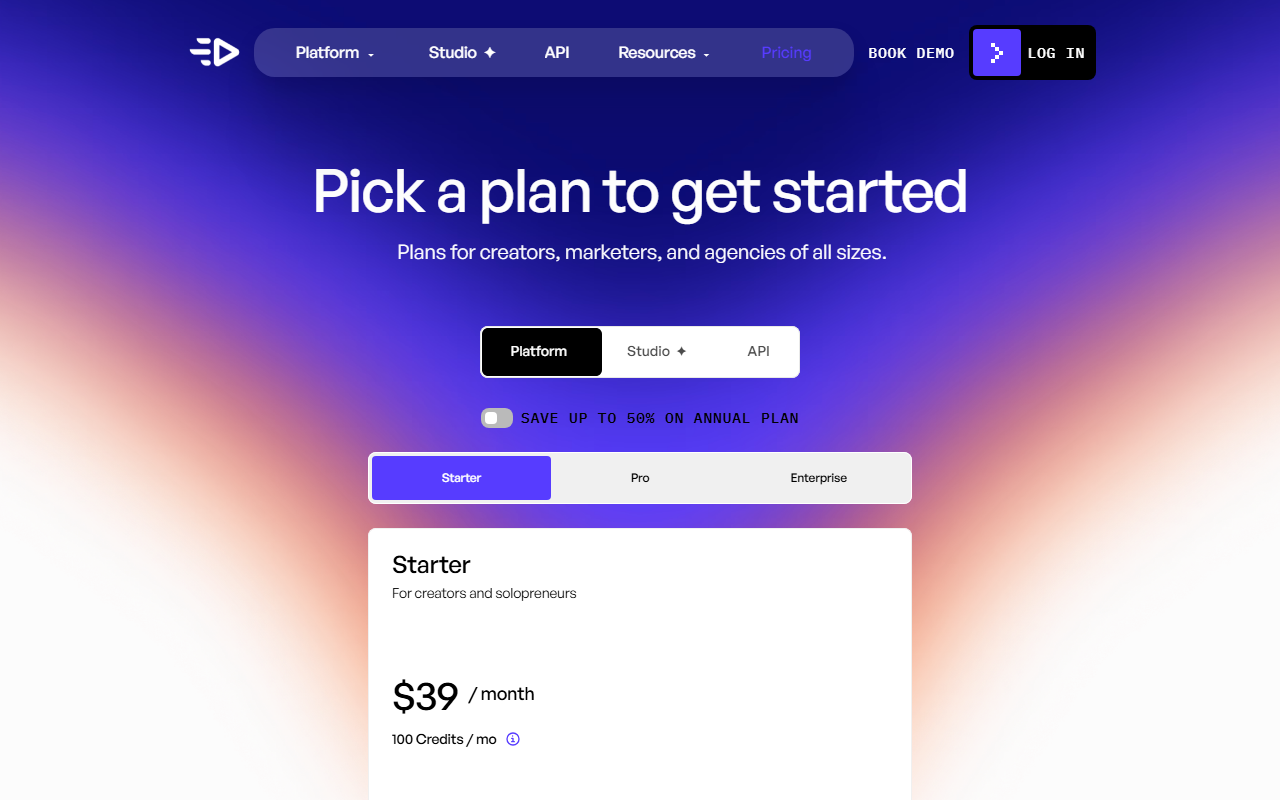 Creatify's pricing page, captured 5 September 2026.
Kling AI's pricing page lists Standard at $8.80/month on renewal ($6.60/month billed yearly), Pro at $25.99/month, Premier at $64.99/month, and Ultra at $127.99/month, with commercial usage rights included from Standard upward (kling.ai, verified in hokai's own vendor check 2 June 2026 and confirmed against three independent pricing trackers).
Credits cost 6 per second of video at 720p with no audio, up to 12 per second at 1080p with native audio. A 5-second 1080p clip with sound costs 60 credits: on the $25.99 Pro plan that works out to roughly $1.30 per clip before any of it becomes a usable ad. None of that clip is captioned, branded, or connected to an ad account yet. That work happens somewhere else.
Read those numbers side by side and the honest comparison is not "which is cheaper." It is that Creatify's price buys you a finished, trackable ad; Kling's price buys you raw footage that still needs editing, captioning, and a place to run.
Where Creatify wins
Creatify is the right pick for an e-commerce brand with a product catalog and no in-house video team. Alibaba's use of the platform to generate more than 200,000 ads is the extreme end of that case, but the pattern holds at small scale too. Zumper's team produces 300-plus videos a month through Creatify's API and reports saving roughly $20,000 doing it. 1More cut its per-video production cost by an estimated $10,000 while lifting click-through rate by 47.6%, according to case studies published on Creatify's own site.
An agency running the same handful of product pages through Creatify's API into dozens of ad variants, then using the Competitor Ad Tracker to see what a rival is testing, gets a workflow no general-purpose video generator offers.
Creatify also states 2.7 times more leads and 1.7 times higher ROI versus static image ads, and a 90% lower production cost than traditional video shoots. Those are Creatify's own aggregate figures, not an independently audited benchmark, and they should be read that way: directionally useful, not a guarantee for any specific product.
Where Kling AI wins
Kling AI is the right pick when the ad needs a shot nobody has: a product used in a setting that was never photographed, a stylized scene built entirely from a text description, or B-roll for a brand story that has no existing footage to start from. A SaaS company launching a feature with no visual metaphor, or a DTC brand whose only asset is a single hero photo, can prompt Kling AI into an opening shot that Creatify's template library cannot originate on its own.
Once that raw clip exists, it typically still needs finishing. VEED's browser-based editor adds subtitles, AI avatars, and voice cloning on top of generated or filmed footage without a download, which is the natural next stop for a Kling clip headed toward a finished ad. For teams leaning on avatar-led spokesperson ads specifically, HeyGen remains the category's most-cited option in the wider 2026 roundups, translating a single script into 175-plus languages with lip-synced delivery.
The turn
The obvious objection to writing this as a "versus" at all is that teams increasingly do both: generate a scene in Kling, then finish it in an editor or run it through Creatify's assembly tools once footage exists. That workflow is real, and it is also not available to a team choosing its first subscription. Paying for two platforms to solve one ad is a decision a four-person team's budget rarely allows on day one.
The question this piece answers is which one earns that first dollar, and the answer depends entirely on whether a usable product asset already exists. Teams without one should also check whether they need either tool yet. HokAI's own Smart Match can rule out a full ad-generation platform for a founder who really just needs Viggle's five-videos-a-day free tier to animate a single product photo into motion, no ad-platform integration required.
Switching cost
Moving from Creatify to Kling means giving up the Performance Agent's ad-account integration and the Competitor Ad Tracker entirely; nothing in Kling replaces them, so a team would need to rebuild reporting somewhere else, most likely inside the ad platform itself. Moving from Kling to Creatify means giving up scene generation: a brand with an established look built from Kling-originated footage would need to keep a Kling subscription running alongside Creatify just to keep making new source material, since Creatify only assembles from what it is given.
What would change this
The gap closes the day either company ships the other's core feature. If Creatify adds native scene generation instead of pure template assembly, it stops being a one-directional tool. If Kling adds product-catalog import and ad-specific templates the way Google folded Veo 3 directly into Ads Asset Studio in March 2026, the origination-versus-assembly split stops being the deciding question. Neither has happened yet, and until one does, the choice comes down to what a team is starting from: a product, or a blank page.
Frequently asked questions
Is Creatify or Kling AI better for video ads?
It depends on what you are starting from. Creatify is better when you already have product photos or a live product page and need finished, trackable ad variants fast. Kling AI is better when the ad needs footage that does not exist yet, since it generates original video from a text prompt or image rather than assembling from existing assets.
Can Kling AI create finished ads like Creatify does?
Not on its own. Kling AI generates raw video clips but has no product-catalog import, ad-copy generator, or Meta/TikTok performance tracking. A Kling clip typically needs an editor such as VEED before it becomes a finished ad.
How much does Creatify cost compared to Kling AI?
Creatify starts at $39/month for its Starter plan, which includes 100 credits and no watermark, and $99/month for Pro. Kling AI starts around $8.80/month for Standard at the renewal price and $25.99/month for Pro, priced per second of video generated rather than per finished ad.
What is a cheaper alternative to Creatify for video ads?
AdsMaker.ai covers similar ground at roughly a third of Creatify entry pricing, turning a script into a lip-synced avatar ad in about 60 seconds. Viggle is cheaper still, at $4.99/month, for teams that only need to animate a single product image rather than assemble a full ad.
Do Creatify and Kling AI work together?
Some teams do pipe Kling-generated footage into an editor or Creatify assembly tools once the clip exists, but that requires paying for both platforms. For a team choosing a first subscription, the decision comes down to whether a usable product asset already exists.
Covered in this guide
- Creatify: Creatify AI converts product page links into ready-to-publish video ad variations voiced by AI avatars, built for performance marketers who need volume creative without a film shoot.
- Kling AI: Kuaishou's text-to-video platform with native 4K, lip-synced audio in 5 languages, and free daily credits. Used by 60M+ creators; plans from $6.99/month.
- AdsMaker.ai: AdsMaker.ai turns a script into a lip-synced avatar video ad in 60 seconds, plus ad copy and product photos for Meta, TikTok, and Google.
- HeyGen: Fast, simple AI video generator that creates professional videos with realistic avatars in 175+ languages.
- VEED: Browser-based video editor with AI subtitles, avatars, voice cloning, and text-to-video: no download needed.
- Viggle: Viggle animates still characters into video by swapping them into clips or applying a motion reference. Free plan: 5 watermarked videos a day. Paid plans add credits and remove the watermark.
Sources
Still deciding?
This guide covers a handful of options. Smart Match checks every listing in the directory against how you actually work and what you can spend, then hands you the shortlist and the reason behind each pick.
Find your toolsRelated guides
- AdsMaker.ai vs Creatify: Creatify Tripled Its Price, AdsMaker Didn'tComparisonHead-to-head, with a verdict
- The AI 80s Photo Trend: How to Make Yours (and Turn It Into a Video) in 2026AnalysisWhat changed and who it affects
- Best AI Dubbing and Video Translation Tools in 2026Buyer's guideHow to pick, across a category
- Best AI for Creating YouTube Videos in 2026: A Buyer's GuideBuyer's guideHow to pick, across a category
- The Best Free AI for Turning a Photo Into a Video in 2026Buyer's guideHow to pick, across a category
- Best AI for Video Editing and Content Creation in 2026: Pick the Job, Not the CategoryBuyer's guideHow to pick, across a category