Codag vs Crukx: Why Only One of Them Ships in 2026
As of August 2026, Crukx is a pre-release AI agent regression gate available only through a waitlist, with no published pricing; it is not the LLM observability and cost-optimization product earlier listings describe. Codag remains a live, credit-metered log-compression tool for AI coding agents at $0.05 per credit.
The short version
Codag and Crukx used to compete for the same AI-agent-observability budget. Crukx rebuilt itself in 2026 into an unreleased regression gate with no public price, while Codag stayed a live, metered log-compression tool. For a team that needs something running today, Codag wins by default; Archal and Maitai are the live picks for the jobs Crukx abandoned.
Crukx spent early 2026 marketed as an enterprise LLM observability platform; by August its homepage sold something else: a regression gate with no listed price and a waitlist instead of a signup button.
That is not a rebrand in name only. Crukx now ships a CLI that captures production failures, replays them as regression tests, and blocks a deployment that fails its own reliability score, according to the product tour live at crukx.dev.
For a team choosing between it and Codag, the log-compression tool that has sat next to it on nearly every AI agent observability shortlist since Codag launched out of Y Combinator's Summer 2026 batch, the real question has quietly stopped being about features. It has become which one you can actually buy.
What Crukx actually is now
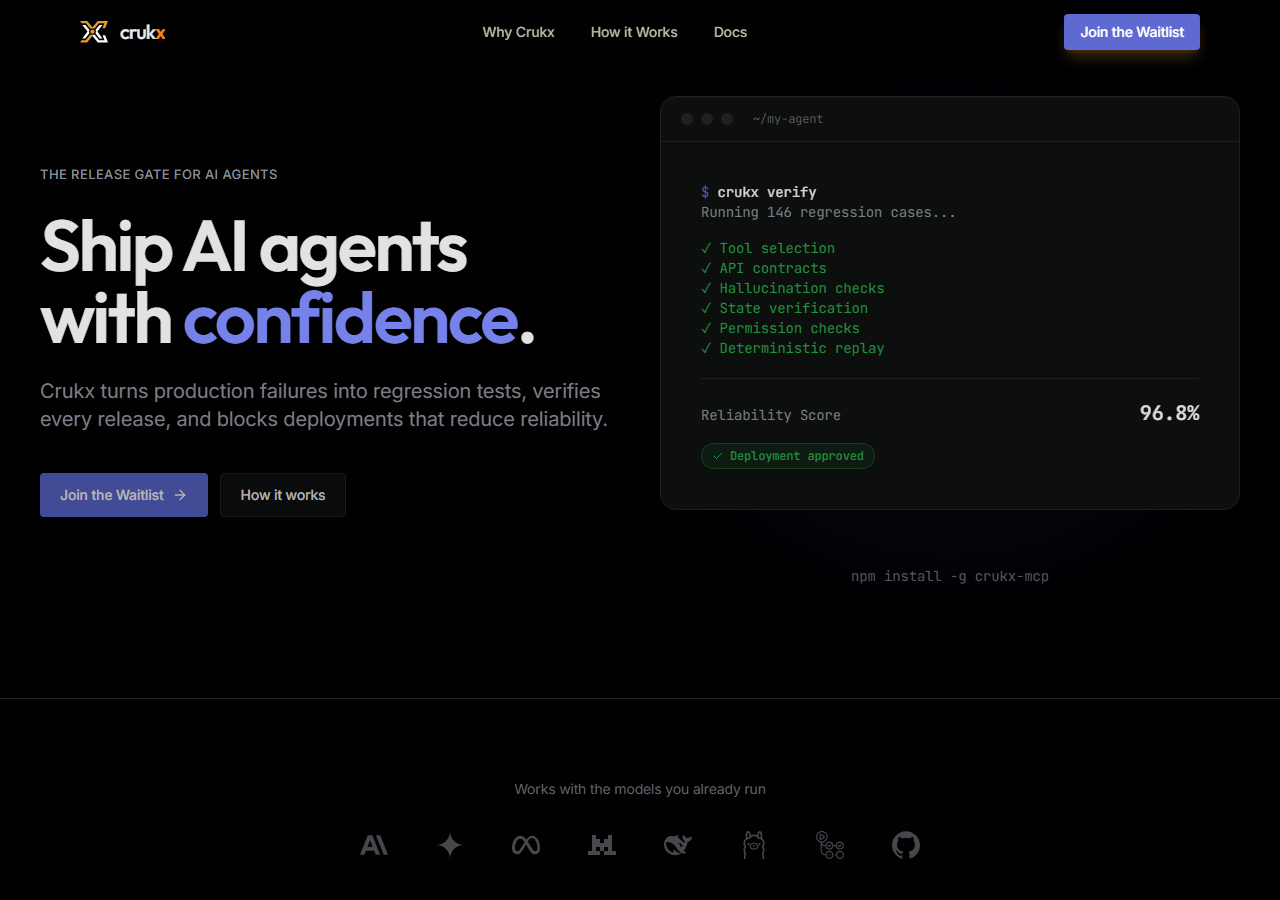 Crukx's live homepage, captured 24 Aug 2026. Every call to action on the page leads to a waitlist, not a price.
Crukx.dev opens on four words: THE RELEASE GATE FOR AI AGENTS. Under that sits a CLI walkthrough. crukx record captures a production trace. crukx replay turns a real failure into a deterministic regression test. crukx verify scores a release against the accumulated suite. crukx release ships or blocks the deployment depending on that score.
The site's own worked example runs 146 regression cases against a hypothetical model migration. It finds 14 regressions across tool selection, state verification and API contracts, and drops the reliability score from 96.8% to 81.2%. The deployment gets blocked as a result.
None of that resembles the product this site, and most other trackers, still describe: an enterprise LLM observability and cost-optimization platform pairing production tracing with spend analysis, the pitch Crukx carried through mid-2026 under its old domain, observai.dev. That domain now resolves to the same waitlist page. There is no pricing tier, no self-serve signup, and no published date for general availability. The only call to action is "Join the Waitlist," aimed at "a small number of teams shipping AI agents to production."
A GitHub Action, crukx/crukx-action, is already published on the GitHub Marketplace and wired to gate a pull request on a minimum reliability score (the sample workflow sets min-score: 95), but it needs an API key nobody outside the waitlist currently holds. That is further along than a landing page mockup. It is not a product a team can install this afternoon.
What Codag still is, and what it costs
Codag did not pivot. It still exists, in its own words, to cut "the tool-output tax" a coding agent pays when one command floods its context window: a 4,212-line test run, a multi-megabyte log tail, a directory listing nobody asked for in full. Its FAQ describes the mechanism plainly: large tool results shrink to the lines that carry signal (failures, exact matches, causal log lines) while the omitted bytes stay retrievable, encrypted, on the developer's own machine for seven days, capped at 1 GiB.
Pricing is credit-metered, not seat-metered. One credit optimizes roughly 100 MB of tool output for $0.05, about $0.50 per gigabyte. New accounts start free with 10 credits, about 1 GB, no card required. A Team plan runs $499 a month for a bundle of 12,500 credits, about 1.25 TB, priced around 20% cheaper per credit than pay-as-you-go, and Enterprise is custom.
That is a different shape than the flat per-seat tiers some older write-ups, including this site's own, still list for Codag. It reflects a business model built around bytes processed rather than seats filled.
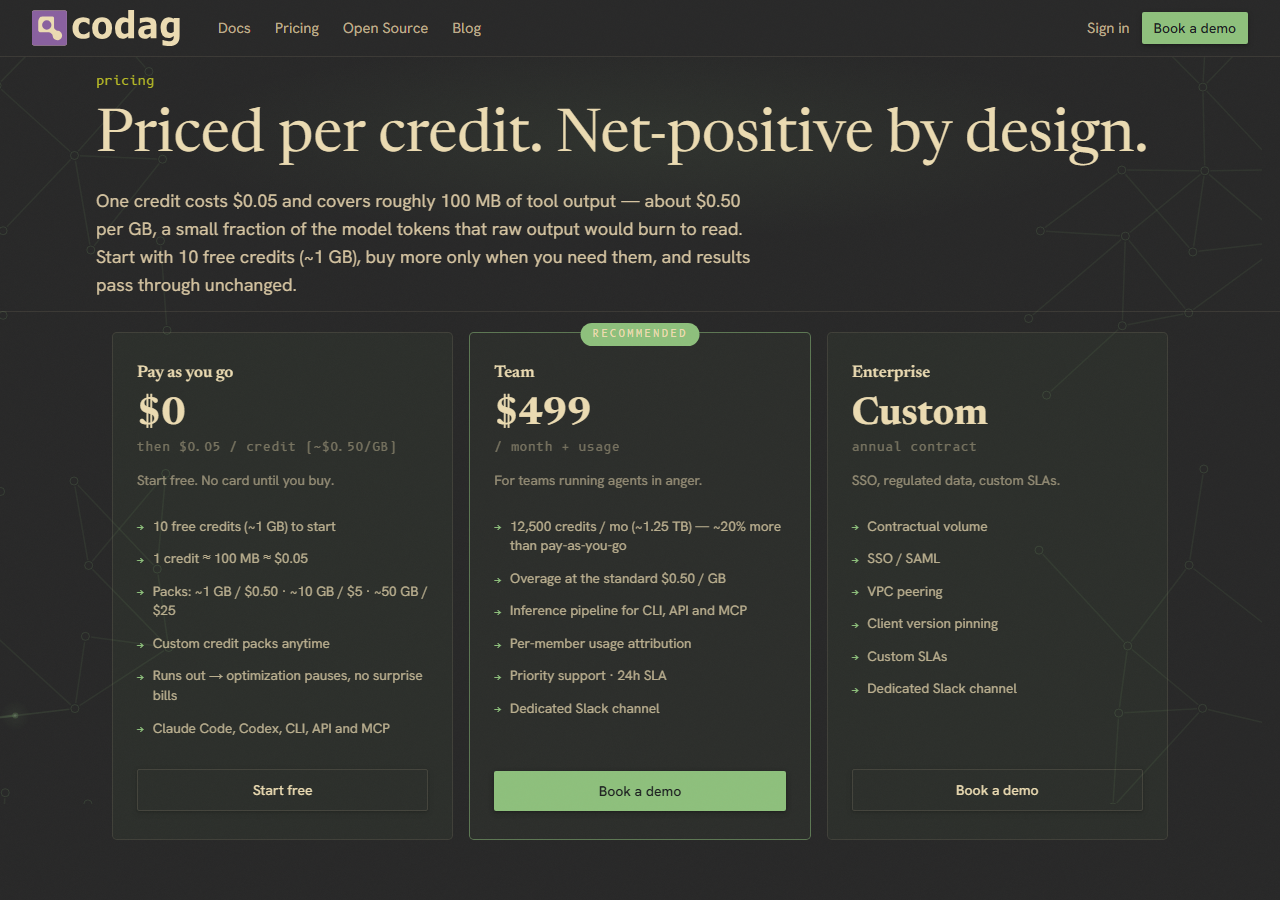 Codag's pricing page, captured 24 Aug 2026. Credits, not seats, are the billed unit.
The company behind it is small on purpose. Codag's Y Combinator profile lists a team of one, founder Michael Zhou, who says he built and sold the product solo. More than 90 organizations use it today, including teams as large as 35 people, and Codag reports a 75% average reduction in optimized tool output across that usage. The product currently attaches only to Claude Code and Codex; other harnesses are detected and left untouched.
Codag's own dashboard example, covering a sample 30-day window, shows 38.4 million tokens avoided and $291 saved across 1,247 sessions. The site presents those as an illustration of what the savings report looks like, not as disclosed results from a named customer, and this piece treats them the same way: real product mechanics, unverified specific totals.
The verdict: pick Codag today, watch Crukx
Strip away the branding and the decision is closer to an availability check than a feature comparison. If the job is cutting what a coding agent spends rereading its own tool output this week, Codag is the pick: it is live, metered in cents, and a single setup command away from running.
If the job is stopping a bad release before it reaches users, the tool actually built for that today is not Crukx. It is Archal, a fellow 2026 Y Combinator company with its own pricing and a self-serve signup. If the job is closer to what Crukx used to promise, production monitoring with automatic correction, Maitai is live with published pricing starting at $50 a month.
Crukx wins nothing in this comparison right now, for a plain reason: there is nothing to buy.
The live alternative for a release gate: Archal
Archal's sandboxes sell the pre-release testing job Crukx's new pitch describes almost exactly: stateful clones of the third-party services an agent actually calls, GitHub, Linear, Slack, Supabase and more than a dozen others, so a test suite or CI job runs against realistic state without touching a live account or hitting a rate limit.
Signup grants $20 in usage credits with no card required, split as $5 on verified signup and the remaining $15 once the first sandbox is ready, and every environment resets to a declared baseline after each run.
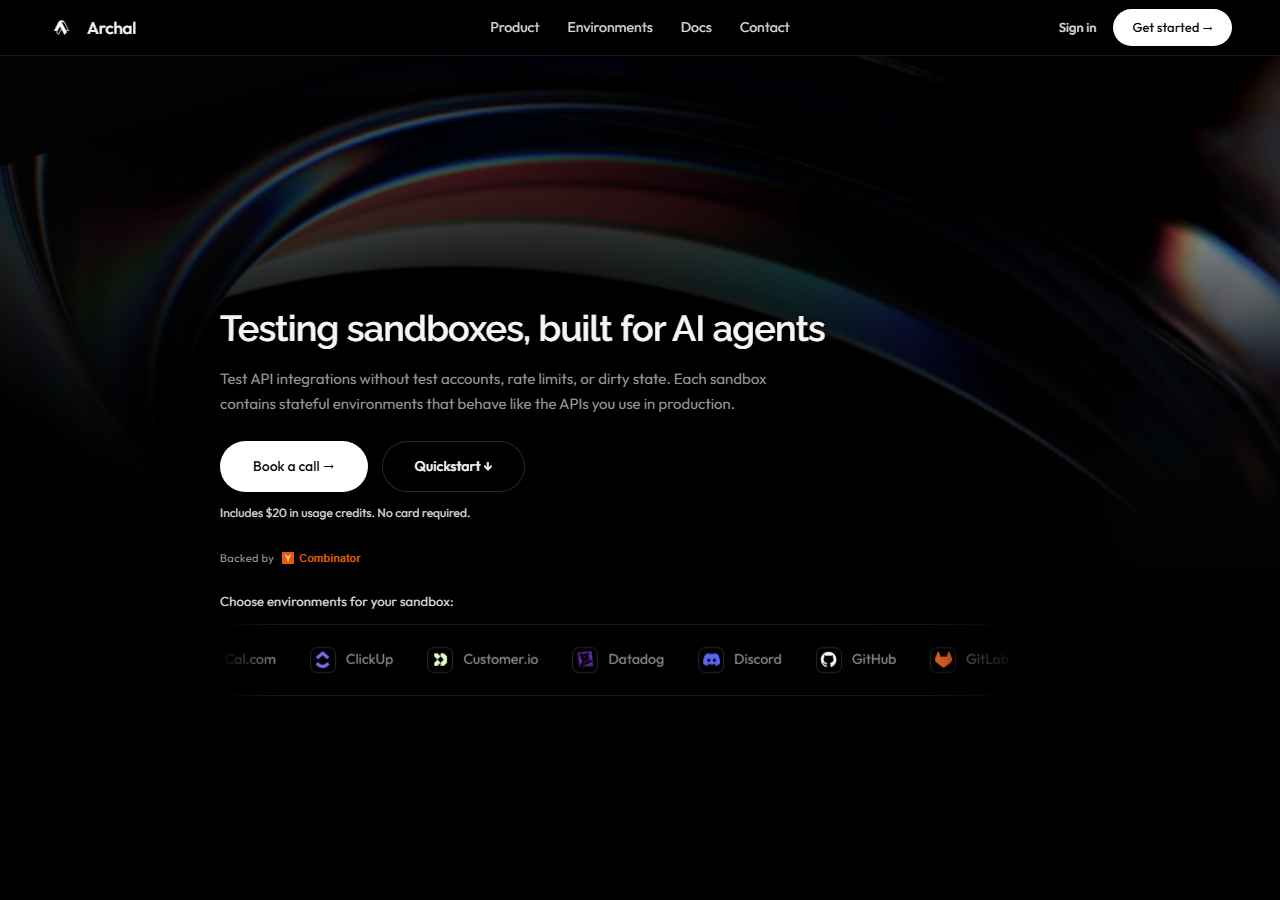 Archal's signup page, captured 24 Aug 2026. Twenty dollars in credits and no card, live today.
The overlap with Crukx's new pitch is direct. Both exist to catch an agent regression before a real user does, and both wire into CI. The difference is availability: Archal has been provisioning sandboxes and billing usage since before Crukx's pivot, while Crukx has a worked example on a marketing page and an email form.
The live alternatives for what Crukx used to promise
For the observability-plus-correction job Crukx abandoned, Maitai is the closer match today. It markets itself as the control plane for production AI: traffic gets indexed, evaluated in real time, and fed back into fine-tuning and dataset curation, with Sentinels, its name for guardrails that intercept and correct a bad model output before it reaches a user.
Pricing is published and tiered. A $50-a-month Starter plan covers one user with 30-day traffic retention. A $200-a-month Professional plan covers up to five users, a million indexed requests a month, 90-day retention and three hosted models. A custom Enterprise tier adds SOC 2 Type II and HIPAA compliance, on-premise deployment and dedicated support.
If the actual complaint was Crukx's cost-optimization half rather than correction, SuperPenguin answers that more narrowly and more cheaply. It attributes AI spend to a customer, feature, team or pull request instead of leaving it as one lump provider bill, starts free up to $2,000 in managed spend, and steps up to $30 a month at $5,000 and $200 a month at $20,000. Neither Maitai nor SuperPenguin blocks a release the way Crukx's new pitch does. Both are live, priced and running today, which nothing Crukx currently sells actually is.
A third live neighbor, Kashikoi, runs no-code agent simulations before a release rather than gating a CI pipeline after one, and it is reachable only by booking a demo, not by self-serve signup. It is not a Crukx substitute either. It is one more sign that the pre-release testing space Crukx just entered was already crowded before Crukx showed up.
The turn: waitlists sometimes move fast
The obvious objection to all of this is that a waitlist is not a rejection. Crukx could ship pricing and a self-serve flow within weeks, and this comparison would need rewriting the day it does. The same caution cuts the other way, too. Codag is a one-person company by its own founder's account, and a solo-founder tool sitting inside an agent's tool path carries its own operational risk, whatever its current uptime looks like.
Neither risk changes what a team can run this afternoon. It changes how much slack to build into the decision, not which box gets checked first. Archal and Maitai are themselves young companies, one backed by a 2026 Y Combinator batch and one still signing its early enterprise contracts, so "live" does not mean "battle-tested for a decade." It means a credit card, or in Archal's case no card at all, gets access today instead of an email address on a list.
What waiting actually costs
Waiting on Crukx costs nothing in a literal sense. There is no contract to sign and no seat to pay for. It costs whatever a team spends in the meantime shipping agent changes with no regression gate at all, or paying a second vendor, Archal, to cover that gap now.
Switching later, if Crukx does launch with pricing, means standing up a second CLI and a second GitHub Action alongside whatever a team already adopted, not migrating away from one tool into another. That is a real cost. It is just a deferred one.
Check crukx.dev before committing budget to either alternative above. The day its worked example, the one currently showing a reliability score of 81.2%, 14 regressions and one blocked deployment, sits next to a price instead of an email field is the day this comparison needs to be rerun.
Frequently asked questions
Is Crukx still an LLM observability platform?
No. As of August 2026, Crukx's own homepage markets it as 'the release gate for AI agents,' a CLI that captures production failures, replays them as regression tests, and blocks a deployment that scores below a reliability threshold. Its old domain, observai.dev, described a different product, an enterprise LLM observability and cost-optimization platform, and now redirects to the same new page.
How much does Codag cost in 2026?
Codag is priced in credits: one credit optimizes about 100 MB of tool output for $0.05, roughly $0.50 per gigabyte. New accounts get 10 free credits with no card required, and a Team plan runs $499 a month for 12,500 credits, about 1.25 TB. Enterprise pricing is custom.
Can I sign up for Crukx right now?
No self-serve signup exists. Crukx's site offers a waitlist form aimed at 'a small number of teams shipping AI agents to production,' with no published price or general-availability date. A GitHub Action, crukx/crukx-action, is documented on the GitHub Marketplace, but it requires an API key only waitlisted teams currently have.
What's a live alternative to Crukx for gating releases?
Archal, also a 2026 Y Combinator company, sells pre-release testing against stateful sandboxed clones of services like GitHub, Linear and Slack, with CI integration that can fail a build on a regression. Signup grants $20 in usage credits with no card required. Kashikoi offers a no-code alternative in the same space, reachable by booking a demo.
What replaced the observability product Crukx used to be?
Two live tools split that old pitch. Maitai indexes production traffic and uses guardrails called Sentinels to correct bad output in real time, priced from $50 a month. SuperPenguin instead attributes AI spend to a customer, feature or pull request, starting free up to $2,000 in managed spend.
Covered in this guide
- Codag: Compresses 1.2M log lines to 3,300 tokens (8,021x) so AI agents diagnose incidents fast without burning token budgets.
- Crukx: Enterprise LLM observability and optimization platform for engineering teams monitoring AI models and agents in production at observai.dev.
- Archal: Eval platform that tests AI agents against stateful sandboxed clones of GitHub, Slack, and Stripe before production. Free: 100 evals. YC S26.
- Kashikoi: Kashikoi is a no-code simulation platform for evaluating AI agents, built by the ex-Moveworks lead behind 250+ shipped enterprise agents.
- Maitai: Maitai is a $50 to $200/mo control plane that indexes production LLM traffic and auto-corrects bad output in real time with Sentinels.
- SuperPenguin: AI spend platform with 2 native SDKs (Python, TypeScript) that attributes provider costs to a customer, feature, or pull request instead of one monthly total.
Sources
Still deciding?
This guide covers a handful of options. Smart Match checks every listing in the directory against how you actually work and what you can spend, then hands you the shortlist and the reason behind each pick.
Start Smart MatchRelated guides
- Archal vs ReasonBlocks: You're Not Choosing Between Them, You're Choosing WhenComparisonHead-to-head, with a verdict
- ReasonBlocks vs Touchmark: Which One Actually Fixes Your AI Bill?ComparisonHead-to-head, with a verdict
- The Three Jobs Hiding Inside "AI Agent Observability" in 2026Buyer's guideHow to pick, across a category