ReasonBlocks vs Touchmark: Which One Actually Fixes Your AI Bill?
ReasonBlocks is runtime middleware that reduces AI agent token consumption by detecting loops and reusing prior reasoning traces mid-execution. Touchmark is a forward marketplace, launched August 14, 2026, where buyers purchase AI inference token capacity months ahead at a discounted, fixed price instead of paying on-demand provider rates.
The short version
ReasonBlocks and Touchmark are both two-person 2026 YC startups promising to fix runaway AI spend, but they solve different problems. ReasonBlocks cuts the tokens an agent wastes through loops and redundant work. Touchmark, after an August pivot, sells forward contracts that lock in the price of tokens you will use regardless.
ReasonBlocks says it cuts a coding agent's token bill by 52 percent without changing a line of code. Touchmark makes an almost opposite promise: lock in what you will pay for those tokens months before you spend them, at a price fixed today.
Both are two-person teams out of Y Combinator's 2026 batches, both selling into the same complaint from engineering teams: production AI agents burn cash unpredictably. But they are fixing different halves of that problem. ReasonBlocks changes how much an agent wastes while it runs. Touchmark, which rewrote its entire product on August 14, 2026, changes what you pay for the tokens regardless of how efficiently they get used.
For a team watching a five-figure monthly LLM bill drift upward, that distinction decides which one is worth a demo call this week.
The Verdict: Same Complaint, Opposite Ends of the Pipeline
Pick ReasonBlocks' runtime if your bill is high because agents loop, re-fetch files they already read, or re-derive reasoning they have already solved once. Pick Touchmark's forward contracts if your bill is high, or just unpredictable, because of the per-token list price itself, no matter how disciplined your agents already are.
They are not really competing products. A team that has both problems, and most teams running agents at scale eventually do, ends up wanting both tools, just not on the same day. That sequencing matters enough to get its own section below.
What Each One Actually Costs
Neither company publishes a price list, which is itself worth knowing before a demo call. ReasonBlocks has no public pricing page: access runs through a demo request, negotiated per customer. There is no free tier and no self-serve signup as of this writing.
Touchmark's pricing is transparent in a completely different way: every contract is a live, named price. Buy a 1-billion-token block on GLM 5.2 for delivery in September 2026 and the site quotes $3,960 against a $4,400 list price, a discount of roughly 10 percent for the nearest month.
Push the delivery window out to November 2026 on Kimi K3 Fast and the same 1-billion-token block runs $15,750 against $22,500 at list, a 30 percent discount, because Touchmark's curve prices further-out commitments cheaper. The site's own headline claim is up to 35 percent off list for committing ahead.
None of that is a subscription. It is a forward contract: fund a balance, buy a block, connect an API key, and draw the block down during its delivery month. Unused tokens expire when the window closes, and sales are final.
The pivot has not fully propagated across Touchmark's own site yet. Its developer docs at docs.touchmark.ai still describe the pre-August product: pricing AI output by a quality score rather than selling forward token contracts.
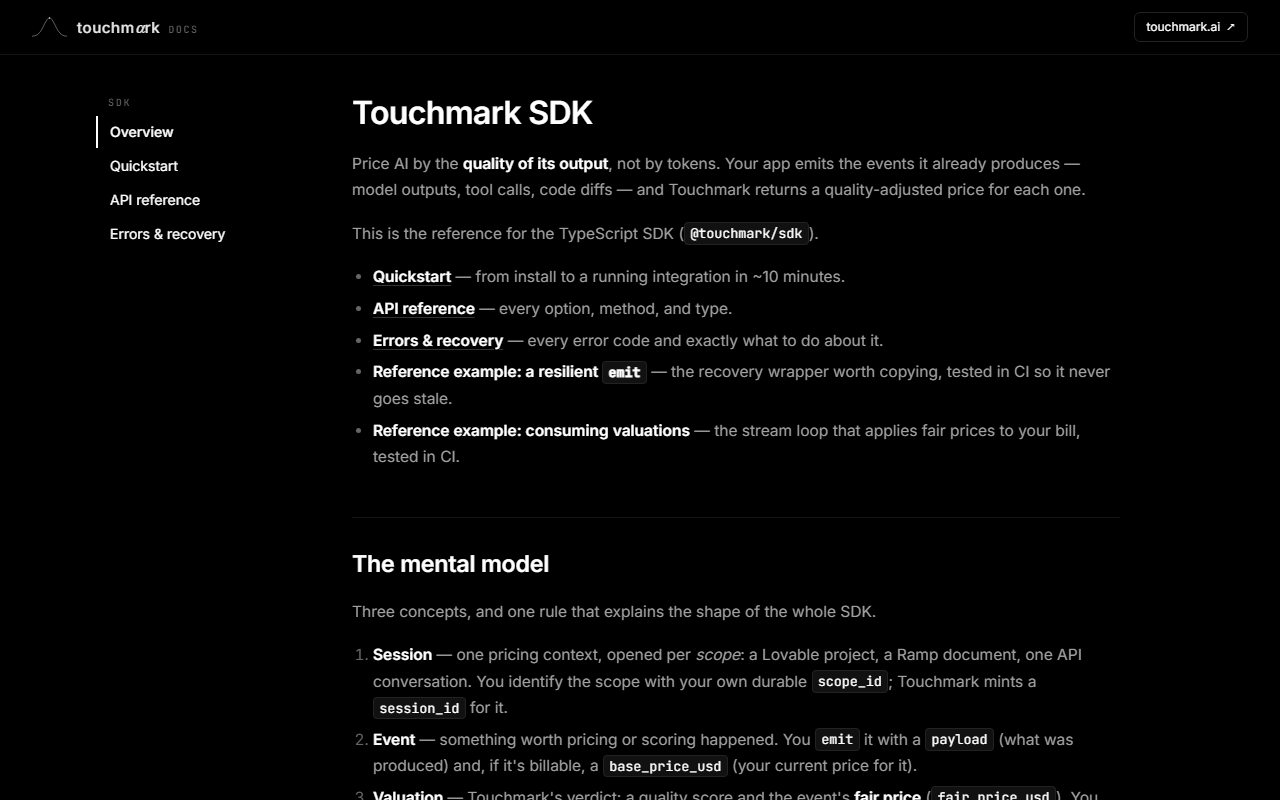 Touchmark's developer docs, captured 20 Aug 2026, six days after the company's homepage relaunched as a forward token marketplace. The docs had not caught up.
Four Places They Genuinely Differ
What you are actually buying. ReasonBlocks sells a change in agent behavior: fewer loops, less redundant context, more reused reasoning. Touchmark sells a change in what you pay for behavior that does not change at all. A team could adopt Touchmark and watch its bill drop without a single agent running any differently that day.
Integration effort. ReasonBlocks wraps your existing stack. Its own documentation shows a single middleware object passed into a LangChain or LangGraph agent, with support for the OpenAI Agents SDK and the Claude Agent SDK listed alongside it; no model swap, no rewrite. Touchmark also avoids a rewrite, but the mechanism is different: you point inference calls at the key tied to a purchased contract instead of your usual provider key, so the integration cost shows up later, in demand forecasting, not in code.
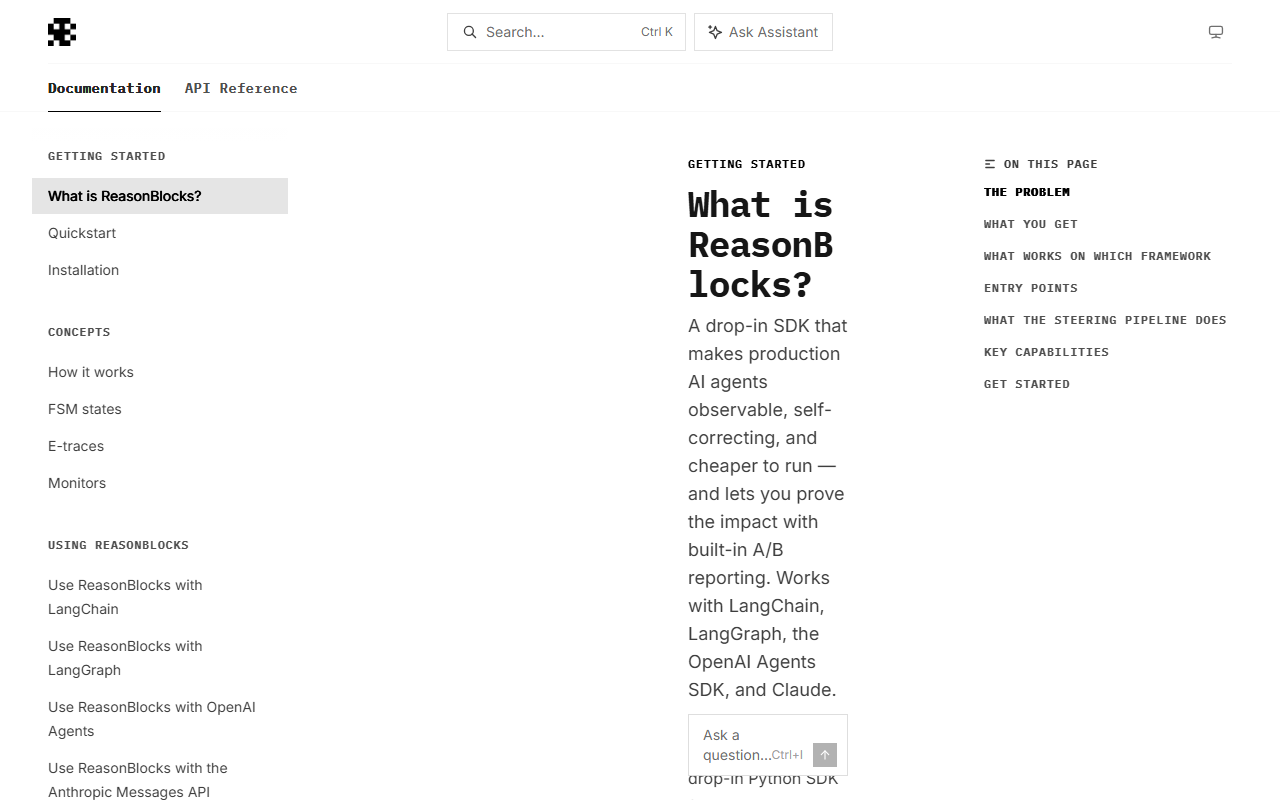 ReasonBlocks' docs, captured 20 Aug 2026. The framework list matches what the "Integration effort" section above describes: a drop-in SDK, not a rewrite.
Where the risk sits. ReasonBlocks' savings are variable and depend on your actual agent behavior. The company's own benchmark, run on 75 SWE-bench Pro problems against Claude Sonnet and Claude Opus, reports a 42 percent accuracy lift on Sonnet, a 100 percent lift on Opus, a 52 percent token reduction per task, and a 24 percent latency reduction, but that figure has not been independently replicated.
Touchmark's savings are contractual and certain the moment you buy, but the risk moves to volume forecasting: buy more capacity than you use in the delivery window and the difference is gone, with resale only guaranteed if a provider on the other side of the book agrees to take it.
Company maturity. Both are effectively pre-seed. ReasonBlocks came out of Y Combinator's Spring 2026 batch with founders Sajeev Magesh and Rohan Vij, a team that has worked together for 11 years; Y Combinator lists no funding amount beyond the standard deal.
Touchmark came out of the Summer 2026 batch, founded by Ilia Bolgov and Roman Yanushevskyi, and only launched its current product on August 14, with structuring help from Tölt Strategies, a firm led by a former CFTC market-oversight director. Neither has a decade of enterprise customers behind it.
Where ReasonBlocks Wins
Name the use case precisely: a platform engineer whose agents are already correct often enough, but whose token spend keeps climbing because the same agent re-reads files, re-runs failed searches, and re-solves problems it already solved three tickets ago. ReasonBlocks' loop detection and its reasoning-reuse trace lookup, which the company says has 190,000 traces indexed in its own demo, target exactly that failure mode. If the bill problem is behavioral, a pricing tool downstream of that behavior cannot fix it. Only something that watches the run can.
Where Touchmark Wins
Name a different use case: a team whose agents are already efficient, running a predictable, recurring workload, such as a nightly batch job or a fixed-volume support pipeline, where the pain is not waste but a rising or volatile on-demand rate. For that team, ReasonBlocks has nothing left to optimize away, because there is no waste to cut.
Touchmark's contracts fit a team that can forecast next month's token volume with reasonable confidence and wants to lock today's price against it, the same logic that makes any commodity buyer hedge forward instead of paying spot every time.
The Case for Using Both, and Why Order Matters
The obvious objection to treating these as separate purchases is that a team with real AI infrastructure spend should just use both: cut the waste, then lock in a price for what is left. That is a fair rebuttal, and the honest answer is that it works, but only in that order. Touchmark's forward contracts require forecasting how many tokens you will actually draw down in a delivery month; buy too much and it expires unused, buy too little and you are back on the spot market mid-month.
A forecast built on a bill that still contains fixable waste is a forecast of the wrong number. Cut the waste first, and the volume left to hedge is smaller, steadier, and easier to price a forward contract against. Buying the hedge before fixing the waste locks in a discount on tokens you should never have needed to buy at all.
What Switching Actually Takes
ReasonBlocks is the lower-friction trial: wrap the middleware around one agent, compare a week of runs against the same agent unwrapped, and decide from there. There is no contract to unwind if it does not work, because there was never a contract, only a demo relationship.
Touchmark is the opposite. A forward contract is a commitment with an expiration date built in: fund the balance, buy the block, and you are exposed to that volume whether or not your actual usage matches your forecast. That is a different kind of switching cost than a bad software trial.
It is closer to the commitment a company takes on with Archal, which tests agents against sandboxed clones of real services before code ships rather than after. The softer comparison is an observability layer like Crukx, which watches production traffic without ever touching the price you pay for it. Neither ReasonBlocks nor Touchmark asks you to migrate away from whatever you already use for tracing; both are additions to that stack, not replacements for it.
A third 2026 cost-focused YC company, Codag, takes a narrower swing at the same general problem by compressing incident logs rather than correcting agent behavior or hedging price, a reminder that "cut AI costs" now covers at least three genuinely different products, not one category with three logos.
What Would Change This
Touchmark's own price index, the reference series it says will track what buyers actually paid across models and delivery months, is listed as coming soon on a site that only went live on August 14. If that index ships and enough providers post real forward liquidity against it, Touchmark stops being a two-person marketplace experiment. It starts being the reference rate the rest of the AI cost tooling market prices against, the way a commodity exchange's settlement price outlives any single trading firm.
ReasonBlocks faces a narrower but sharper test: its 42 to 100 percent accuracy claims are the company's own numbers from its own whitepaper. The first independent replication of that SWE-bench Pro result, in either direction, will say more about which of these two bets is durable than anything on either homepage does today.
Frequently asked questions
What is the difference between ReasonBlocks and Touchmark?
ReasonBlocks is a runtime layer that sits inside an AI agent's execution loop, catching failures and cutting wasted tokens as the agent runs. Touchmark is a marketplace where buyers purchase AI inference token capacity in advance at a fixed, discounted price. One changes how many tokens an agent uses; the other changes what you pay for the tokens you already planned to use.
Does ReasonBlocks require changing my agent's code?
No. ReasonBlocks wraps an existing LangChain, LangGraph, or Claude Agent SDK setup with a middleware object, and the company's own documentation shows the integration as a few lines around an existing agent call. No model swap or architecture rewrite is required.
How much can Touchmark actually save on AI inference costs?
Touchmark's own site quotes specific contracts rather than a blanket number: a 1-billion-token block on GLM 5.2 for September 2026 delivery runs about 10 percent under list, while a block on Kimi K3 Fast for November 2026 runs about 30 percent under list. The company's homepage advertises up to 35 percent off list for committing further ahead.
Is Touchmark still the quality-based AI billing platform it launched as?
No. Touchmark's original pitch scored AI outputs and adjusted customer billing based on quality. On August 14, 2026, the company relaunched as a forward marketplace for AI inference token capacity, a different product built around fixed-price contracts rather than quality scoring.
Should a team use ReasonBlocks and Touchmark together?
They can be complementary rather than competing, but the order matters. Cutting agent waste with a tool like ReasonBlocks first makes future token volume smaller and easier to forecast, and only then does locking that smaller volume into a Touchmark forward contract make sense.
Covered in this guide
- ReasonBlocks: YC-backed runtime that catches AI agent failures mid-run and, since a September 2026 site update, can turn recorded agent traffic into a smaller model the company markets as 3x cheaper at comparable accuracy.
- Touchmark: AI inference forward market (YC S26) where buyers lock in future token capacity on models like GLM, Kimi and Qwen below list price, delivered through an OpenAI-compatible API.
- Archal: Eval platform that tests AI agents against stateful sandboxed clones of GitHub, Slack, and Stripe before production. Free: 100 evals. YC S26.
- Codag: Compresses 1.2M log lines to 3,300 tokens (8,021x) so AI agents diagnose incidents fast without burning token budgets.
- Crukx: Enterprise LLM observability and optimization platform for engineering teams monitoring AI models and agents in production at observai.dev.
Sources
Still deciding?
This guide covers a handful of options. Smart Match checks every listing in the directory against how you actually work and what you can spend, then hands you the shortlist and the reason behind each pick.
Start Smart MatchRelated guides
- Archal vs ReasonBlocks: You're Not Choosing Between Them, You're Choosing WhenComparisonHead-to-head, with a verdict
- Codag vs Crukx: Why Only One of Them Ships in 2026ComparisonHead-to-head, with a verdict
- The Three Jobs Hiding Inside "AI Agent Observability" in 2026Buyer's guideHow to pick, across a category