Best AI Orchestration Tools in 2026: How to Actually Choose
HokAI's AI orchestration category holds nine tools split into three tiers: no-code app automation (Zapier, n8n, Make, IFTTT), durable background execution (Trigger.dev, Inngest), and AI agent frameworks (LangChain, Mastra, LlamaIndex). Each tier solves a different engineering problem, so most of the nine never compete for the same budget line.
The short version
Startups shopping for AI orchestration usually compare tools across tiers by mistake. Zapier's 9,976 app integrations beat n8n's 2,067, but n8n self-hosts free. Trigger.dev and Inngest only matter once a step must survive a crash. LangChain, Mastra and LlamaIndex are for teams writing an agent's own reasoning loop, not wiring apps together.
n8n charges nothing to self-host with unlimited workflow runs. Trigger.dev charges $10 a month for a plan that caps you at 50 concurrent runs and bills compute by the second on top. Both call themselves AI orchestration tools, and a team that picks between them on price alone is comparing the wrong two products.
Nine tools sit in HokAI's AI orchestration category as of August 2026, and they split into three tiers that do not compete with each other: no-code business automation, durable background execution, and AI agent frameworks. The axis that actually separates them is not price or app count. It is who is building the workflow, and what has to happen when one step of it fails halfway through.
How to choose: the one axis that actually splits this category
A non-engineer connecting a form to a CRM needs Zapier, n8n, Make, or IFTTT. An engineer whose workflow has to survive a server restart or wait three days for a human approval needs Trigger.dev or Inngest. A team writing the actual reasoning loop an AI agent runs, memory, tool calls, multi-step planning, needs LangChain, Mastra, or LlamaIndex. Buying "an orchestration tool" as one line item, before answering that question, is the actual mistake.
Five questions narrow it down faster than any feature matrix:
1. Who builds the workflow day to day? If it is someone outside engineering, the answer is one of the no-code tier's four tools, full stop. Engineers hand-rolling YAML for a non-technical ops team is how shadow IT starts.
2. Does a single step ever need to survive a crash or run for hours? A form-to-CRM sync does not. An agent that waits on a human approval, retries a flaky API for a day, or processes a long batch job does, and that is what pushes a team toward Trigger.dev or Inngest.
3. Is the work building the agent's reasoning, or wiring finished apps together? Memory, tool-calling loops, and multi-agent planning belong to LangChain, Mastra, and LlamaIndex. Moving data from one SaaS product to another belongs to the no-code tier, even when an LLM call sits in the middle of the workflow.
4. Does compliance or cost require self-hosting? n8n, LangChain, and Mastra all ship a free, self-hosted core with no seat cap. Zapier, IFTTT, Trigger.dev, and Inngest are cloud-first, with pricing that scales by usage rather than infrastructure.
5. How wide is the integration surface the workflow actually touches? A workflow that only ever talks to three or four well-known apps does not need Zapier's 9,976-app catalog; one that touches a long tail of niche tools might need exactly that.
| Tier | Pick | Price from | The one caveat |
|---|---|---|---|
| No-code automation | Zapier | $29.99/mo (750 tasks) | 750-task ceiling means a busy team upgrades fast |
| No-code automation | n8n | $0 self-hosted | You run the infrastructure yourself |
| Durable execution | Trigger.dev | $10/mo | Compute is billed separately, per second |
| Durable execution | Inngest | $99/mo (Pro) | Free tier caps at 50,000 executions/month |
| Agent framework | LangChain | Free (framework) | Observability via LangSmith costs extra |
The no-code tier: Zapier, n8n, Make, and the outlier nobody mentions
Zapier's pitch is reach: it connects 9,976 apps, according to its own app directory. The free plan gives 100 tasks a month on two-step Zaps only; Professional starts at $29.99 a month billed monthly (or $19.99 annually) for 750 tasks with multi-step workflows, and Team runs $103.50 a month for 2,000 tasks and 25 users, per Zapier's pricing page. Task-based tiers climb to $5,999 a month before Enterprise custom pricing.
n8n's pitch is the opposite: fewer prebuilt connectors (2,067, per n8n's own integrations page) but a self-hosted Community edition that costs nothing and caps nothing. n8n's Cloud plans start at €20 a month billed annually for 2,500 workflow executions, rising to €50 for 10,000 and €667 for 40,000, all with unlimited steps per workflow. The gap between "self-host for free" and "pay Zapier by the task" is the real decision most teams comparing these two are making, not a feature checklist.
Make sits between the other two on cost. It moved to a credit-based system where most standard actions consume one credit, with a free allowance each month and paid tiers priced well below Zapier's task-based rate for equivalent volume. For a team that finds Zapier's task pricing punishing but does not want to self-host, Make is the middle option worth a look before committing either way.
Then there is IFTTT, which appeared in none of the five orchestration roundups read while researching this piece, despite being a live, priced product in the same category. IFTTT's free tier allows two Applets; Pro is $2.99 a month for 20 Applets; Pro+ is $8.99 a month for unlimited Applets, per IFTTT's own plans page.
IFTTT is built for single-trigger consumer automations, like a smart bulb turning on at sunset, not multi-step business workflows, and that scope limit is exactly why the business-automation roundups skip it. It belongs on this list for completeness, not as a shortlist contender for a startup team.
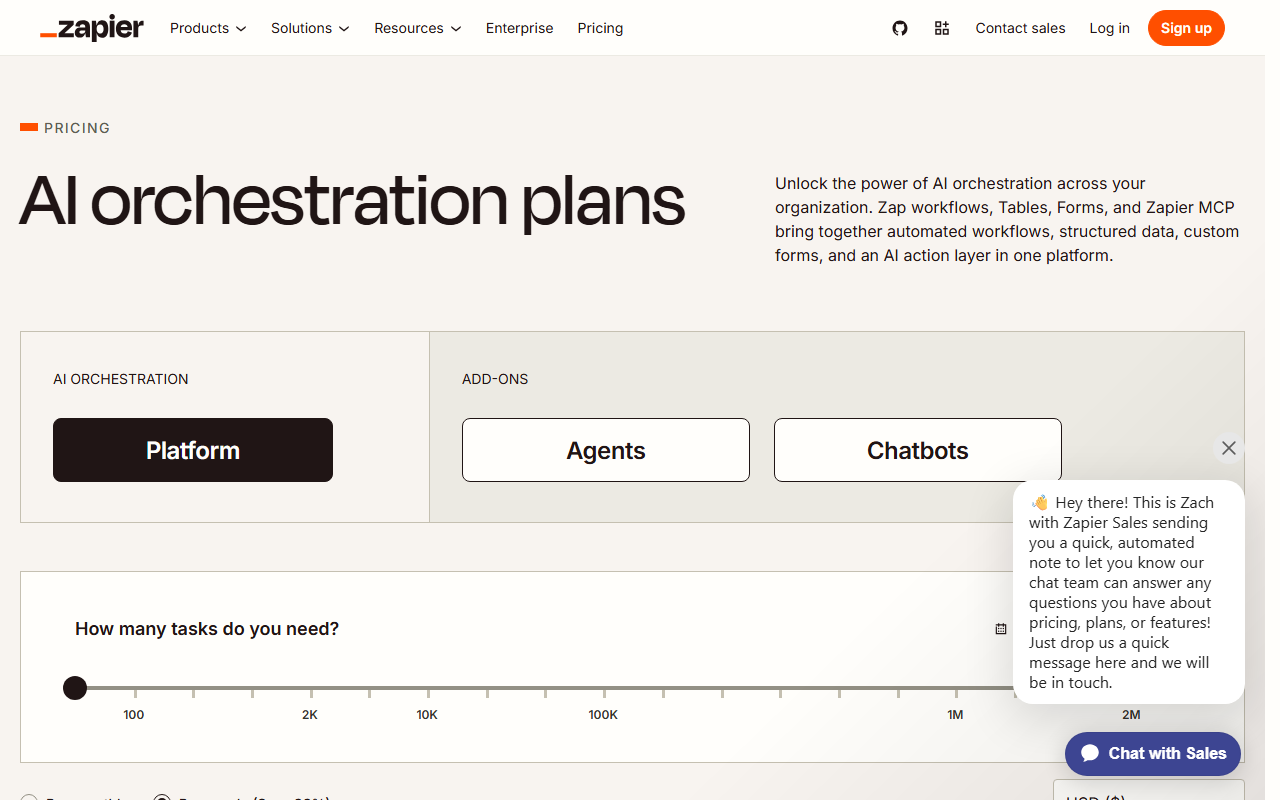 Zapier's pricing page, captured 20 Aug 2026. The task-volume slider is how Zapier prices every tier above Free: drag it up and the monthly cost climbs with it.
The durable-execution tier: Trigger.dev and Inngest
Neither of these tools automates an app. They run your code reliably, which matters once an AI agent workflow includes a step that can time out, need a retry, or wait on a slow external API.
Trigger.dev's free tier gives $5 of monthly credits, 20 concurrent runs, and one day of log retention. Hobby is $10 a month for 50 concurrent runs and seven-day logs; Pro is $50 a month for 200-plus concurrent runs and 30-day logs, with additional concurrency at $10 per 50 runs and extra seats past 25 at $20 each, according to Trigger.dev's pricing page. Compute is metered separately, from $0.0000169 to $0.00068 per second depending on machine size, plus $0.000025 per run invocation.
Inngest's free Hobby tier includes 50,000 executions a month and five concurrent steps. Pro starts at $99 a month for one million executions, with pay-as-you-go capacity up to 20 million, per Inngest's pricing page. Both tools target the same job: an engineering team that has outgrown Zapier's or n8n's execution model because a step needs to survive longer than a request timeout allows.
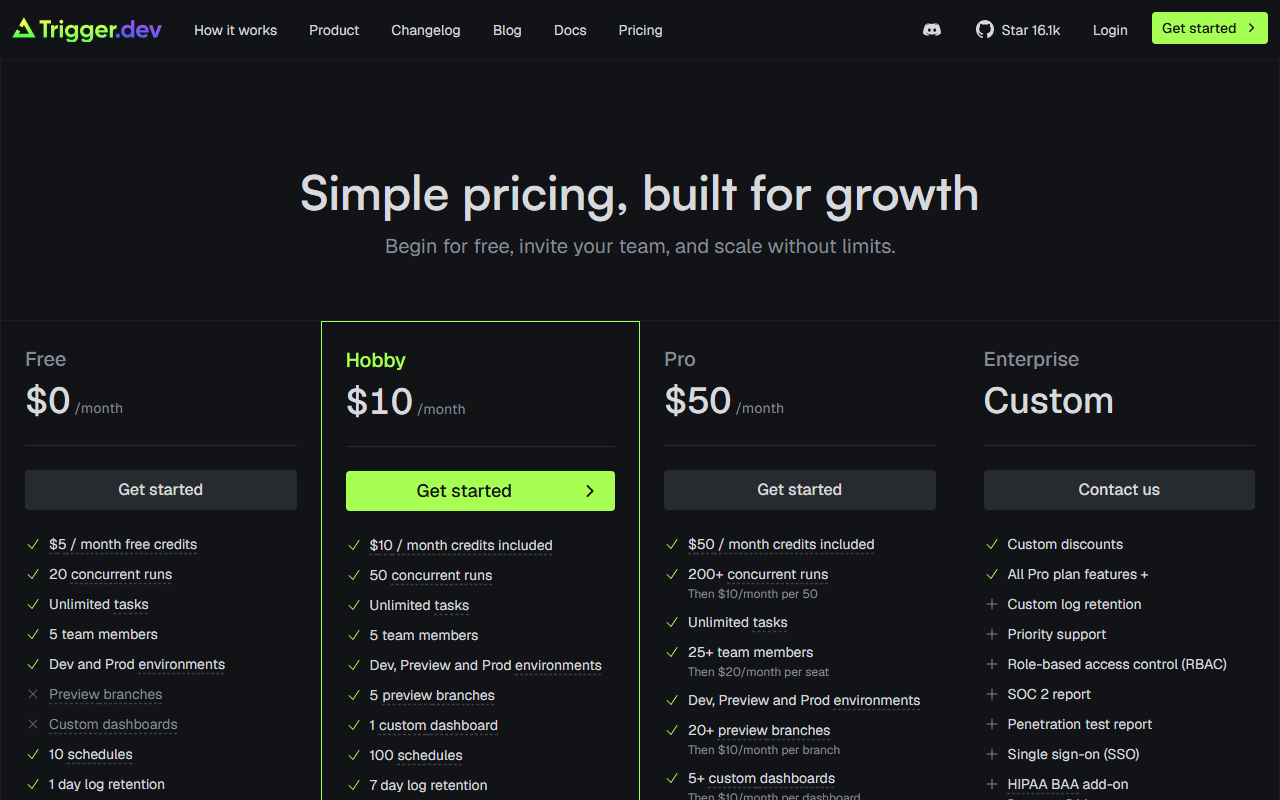 Trigger.dev's pricing page, captured 20 Aug 2026. Concurrent runs, not task volume, is the number that scales the price here, the opposite of Zapier's model above.
The agent-framework tier: LangChain, Mastra, and LlamaIndex
These three are code libraries, not platforms you point-and-click into. A team reaches for one of them when the work is building the AI agent's own reasoning, not wiring two SaaS apps together.
LangChain's core framework is free and open source under the MIT license, with the broadest set of model-provider integrations of the three. Its paid layer is LangSmith, the observability and evaluation platform: the Developer plan is free for one seat with 5,000 traces a month, and Plus is $39 per seat monthly with 10,000 base traces, billed further by LangChain Compute Units at $1.50 each past that, according to LangChain's pricing page.
Mastra is the TypeScript-native alternative, built for teams that do not want a Python dependency in their agent stack. Self-hosting the framework has no seat caps or usage fees. Mastra Cloud's Starter tier is free with 100,000 observability events and 24 CPU hours a month; Teams is $250 a month for one million events, 250 CPU hours, and six months of retention with SSO and SOC 2 documentation, per Mastra's pricing page.
LlamaIndex is narrower than the other two: it is purpose-built for retrieval-augmented generation and document parsing, not general agent orchestration, and its own marketing leads with document OCR rather than agent workflows.
Credits are the billing unit on its LlamaCloud platform, at $1.25 per 1,000, and the free monthly allowance runs to 10,000 of them before a paid tier is needed; the two paid tiers above it multiply that allowance by four and forty times respectively, according to LlamaIndex's pricing page. A team should reach for it specifically when the bottleneck is getting documents into an LLM cleanly, not when the bottleneck is agent logic.
n8n vs Zapier: the head-to-head most teams are actually having
Of the nine tools, these two are the pair startups genuinely deliberate between, because they are the only two that can plausibly serve the same workflow. The trade is integration breadth against control.
Zapier's 9,976 app connections outnumber n8n's 2,067 by roughly 5 to 1, so a team whose workflow touches a long tail of niche SaaS tools will find something on Zapier that is missing on n8n. But n8n ships custom-code nodes (JavaScript and Python) inside the same visual canvas, which closes a meaningful share of that gap for teams willing to write a script instead of waiting for a prebuilt connector.
The cost model inverts at scale. Zapier bills by the task, so a workflow that runs 10,000 times a month lands in the $103.50-plus Team tier or higher. The same volume on n8n's self-hosted Community edition costs whatever the server does, which for a small VPS is a few dollars.
The honest split: pick Zapier when the team is non-technical and the integration list matters more than the bill. Pick n8n when someone on the team can write JavaScript and the workflow volume is high enough that task-based pricing would sting.
Who should skip this whole category
A team with fewer than five recurring workflows and no plan to touch code should not be shopping this list at all. IFTTT's free tier or a paid tool's native integrations (Slack's own workflow builder, Notion's automations) will cover that need without adding a fourth vendor to the stack. Orchestration tools earn their keep once the number of connected steps, or the reliability requirement on those steps, exceeds what a single app's built-in automation can do. Below that line, every tool on this list is over-engineering.
The turn: the case for buying one tool for everything
The obvious objection to a three-tier framework is that n8n's own AI nodes already reach into the other two tiers: it can call LLM APIs, chain steps with conditional logic, and run custom code, which starts to look like both durable execution and agent orchestration in one product. If that is true, why not just start with n8n and skip the framework?
For a team running fewer than roughly five workflows a week, that objection holds. n8n's AI nodes are genuinely capable enough to prototype an agent without touching LangChain or Mastra.
But those nodes still execute inside n8n's own workflow engine, with n8n's retry and timeout model, not a purpose-built durability layer like Trigger.dev's per-second compute isolation, and without the memory and multi-agent primitives LangChain's LangGraph or Mastra ship as first-class objects. The three-tier split still describes the point where a team outgrows n8n. It just is not the point where most teams start.
That gap is also the one to watch. If n8n's or Zapier's AI-agent nodes gain crash-surviving retries and genuine multi-agent tool-calling loops before this framework's next update, the three-tier model collapses into "just use n8n," and the decision this piece describes gets a lot simpler for a lot of teams.
Frequently asked questions
What's the difference between AI orchestration and workflow automation?
On HokAI, workflow automation (Zapier, n8n, Make, IFTTT) connects existing apps through prebuilt triggers and actions, no code required. AI orchestration frameworks (LangChain, Mastra, LlamaIndex) are code libraries for building an agent's own reasoning: memory, tool calls, and multi-step planning. The two overlap in marketing copy far more than they overlap in what they actually do.
Is n8n or Zapier better for AI agent workflows?
Zapier connects more apps (9,976 versus n8n's 2,067, per each vendor's own site), which matters if your workflow touches a long tail of niche SaaS tools. n8n costs nothing to self-host with unlimited runs and ships custom-code nodes, which matters once task-based billing gets expensive. Non-technical teams with a wide app footprint lean Zapier; teams with someone who can write JavaScript lean n8n.
Do I need Trigger.dev or Inngest if I'm already using LangChain?
Only if a step in the workflow needs to survive a crash, retry automatically, or run longer than a typical request timeout allows. LangChain governs the agent's reasoning; Trigger.dev and Inngest govern whether that reasoning keeps running when the server restarts. Many small agent projects skip both and run fine inside LangChain alone until a step starts failing under load.
Which AI orchestration tool is free to self-host?
n8n's Community edition is free and self-hosted with unlimited workflow executions, as is LangChain's core framework and Mastra's framework layer (both open source). Trigger.dev and Inngest both offer free cloud tiers with real limits rather than a self-hosted free option: Trigger.dev caps at 20 concurrent runs, Inngest at 50,000 executions a month.
What's the cheapest way to start with AI orchestration in 2026?
Self-hosted n8n costs whatever a small server does, often a few dollars a month, and covers both no-code automation and light AI-node workflows. For agent logic specifically, LangChain's and Mastra's core frameworks are free open source with no platform fee until you add hosted observability. Trigger.dev's free tier ($0, 20 concurrent runs) is the cheapest way to test durable execution before paying for it.
Covered in this guide
- LangChain: Observe, evaluate, and deploy reliable AI agents
- n8n: AI workflow automation platform for technical teams
- Zapier: The automation layer for agentic AI connecting 8,000+ apps
- IFTTT: Automate anything by connecting your favorite apps and devices
- Inngest: Inngest runs event-driven background jobs and AI workflows with no queue or worker fleet to manage. A Free plan that needs no credit card covers development and small production apps.
- LlamaIndex: The world's most accurate agentic OCR and document-specific AI workflows for enterprise automation
- Make: No-code visual automation platform to connect apps and build AI workflows at scale
- Mastra: Open-source TypeScript framework for building AI agents and workflows, routing to 90+ model providers through one interface.
- Trigger.dev: Open-source TypeScript platform for durable background jobs and AI agents. Checkpoint-resume execution survives crashes and redeploys, auto-retries, real-time traces. Free tier available.
Sources
Still deciding?
This guide covers a handful of options. Smart Match checks every listing in the directory against how you actually work and what you can spend, then hands you the shortlist and the reason behind each pick.
Start Smart MatchRelated guides
- AI Development Services in 2026: Which Layer You Actually NeedBuyer's guideHow to pick, across a category
- The AI Tool Ecosystem in 2026: Buy the Meter, Not the CategoryBuyer's guideHow to pick, across a category
- Bardeen vs Browse AI: Same Comparison, Different Products NowComparisonHead-to-head, with a verdict
- Best AI Search & Retrieval Infrastructure Tools in 2026Buyer's guideHow to pick, across a category
- Context.dev vs You.com: Which Should You Use in 2026?ComparisonHead-to-head, with a verdict
- How to Automate Repetitive Work With AI (Without Writing Code)Buyer's guideHow to pick, across a category