Best AI for Financial Advisors in 2026: Notetakers, CRM Sync and the Recordkeeping Question
AI tools for financial advisors mostly automate the work after a client meeting: notes, follow-up emails and CRM updates. The main advisor-built notetakers in 2026 are Jump, Zocks and Zeplyn, from about $67 to $120 per advisor a month, and they differ chiefly on whether a recording of the meeting is kept.
The short version
For most advisory firms, Jump is the pick: notes land as CRM fields within a minute and compliance chooses whether recordings are kept. Zocks suits firms that never want client audio stored, and costs less per seat. Redtail plus a notetaker is the cheapest stack; Wealthbox bundles its own notetaker.
Not sure which one fits you? Describe your situation and Smart Match names three tools.Find my AI tools
In this guide8 sections
On 26 November 2026 an AI notetaker built for financial advisors cost between $49 and $120 per advisor a month. Three advisor-built tools, Jump, Zocks and Zeplyn, do most of that work, and they split on one question: whether a recording of the client meeting is kept at all.
The hours advisors lose are not in the meeting. They are in the hour after it, typing notes into Redtail or Wealthbox and writing the follow-up email. Every tool below automates that hour, and the one question that splits them is what happens to the conversation once the summary exists, because that summary may become your record of the advice you gave.
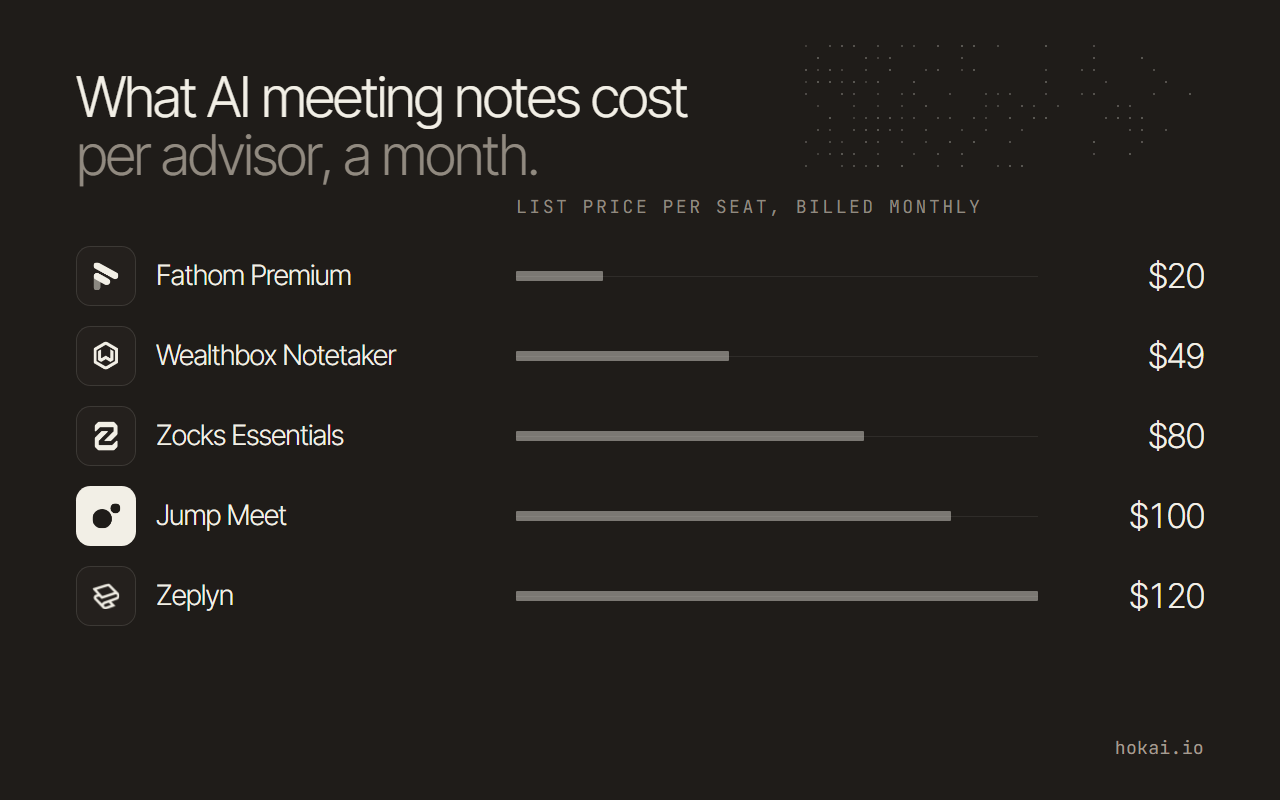 Hokai chart of the list price per advisor seat, paid monthly, read on the Fathom, Wealthbox, Zocks and Jump pricing pages on 26 November 2026; Zeplyn's price is the one Wealth Management reported on 24 July 2026. Annual billing is cheaper on every plan that offers it.
- Jump Meet, per advisor a month
- $100
- Jump pricing page, 26 Nov 2026
- Zocks Essentials, per user a month on annual billing
- $67
- Zocks pricing page, 26 Nov 2026
- How long an RIA keeps advice records
- 5 years
- SEC Rule 204-2
- FINRA's default when no other period applies
- 6 years
- FINRA Rule 4511(b)
How to choose: five questions that settle it before any demo
These work even if you ignore every product named later. Ask them of any vendor, including the one your CRM sells you.
- Is a recording kept, and who decides? Some tools keep audio, some never do, and Jump lets the firm choose per advisor group.
- Does it write fields into your CRM, or paste a note? A pasted summary still leaves someone to update the client's goals, beneficiaries and tasks by hand.
- Where does the approved note get archived? Jump and Zocks both name Smarsh, Global Relay and Proofpoint as archive routes on their compliance pages; ask your compliance team which one your firm uses.
- Does a human approve before anything leaves? FINRA's 2026 oversight report lists human-in-the-loop review of model outputs among the controls it expects firms to consider.
- What does it cost for your whole team, with the add-ons you will actually use? Several vendors sell meeting notes cheaply and charge separately for onboarding, signals or document reading.
A firm with a chief compliance officer should send question 1 to that person first.
The shortlist: one table, six jobs
| Tool | Best for | Price from | The one caveat |
|---|---|---|---|
| Jump | Most firms, any CRM | $100 per advisor a month | No free trial listed |
| Zocks | No stored audio, self-serve trial | $67 per user, annual | Trial needs a card |
| Zeplyn | Larger RIAs building agents | $120 per seat, reported | No public price list |
| Wealthbox | CRM with AI built in | $65 per user | Notetaker is $49 extra |
| Redtail CRM | Cheapest advisor CRM | $39 per user, annual | No native AI |
| Holistiplan | Tax prep before reviews | $749 a year, 30 households | Federal returns only |
Jump leaves the recording choice to compliance: its compliance page offers both a no-recording mode and retained recordings. Its Meet plan joins Zoom, Teams, Google Meet, Webex and phone calls, records in-person meetings on iOS and Android, and has notes, tasks and a draft follow-up ready within a minute, according to its notetaker page. It runs embedded inside Redtail and syncs to Wealthbox, Salesforce and HubSpot. Jump said in February 2026 that 27,000 advisors used it after an $80 million Series B.
Zocks is built for privacy. It takes notes without keeping a recording, lets a firm delete transcripts on a schedule set by the hour, and fills intake and account forms from what was said; Schwab Advisor Services accepts account applications from it directly. It is also the only one of the three advisor notetakers with a 14-day trial you can start yourself.
Zeplyn also discards audio once notes are processed, and adds Agent Nexus, which runs a firm's own written playbooks as agent workflows. It suits RIAs with an operations team and IT requirements such as single tenancy.
Recording or no recording: what the rules actually require
This is a decision about records, not features. An AI note that an advisor approves and saves to the CRM is a written record of what was discussed and recommended.
For a registered investment adviser, SEC Rule 204-2(a)(7) requires keeping written communications relating to any recommendation or advice given, and the rule's retention clause says records are preserved for not less than five years, the first two in an appropriate office. For a broker-dealer, FINRA Rule 4511(b) sets six years for any record with no other specified period, and 4511(c) requires the format to meet SEA Rule 17a-4.
Neither rule tells you to record a meeting. Jump's compliance page puts it plainly: neither Rule 204-2 nor FINRA Rule 4511(b) requires a recording, but if you treat a recording or transcript as books and records, retention and supervision obligations follow. So a recording you keep is a second record you must store, supervise and produce in an exam.
| Tool | Keeps client audio? | Transcript retention | Archive route |
|---|---|---|---|
| Jump | Firm's choice | Set by firm storage policy | Global Relay, Smarsh, Proofpoint |
| Zocks | No | Delete by hour, day or month | Smarsh, Global Relay, Proofpoint |
| Zeplyn | No, discarded after notes | Not published | WORM-compliant storage options |
| Wealthbox Notetaker | Yes, switched per meeting | Not published | Inside the CRM |
FINRA's 2026 Annual Regulatory Oversight Report says its rules are technologically neutral and apply to generative AI as to any tool, and that summarization and information extraction is the top generative AI use among member firms. Its suggested controls include storing prompt and output logs, tracking which model version was used, and human review of outputs. Ask each vendor in the demo whether it keeps those logs and who at your firm can export them.
What it costs a three-advisor team
The notetaker is half the bill. Most practices also pay for the CRM it writes into, so the real number is the pair. These totals use list prices read on 26 November 2026, three advisors, and the cheapest plan that includes meeting notes.
| CRM plus notetaker | CRM, 3 seats | Notes, 3 seats | Monthly total |
|---|---|---|---|
| Redtail Launch + Zocks Essentials | $117 | $201 | $318 |
| Wealthbox Basic + Wealthbox Notetaker | $195 | $147 | $342 |
| Wealthbox Basic + Zocks Essentials | $195 | $201 | $396 |
| Redtail Launch + Jump Meet | $117 | $300 | $417 |
| Redtail Launch + Zeplyn | $117 | $360 | $477 |
Each price assumes the billing its vendor's page shows: annual for Redtail, Wealthbox and Zocks, and the monthly list price for Jump, which takes up to 20% off for paying annually. Redtail's Launch plan is also capped at five users.
Totals from the Redtail, Wealthbox, Zocks and Jump pricing pages and Wealth Management's report of Zeplyn's seat price.
Two published numbers move these totals. Kitces reported in April 2026 that Jump had cut its notetaker price and quoted a lower rate for smaller firms that its pricing page does not show today. And Jump's Onboard and Grow modules cost $50 per advisor a month each, so a team that wants signals and form-filling as well doubles its Jump bill.
CRM sync: Redtail, Wealthbox or Salesforce
The CRM decides how much the notetaker can do. A notetaker that writes fields, not just text, saves the second half of the admin hour.
Redtail CRM, owned by Orion, cites the 2026 T3/Inside Information survey for the top advisor CRM market share. It has no built-in AI assistant on its plans, so AI arrives through partners: Jump runs inside Redtail's own screens. Redtail's Growth plan adds Speak, compliant client texting, and the separate Redtail Email product archives every client email, which keeps two other books-and-records channels next to the client file.
Wealthbox went the other way. Every plan includes an AI assistant and agents that triage new contacts or review the pipeline on a schedule, and its own AI Notetaker writes summaries onto the contact record for $49 per user a month. Kitces wrote in April 2026 that Wealthbox's position is that AI acting on client data belongs inside the system of record, and that AI-native rivals had moved faster.
Firms on Salesforce are covered too: Jump, Zocks and Zeplyn all list Salesforce among their CRM integrations, so the notetaker choice does not hinge on it.
Prospecting and client-review prep
For review prep, Holistiplan reads a client's federal return by OCR and builds a tax review, including a Solve for Max button that finds the income room before the next marginal rate, a common starting point for Roth conversions.
Basic Tax costs $749 a year for 30 households, shared by any number of users. It does not read corporate, state-only or trust returns. The notetakers help here too: Jump and Zocks both build a pre-meeting brief from the CRM and past notes, and Wealthbox's assistant answers questions about any client in plain words.
For prospecting, FINNY assigns each prospect an F-Score for likelihood to convert and runs an AI agent that plans and sends campaigns in the advisor's voice; it says it holds an ongoing SOC 2 Type 2 examination. Inside existing books, Jump's Grow add-on flags held-away assets and referral mentions, Zocks' Client Signals catch life events in conversations and email, and Zeplyn mines a book for required minimum distributions and idle cash. All three work from conversations your firm already holds.
General assistants such as ChatGPT and Claude can draft a client letter or explain a Roth conversion in plain words. FINRA's report is clear that communications and recordkeeping rules still apply, so anything one drafts for a client goes through the same review and archive as an email you wrote yourself.
Who should skip the advisor-built tools
The obvious objection: a $100 seat is a lot for an advisor with eight meetings a month. For a practice with few meetings, the numbers favour a general notetaker.
Fathom has a free plan with unlimited recordings and Premium at $16 a user a month on annual billing, per its pricing page. It writes meeting summaries, but nothing maps them to CRM fields, nothing routes them to Smarsh, and it keeps recordings. A solo RIA with light meeting volume, no broker-dealer archive to feed and a willingness to paste notes into Redtail by hand can live with that. The AI meeting assistants guide compares Fathom with Fireflies, Otter and the rest.
The second group that should skip: advisors already on Wealthbox who meet mostly in person and do not mind recordings. The $49 add-on writes straight to the contact record, with no second vendor to put through due diligence.
None of the advisor-built products could be exercised for this guide without an account: Jump and Zeplyn sell through demos, and the Zocks trial needs a card. The outside test we can point to is an advisor quoted by Financial Planning, whose team says Jump saves at least 30 minutes per meeting.
Jump or Zocks: the head-to-head most firms face
| Jump Meet | Zocks Essentials | |
|---|---|---|
| Price per advisor, monthly billing | $100 | $80 |
| Keeps a recording | Firm's choice | Never |
| Self-serve trial | Not listed | 14 days, card needed |
| Forms from conversations | $50 Onboard add-on | In its plan comparison |
Pick Jump if your firm wants the option of recordings for coaching or supervision, runs Redtail and wants notes inside it, or needs one tool across Salesforce, Wealthbox and HubSpot teams. Kitces research rated it highest in advisor satisfaction among notetakers. Pick Zocks if your compliance officer would rather never hold client audio, or if you want to test on real client reviews before talking to sales.
To weigh these against your own CRM and meeting mix, Smart Match ranks the AI meeting assistants on Hokai.
The next change to watch is the CRM vendors closing the gap: Wealthbox already bundles a notetaker, and Kitces wrote in April 2026 that momentum in advisor AI is shifting from standalone startups to the bigger incumbents. If Redtail ships one inside its own plans, the cheapest stack in the table above changes overnight.
Frequently asked questions
Do AI meeting notes count as books and records for an RIA?
An approved AI summary of a client meeting is a written record of advice discussed, and SEC Rule 204-2 requires an RIA to keep written communications relating to advice for at least five years, the first two in an appropriate office. Firms should decide in writing whether the summary, the transcript or a recording is the record. Confirm the policy with your compliance counsel.
Do SEC or FINRA rules require advisors to record client meetings?
No. Neither SEC Rule 204-2 nor FINRA Rule 4511 requires a recording to be made. If a firm chooses to keep recordings or transcripts as books and records, retention and supervision duties then apply to them as well.
Which AI notetaker for advisors does not record meetings?
Zocks keeps no meeting recording, and Zeplyn discards the audio once notes are processed. Jump offers a no-recording mode that purges cached audio after the summary is made, or a retained recording if the firm prefers one.
Can I use a free notetaker like Fathom as a financial advisor?
You can, and Fathom's free plan has unlimited recordings. It will not map notes to CRM fields or send them to your firm's archive, and it keeps recordings, so broker-dealer reps should check with compliance first.
Is Wealthbox's built-in notetaker good enough?
For a small team already on Wealthbox that is comfortable keeping recordings, the $49 add-on is the simplest choice because notes land on the contact record with no second vendor. Firms that want a no-recording mode or archiving to Smarsh or Global Relay should compare Jump or Zocks.
Covered in this guide
- Jump: AI notetaker and assistant for financial advisors that writes client meeting notes within a minute and syncs them to the CRM, used by 27,000+ advisors.
- Zeplyn: Recording-free AI meeting assistant and agent platform for wealth management firms, which says it saves advisors 12+ hours a week on admin.
- Zocks: Privacy-first AI assistant for financial advisors that takes meeting notes without keeping recordings, used by more than 5,000 advisory firms.
- ChatGPT: ChatGPT is OpenAI's AI assistant, with 1.2 billion weekly users by OpenAI's count, the GPT-6 model family and plans that run from a free tier to a premium Pro tier.
- Claude: Claude is Anthropic's AI assistant, with a free tier, Pro, Max and Ultra personal plans, and Team and Enterprise seats. Opus access starts at Pro.
- Fathom: AI notetaking for meetings - summarize conversations to focus on what matters
- Holistiplan: Tax-planning software for financial advisors that reads a client's federal return with OCR and flags planning opportunities, sold by household band.
- Redtail CRM: Advisor CRM from Orion with compliant texting and email archiving, holding the top CRM market share in the 2026 T3/Inside Information survey.
- Wealthbox: CRM for financial advisors with a built-in AI assistant, agents and an optional notetaker, used by thousands of advisory firms since 2014.
Sources
Still deciding?
This guide covers a handful of options. Smart Match checks every listing in the directory against how you actually work and what you can spend, then hands you the shortlist and the reason behind each pick.
Find your tools