Best AI for Accountants and Bookkeepers in 2026: What Each Tool Does With Client Data
AI for accountants in 2026 covers four jobs: bank-feed categorization, receipt and invoice capture, accounts payable, and advisory reporting. Booke AI, Dext, Digits, Vic.ai and Fathom lead those jobs, and they differ most on whether they run their own models, named outside models, or say little about client data training.
The short version
Booke AI wins bank-feed bookkeeping inside QuickBooks Online and Xero, and Dext wins receipts. Digits suits clients starting fresh, Vic.ai high-volume payables and Fathom advisory reports. Check each vendor's data stance in writing: Xero's models do not learn from your clients, and Intuit's privacy statement reserves more room.
Not sure which one fits you? Describe your situation and Smart Match names three tools.Find my AI tools
In this guide9 sections
For most accounting firms on QuickBooks Online or Xero in November 2026, the AI to start with is Booke AI for the bank feed and Dext for receipts and supplier paper. The harder question is what each tool does with a client's books once its AI has seen them.
On that, even the two big ledgers disagree. Xero says the models behind its JAX assistant do not train on what you send. Intuit's own policy page lists customer data among what its in-house AI learns from. What separates these tools for a firm is whether the vendor will put its answer in writing.
This guide covers the books: bookkeeping, capture, payables and reporting. Tax research, return preparation and practice management tools such as TaxDome and Canopy are a separate purchase and are not ranked here.
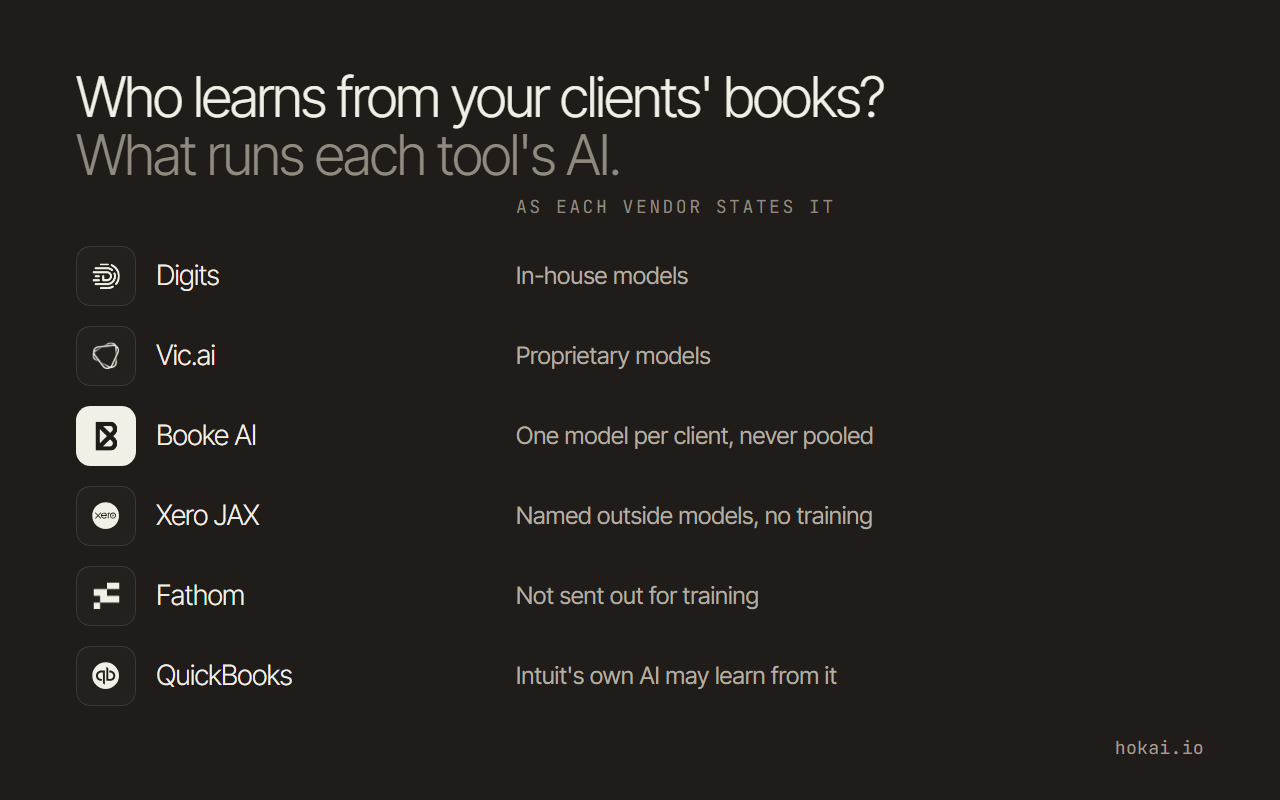 Hokai chart of what each vendor says runs its AI and whether client data trains it, read on each vendor's security, privacy or AI page on 26 November 2026.
- Booke AI, per business a month
- $129
- Booke pricing page, 26 Nov 2026
- Dext Practice Essentials, per client a month
- $17.70
- Dext partner pricing, 26 Nov 2026
- Transactions behind Digits' own models
- 170 million
- Digits AGL page, 26 Nov 2026
- Vic.ai's stated no-touch invoice rate by month 6
- 85%
- Vic.ai homepage, 26 Nov 2026
How to choose: four questions to put to any vendor
The shortlist below is one answer. These four questions are the method, and they hold for any accounting AI a vendor pitches you, including the one inside your ledger.
- Which job is the bottleneck? Bank-feed categorization, paper capture, supplier invoices at volume, and the advisory pack after close are four different products.
- Does it work inside your ledger, or replace it? An add-on keeps the client in QuickBooks Online or Xero. A new ledger means moving years of history.
- What runs the AI, and does client data train it? You want the model named, or at least the training stance stated, on a page you can link in an engagement letter.
- Which audit report can you download? SOC 2 Type II or ISO 27001 from the vendor itself, not "we host on AWS".
If a vendor cannot answer question 3 in one sentence, you have your answer.
The shortlist: one table, five jobs
| Tool | The job | Price from | The one caveat |
|---|---|---|---|
| Booke AI | Bank feed inside QBO or Xero | $129 per business a month | No SOC 2 report of its own |
| Dext | Receipts and supplier invoices | $17.70 per client a month | 10-client minimum for firms |
| Digits | AI-run ledger for new clients | $65 a month | Replaces the client's ledger |
| Vic.ai | Accounts payable at volume | Quote only | No public price |
| Fathom | Advisory reports and commentary | $59 per company a month | Per-company cost adds up |
Prices are the vendors' monthly list prices, read on 26 November 2026. The ledgers themselves are covered further down, and every finance tool Hokai tracks sits in the AI tools for financial services list.
Booke AI handles the job most firms mean by "AI bookkeeping". You invite it as a user to a client's QuickBooks Online file or connect a Xero organisation, and every day it categorizes bank-feed lines, matches them to invoices, bills and receipts, and asks the client for missing documents. Low-confidence items come to your team with a suggested treatment. The bank connection stays as it is.
Dext does the paper. Receipts and supplier invoices arrive by app, email or WhatsApp, Dext extracts line items and codes them, and it publishes into more than 36 accounting platforms. Its site counts over 12,000 accounting and bookkeeping firms among its users. Firm plans start at $17.70 per client a month with a 10-client minimum, so a practice with three clients pays for ten.
What is actually inside: own models, outside models, or a chatbot
The question "is this just a ChatGPT wrapper?" has a practical form. Ask what model does the work and who else learns from the data. Here is what each vendor says on its own pages.
| Tool | What runs the AI | Client data trains it? | Own audit report |
|---|---|---|---|
| Digits | In-house models | Not stated | SOC 2 Type II |
| Vic.ai | Proprietary models | Not stated | SOC 1 and SOC 2 Type II |
| Booke AI | A separate model per client | Only that client's own | None; SOC 2 hosting |
| Xero JAX | AWS, Azure, GCP, OpenAI | No | ISO 27001, SOC 2 |
| Fathom | Model not named | No, not externally | ISO 27001, SOC 2 Type 2 |
| Dext | Not stated | Not stated | ISO 27001:2022 |
| QuickBooks | Intuit, with OpenAI and Anthropic | Intuit may; partners may not | Not checked |
The first two are the furthest from a wrapper. Digits says its models were trained on more than 170 million transactions worth $875 billion, and that it uses custom language models to read statements and invoices. Vic.ai's trust page says its models were trained on over 1 billion invoices and that it holds SOC 1 Type II and SOC 2 Type II, renewed annually.
Booke AI takes a third route. Its data handling page answers "does Booke train models on my client data?" with a plain no: each account gets its own isolated model, with separate keys, and nothing is pooled across clients. It deletes everything, backups included, 30 days after you cancel. The gap is the audit: Booke says it runs on SOC 2 certified clouds but claims no SOC 2 report of its own, and its subprocessor list comes by email.
Xero and Fathom are the honest version of a language-model layer. Xero names its model providers in its JAX FAQ and says the data they process is not used to train them. Fathom fences its Commentary Writer to the report figures a user selects, at trial balance level, and says client data is not sent to external models for training. Neither is a wrapper in the bad sense. Both tell you where the data goes.
The ledger you already have: QuickBooks Online and Xero
Before buying an add-on, look at what your clients' ledgers already include, because both now sell AI as part of the plan.
| Ledger | Entry plan | Where the AI starts | Data stance |
|---|---|---|---|
| Xero | Early, $27 a month | JAX on every plan | Outside models, no training |
| QuickBooks Online | Simple Start, $38 a month | Accounting AI on Essentials, $85 | Intuit may train its own AI |
Xero's JAX FAQ says JAX chat is available to every subscriber and answers only within each user's permissions. Automatic reconciliation starts on the Growing plan at $59. Xero's security page lists ISO/IEC 27001:2022 and SOC 2 reports that customers can download after logging in.
QuickBooks Online gates its AI by plan. Simple Start gets an AI chat marked beta; Accounting AI, Payments AI and Business Tax AI start on Essentials at $85; Finance AI needs Advanced at $340. Every paid plan includes two accountant seats. On data, Intuit's blog of 21 July 2026 says its contracts bar OpenAI and Anthropic from training on customer data, while its responsible AI page lists customer data, under its Global Privacy Statement, among the material Intuit uses to train its in-house AI.
If your engagement letters promise clients that their books feed no model, read Intuit's privacy statement before switching the QuickBooks AI on.
What it costs a ten-client firm
The vendors price by different units, which hides the real comparison. Here is the monthly list price at each tool's entry point, as each one sells it.
From each vendor's own pricing page. Units differ: Dext and Fathom are per client, the ledgers per business.
For a firm with ten small clients on Xero, the add-ons dominate the bill.
| Add-on | Ten clients a month | Note |
|---|---|---|
| Dext Practice Essentials | $177 | The 10-client minimum |
| Fathom Pro | $590 | Fathom Portfolio covers 100 for $67 |
| Booke AI Business | $1,290 | Firm plan priced on request |
Booke only pays off where a client's bank feed takes real staff hours, and its firm plan may come in lower than the per-business list price. Fathom's Portfolio plan is for watching a client base, not for full reports.
Vic.ai publishes no price at all. Its homepage claims an 85% no-touch rate by month six, 99% invoice accuracy without setup, and a seven-month payback, which tells you who it is sold to: finance teams with enough invoices that a quote-only contract makes sense.
Where each one fits
| If your bottleneck is | Pick | Why |
|---|---|---|
| Bank-feed categorization in QBO or Xero | Booke AI | Works inside the existing file |
| Receipts and supplier paperwork | Dext | Codes and publishes to 36+ ledgers |
| A new client with messy or no books | Digits | Its own models run a fresh ledger |
| Hundreds of supplier invoices a month | Vic.ai | SOC 1 and SOC 2, built for AP |
| The monthly advisory pack | Fathom | AI commentary fenced to the report |
| Close workpapers on Sage Intacct | Truewind | Built for close on QBO and Intacct |
Digits is the one that changes the ledger. It runs categorization and reconciliation continuously on its own models, connects to more than 12,000 banks, cards and payroll providers, and charges no per-seat fee on any plan. It also ships a developer API and an MCP server. The cost is the move: a client on QuickBooks or Xero has to leave it.
Vic.ai is the specialist for accounts payable inside larger finance teams, with VicInbox for invoices, VicPay for payments and VicAgents for approvals. Truewind prepares close workpapers for firms on QuickBooks Online or Sage Intacct. A solo owner who only wants the bank feed sorted can look at Kick. If your bottleneck sits outside this list, Smart Match matches it to a tool from a short description of the work.
Fathom deserves its own line. Its Commentary Writer drafts the narrative under the charts in a management report, and every figure it cites shows its source on hover. On the Xero App Store it carries 4.96 out of 5 from 629 reviews, read on 26 November 2026.
Who should skip the add-ons and stay put
The best argument against buying any add-on is that the ledgers are catching up. Xero already includes JAX on its $27 plan, and QuickBooks' Accounting AI does categorization and reconciliation work inside Essentials. For a firm whose clients have light, regular bank feeds, an add-on at $129 per business duplicates what the ledger now does for free.
That is true for simple clients, and it is why Booke is not the pick for everyone. The add-ons win on two things the ledgers do not offer. Booke's per-client model and 30-day deletion give a cleaner data story than Intuit's, and Dext's capture covers paper the ledger never sees. Where neither matters, use the ledger's AI and skip the add-on.
The other wrong pick is a general chatbot. OpenAI's help page says that on personal plans (Free, Plus and Pro) it may use your content to train its models unless you switch off "Improve the model for everyone". Pasting a client's ledger into a personal ChatGPT account is the one move here that can put client data into a model's training set. ChatGPT Business and Enterprise do not train on business data by default, and OpenAI will sign a data processing addendum for them.
What users report
No product on this list can be tried without an account, so Hokai did not run one for this guide. The best outside evidence is the Xero App Store, where accountants review the add-ons they use.
- Dext holds 4.81 out of 5 from 1,121 reviews. A reviewer on 11 November 2026 called it the employee who never takes a day off, for extracting scanned invoices into Xero.
- Fathom holds 4.96 out of 5 from 629 reviews. A reviewer on 20 November 2026 expected a bot in the support chat and got a person who fixed an update problem within an hour.
- Booke cites 4.6 out of 5 from 120 ratings on the QuickBooks App Store on its own pricing page.
If your firm also manages wealth clients, the notetakers and CRMs in the guide to AI for financial advisors cover the meeting side this guide leaves out.
The decision, in one line each
Before signing with any bank-feed add-on, ask for its subprocessor list. Starting a client from scratch: Digits. Hundreds of supplier invoices: get a Vic.ai quote. Selling advisory: Fathom. Clients with light, regular bank feeds: switch on the AI already in Xero, or read Intuit's privacy statement before switching on QuickBooks'.
The next change to watch is the ledgers' own AI. When QuickBooks or Xero match Booke's per-client data promise, the bank-feed add-on becomes a harder sell.
Frequently asked questions
What is the best AI tool for bookkeeping in QuickBooks Online or Xero?
For the daily bank feed, Booke AI works inside an existing QuickBooks Online or Xero file, categorizing and matching transactions and sending exceptions to your team. It costs $129 per business a month, with firm pricing on request. Firms whose problem is paper receipts should add Dext instead or as well.
Is it safe to put client financial data into ChatGPT?
Not on a personal plan with default settings: OpenAI says it may use content from Free, Plus and Pro accounts to train its models unless you turn off Improve the model for everyone. ChatGPT Business and Enterprise do not train on business data by default and offer a data processing addendum. A tool built for accounting with a published audit report is the safer route for client books.
Does QuickBooks use my clients' data to train its AI?
Intuit's responsible AI page says it trains its own AI on customer data as described in its Global Privacy Statement. Its July 2026 blog says its contracts with OpenAI and Anthropic forbid those partners from training on customer data. Firms that promise clients no AI training should read the privacy statement before enabling QuickBooks' AI.
Which accounting AI tools are SOC 2 compliant?
On their own pages, Digits states SOC 2 Type II, Vic.ai SOC 1 and SOC 2 Type II, Fathom a SOC 2 Type 2 report with ISO 27001, and Xero SOC 2 reports with ISO 27001. Dext lists ISO 27001:2022. Booke AI says it is hosted on SOC 2 certified clouds but does not claim its own report.
How can I tell if an accounting AI tool is just a ChatGPT wrapper?
Ask the vendor which model does the work and whether client data trains it, and ask for the answer on a page. Digits and Vic.ai run their own trained models, Xero names its providers and says they do not train on your data, and Fathom fences its AI to report figures. A tool that cannot answer either question is the one to worry about.
Covered in this guide
- Booke AI: AI bookkeeper that works the bank feed inside QuickBooks Online and Xero, categorizing and matching daily; used by 10,000+ businesses, it says.
- Dext: Receipt, invoice and bank-feed capture for bookkeepers that reads documents and publishes them to 36+ ledgers; used by over 12,000 accounting firms.
- Digits: AI-native general ledger that categorizes and reconciles transactions on its own models, trained on 170 million transactions; SOC 2 Type II.
- Fathom: Management reporting, forecasting and consolidation for accountants, with an AI Commentary Writer; rated 4.96 out of 5 by 629 Xero App Store users.
- Vic.ai: AI-powered accounts payable automation for 10,000+ customers. Processes 500M+ invoices with 99% accuracy.
- ChatGPT: ChatGPT is OpenAI's AI assistant, with 1.2 billion weekly users by OpenAI's count, the GPT-6 model family and plans that run from a free tier to a premium Pro tier.
- Kick: Kick is an AI bookkeeping platform that automates categorization and reporting for 5,000+ business owners and their accountants.
- QuickBooks Online: Intuit's cloud ledger for small businesses, with AI helpers for bookkeeping, payments and tax that grow with the plan, and 2 accountant seats on each.
- Truewind: AI accounting agent that turns bank statements into journal entries for QuickBooks Online and Sage Intacct; the vendor cites 500+ accountants.
- Xero: Cloud accounting ledger with the JAX AI assistant included for every subscriber, plus SOC 2 reports and an ISO security certificate customers can download.
Sources
Still deciding?
This guide covers a handful of options. Smart Match checks every listing in the directory against how you actually work and what you can spend, then hands you the shortlist and the reason behind each pick.
Find your tools