
Last updated: 2026-09-22
Trigger.dev is an open-source TypeScript platform for durable background jobs, launched in 2022 to remove the timeout ceilings that make serverless functions unworkable for long AI agent tasks. Its checkpoint-resume design restores a task's exact state after any restart or failure, with automatic retries and idempotent execution handled for you.
About Trigger.dev
Trigger.dev is an open-source, TypeScript-native platform for durable background jobs and AI agents, founded in 2022 in London. The team has raised $20.3M in funding, including a $16M Series A led by Standard Capital, and releases the core engine under an open-source license carrying roughly 16.4k GitHub stars. It sits in HokAI's AI orchestration category alongside the workflow tools it most often gets shortlisted against.
Its checkpoint-resume architecture snapshots a running task's full state at each wait point and restores it on recovery, which is what lets jobs keep going past the limits that stop ordinary serverless functions. Tasks are written as plain async TypeScript, with no special DSL or determinism rules, while the platform handles retries, deduplication, and OpenTelemetry tracing automatically. Trigger.dev ships as a fully managed cloud service or a self-hosted Docker and Kubernetes deployment for teams that need to keep jobs on their own infrastructure. Temporal is the closest enterprise alternative on raw durability guarantees, and n8n covers the same job when a team wants a visual builder instead of code.
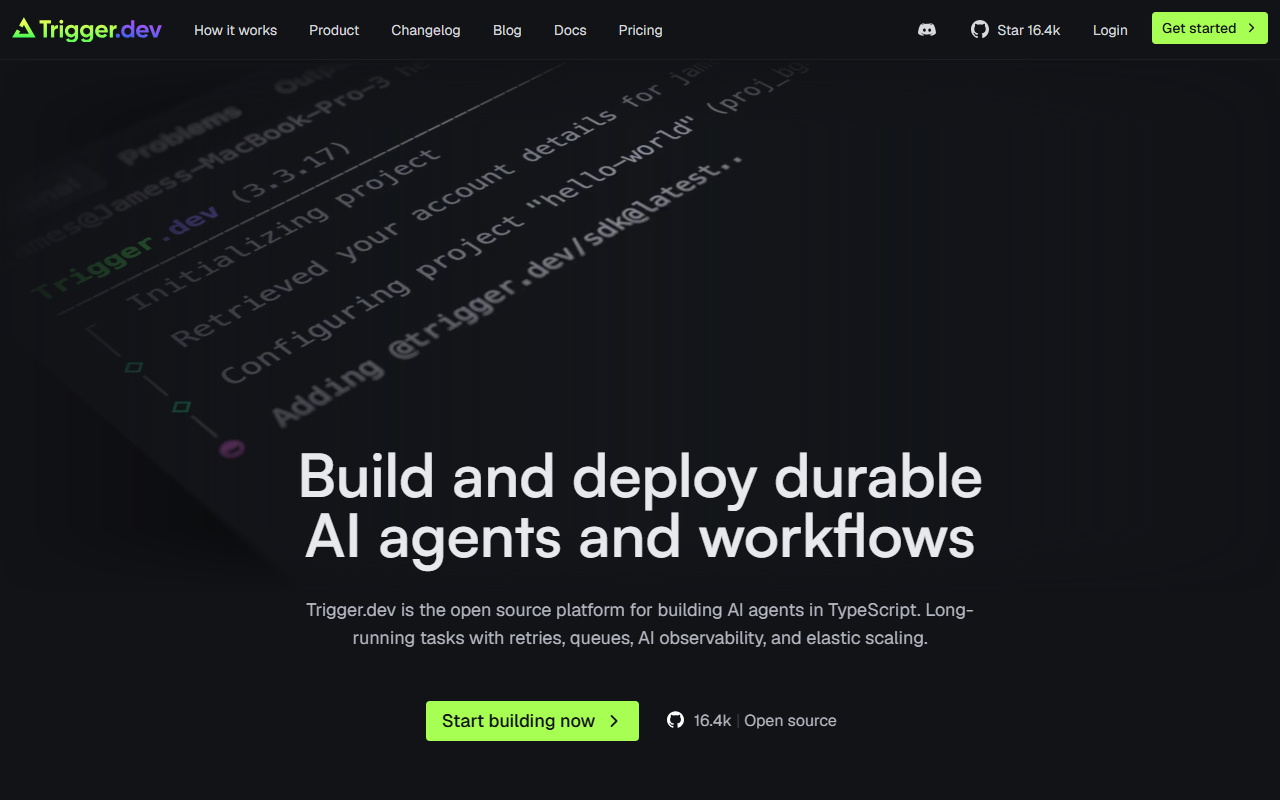
Since mid-2026 the vendor's own homepage leads with a durable AI agents platform (chat.agent) built on the same checkpoint-resume engine: multi-turn chat agents that survive refreshes, redeploys, and process crashes, stream tool calls and output straight to a frontend with no separate API route, and support human-in-the-loop approval steps that consume no compute while waiting. It ships worked patterns for autonomous agents, prompt chaining, routing, parallelization, multi-agent orchestration, and evaluator-optimizer loops, alongside built-in observability for model calls, tokens, cost, and latency. HokAI's Trigger.dev vs Inngest guide and best AI orchestration tools roundup cover how it stacks up against Inngest and the rest of the category in more depth.
Screenshots
Pricing
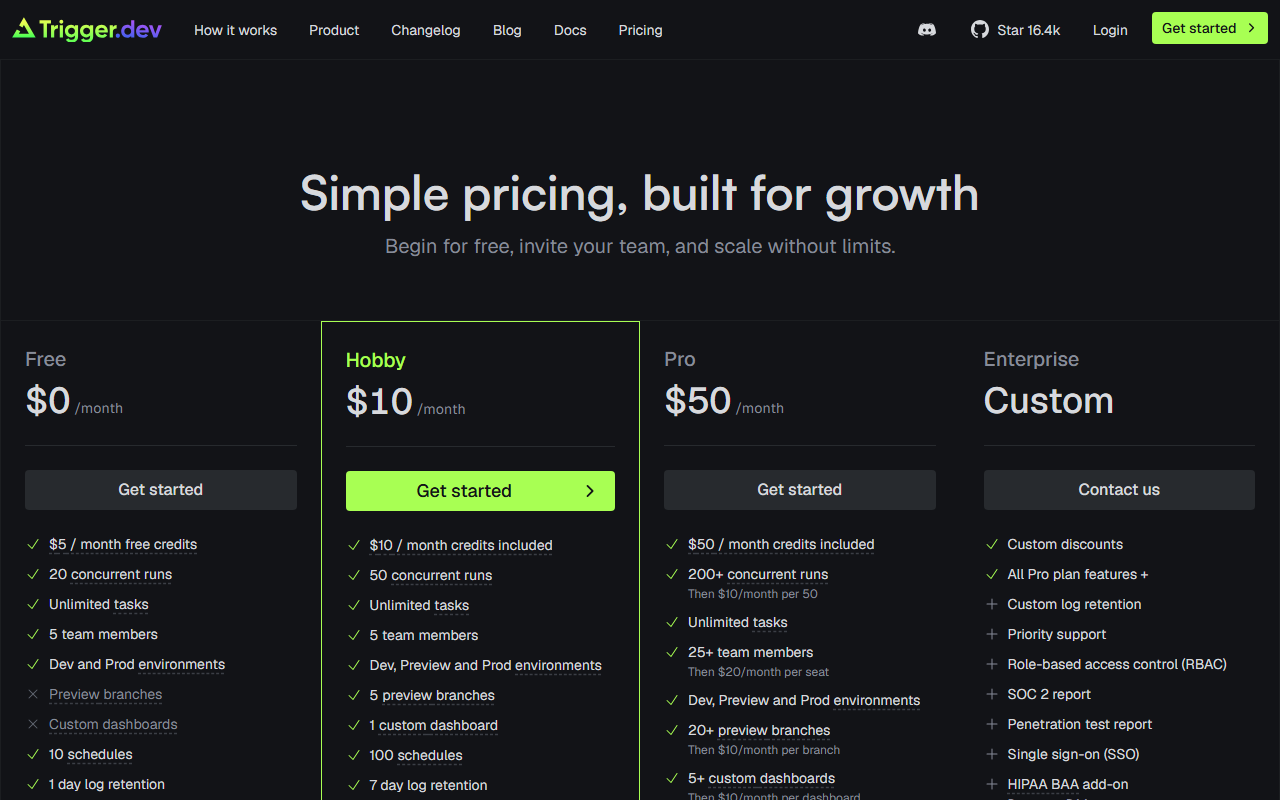
Free: $0/month, 20 concurrent runs, 10 schedules, 1-day log retention. Hobby: $10/month, 50 concurrent runs, 100 schedules, 7-day logs. Pro: $50/month, 200+ concurrent runs, 1000+ schedules, 30-day logs, 25+ team members.
Enterprise: custom pricing. 000025 per run invocation.
| Tier | Monthly price | What it includes |
|---|---|---|
| Free | Free | |
| Hobby | $10/mo | per-second execution, per-run invocation |
| Pro | $50/mo | per-second execution, per-run invocation |
| Enterprise | Custom |
Feature Comparison by Tier
| Feature | Pro | Free | Hobby | Enterprise |
|---|---|---|---|---|
| Concurrent runs | 200+ | 20 | 50 | Custom |
| Team members | 25+ | 5 | 5 | Custom |
| Log retention | 30 days | 1 day | 7 days | Custom |
| Preview branches | 20+ | — | 5 | Custom |
| Custom dashboards | 5+ | — | 1 | Custom |
| Monthly usage credit | $50 | $5 | $10 | Custom |
| SOC 2 report | — | — | — | ✓ |
| HIPAA BAA add-on | — | — | — | ✓ |
Key Features
- Durable AI Agents (chat.agent): Multi-turn chat agents built on the same checkpoint-resume engine keep their conversation state through a browser refresh, a redeploy, or a process crash, and wait for a human approval step without burning any compute while idle.
- Checkpoint-Resume Durable Execution: Snapshots exactly where a task left off and resumes it after any restart, letting jobs run for up to 14 days instead of hitting a serverless function's timeout ceiling.
- Plain Async TypeScript, No DSL: Tasks are ordinary async functions; Trigger.dev handles state capture, retries, and idempotency without a workflow-specific syntax or determinism constraints to learn.
- 100+ Native Integrations: Built-in connectors for Slack, Stripe, Linear, GitHub, SendGrid, Notion, OpenAI, Deepgram, Twilio, and Airtable remove the need to hand-write API auth and retry logic.
- Live OpenTelemetry Traces: Every run streams a real-time execution timeline with logs and error detail to a live dashboard, so failures surface immediately instead of requiring log-polling.
- Self-Host or Managed Cloud: Run on Trigger.dev's managed SaaS with no Redis or worker processes to operate, or self-host the same engine via Docker and Kubernetes Helm charts.
Pros
- Removes the serverless timeout ceiling that makes AWS Lambda, Vercel, and Google Cloud Functions unsuitable for long AI agent runs, without asking developers to learn a new orchestration DSL.
- The durable chat-agent primitive gives a multi-turn AI agent crash and redeploy resilience for free, a guarantee most agent frameworks leave to the developer to build themselves.
- Lower operational overhead than Temporal or BullMQ-style setups: no Redis instance, no worker pool, and no Kubernetes cluster to keep patched when you use the managed cloud tier.
- Open-source with an active, sizeable GitHub community, so self-hosting or auditing the engine is possible without vendor lock-in.
Cons
- TypeScript and JavaScript are the primary languages; Python support exists only through a limited extension, so Python-first teams pay a context-switching cost.
- Cloud-tier tasks are capped at a 14-day maximum runtime with no published path to longer durations, so workflows that inherently need weeks of execution require a custom enterprise conversation.
- Local development requires an internet connection to Trigger.dev Cloud; there is no offline or fully air-gapped test mode.
- SOC 2 report access and HIPAA's Business Associate Agreement are gated behind the custom-priced Enterprise tier, not available on Pro.
Product Information
- Cloud
- Yes
- Self-Hosted
- Yes
- Languages
- English
- Training
- Documentation, Changelog, Community Discord, GitHub Discussions
Data Handling
- Compliance
- SOC 2 Type II · GDPR · HIPAA (Business Associate Agreement add-on)
Frequently Asked Questions
How much do you pay for Trigger.dev?
Free costs $0/month with 20 concurrent runs. Hobby is $10/month with 50 concurrent runs and 7-day log retention. Pro is $50/month with 200+ concurrent runs and 30-day retention. Enterprise pricing is custom, and all paid tiers also bill compute time and run invocations separately.
Does Trigger.dev have a free plan?
Yes, the Free plan costs $0/month and includes 20 concurrent runs, 10 schedules, and 1-day log retention. The same durable-execution engine runs underneath, just with lower concurrency and schedule caps than the paid tiers.
Which tools compete with Trigger.dev in 2026?
Temporal is the enterprise alternative, with more mature replay-based durability but a steeper learning curve and infrastructure to run yourself. Inngest is the closest peer, scheduling jobs through its own dashboard instead of running your code directly the way Trigger.dev does.
Trigger.dev or Temporal: which should you pick?
Temporal guarantees exact replay determinism for mission-critical workflows at companies like Stripe and Netflix, but that requires writing deterministic workflow code and operating your own worker infrastructure. Trigger.dev trades some of that rigor for speed: plain async TypeScript, a managed cloud tier, and a setup that takes minutes instead of the hours Temporal's client SDKs typically require.
How long does it take to get going with Trigger.dev?
Getting Trigger.dev running takes minutes: install the SDK, define a task as a plain async function, and run it locally with the CLI dev server. Temporal's own client libraries ask for a heavier lift by comparison, so deploying to the free tier here to try checkpoint-resume durability needs no credit card and no dedicated worker setup.
Top Alternatives
- Temporal: Pick Temporal if you need Stripe- or Netflix-scale replay determinism and are willing to run your own worker infrastructure for it.
- Inngest: Pick Inngest if you would rather schedule jobs through a managed dashboard than run your own code directly inside the durable engine.
- n8n: Pick n8n if your team wants a visual, low-code workflow builder instead of writing durable jobs in TypeScript.
HokAI guides covering Trigger.dev
- Trigger.dev vs Inngest: Which Should You Use in 2026?: Trigger.dev and Inngest both push free self-hosting, but their docs warn against it in production. Real 2026 pricing and the agent-pause gap that decides this.
- Best AI Orchestration Tools in 2026: How to Actually Choose: n8n self-hosts free with 2,067 integrations; Zapier bills by task but lists 9,976 apps. Nine AI orchestration tools sorted into the three tiers that matter.