
Last updated: 2026-09-04
Launched in 2021, Inngest is a serverless, event-driven workflow engine for background jobs, scheduled tasks, and multi-step AI pipelines that needs no queue or worker infrastructure to manage. Each function step retries independently instead of restarting the whole run, functions deploy natively alongside Vercel, Cloudflare Workers, or any Node.js backend, and the open-source core engine can be self-hosted.
About Inngest
Inngest is an event-driven durable workflow platform founded in 2021 by Tony Holdstock-Brown and Dan Farrelly. The company has raised $34M across four rounds including a $3M seed in July 2023 from GGV Capital and a $6.1M Series A in January 2024 from Andreessen Horowitz, with a Series B in May 2025. Based in San Francisco with a 9-person team, Inngest lets developers build reliable background jobs, scheduled workflows, and AI agent tasks on serverless platforms without managing infrastructure.
The platform is serverless-first: TypeScript, Python, and Go SDKs deploy alongside your existing app on Vercel, Cloudflare Workers, Hono, or any Node.js backend, with the orchestration engine and dashboard hosted by Inngest rather than self-managed. The core engine is open-source and can be self-hosted, though the cloud product's dashboard, managed infrastructure, and observability stack stay cloud-only. Inngest added MCP (Model Context Protocol) support to its local dev server in 2026, letting Claude Code, Cursor, and other AI assistants connect directly to functions for debugging. The company states in its footer that Inngest is SOC 2 Type II compliant company-wide, with SAML, RBAC, audit trails, and HIPAA BAAs available as Enterprise add-ons.
Inngest competes with Trigger.dev, which runs compute but lacks the event-driven model, Temporal, which is enterprise-grade, self-hosts natively, and carries heavier infrastructure overhead, and traditional queue systems like BullMQ. Reviewers point to the combination of event-driven architecture, zero infrastructure on Vercel, and a free Hobby tier as the main reason early-stage teams pick it over those alternatives.
Screenshots
Pricing
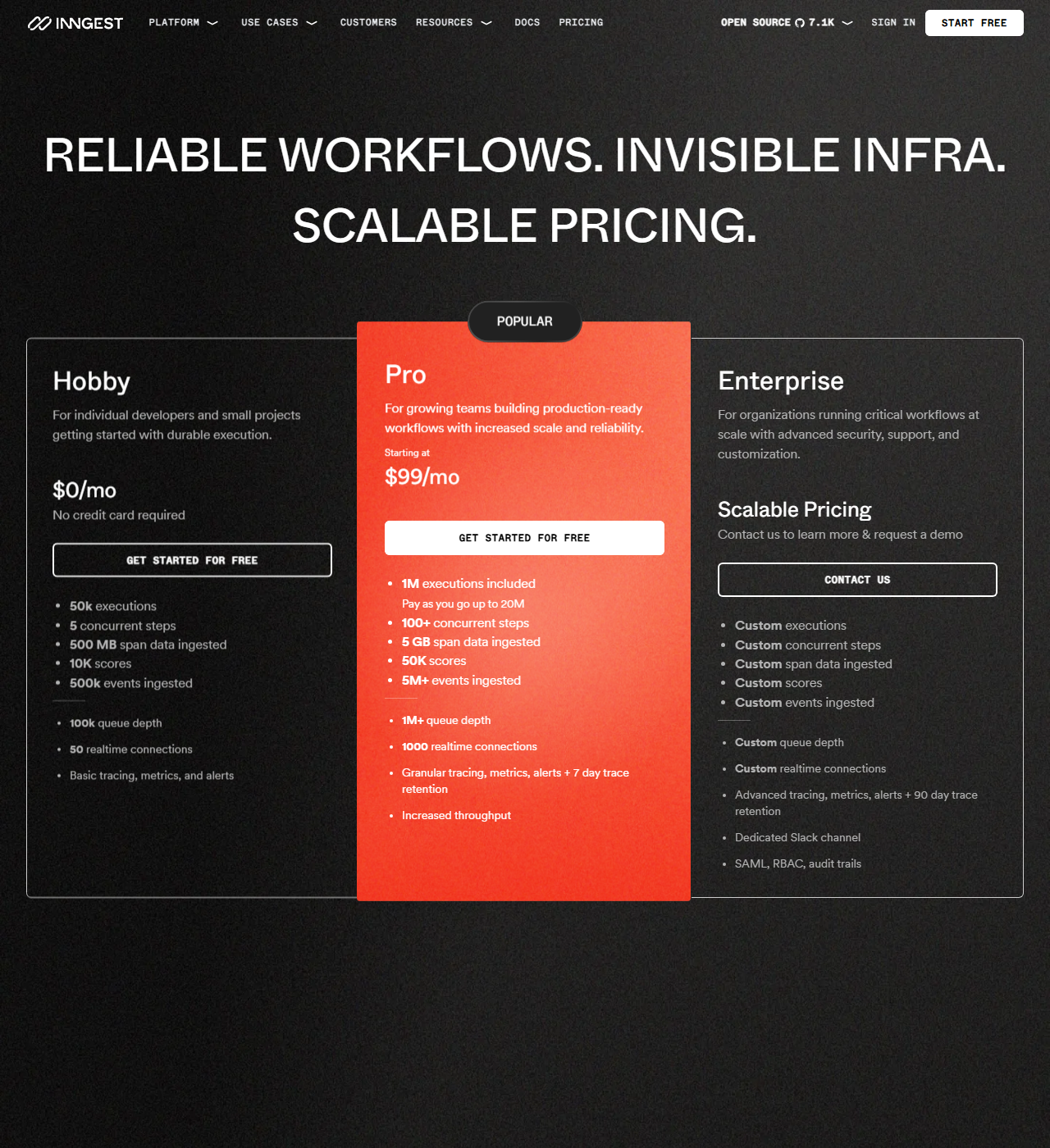
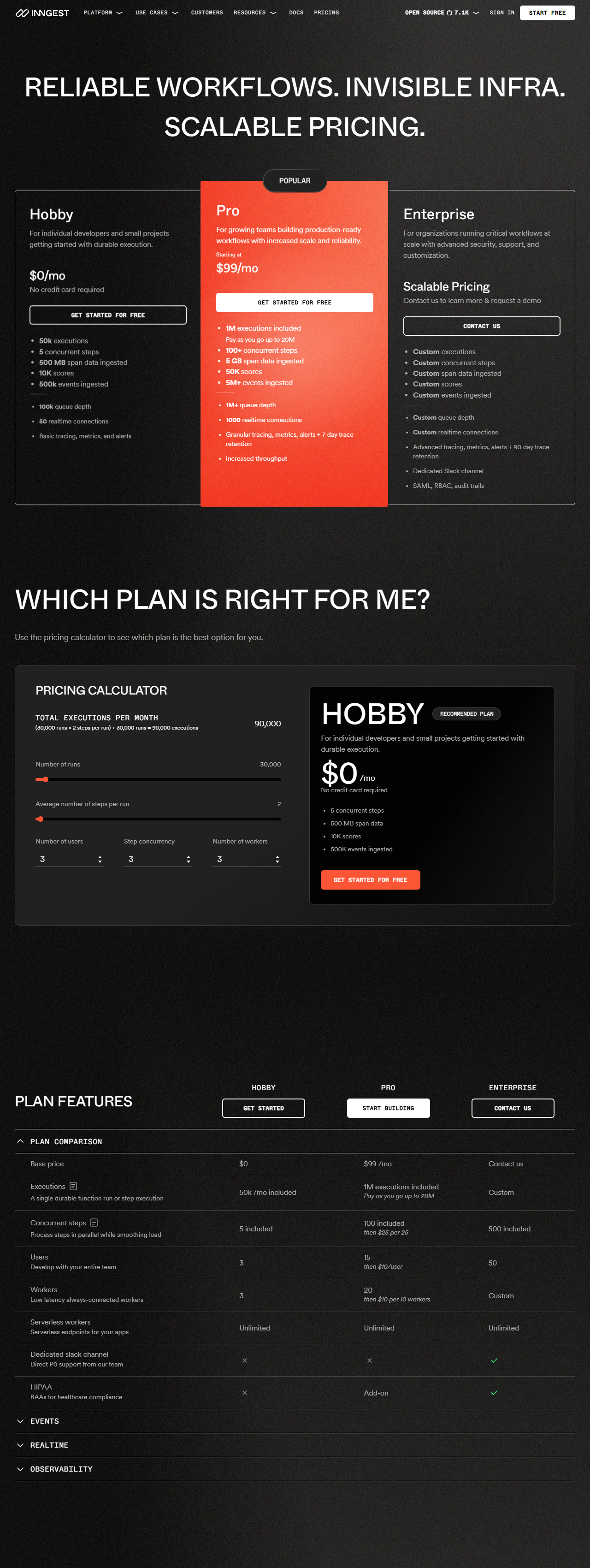
Hobby: $0/month, 50,000 executions and 500,000 events included, 5 concurrent steps, 3 users, 3 workers. Pro: $99/month, 1,000,000 executions included with metered pay-as-you-go overage up to 20M, 100 concurrent steps, 15 users, 20 workers, 5,000,000 events included. Enterprise: custom pricing with SAML, RBAC, audit trails, and HIPAA BAAs.
50 per 1K; execution overage itself is metered at tiered rates Inngest does not publish as a flat figure. All plans include unlimited dev and staging environments, and the core engine can be self-hosted, though the managed dashboard and observability stack are cloud-only.
| Tier | Monthly price | What it includes |
|---|---|---|
| Hobby | Free | 50,000 executions and 500,000 events included per month; pauses when the quota is exhausted |
| Pro | $99/mo | 1,000,000 executions included, pay-as-you-go metered overage up to 20M; event overage $0.50 per 1M events beyond the 5,000,000 included |
| Enterprise | Custom |
Feature Comparison by Tier
| Feature | Hobby | Pro | Enterprise |
|---|---|---|---|
| Price | $0 | $99/mo | Custom, quote only |
| Executions per month included | 50,000 | 1,000,000 (pay-as-you-go to 20M) | Custom |
| Events per month included | 500,000 | 5,000,000 | Custom |
| Concurrent steps | 5 | 100+ | Custom |
| Users | 3 | 15+ | 50 |
| Self-hosting | Core engine only | Core engine only | Core engine only |
| SOC 2 Type II | ✓ (company-wide) | ✓ (company-wide) | ✓ plus SAML, RBAC, audit trails, HIPAA BAAs |
| Trace retention | 24 hours | 7 days | 90 days |
Key Features
- Event-Driven Workflows: Everything is triggered by events, eliminating the need to manage traditional queues or worker processes. Functions respond to events from webhooks, external services, or scheduled triggers.
- Step-Level Durability: Each step is backed by its own queue job with automatic retry on failure, saving costs and complexity compared to queue-level durability approaches used by other platforms.
- Multi-Tenant Flow Control: Built-in concurrency, throttling, rate limiting, prioritization, and debouncing controls handle multi-tenant fairness and reliability without custom implementation.
- Scheduled and Cron Jobs: Schedule jobs to run minutes or weeks into the future, enabling time-delayed workflows, deferred notifications, and reminder systems without additional infrastructure.
- Native Vercel Integration: Automatically syncs deployed code, sets environment variables, and manages infrastructure synchronization when you deploy Next.js apps, eliminating manual setup and worker processes.
- Event History and Replay: Stores full event history for observability, testing, and replay. Re-run failed workflows in bulk or test with historical events without re-triggering real upstream sources.
Pros
- The free Hobby tier is enough for most side projects and early-stage startups to run real background jobs without paying anything upfront.
- Automatic step-level retries mean a single flaky step gets retried in isolation rather than re-running an entire multi-step workflow, which reviewers say saves real debugging time.
- MCP support lets you debug and trigger functions directly from Claude Code or Cursor, a convenience most workflow platforms don't offer yet.
Cons
- The open-source core engine can be self-hosted, but the dashboard, managed infrastructure, and full observability stack are cloud-only, so a self-hosted deployment gives up most of what makes the hosted product easy to run.
- Every piece of workflow logic has to be wrapped in explicit step.* calls with cache keys for resumability, which is more verbose than Trigger.dev's plain async function style.
- Documentation thins out fast for advanced cases like multi-region setups and integration troubleshooting, so non-standard architectures take more trial and error to get working.
- Pro pricing adds up fast once you exceed the included limits: extra users, workers, span data, evaluation scores, and concurrent steps are each billed as separate line items on top of the $99/month base.
Data Handling
- Training-data policy
- Inngest is a workflow orchestration platform, not a model provider, and does not train AI models on customer event or execution data. Trace and log history for observability is retained per plan: 24 hours on Hobby, 7 days on Pro, 90 days on Enterprise.
- Compliance
- SOC 2 Type II (company-wide · per Inngest's own site footer) · SAML/RBAC/audit trails and HIPAA BAAs (Enterprise add-ons)
Frequently Asked Questions
What does Inngest actually cost?
Inngest has three tiers. Hobby is free with 50,000 executions and 500,000 events included per month. Pro starts at $99/month with 1,000,000 executions included, pay-as-you-go metered overage up to 20M, and tiered overage pricing on extra events ($0.50 per 1M), concurrent steps, users, workers, span data, and evaluation scores. Enterprise uses custom pricing that adds SOC 2 Type II, SAML, RBAC, audit trails, and HIPAA BAAs. All tiers include unlimited dev and staging environments.
Can you use Inngest without paying?
Yes, the Hobby plan stays free for good rather than expiring after a set period. It includes 50,000 function executions and 500,000 events per month, 5 concurrent steps, and access for up to 3 team members, enough for most development work and small production apps. Functions pause once the monthly quota is used until the next billing cycle or an upgrade to Pro.
What should you use instead of Inngest?
The closest alternatives are Trigger.dev, which runs your own compute but lacks Inngest's fully event-driven trigger model, and Temporal, which offers deeper workflow control across more languages but requires running or subscribing to a dedicated cluster. Teams wanting a lighter-weight, queue-free option on Vercel or Next.js typically pick Inngest over either.
Inngest or Temporal: which should you pick?
Temporal is the more capable option for complex, long-running, mission-critical workflows across many languages, with deterministic replay, and it self-hosts natively as a dedicated cluster (or via Temporal Cloud). Inngest's open-source core engine can also be self-hosted, but its managed dashboard and observability stack are cloud-only, and functions deploy directly alongside your existing Vercel, Cloudflare, or Node.js app with no cluster required. Teams with deep multi-language enterprise workflows should lean toward Temporal; teams shipping typical web app background jobs in TypeScript or Python usually start with Inngest instead.
What does it take to start using Inngest?
Getting started means creating a free Inngest account, installing the TypeScript, Python, or Go SDK, and writing your first function with an event trigger and one or more step calls. The built-in dev server runs locally so you can test event flows and step retries before deploying to Vercel, Cloudflare, or any Node.js host. Beginners typically have a working scheduled or event-triggered job running within an hour by following the Next.js quick start guide.
Top Alternatives
- Trigger.dev: Trigger.dev opens source with plans from $10/month; Inngest answers with zero-infrastructure Vercel integration and a free Hobby tier.
- Temporal: Temporal handles workflows-as-code with deterministic replay for resilient microservices at large scale; Inngest handles zero-infrastructure background jobs on Vercel or Node.js without a cluster to manage.
- n8n: n8n brings a free workflow automation platform built for technical teams; Inngest brings a code-first, event-driven engine built for developers shipping on Vercel or Next.js.
HokAI guides covering Inngest
- Inngest vs LlamaIndex: Why the Comparison Is the Wrong Question: Inngest and LlamaIndex both surface in AI agent searches, but they solve different layers of the stack: one runs step functions, the other builds RAG pipelines.
- Trigger.dev vs Inngest: Which Should You Use in 2026?: Trigger.dev and Inngest both push free self-hosting, but their docs warn against it in production. Real 2026 pricing and the agent-pause gap that decides this.
- Best AI Orchestration Tools in 2026: How to Actually Choose: n8n self-hosts free with 2,067 integrations; Zapier bills by task but lists 9,976 apps. Nine AI orchestration tools sorted into the three tiers that matter.
- AI Development Services in 2026: Which Layer You Actually Need: AI development services means four separate infrastructure layers, not one purchase: sandboxing, prompt testing, workflow durability, and API governance.