
Built for Grok and X users who want fast, on-platform image generation, not buyers chasing the single top Arena score. Image 2.0 takes up to 5 reference images per generation at up to 2K resolution, then packages the workflow into ready-made templates for product shots and headshots.
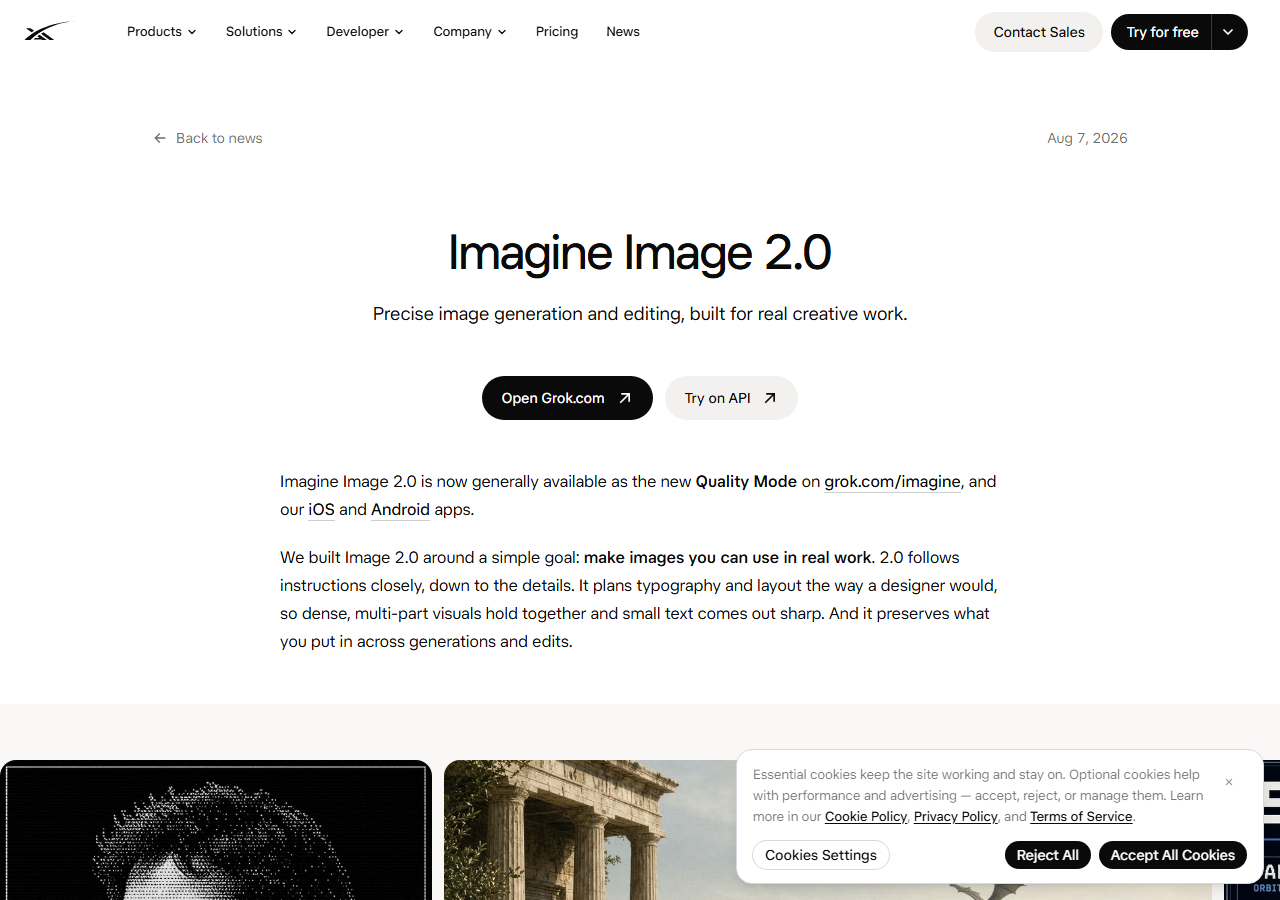
Grok Imagine Image 2.0 is xAI's image generation and editing model, launched August 7, 2026 as the Quality Mode inside Grok Imagine. It ranks #2 worldwide on the Arena text-to-image and image-editing leaderboards, behind only OpenAI's gpt-image-2, and adds region-level editing tools like a magic wand and background removal.
Provider: xAI · Family: Grok Imagine
Input modalities: text, image · Output: image
About Grok Imagine Image 2.0
Grok Imagine Image 2.0 is xAI's second-generation image generation and editing model, shipped August 7, 2026 as the new Quality Mode inside Grok Imagine, the image-and-video product that launched July 28, 2025. The model runs on Aurora, xAI's autoregressive mixture-of-experts image engine first announced December 9, 2024, which generates images token by token the way a language model predicts text, rather than denoising from noise the way diffusion models do. Image 2.0 sits alongside Grok 4.3 and Grok 4.5 in xAI's current lineup, covering image generation and editing where the numbered Grok models cover text and agentic tasks.
On the Arena leaderboards, the industry's crowdsourced head-to-head ranking, Image 2.0 scored 1,320 Elo on text-to-image and 1,439 Elo on image editing as of August 7, 2026, placing second in the world in both categories. OpenAI's GPT Image 2 leads both boards at 1,380 Elo (text-to-image) and 1,463 Elo (editing), a gap of 60 points and 24 points respectively; the margin is narrowest on editing, where Image 2.0's region-level tools close most of the distance. Two other rivals already cataloged on HokAI, Google's Gemini 3 Pro Image and Sourceful's Riverflow 2.0 Pro (ranked #1 on the separate Artificial Analysis leaderboard), plus Recraft V3 for vector-style output, show the image-model race is now genuinely multi-polar rather than a single-vendor lead. HokAI's guide to the best AI image generators tracks how the field is shifting model by model, and the ChatGPT vs Grok comparison covers how xAI's broader model lineup stacks up against OpenAI's on text as well as images.
The model outputs at 1K or 2K resolution across nine aspect ratios, from a 1:2 tall banner to a 2:1 wide banner, and uses xAI's Temporal Latent Flow technique to produce a 1024x1024 image in a few seconds. Editing is a first-class capability rather than an add-on: a magic wand tool changes only the region a user points at, segmentation selects precise areas to modify, and background removal exports any subject with transparency for reuse elsewhere, similar in outcome to a dedicated tool like Photoroom but without leaving the Grok app. Multi-reference editing accepts up to five input images in a single generation, replacing the manual compositing that previously required stitching sources together by hand, and a typography mode handles on-image text for posters, packaging, and other layout-heavy graphics. New templates wrap these tools into starting points for common creative jobs.
xAI bills its image API per generation rather than per token, with a standard tier, an Image 2.0 tier priced by a low/medium quality setting, and an older quality tier now being phased out (exact rates in the pricing FAQ below); edits bill for the input image and the generated output separately. Inside the Grok consumer app, generation is bundled into the existing subscription ladder instead: a rate-limited free tier, SuperGrok Lite at $10 a month, SuperGrok at $30 a month, and SuperGrok Heavy at $300 a month for the highest limits. Image 2.0 is generally available today on web, iOS, and Android as Quality Mode, and as of this review xAI's own first-party API has shipped at api.x.ai/v1/images/generations under the model id grok-imagine-image-2.0, alongside the third-party inference gateways named in the API section below. There is no self-hosting option; the model is closed-weight and cloud-only.
xAI's content-moderation stance runs more permissive than most rivals: Grok's image and video tools have drawn a California Attorney General cease-and-desist over sexualized deepfake generation and access blocks in Indonesia, Malaysia, and the Philippines over misuse, and independent researchers have published prompt-based bypasses of Grok's image filters. xAI states moderation stays active even where a permissive setting is exposed on consumer surfaces.
The natural audience is anyone already living inside Grok or X who'd rather generate and edit images without opening a second app, plus social or marketing teams leaning on the new templates for high-volume product shots and ad graphics. Teams chasing the single highest-ranked output should look at GPT Image 2 or Riverflow 2.0 Pro instead; cost-sensitive teams wanting open, self-hostable weights should consider FLUX.2; and developers who need pixel-level edit precision inside the Microsoft 365 stack should look at MAI-Image-2.5. Enterprises with strict brand-safety requirements should add their own moderation layer before deploying Grok-generated content publicly, given xAI's regulatory history above.
Aurora was trained on xAI's Colossus supercomputer, a cluster of 110,000 Nvidia GB200 GPUs, using interleaved text-and-image data xAI describes as billions of examples drawn from the public internet. xAI has not published a parameter count or a formal training-data breakdown; Grok's general privacy settings train on X posts and user interactions by default with an opt-out, but whether that extends to Imagine's uploaded references or generated outputs is not separately documented.
Aurora first shipped as a standalone image model on December 9, 2024, briefly available to X users before xAI pulled it back, then became the foundation for Grok Imagine's July 28, 2025 launch, which grew to 1.245 billion videos generated in January 2026 alone on the strength of X's built-in distribution. xAI kept iterating through 2026, adding 1080p video output, voice cloning, and seven-reference scene control on August 2, 2026, five days before shipping Image 2.0 on the image side.
Screenshots
Pricing
xAI's own API is now live at api.x.ai (model id grok-imagine-image-2.0): $0.04-$0.06 per image at low quality (1K/2K) and $0.06-$0.08 at medium quality, with the quality setting defaulting to "auto." The standalone grok-imagine-image tier stays a flat $0.02 per image. The older grok-imagine-image-quality tier ($0.05 at 1K, $0.07 at 2K) is being retired on November 2, 2026; after that date its requests route automatically to grok-imagine-image-2.0 at low quality. In-app use inside the Grok app rides the free/SuperGrok subscription ladder instead of per-image billing.
Key Features
- Region-Level Editing: A magic wand tool, segmentation, and background removal let you change only the pixels you select instead of regenerating the whole image, with clean transparent exports.
- Multi-Reference Editing: Combine up to 5 reference images in a single generation, replacing manual compositing across separate tools.
- Typography and Layout Planning: Plans text placement before rendering, so dense multi-part graphics like posters, packaging, and menus keep small text sharp and legible.
- Ready-Made Templates: Packaged starting points for product shots, headshots, icons, and game assets, so routine jobs skip prompt engineering.
- Native Grok/X Distribution: Generates and publishes without leaving the Grok app or X, unlike API-only rivals that need a separate publishing step.
Pros
- Ranks #2 worldwide on both Arena image leaderboards as of August 7, 2026, xAI's closest approach yet to a leaderboard-topping vendor in image generation.
- Multi-reference editing takes up to 5 input images per generation, ahead of FLUX.2 [klein]'s 4-image limit.
- Ships inside the Grok app's existing free tier, so casual users get generation and editing without a separate API key or credit card, unlike gpt-image-2 or Riverflow 2.0 Pro.
- Region-level tools (magic wand, segmentation, background removal) edit only the selected pixels instead of regenerating the full image.
Cons
- Trails OpenAI's GPT Image 2 on both Arena leaderboards, and trails Sourceful's Riverflow 2.0 Pro on the separate Artificial Analysis ranking.
- No committed timeline exists for xAI's own developer API; production integrations today have to route through a third-party gateway instead.
- xAI's comparatively permissive content moderation has drawn a California Attorney General cease-and-desist and country-level access blocks over deepfake misuse elsewhere in the Grok product line, a real brand-risk factor for regulated buyers.
- Nine aspect ratios and 1K/2K output cover most social and product formats, but there's no option above 2K for print-grade work the way some rivals offer.
Benchmarks
- LMArena rank: #2 vendor-reported · 16 Sep 2026 — Position on the blind human-preference leaderboard; #1 is best.
A benchmark is an exam, not the job. Scores transfer unevenly between tasks, so weigh the one closest to your workload and read every figure with its source.
Frequently Asked Questions
How much does Grok Imagine Image 2.0 cost per image?
The per-image API pricing here has nothing to do with the Grok consumer app, where a subscription — free, or one of the paid SuperGrok tiers — covers generation instead. For developers calling xAI directly, three price points apply depending on which model id is requested: the plain grok-imagine-image endpoint is a flat two cents a picture, grok-imagine-image-2.0 scales from four cents up to eight cents across its low and medium quality settings (auto by default), and the legacy grok-imagine-image-quality endpoint, priced at five to seven cents, stops working on its own after November 2, 2026 and silently falls back to the 2.0 endpoint's low-quality rate.
How does Grok Imagine Image 2.0 compare on benchmarks vs GPT Image 2?
OpenAI's GPT Image 2 tops both Arena boards with an August 7, 2026 snapshot showing 1,380 Elo on text-to-image and 1,463 Elo on editing. Grok Imagine Image 2.0 comes in second on each: 1,320 Elo for text-to-image, a 60-point gap, and 1,439 Elo for editing, a narrower 24-point gap. That narrower editing gap tracks with Image 2.0's region-level tools (magic wand, segmentation) doing real work to close the distance.
Is Grok Imagine Image 2.0 open source or proprietary?
Grok Imagine Image 2.0 is proprietary and closed-weight; xAI has not released model weights or a parameter count for the underlying Aurora engine. Access is through the Grok app on web, iOS, and Android, or for developers, through third-party inference gateways while xAI's own API remains pending. There is no self-hosting or fine-tuning option, unlike open-weight rivals such as FLUX.2 [dev].
Does Grok Imagine Image 2.0 train on user data?
xAI has not published an image-specific data retention or training policy for Grok Imagine Image 2.0. What is documented is Grok's general approach: X activity and conversations feed back into training unless a user opts out in privacy settings. Whether that same default applies to uploaded reference images or the pictures the model generates isn't spelled out anywhere, so enterprise buyers needing a contractual zero-retention guarantee should confirm current terms directly with xAI first.
Who is Grok Imagine Image 2.0 best for and who should avoid it?
It suits X and Grok users who want fast, on-platform image generation and editing, plus social and marketing teams producing high volumes of product shots or ad graphics from ready-made templates. Developers chasing the single best-ranked model should look at GPT Image 2, which leads both Arena boards, or Riverflow 2.0 Pro, which tops the separate Artificial Analysis ranking. Enterprises with strict content-safety requirements should also weigh xAI's comparatively permissive moderation stance, which has drawn regulatory scrutiny, before deploying it on public-facing surfaces.
Top Alternatives
- GPT Image 2: Pick GPT Image 2 if you need the single top-ranked model on both Arena boards and don't mind OpenAI/Azure-only access.
- Gemini 3 Pro Image: Pick Gemini 3 Pro Image if you need native 4K output and Search-grounded accuracy over Grok's faster, X-native workflow.
- FLUX.2: Pick FLUX.2 if you want open, self-hostable weights or sub-3-cent-per-image pricing instead of Grok's closed, app-first release.
- MAI-Image-2.5: Pick MAI-Image-2.5 if pixel-level edit precision inside the Microsoft 365/Copilot stack matters more than Grok's X distribution.
- Riverflow 2.0 Pro: Pick Riverflow 2.0 Pro if you want the Artificial Analysis #1-ranked agentic editor over Grok's Arena-#2 general release.