
Last updated: 2026-09-04
Cerenovus is a San Francisco AI software company backed by Y Combinator (Summer 2026) that sells an AI operating partner for large organisations - it reads a company's own email, contracts, invoices, tickets, calendars and chat to find operational inefficiencies, ranking each finding by impact with a named owner and a citation that opens to the source document. It is not the neurovascular medical-device business of the same name. It is sold by engagement with no published price and no self-serve tier, deploys read-only against customer-approved systems, does not train on customer data, and holds zero-data-retention agreements with OpenAI and Anthropic. Its SOC 2 Type II and ISO 27001 certifications are in progress rather than complete.
About Cerenovus
Cerenovus is an AI software company in San Francisco, backed by Y Combinator (Summer 2026), that sells what it calls an AI operating partner for large organisations. It reads the records a company already produces - email, contracts, invoices, tickets, calendars, chat and documents - and looks for the operational inefficiencies that no single system reports on, because each system can only report on itself.
Cerenovus Inc. has no connection to the neurovascular medical-device business that shares the name. The company states this explicitly in its own machine-readable guide, and it is the most common way searches for "Cerenovus" go wrong.
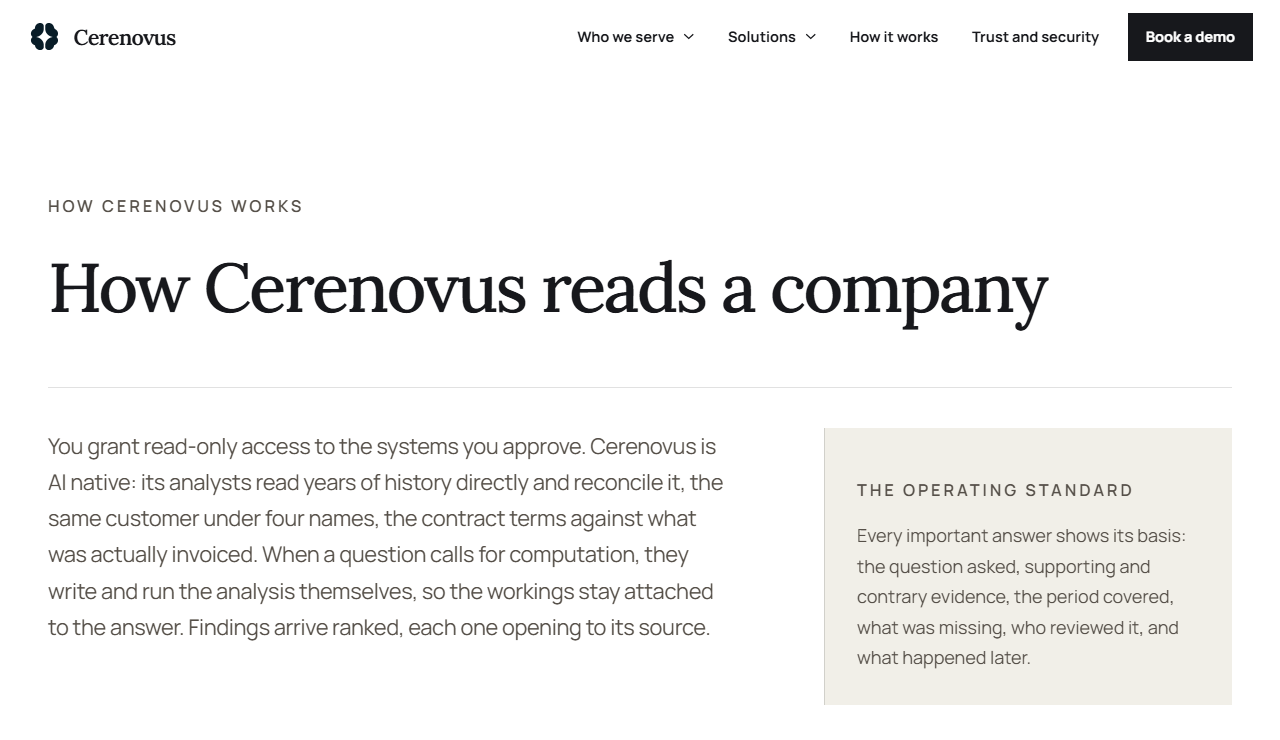
The pitch is not search and not a chatbot with connectors, and the vendor is direct about the distinction: a model with connectors answers the question you type and forgets it when the session ends, while Cerenovus is built to keep a governed record of what the organisation knew, decided, did and learned. Findings arrive ranked by impact, each with a named owner and a citation that opens downward to the original document rather than to another summary. The company publishes four guarantees behind that: every claim opens to its source, the record is time-aware so what was believed in March and what was true in March are answered separately, findings are challenged before they reach you, and every number ships with its workings.
It is sold by engagement rather than by seat. There is no self-serve signup and no published price - the route in is a booked demo - and the buyer segments named on the site are enterprises, middle-market companies, private equity, consulting and advisory firms, secondaries and continuation vehicles, and corporate M&A and integration teams. Deployment starts read-only and scoped to the systems the client approves, defaulting to a single-tenant cloud machine Cerenovus runs, with bring-your-own-cloud and full on-premises options where security demands them.
The main caution for a buyer is stage. Cerenovus was founded in 2026 and its SOC 2 Type II and ISO 27001 certifications are, by its own account, still in progress rather than complete, so a regulated buyer is signing NDAs and DPAs today rather than reading a finished audit report.
Screenshots
Pricing
Custom pricing by engagement; no public price list and no self-serve tier. ai. Deployment shape is part of the commercial conversation: the default is a single-tenant cloud machine run by Cerenovus, with bring-your-own-cloud and full on-premises available where a security review requires them, and Cerenovus also offers deeper specialisation - a harness tuned to a company's tasks, and a dedicated estate around proprietary data where sustained volume justifies it.
Its stated recommendation is to start on the default configuration, prove the economics on real work, and specialise only the workloads that clear quality, reuse and control gates.
Feature Comparison by Tier
| Feature | On-premises | Hosted (default) | Bring your own cloud |
|---|---|---|---|
| Price | Custom, quote only | Custom, quote only | Custom, quote only |
| Who runs the infrastructure | Customer's own data centre | Cerenovus, single-tenant | Customer's cloud account |
| Network exposure | Customer-controlled | Restricted to customer upload and Cerenovus install/telemetry | Customer-controlled |
| Model execution | Local models on customer infrastructure supported | Frontier models in Cerenovus's harness | Frontier models in Cerenovus's harness |
| Access mode at start | Read-only, customer-approved systems | Read-only, customer-approved systems | Read-only, customer-approved systems |
| Data scope control | Per source, channel, column and folder | Per source, channel, column and folder | Per source, channel, column and folder |
| Customer data used to train models | No | No | No |
| Zero-data-retention with model providers | ✓ (OpenAI, Anthropic) | ✓ (OpenAI, Anthropic) | ✓ (OpenAI, Anthropic) |
| Retention period | Customer-defined | Customer-defined | Customer-defined |
| SOC 2 Type II | In progress | In progress | In progress |
| ISO 27001 | In progress | In progress | In progress |
| NDA / DPA on request | ✓ | ✓ | ✓ |
| Self-serve signup | — | — | — |
Key Features
- Findings Ranked and Priced: Surfaces duplicate payments, missed discounts, dormant vendors, zombie software seats, stalled receivables, approval gates that reject nothing but add weeks, and the same process run several different ways. Each finding arrives ranked by impact with a named owner.
- Drill-Down Provenance: Every claim opens downward to the original document rather than to another summary, and a quote that cannot be located in its source is not admitted to the record.
- Time-Aware Record: Treats what the company believed at a point in time and what was actually true at that time as two separate questions with two correct answers, so last quarter's company stays in the record.
- Process and Dependency Reconstruction: Reconstructs how work actually moves across systems, owners, controls and handoffs from transactions, approvals, queues and system events, rather than from the policy that describes the intended process.
- Operational Foresight and Early Warning: Flags the promise past its deadline with no fulfilling event, the account whose rhythm has broken, the renewal approaching at last year's usage and the process that quietly stopped running, and pressure-tests a plan before it is committed.
- Read-Only, Scoped Deployment: Starts read-only against only the systems the client approves, with source-system access rules carried into every downstream answer. Default is a single-tenant cloud machine run by Cerenovus; bring-your-own-cloud and full on-premises are supported.
Pros
- Every claim is traceable to an original source document, and Cerenovus states that a quote it cannot find in the source never enters the record - a direct answer to the fabrication risk that blocks most AI deployments in finance and diligence.
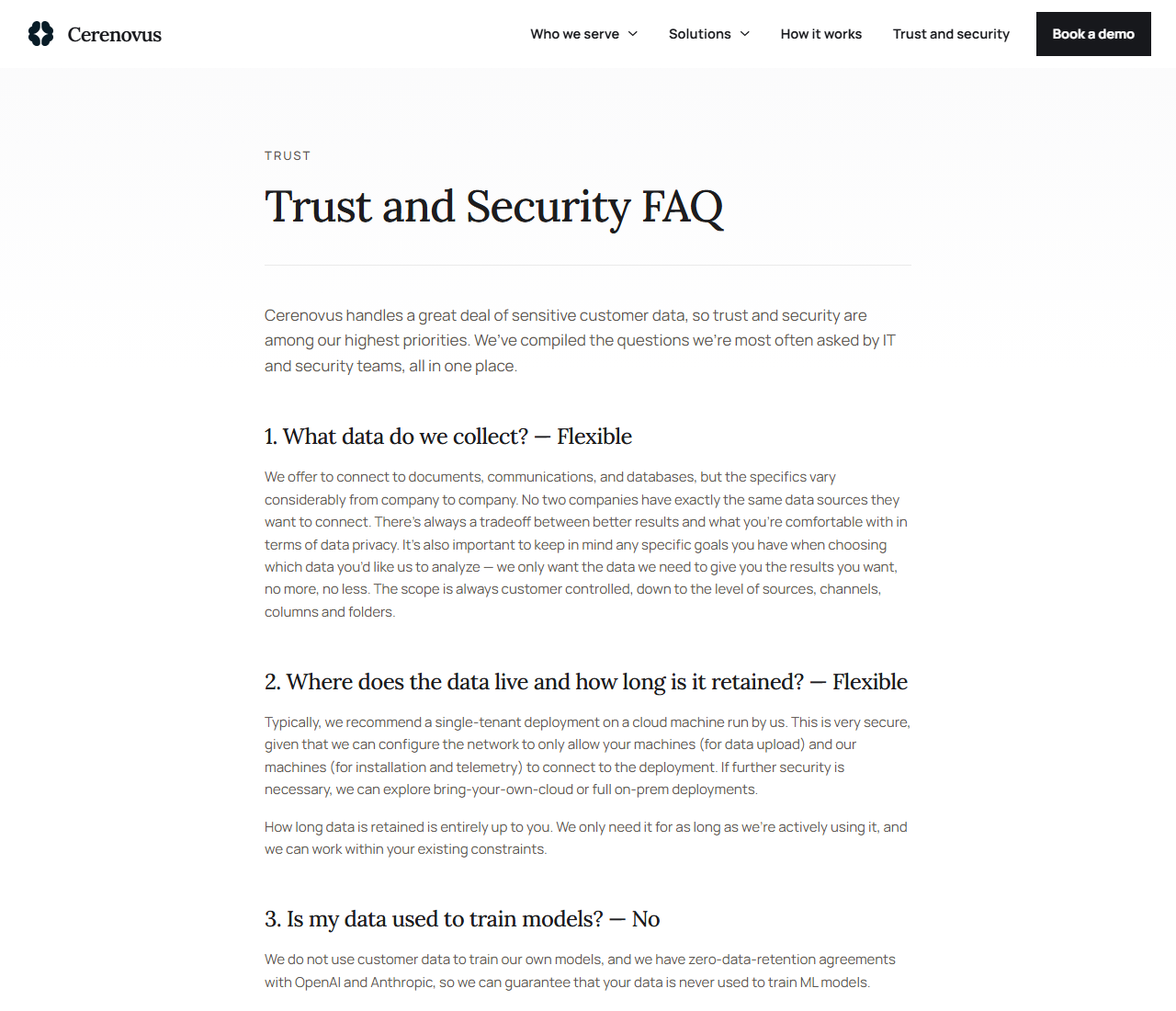
- Cerenovus states it does not train on customer data and holds zero-data-retention agreements with both OpenAI and Anthropic, so customer records are not retained by the underlying model providers.
- Deployment is read-only and scoped by the customer down to individual sources, channels, columns and folders, and retention length is set by the customer.
- Single-tenant hosting is the default, with bring-your-own-cloud and full on-premises available for buyers whose security review rules out shared infrastructure.
- The positioning is specific rather than generic: eight named jobs across six buyer segments, including operational due diligence, post-merger integration and exit readiness, instead of a general assistant.
Cons
- SOC 2 Type II and ISO 27001 are described by Cerenovus as in progress, not complete, so a regulated buyer has no finished audit report to review today.
- No published pricing and no self-serve tier - the only route in is a booked demo, which makes budgeting and quiet evaluation impossible.
- Founded in 2026 and backed by YC that same year, so there is no long deployment track record and no public customer list to reference.
- The deliverable is primarily finished, verified reports rather than a product your team operates continuously; agent integrations are described as something to explore per engagement.
- Scope is negotiated per customer, so what Cerenovus actually covers - and therefore what it costs - is not comparable between two buyers without a bespoke conversation.
Data Handling
- Training-data policy
- Cerenovus's trust and security page states it does not use customer data to train its own models and holds zero-data-retention agreements with OpenAI and Anthropic. Data scope is customer-controlled down to individual sources, channels, columns and folders, and retention length is set by the customer. Default deployment is a single-tenant cloud machine run by Cerenovus with the network restricted to customer upload and Cerenovus install/telemetry; bring-your-own-cloud and full on-premises are offered where further security is required. SOC 2 Type II and ISO 27001 are described as in progress, not complete, with NDAs and DPAs offered in the meantime.
- Compliance
- SOC 2 Type II and ISO 27001 both stated as in progress · not yet certified (vendor trust page)
Frequently Asked Questions
How much do you pay for Cerenovus?
Cerenovus publishes no price and offers no self-serve tier. It is sold by engagement, quoted after a booked demo at cerenovus.ai/book-demo or a mail to founders@cerenovus.ai, and the scope is negotiated per customer down to which sources, channels, columns and folders it may read - so two buyers will not get comparable quotes. The deployment shape is part of the commercial conversation too: the default is a single-tenant cloud machine Cerenovus runs, with bring-your-own-cloud and full on-premises available where a security review requires them.
Does Cerenovus have a free plan?
No. There is no free tier and no signup form - the only published route in is a booked demo. Cerenovus's own recommendation is to start on its default hosted configuration, prove the economics on real work, and specialise only the workloads that clear its quality, reuse and control gates, so the first commitment is an engagement rather than a subscription you can cancel in an app.
What should you use instead of Cerenovus?
Glean is the mature alternative and the safer buy for a regulated team today: permission-aware search across a hundred-plus connected apps, with the compliance certifications Cerenovus is still working toward. Microsoft Copilot is the default if the records already sit in Microsoft 365, though it answers the question you type rather than accumulating evidence between sessions. Notion is the opposite approach - a wiki your team curates by hand, only as accurate as the effort behind it.
Is Cerenovus better than Glean?
They solve different problems. Glean retrieves documents across connected apps and is certified for it; Cerenovus reconstructs how work actually moves across systems and returns findings ranked by impact with a named owner and a citation that opens to the source document. On assurance Glean is ahead: Cerenovus does publish a data policy - no training on customer data, zero-data-retention agreements with OpenAI and Anthropic, customer-set retention - but states that its own SOC 2 Type II and ISO 27001 certifications are still in progress. Choose Glean for audited search at scale; choose Cerenovus for operational analysis, accepting a vendor founded in 2026.
How long does it take to get going with Cerenovus?
A booked demo comes first; there is no way to start on your own. Deployment then begins read-only and scoped to the systems you approve, with the access rules from those source systems carried into every downstream answer. Cerenovus runs frontier models inside its own harness rather than training its own, and can run local models on your infrastructure where circumstances require it, so the timeline depends on which sources you clear and how much history they hold rather than on an install.
Top Alternatives
HokAI guides covering Cerenovus
- Best AI Search Tools in 2026: Match the Tool to the Job: Perplexity, Bing, and Glean all get called AI search tools, but only Glean searches a company's internal Slack. Here is how the category splits by job in 2026.