What TradingPulse Is Actually For
TradingPulse is a $0 to $199 subscription that sends daily plain-English market summaries covering 11 crypto, forex, and commodity assets. Its FAQ states the briefs are for informational purposes only, and the product issues no buy or sell signals, unlike several similarly named 'Pulse' branded trading apps.
The short version
TradingPulse costs $8 a month and reads the market to you in plain English: no charts, no jargon, and by its own FAQ, no financial advice. It suits a five-minute daily reading habit. Traders who actually want picks or automated execution need Tenki or MiDash instead, not TradingPulse.
TradingPulse.org charges $8 a month to read you the crypto and forex market every morning, and its own FAQ says outright that it will not tell you what to trade.
That distinction matters because the market is full of near-identical "Pulse" branded trading products, and at least one of them sells exactly what TradingPulse refuses to. TradePulse AI markets itself, in its own homepage headline, as an "Advanced Trading Signals & AI-Powered Market Analysis Platform." TradingPulse's actual job, reading the market in plain English without recommending a trade, is a narrower promise than that neighbor makes. Whether that narrower promise is the whole point or the whole problem depends on what a trader came here for.
What TradingPulse actually sends you every morning
TradingPulse's live pricing page, checked on 20 August 2026, lists four tiers: a $0 free plan capped at one asset with no credit card required, an $8-a-month Pro plan covering the full asset list, a $96-a-year Pro Yearly plan (about two months free versus paying monthly), and a $199 Founding Member Lifetime option. New signups do not start on the free tier at all: the homepage offers a 7-day Pro trial with no card needed before anything drops to the capped free plan.
That trial covers 11 assets: Bitcoin, Ethereum, Solana, XRP, BNB, gold, silver, and four forex pairs including EUR/USD. On the morning of the capture for this article, the homepage's own snapshot read Bitcoin at $84,200 and tagged "bullish," gold at $4,520 and "neutral," and EUR/USD at 1.0810 and "bearish."
Pro also unlocks an interactive AI chat about a user's own watchlist, market news scored for sentiment, and a Market Radar panel showing the Fear and Greed index, BTC dominance, and the VIX. Ask TradingPulse's own FAQ whether any of this counts as financial advice and the answer is one word: no.
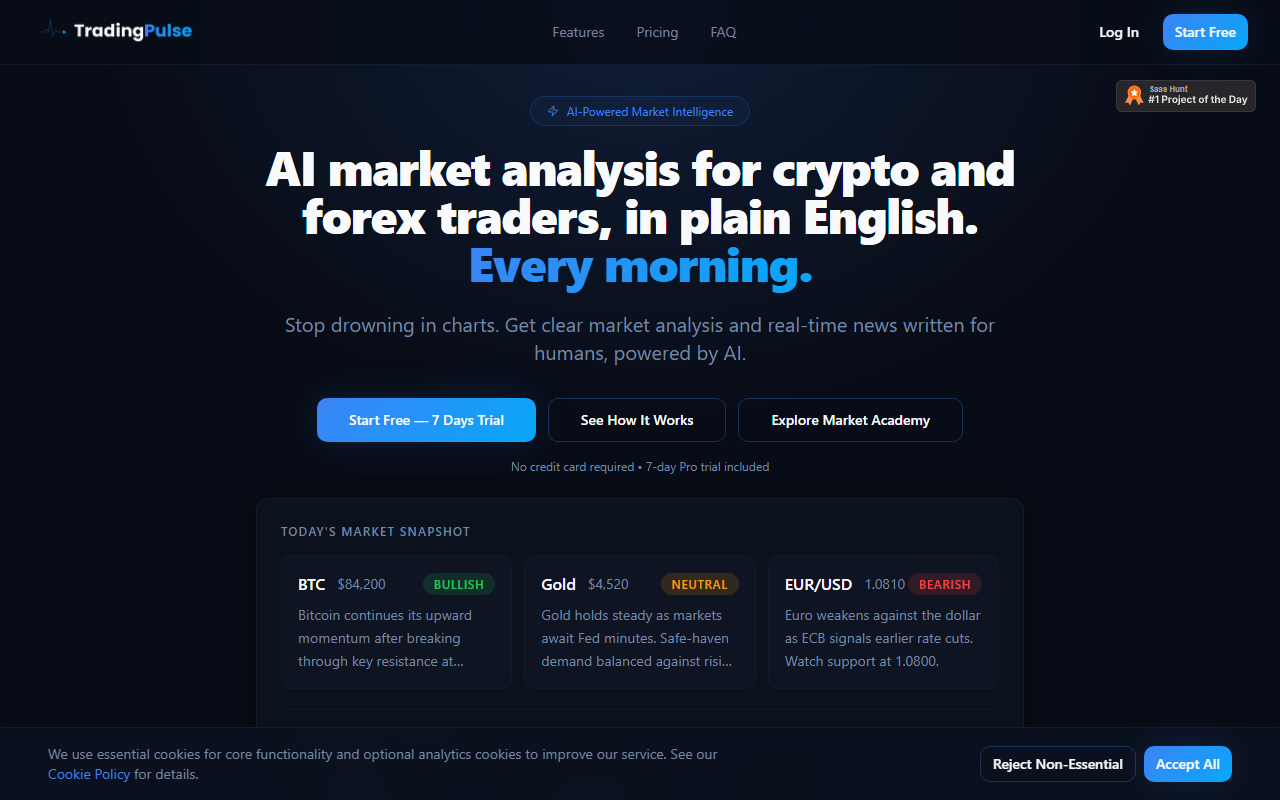 TradingPulse's homepage, captured 20 August 2026. The snapshot cards are the entire product in miniature: a price, a one-word read, and no instruction to buy or sell.
The name sits next to tools built to do the opposite
Search for TradingPulse and the results blur into a small industry of near-identical brand names. TradePulse AI is a separate product at a separate domain, and its own homepage leads with the phrase "Advanced Trading Signals," not market commentary.
That is a meaningfully different product: a signal is an instruction, and TradingPulse's FAQ explicitly declines to give one. A shopper who lands on the wrong "Pulse" by accident is comparing a habit-forming morning read against a tool built to tell them when to click buy, and the two should not be evaluated by the same yardstick.
Inside hokai's own catalog, the real comparison is Tenki and MiDash
The closer comparison lives inside hokai's AI financial assistants directory, and it is not TradePulse AI. It is Tenki, which also lands in a trader's inbox each morning but does the opposite job: instead of a narrative read across a fixed asset list, Tenki scans Kalshi and Polymarket overnight and hands over three to seven picks where it believes the market price and the evidence disagree.
Tenki's own homepage, checked the same day as TradingPulse's, no longer shows a live price at all: it reads "launching soon, waitlist open," offering early members "a free two-week trial at launch" instead of the $12-a-month plan hokai's own coverage recorded when it published a three-way comparison on 5 August 2026.
TradingPulse added its $8 tier around that same date and has kept a stable price since, while Tenki pulled its live product back to a waitlist. That is itself the more current answer to "which of these should I pay for right now."
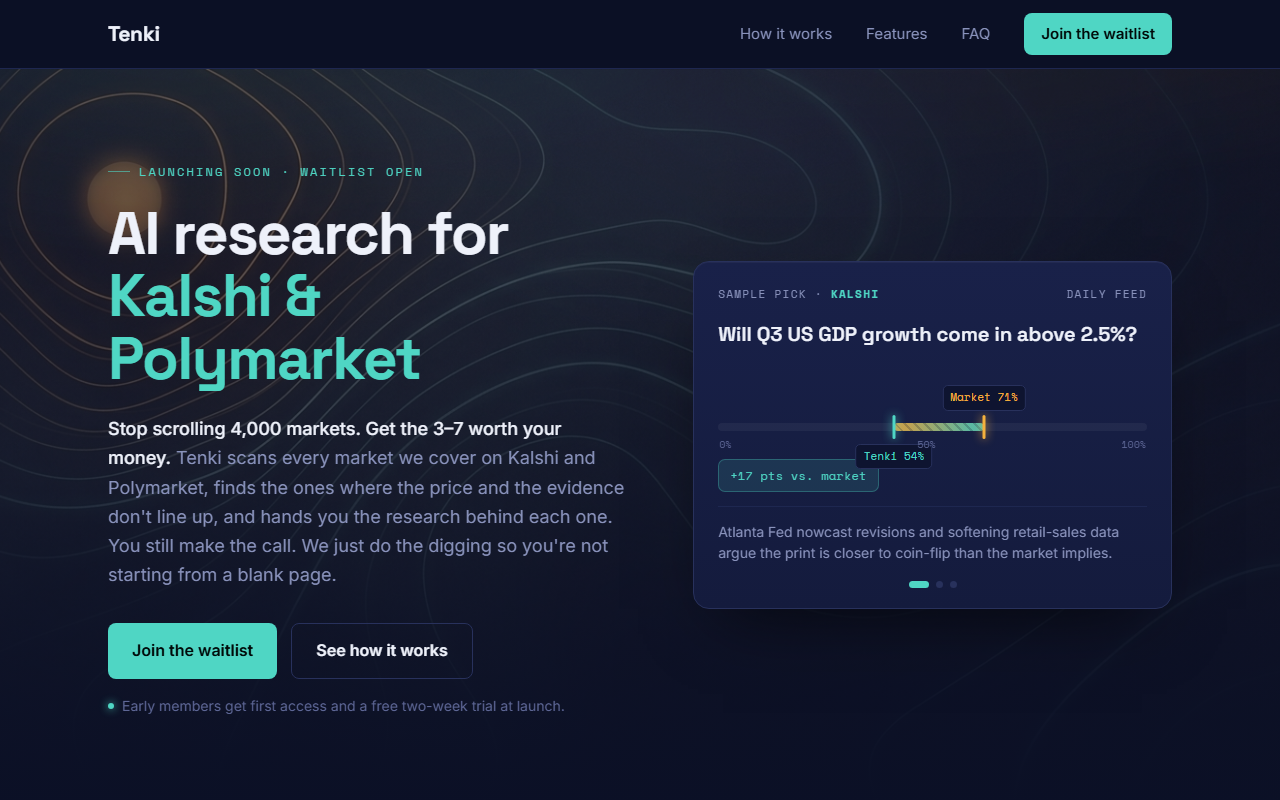 Tenki's homepage, captured 20 August 2026. The tool most likely to be confused with TradingPulse as "another AI trading email" is not currently a paid product at all.
The other real comparison is MiDash, which sits at the opposite design extreme. Where TradingPulse refuses to issue a signal, MiDash converts a plain-English or Arabic prompt directly into a backtested strategy, and its higher tiers execute that strategy automatically across stocks, crypto, and forex. MiDash's free tier covers strategy building and backtesting; live automated trading requires a premium plan, and MiDash does not publish that plan's exact price, a gap this article cannot fill in either. Someone who wants TradingPulse to eventually add automation is really describing MiDash.
Who this is actually for, and who should skip it
TradingPulse's free plan and 7-day trial makes trying it a five-minute decision with nothing at stake. Where it earns the $8-a-month Pro price is for a trader who already understands what a bullish BTC tag or a bearish EUR/USD read means, doesn't want to learn candlesticks, and would rather have that context delivered than go look for it.
It is a worse fit for a trader who wants a specific recommendation: that reader wants Tenki's waitlist or MiDash's backtesting engine, not a narrative brief. It is also a poor fit for the other jobs crammed into "AI financial assistant" on hokai's own catalog: Aleph and Campfire are built for corporate finance teams closing multi-entity books, and ProBors tracks Congressional trading disclosures, not a retail trader deciding whether to check crypto before coffee.
The case for skipping it entirely
The strongest objection to paying $8 a month, or $199 for the lifetime plan, is that a general-purpose chatbot will give a trader the same plain-English read of Bitcoin or EUR/USD for free, on demand, right now. That is true for a single question.
It is a weaker argument against a habit: TradingPulse's whole design is that the brief shows up every morning across a fixed watchlist without anyone having to remember to ask, paired with sentiment-scored news a general chatbot will not surface unprompted. The objection wins for someone who only checks the market occasionally. It loses for someone who wants the same watchlist read to them every single day without opening a new chat window to do it.
What to watch
Watch whether TradingPulse adds anything that functions as a signal, a buy-or-sell call, or a confidence score before the end of 2026. Its closest brand lookalike already sells one, and the FAQ's flat "no" to "is this financial advice" is the one line standing between TradingPulse and the rest of the "Pulse" field. The day that line changes is the day this entire read of the product stops being accurate.
Frequently asked questions
What does TradingPulse actually do?
TradingPulse sends a daily plain-English market brief covering 11 assets: Bitcoin, Ethereum, Solana, XRP, BNB, gold, silver, and four forex pairs including EUR/USD. There are no charts and no technical indicators, just narrative commentary on each asset. Its own FAQ states the analysis is for informational purposes only.
Is TradingPulse the same as TradePulse AI or other similarly named apps?
No. TradePulse AI is a separate product at a separate domain that markets itself as an 'Advanced Trading Signals' platform, the opposite of TradingPulse's no-signal design. The overlapping brand names make it easy to land on the wrong product when searching.
Does TradingPulse give buy or sell signals?
No. TradingPulse's FAQ directly answers whether its briefs count as financial advice with a single word: no. Traders looking for actual recommendations should look at Tenki, which hands over vetted picks, or MiDash, which converts prompts into backtested and automatically executed strategies.
How much does TradingPulse cost in 2026?
TradingPulse's pricing page lists a $0 free plan capped at one asset, an $8-a-month Pro plan, a $96-a-year Pro Yearly plan, and a $199 Founding Member Lifetime option. New signups start with a 7-day Pro trial that requires no credit card before dropping to the free tier.
Who should skip TradingPulse?
Anyone who wants a specific trade recommendation or automated execution should skip TradingPulse for Tenki or MiDash instead. Anyone who only checks the market occasionally is better served asking a general-purpose chatbot the same question for free, since TradingPulse's value is the daily habit, not a one-off answer.
Covered in this guide
- TradingPulse: AI-powered daily market briefs for crypto and forex traders covering BTC, ETH, Gold, and EUR/USD in plain language with no charts, no jargon. Free tier, Pro at $8/month.
- Aleph: AI-native FP&A platform that syncs 150+ ERP/CRM systems into live Excel and Sheets models, founded 2020, backed by $46M from Khosla Ventures.
- Campfire: AI-native ERP for startups, consolidating multi-entity books across 180+ currencies with the Ember AI Assistant, used by Replit and PostHog.
- MiDash: Conversational AI trading platform that converts plain English or Arabic prompts into backtested, executable algorithmic strategies across stocks, crypto, and forex.
- ProBors: ProBors is a 2026 AI research tool for tracking Congress and insider stock trading disclosures, with built-in AI chat and MCP developer access.
- Tenki: AI-powered overnight scanner for Kalshi prediction markets that emails 3-7 vetted trading opportunities to subscribers each morning.
Sources
Still deciding?
This guide covers a handful of options. Smart Match checks every listing in the directory against how you actually work and what you can spend, then hands you the shortlist and the reason behind each pick.
Start Smart MatchRelated guides
- Best AI Tools for Writing Excel Formulas and Data Analysis in 2026Buyer's guideHow to pick, across a category
- The Best AI Financial Assistants in 2026, Sorted by What They Actually DoBuyer's guideHow to pick, across a category
- Parcel Perform vs TradingPulse vs Tenki, Five Months LaterComparisonHead-to-head, with a verdict
- What Pineify Is Actually ForAnalysisWhat changed and who it affects