What Skilly Is Actually For, and Which Skilly You Mean
Skilly refers to two unrelated small products from moelabs.dev: a macOS menu bar app that voice-tutors creative software at $19 a month, and Skilly for Builders, an embeddable onboarding widget still in a founder-led pilot. Both were forked from Farza Majeed's open-source Clicky in five days during April 2026. Neither is a general voice assistant like Siri.
The short version
Skilly is a five-day fork of the open-source Clicky project, split into a $19-a-month macOS tutor and a separate, pre-traction embeddable widget called Skilly for Builders. It is filed as an AI voice assistant alongside Siri and ElevenLabs, but does neither company's job. The widget suits small SaaS teams building onboarding; the macOS app has cheaper, more established alternatives.
Skilly's code repository has 27 stars as of August 18, 2026, one day younger than the open source project it was forked from. That project, Clicky, sits at 7,361 stars under its own name. Skilly is not a bigger, better Clicky. It is a five-day fork that turned into two much smaller, much narrower products, filed on hokai.io under a category label that also contains Apple's own phone assistant.
That filing is the actual problem. A reader searching for an AI voice assistant and landing on Skilly is not getting a phone-assistant competitor, and is not even getting a general-purpose screen buddy of the kind it was forked from.
They are getting a menu bar app that teaches five creative apps by voice, or a separate, much less finished product for embedding voice-guided onboarding into someone else's software. Neither is what the category label promises, and the gap matters most to a small team deciding whether to trust either one with its own signup flow.
What Skilly Actually Is
According to Clicky's own README, Farza built it as "an AI teacher that lives as a buddy next to your cursor," released it under an open MIT license, and on April 27, 2026 said he would keep new development private at a new address while leaving the existing code as is. The fork that became Skilly was created one day after that, on April 8, 2026, and its own comparison page says the rebuild took five days.
The two projects diverged fast. Skilly ships under a different license, Apache-2.0, and its README dates a version 2.0 update to May 30, 2026, when the whole voice pipeline moved onto OpenAI's general-availability Realtime API. That single call replaced a slower three-step chain of speech recognition, a language model, and speech synthesis, cutting the delay between a spoken question and a spoken answer.
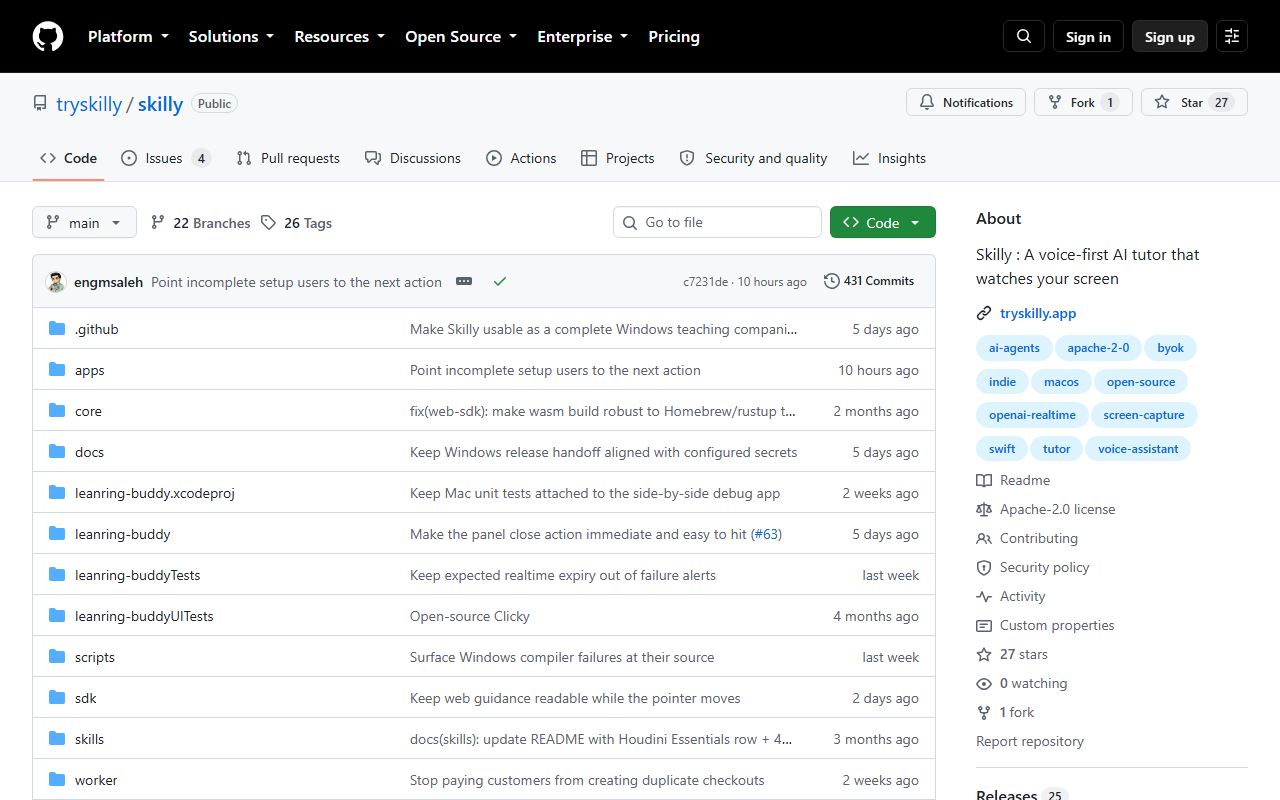 Skilly's repository, captured 18 Aug 2026. The topic tags it chose for itself include voice-assistant, the same label driving the confusion this article is about.
The Same Name Belongs to Several Other Products
Search the name and this project is not what surfaces first. A soft-skills mentor bot in Georgia runs under the same word. A wellbeing platform for Irish schools uses it too, and so does a separate, unrelated site calling itself an organizational AI guide.
None of these four products share code, ownership, or a single line of coverage between them. A buyer typing the name into a search bar has to do the disambiguation work this article is doing, by hand, every single time, with no site doing it for them first.
Filed Next to Siri, Not Next to a Tutor
On hokai.io's own list of AI voice assistants, Skilly sits beside speech infrastructure APIs like Deepgram, voice-cloning platforms like ElevenLabs, phone-call agent builders like Retell AI, and Siri itself. Skilly does none of those four jobs. It does not clone a voice, and it does not run a telephone call the way a Retell agent does.
What it does is narrower: point a cursor at the one button a user needs, while a voice explains why that button matters right now. That is a screen-tutoring and onboarding job, closer to a product-tour widget than to anything else on that shared list, and the category page itself gives no hint of the difference before a reader clicks through.
Who Skilly Actually Helps
The more defensible half of the business is Skilly for Builders, the embeddable widget. Per its own documentation, the widget is a roughly 24-kilobyte package with no framework dependency that reads a page's structure rather than screenshots, speaks over a peer-to-peer connection, and drops into any site with one script tag.
Its pricing page lists an Early Access tier at $0, then three paid steps at $29, $99, and $299 a month. For a small devtools or no-code team trying to cut support load during onboarding, that is a real, buildable option: open source, self-hostable in principle, and not welded to one vendor's screen-capture stack.
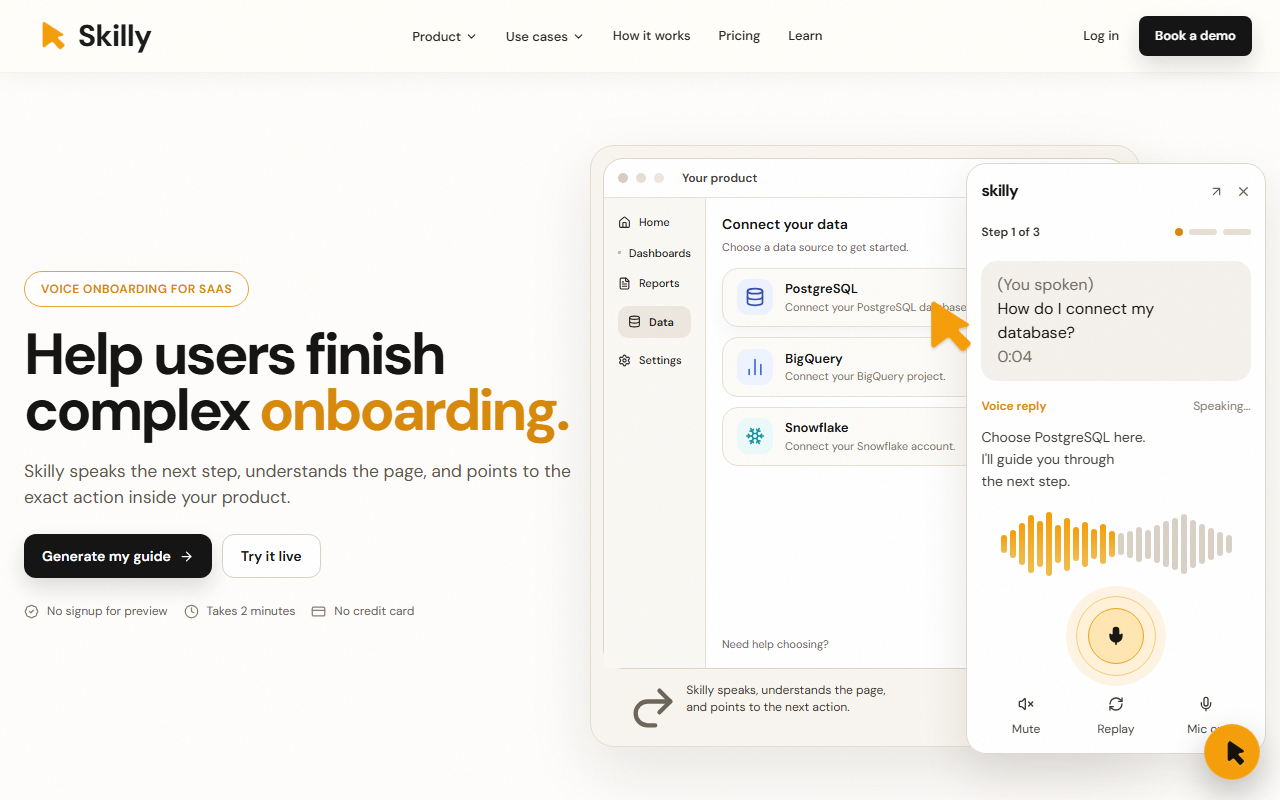 Skilly for Builders' own demo, captured 18 Aug 2026. This is the actual mechanism: cursor plus voice, not a chat window.
Who It Doesn't Help
The pricing page currently frames the Builders product as a founder-led pilot, with a link to book a call rather than a self-serve signup, and it describes cost as starting at zero and scaling toward that top tier once a pilot actually begins. That is honest framing for what this is: pre-traction. This article could not find one named customer, case study, or usage figure published for it as of this run.
Skilly's menu bar app is a clearer miss for most readers. At $19 a month for three hours of tutoring after a 15-minute trial, it competes directly with the free original it was built on, and with HeyClicky, the paid successor from the same original author, priced at $20 a month for unlimited talk time plus 150 agent actions. A reader who just wants a voice tutor watching their screen has two older, better-known options to weigh before this one even enters the comparison.
The strongest case against that framing is that pre-traction does not mean broken. The widget's code is public and working today, and a five-day build time cuts both ways: it also means fixes can ship just as fast. The honest position sits between those two facts. The code runs. Whether anyone outside a pilot is paying for it is a separate, currently unanswered question, and this piece will not pretend otherwise.
Watch whether the Builders product can name even one paying customer by the end of 2026. A pilot still booking calls one at a time in December is a side project with a pricing page attached, not yet a company, no matter how clean the underlying code is. That single fact, more than any star count, will settle what this name ends up actually meaning to a buyer.
Frequently asked questions
Is Skilly the same company as Clicky?
No. Clicky is Farza Majeed's open-source project, released under an MIT license. Skilly is a separate fork built by moelabs.dev, under Apache-2.0, starting one day after Clicky's own repository was created.
What does Skilly for Builders actually do?
It is an embeddable widget that site owners drop into a web page with one script tag. It reads the page's structure, speaks instructions over WebRTC, and points a cursor at the specific UI element a user needs next.
How much does Skilly cost?
The macOS tutor app costs $19 a month for three hours of voice tutoring after a 15-minute free trial. Skilly for Builders lists Early Access at $0, then Starter at $29, Studio at $99, and Scale at $299 a month, though it currently runs as a founder-led pilot rather than self-serve signup.
Is Skilly a general AI voice assistant like Siri or Alexa?
No. Skilly does not handle general conversation, phone calls, or device control. It is a screen-aware tutoring and onboarding tool, closer to a product-tour widget than to a voice assistant, despite being filed in that category on some directories.
Are the other products named Skilly related to this one?
No. A soft-skills mentor bot in Georgia, an SPHE platform for Irish schools, and a separate "AI guide for your organization" at skillyai.com all use the same name. None of them share code, ownership, or coverage with the tryskilly.app project.
Covered in this guide
- Skilly: Voice-first AI tutor for macOS that watches your screen, points its cursor at UI elements, and teaches Figma, Blender, and After Effects.
- Siri: Apple's free, rebuilt conversational assistant runs a custom 1.2 trillion-parameter Google Gemini model and ships with iOS 27 in fall 2026.
- Deepgram: Real-time voice AI APIs for developers: speech-to-text under 300ms, TTS, and voice agents. Used by 200,000+ developers.
- ElevenLabs: The leading AI voice platform for text-to-speech, voice cloning, and conversational AI agents
- HeyClicky: Open-source macOS AI buddy with screen awareness, push-to-talk voice and background agents. Y Combinator Spring 2026. Free tier, plus paid Pro and Max plans.
- Retell AI: Retell AI builds and deploys realistic AI phone agents with 600ms latency, handling 50M+ monthly calls, and HIPAA/SOC 2 compliance. Rated 4.8/5 on G2 by 1,414 teams.
Sources
Still deciding?
This guide covers a handful of options. Smart Match checks every listing in the directory against how you actually work and what you can spend, then hands you the shortlist and the reason behind each pick.
Start Smart MatchRelated guides
- Best Agentic AI in 2026: Pick the Job, Not the GeneralistBuyer's guideHow to pick, across a category
- Best AI for Creating YouTube Videos in 2026: A Buyer's GuideBuyer's guideHow to pick, across a category
- Best AI Voice Assistants in 2026: A Buyer's Guide to Synthesis, Transcription and AgentsBuyer's guideHow to pick, across a category
- Best HeyClicky Alternatives in 2026: Free, Private and Windows OptionsBuyer's guideHow to pick, across a category
- HokAI vs Insidr.ai: The Sponsorship Price Insidr Never PublishesInside HokAIHow the directory works, verified in the open
- HokAI vs Toolify: What 30,501 Listings Cost You in AccuracyInside HokAIHow the directory works, verified in the open