LlamaIndex Isn't the RAG Framework Anymore. Here's What It Actually Sells.
LlamaIndex is an MIT-licensed Python framework for connecting large language models to external data, and separately the maker of LlamaParse, a paid enterprise document-parsing product with tiers from $0 to $500 a month plus custom enterprise pricing, launched via a $19 million Series A in March 2025.
The short version
LlamaIndex's GitHub page now describes it as a document agent and OCR platform, not the RAG framework most tutorials still teach. Since its 2025 Series A, the company's pricing, funding and named customers point toward enterprise document parsing. The open source framework is still free; the company's attention has moved to LlamaParse.
Want this decided for your own case? Find your tools with Smart Match, starting from this guide's question.
LlamaIndex's own GitHub repository now describes the four-year-old project as "the leading document agent and OCR platform," a description its PyPI listing, last touched on 19 August 2026, does not use.
That gap is not a typo. It is the difference between the open source framework thousands of RAG tutorials still teach and the enterprise document-parsing business LlamaIndex has actually been building since its $19 million Series A in March 2025. For a team choosing a retrieval stack in September 2026, picking LlamaIndex on the strength of a two-year-old explainer means picking a company whose product roadmap, pricing, and named customers now point somewhere else entirely.
The pitch changed twice in eighteen months
On 4 March 2025, LlamaIndex announced a $19 million Series A led by Norwest Venture Partners, with existing investor Greylock, taking its total raised to $27.5 million. The same announcement took LlamaParse out of beta, adding SOC 2 Type 2 certification, a GDPR-compliant EU deployment option, and named enterprise customers including Rakuten, Carlyle, Salesforce, and KPMG, according to LlamaIndex's own blog post.
Two months later, on 1 May 2025, the company announced strategic investments from Databricks Ventures and KPMG Ventures, tying it closer to the enterprise data-platform world than to the open source retrieval-augmented generation community it grew up in.
By 22 April 2026, LlamaIndex and Kaggle had launched ParseBench, a leaderboard scoring document-parsing systems against roughly 2,000 human-verified enterprise pages and more than 167,000 test rules across five dimensions, including table and chart fidelity. LlamaIndex's own blog post framed the company's mission as building document understanding for AI agents, phrasing nowhere near "index your data for RAG."
Who it is actually built for now
The buyer LlamaParse is priced for is not a solo developer prototyping a chatbot. The free tier gives 10,000 credits a month, roughly 1,000 pages. Starter runs $50 a month for 40,000 credits, with pay-as-you-go up to 400,000. Pro is $500 a month for 400,000 credits, pay-as-you-go up to $5,000 a month, at an exchange rate of 1,000 credits per $1.25. Enterprise is custom-priced, with 5x higher rate limits and a dedicated account manager.
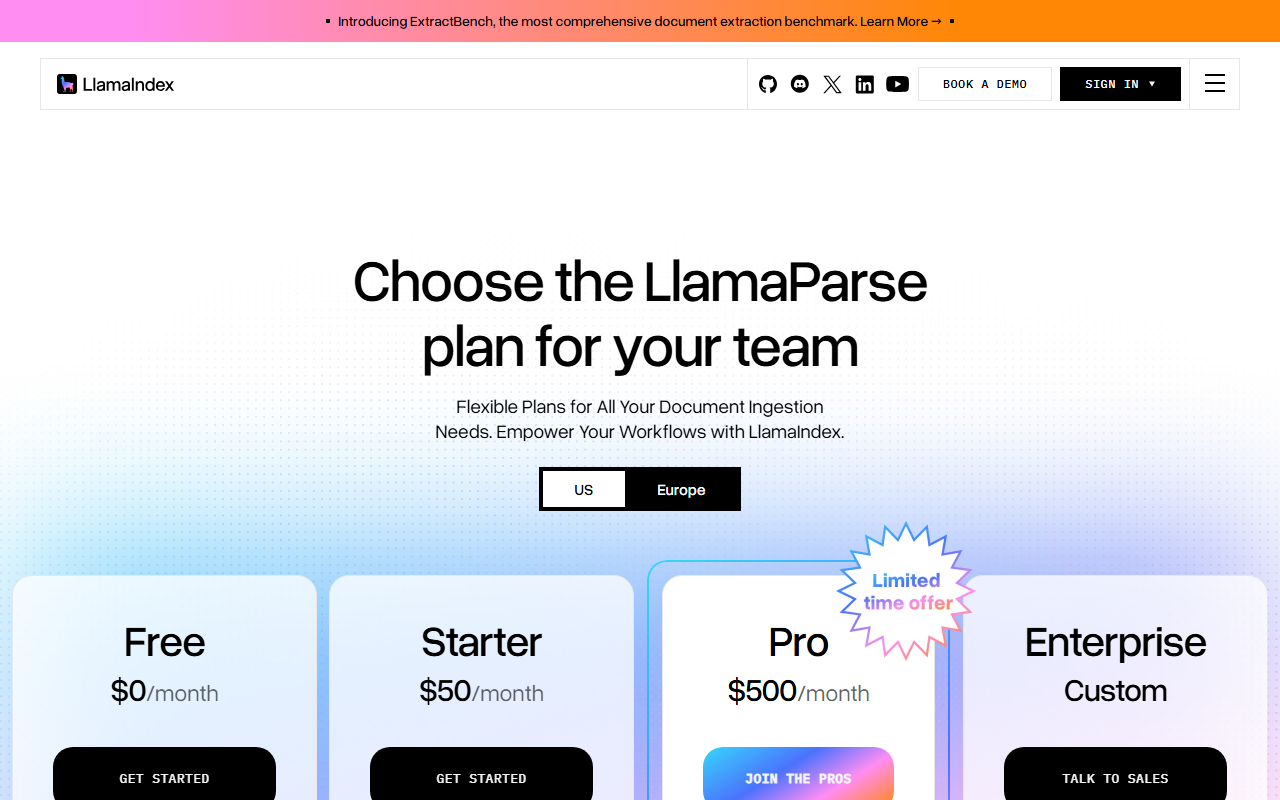 Captured directly from llamaindex.ai on 3 September 2026. Note the "Limited time offer" badge on the Pro tier's bonus credits.
That ladder is built for a company with a stack of scanned contracts, financial filings, or claims paperwork, not a developer testing an idea over a weekend. It puts LlamaIndex in closer competition with document-extraction vendors like Reducto than with the retrieval frameworks it is still filed under on most comparison lists.
It also puts LlamaParse's structured-extraction feature against specialists like NuMind, whose NuExtract3 model scores 65.2 against 53.8 for the next-best similarly sized model on the company's own structured-extraction benchmark. A team parsing 200,000 pages a month is choosing between those three, not opening a RAG tutorial; the credits, not the retrieval algorithm, are the actual purchase decision.
Who gets stuck
The developer this hurts is the one who picked LlamaIndex specifically because it read as "the RAG framework, not LangChain," a distinction that mattered in 2023 and matters less now that both open source layers do broadly similar retrieval work. The differentiated product, ParseBench-grade document parsing, sits behind a $50-to-custom paywall that most RAG tutorials never mention.
The free lane got more crowded too. Zerox, an MIT-licensed library from Y Combinator-backed OmniAI with 12,300 GitHub stars, turns PDFs, Word files and other documents into clean markdown using vision models like GPT-4o, at no cost. A developer chasing the 2023-era "free framework that ingests my PDFs" experience does not need LlamaIndex specifically to get it anymore.
The framework itself did not disappear
The strongest case against this whole argument is that nothing actually changed for a developer who just wants the library. The open source llama-index package is still MIT licensed, still sitting at roughly 52,000 GitHub stars, and still shipping active releases, version 0.14.24 landed as recently as 19 August 2026. You can build a full retrieval pipeline with it for $0, exactly like you could in 2023.
What changed is where the company's attention goes. New product surfaces, ParseBench, Workflows-based agent orchestration, enterprise deployment options, are built around the paid layer. "Still available for free" is not the same claim as "still the thing the roadmap is optimizing for," and a team that only reads the framework's docs will not see that distinction until the feature they wanted shows up Pro-tier only.
This is not unusual for a company that raised $27.5 million: open source frameworks routinely stay free while the vendor's revenue moves to a managed layer built on top of them. What makes LlamaIndex's case worth flagging is how little the public description of the project has caught up. Explainers still ranking for "what is LlamaIndex" mostly describe the 2023 framework, not the 2026 document-parsing company with named enterprise customers and a Kaggle-hosted benchmark.
What to watch
The Pro tier's extra 800,000 bonus credits are explicitly labeled a limited-time offer on LlamaIndex's own pricing page, which means that ladder is due to move again before ParseBench produces a second full leaderboard cycle, plausibly by early 2027. If Reducto or NuMind undercut LlamaParse's per-page rate before then, expect another restructure sooner.
The more useful signal is smaller: check whether the next few llama-index PyPI release notes add retrieval features or only parsing and extraction ones. That is the fastest public read on which half of the business is actually getting engineering time.
Whether any of this matters to a specific team depends on what is actually broken in the stack, bad retrieval logic or a filing cabinet of unreadable PDFs, and Smart Match is built to sort that question out instead of asking a reader to guess from a GitHub tagline.
The pip install llama-index command still works exactly the way it did in 2023. What runs after it increasingly depends on whether the bottleneck is retrieval code or a stack of scanned documents, and LlamaIndex's 2026 roadmap is betting on the second one.
Frequently asked questions
Is LlamaIndex still a RAG framework?
Yes, the open source llama-index Python package still works as a retrieval-augmented generation framework, is MIT licensed, and had roughly 52,000 GitHub stars as of September 2026. But the company's own GitHub description now calls the project "the leading document agent and OCR platform," and its product investment has moved toward LlamaParse, its paid document-parsing service.
What is LlamaParse and how much does it cost?
LlamaParse is LlamaIndex's enterprise document-parsing product. Pricing runs from a free tier (10,000 credits, about 1,000 pages a month) to Starter at $50 a month, Pro at $500 a month, and custom Enterprise pricing, at an exchange rate of 1,000 credits per $1.25, according to LlamaIndex's pricing page.
Is LlamaIndex free?
The core open source framework is free and MIT licensed, with version 0.14.24 released 19 August 2026. The company's revenue comes from LlamaParse and LlamaCloud, its paid document-parsing and deployment products, not from the framework itself.
LlamaIndex vs LangChain: what's the real difference in 2026?
Both remain open source Python frameworks for building LLM applications, and their core retrieval capabilities overlap more than they did in 2023. The meaningful difference now is that LlamaIndex has built a separate, paid enterprise product, LlamaParse, around document parsing and OCR, funded by a $19 million Series A in March 2025; LangChain has not made the same pivot.
Who is LlamaIndex actually built for now?
LlamaIndex's 2025 and 2026 announcements, its Series A, its Databricks Ventures and KPMG Ventures investments, and its ParseBench benchmark with Kaggle, point at enterprise teams with large volumes of unstructured documents: contracts, filings and claims paperwork. Named customers in the company's own funding announcement include Rakuten, Carlyle, Salesforce and KPMG.
Covered in this guide
- LlamaIndex: The world's most accurate agentic OCR and document-specific AI workflows for enterprise automation
- NuMind: NuMind's NuExtract API pulls structured JSON from PDFs and scans, claiming a 9-point F-score edge over GPT-4.1 on its own extraction benchmark.
- Reducto: Reducto turns PDFs, scans, and spreadsheets across 30+ file types into structured JSON for RAG pipelines and AI agents, with agentic OCR correction.
- Zerox: Zerox is a free, MIT-licensed library that turns PDFs and 26+ document formats into clean markdown using vision models like GPT-4o, though development appears to have stalled.
Sources
Still deciding?
This guide covers a handful of options. Smart Match checks every listing in the directory against how you actually work and what you can spend, then hands you the shortlist and the reason behind each pick.
Find your toolsRelated guides
- Best AI Orchestration Tools in 2026: How to Actually ChooseBuyer's guideHow to pick, across a category
- Best AI Search & Retrieval Infrastructure Tools in 2026Buyer's guideHow to pick, across a category
- Context Engineering, Explained: What It Is and How to Do It in 2026Buyer's guideHow to pick, across a category
- Inngest vs LlamaIndex: Why the Comparison Is the Wrong QuestionComparisonHead-to-head, with a verdict
- LlamaParse vs Reducto vs NuMind: Picking a Document-Parsing Vendor in 2026ComparisonHead-to-head, with a verdict
- Ollama vs LM Studio (2026): Which Local AI Runner Should You Use?ComparisonHead-to-head, with a verdict