What Google Vantage Is Actually For
Google Vantage is a free Google Labs tool that assesses collaboration, creativity, and critical thinking by placing a tester in a multi-party AI conversation, then scoring the transcript with a second AI model against a pedagogical rubric built with New York University researchers. It targets students and educators, not job seekers or sales teams.
The short version
Google Vantage is a free Google Labs experiment that scores a student's collaboration and creativity by running an AI-simulated group conversation, then grading the transcript against a rubric validated in two published studies. It is not an interview coach or a sales trainer, and Google has not said how long the free tool will keep running.
Google Research quietly opened public sign-ups for Vantage on labs.google in 2026, a free tool that grades a student's collaboration and creativity by running a Gemini-driven group conversation instead of a multiple-choice quiz.
There was no press release. Coverage outside Google's own research blog is thin, which is why most people who stumble on the sign-up page guess wrong about what it does. Some assume it is a reboot of the retired Google Interview Warmup. Others assume it is a corporate roleplay trainer like Outdoo.ai. It is neither. Vantage exists to answer a question a transcript and a resume cannot: can this specific person hold their ground in an argument, or talk a teammate off a bad plan, in the moment.
What changed: Google is grading conversations, not interviews
Google Research built Vantage with pedagogy researchers at New York University to grade three "durable skills" a standardized test cannot reach: collaboration, creativity, and critical thinking. The mechanism runs on two coordinated Gemini components rather than a single instance of the same consumer chatbot doing double duty.
An Executive LLM plays every AI character in a multi-party conversation and is instructed to manufacture friction: pushing back on an idea, introducing a scheduling conflict, or letting a task stall. The human tester has to demonstrate the skill instead of just discussing it. When the conversation ends, a second model, the AI Evaluator, scores the full transcript against a pedagogical rubric and returns a skill map with numeric scores and written feedback.
Google's own account of the build names Gemini 2.5 Pro as the Executive LLM for collaboration tasks and Gemini 3 for creativity and critical-thinking tasks, with the AI Evaluator also running on Gemini 3, according to Google Research's blog post announcing the experiment. Those are specific checkpoints tied to a research pipeline, not a consumer product tier.
Do not expect Vantage to track version bumps the way a mainline Gemini release does. Gemini 3.7 Flash and Gemini 3.8 Flash, the models currently shipping in the consumer app, are a different generation built for a different job.
The validation numbers behind the grading
The validation numbers are the part most write-ups skip. Google ran a study with 188 US-based testers aged 18 to 25, each working through a 30-minute collaboration task, and reported that the AI Evaluator's scoring agreed with human expert raters about as closely as two human raters agree with each other.
A second study, run with the education platform OpenMic on 180 students doing creative tasks, found a Pearson correlation of 0.88 between the AI Evaluator's scores and expert human judges grading the same work. Neither number proves the skill transfers to a real interview room. It proves the AI's grading matches a human grader's grading, a narrower and more testable claim.
HokAI catalogs Vantage under AI grading tools, a category that otherwise skews toward document and quiz scoring rather than live conversation. A roundup of AI quiz generators covers the more common version of that category: tools that turn a document into a set of questions and grade the answers against a key.
Vantage does not do that. There is no answer key for "did you resolve the conflict well," only a rubric and a second model's judgment call, a fundamentally different kind of grading than anything else in that directory listing.
Who this affects, and who it doesn't
Vantage is aimed at high school and college students preparing for debate, group projects, or college interviews, plus the educators and career-readiness coaches who want a scalable way to check soft skills instead of eyeballing a classroom discussion. It is not aimed at job seekers rehearsing "tell me about yourself," and it is not a sales training platform, even though the underlying idea (put a person in a simulated conversation, score the transcript against a rubric) is the same one three other products already sell.
That overlap is exactly why "what is this actually for" is a real question and not a lazy one. InterviewCue sells AI mock interviews and a live copilot to people preparing for a specific job interview. Outdoo.ai, listed in HokAI's revenue and sales tools directory, sells the same roleplay-plus-scoring mechanic to sales teams practicing pitches against a simulated buyer persona.
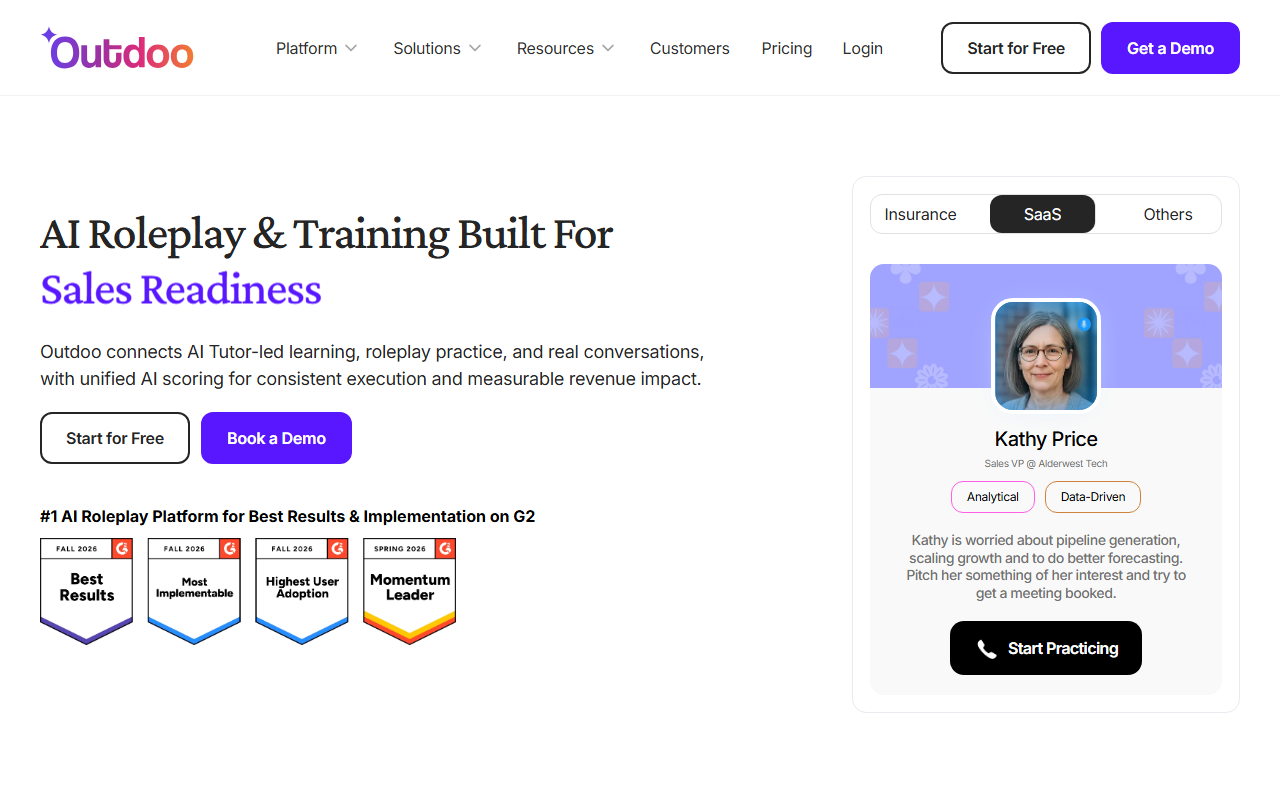 Outdoo.ai sells the same roleplay-and-scoring idea as Vantage, aimed at sales teams instead of students. Captured 20 Sep 2026.
Vantage is neither. It is a research instrument that happens to be free and open to anyone who signs in with a Google account, built to validate a grading method more than to prepare someone for a specific transaction.
It also is not a hiring or admissions product, and nothing in Google's published material suggests it is meant to feed one. A hiring team evaluating AI recruiting software is solving a different problem: screening a pool of external candidates at scale, not coaching one known student.
Someone polishing a resume with a tool like Kickresume or Teal before a job search is closer to InterviewCue's audience than to Vantage's. Keeping those three lanes separate matters. A Vantage skill score, whatever it eventually becomes, was never validated as a hiring signal, and using it as one would be a misuse Google has not endorsed.
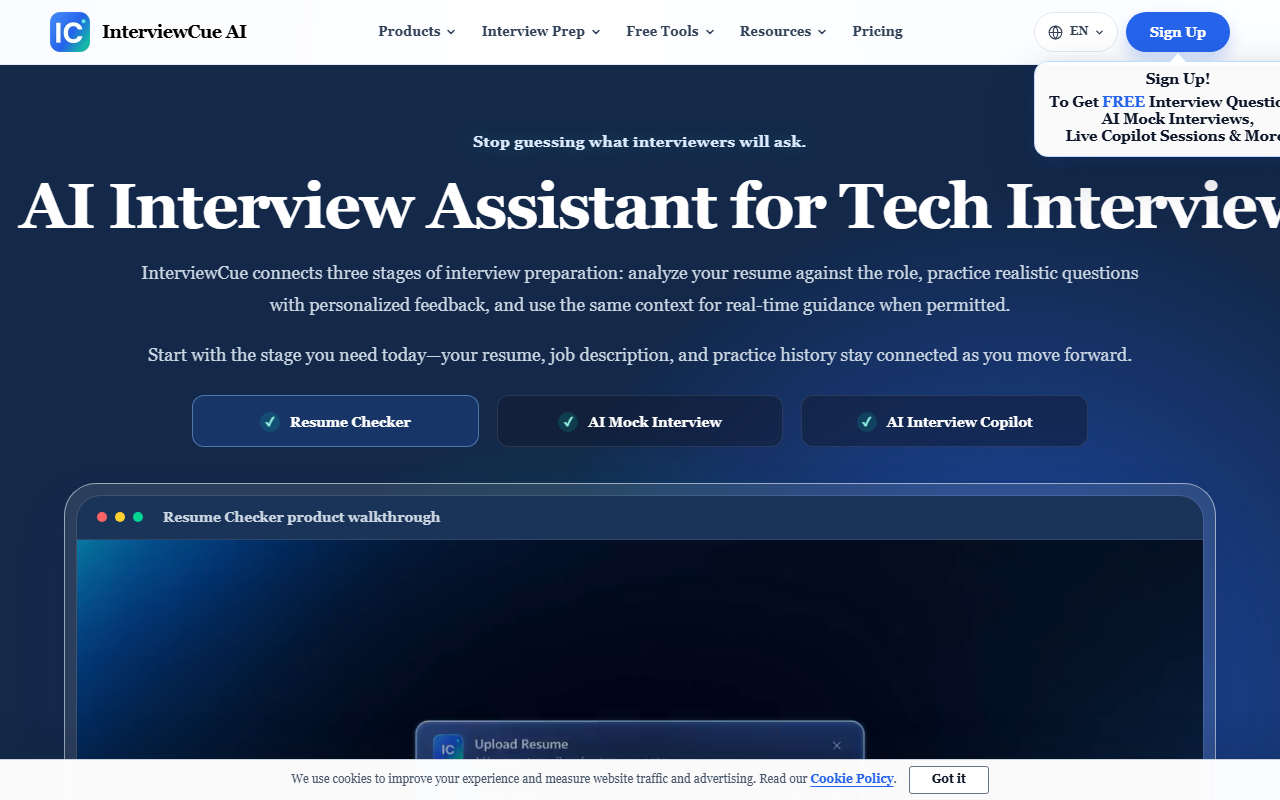 InterviewCue is built for a job interview, a narrower and more transactional goal than Vantage's skills assessment. Captured 20 Sep 2026.
How to try it, and what a session actually does
Signing in at labs.google with a Google account puts a tester into one of two task types, based on Google's own description of the product:
- Collaboration tasks. The tester joins a small group of AI-played teammates working toward a shared goal. The Executive LLM introduces a conflict, a bottleneck, or a disagreement partway through, and the tester has to navigate it in real time rather than answer questions about how they would.
- Creativity and critical-thinking tasks. The tester works through a more open-ended prompt, the version validated separately against real high-school multimedia submissions graded by human judges through the OpenMic partnership.
After either task type, the AI Evaluator reads back the full transcript against its rubric and returns a numeric skill map with written feedback, rather than a pass or fail grade. Google has not published how long that scoring step takes, whether a tester can retake the same scenario for a second attempt, or whether a teacher can see a class-wide view of the results.
Those are the three questions an educator piloting Vantage this term should expect to answer through trial rather than documentation. None of them are covered in the research write-up.
Vantage against what's already selling this idea
| Google Vantage | Outdoo.ai | InterviewCue | Yoodli | |
|---|---|---|---|---|
| Built for | Students and educators | Sales teams | Job seekers | Anyone practicing a talk |
| What it scores | Collaboration, creativity, critical thinking against a pedagogical rubric | Sales pitch execution against a buyer persona | Interview answer content and delivery | Filler words, pace, and structure |
| Validated against human raters | Yes, NYU and OpenMic studies published | Not independently published | Not independently published | Not independently published |
| Price | Free, no published business model | From $9 per user per month | From $16.99 to $59.99 per month depending on term | Free tier (5 lifetime sessions), then $8 to $20 per month |
| Access | Sign in with a Google account at labs.google | Book a demo or start a free trial | Sign up on the web | Sign up on the web |
The row worth sitting with is validation. Outdoo.ai, InterviewCue, and Yoodli all publish product claims about their scoring, but none of them has put out a study measuring how closely their AI's score agrees with an independent human expert's score on the same transcript.
Vantage has, twice, and named the sample sizes. That is a real point in Vantage's favor for anyone who cares whether "AI-graded" means anything beyond a marketing line. It is the one thing a best AI sales assistant roundup is not set up to check, because that category does not publish inter-rater reliability data either.
None of the four tools in that table are interchangeable, which is the actual finding here. A sales manager who signs a team up for Vantage instead of Outdoo.ai will get creativity and collaboration scores with no revenue-forecasting layer and no buyer-persona library. A student who tries InterviewCue instead of Vantage for a college interview will get unlimited practice questions but no published claim that the scoring matches a human evaluator.
The free experiment's money and data catch
Vantage costs nothing today, and Google has not published a commercial pricing plan, a data retention window, or a training-data policy for the conversations a tester has during a session. That silence is not necessarily a red flag, but it is a gap worth naming before you hand a 17-year-old's transcript of a simulated argument to a system with no stated retention limit.
Compare that to what the paid competitors disclose. Yoodli's own pricing page states plainly that on its Advanced plan and above, "your roleplay data is excluded from AI training by default," which means the free Starter tier and the $8-per-month Pro tier do not carry that guarantee.
InterviewCue's pricing page lists three paid tiers, each unlocking more of the product rather than more privacy:
- Monthly: $59.99 per month.
- Quarterly: $32.99 per month, billed per quarter.
- Annual: $16.99 per month, billed per year.
Neither company is hiding the ball. Vantage, by contrast, has not put out the equivalent sentence for its own product yet, free or not.
There is also a longevity question, and Google has already answered a version of it once with a similar product. Google Interview Warmup launched in June 2022 as a free, no-login tool that transcribed a tester's spoken answers to five practice questions.
The Internet Archive's last capture of the live tool is dated March 5, 2026. Sometime after that, Google retired it without a blog post, and the tool's old address now redirects to a general interview-tips article that points visitors toward Gemini Live instead. A free Labs experiment with no stated business model is not a promise Google intends to keep it running, and Vantage carries the same "Labs experiment" label Interview Warmup once did.
Where a human coach still wins
None of this makes Vantage the better pick every time. For leadership development at the executive level, a platform like BetterUp or Torch pairs a human coach with AI-assisted analytics, and the strategic judgment a person brings to a promotion conversation or a reorg is not something a rubric-scored simulated conversation currently replicates. Google's own researchers frame Vantage as a sandbox for practice and assessment, not a substitute for the real interactions it is modeling.
The honest limitation shows up in the research itself: Google says its own next step is studying "transferability," meaning whether a skill a tester demonstrates inside a simulated group chat with AI teammates actually shows up later in a real disagreement with a real classmate or coworker. That question is unanswered by design.
A high score in Vantage tells you the AI Evaluator's rubric was satisfied by that transcript. It does not yet tell you the skill will show up outside the sandbox. A school weighing whether to trust a rubric score over a teacher's own judgment should treat that gap as the reason to use Vantage alongside a human evaluator, not instead of one.
What Google says is next
Google has committed publicly to exactly one next step: expanding the research to test transferability from the simulated sandbox to real-world interaction, the question the NYU and OpenMic studies did not attempt to answer. There is no published roadmap for a mobile app, an API, an LMS integration, or a paid tier, and Vantage remains web-only and English-only at launch.
DeepMind, which co-develops the Gemini family under Google, has not said publicly whether Vantage's Executive LLM or Evaluator architecture will feed into a consumer-facing product. Nothing in the research post promises that it will.
If you are an educator deciding whether to point a class at labs.google this term, the realistic plan is a short pilot, not a rollout:
- Run one collaboration task with a few students before assigning it to a whole class, since Google has not published how scoring behaves at volume.
- Treat the skill map as a conversation-starter with the student, not a grade for a gradebook.
- Keep a human reviewer in the loop for any score that affects a real decision, and revisit the tool's status next semester, since a free Labs experiment is not guaranteed to keep running.
For anyone comparing a general-purpose Gemini chatbot conversation against a purpose-built assessment like Vantage, the difference is the rubric and the published validation study behind it, not just the model doing the talking. The same distinction shows up whenever a general chatbot gets asked to do research work that a narrower, purpose-built tool would do with a citation trail attached.
For teams evaluating any of these platforms against a specific hiring or training gap rather than a classroom one, HokAI's Smart Match will ask what the conversation is actually for: sales practice, interview prep, or skills assessment, before pointing you at one of them. The three answers are not interchangeable products wearing different logos.
Frequently asked questions
What is Google Vantage used for?
Vantage is a free Google Labs experiment that scores a student's collaboration, creativity, and critical thinking by placing them in a live, multi-party AI conversation and grading the transcript against a rubric. It is built for high school and college students and the educators who work with them, not for job interview prep or sales training.
Is Google Vantage the same as Google Interview Warmup?
No. Interview Warmup was a free tool that transcribed spoken answers to five practice interview questions, and Google retired it, with its old web address now redirecting to a general article recommending Gemini Live. Vantage is a separate research product built with New York University researchers to grade durable skills like collaboration, not interview delivery.
How accurate is Google Vantage's AI scoring?
Google says a 188-person study found the AI Evaluator's scores agreed with human expert raters about as closely as two human raters agree with each other, and a second study with OpenMic found a 0.88 Pearson correlation between AI and human scores on creative tasks. Neither study measured whether the skill demonstrated in Vantage shows up later in a real interview or workplace conversation.
Does Google Vantage cost anything?
Vantage is free to use by signing in with a Google account at labs.google, and Google has not published a commercial pricing plan or a data retention policy for it. That is unlike Yoodli, InterviewCue, and Outdoo.ai, which publish explicit pricing tiers and, in Yoodli's case, a stated policy on excluding paid users' data from AI training.
Should a job seeker use Google Vantage to prepare for an interview?
Not really. Vantage was validated for scoring collaboration and creativity in an educational context, not interview delivery, and a tool like InterviewCue, built specifically around mock interview questions and a resume checker, is a closer match for that goal.
Covered in this guide
- Vantage: Free Google Research experiment that uses two coordinated Gemini models to run AI group conversations and grade durable skills like collaboration and creativity.
- InterviewCue: AI interview prep platform bundling 4 tools: a free resume checker, voice-based mock interviews, a live copilot, and a question bank.
- Outdoo.ai: Outdoo.ai is an AI roleplay and coaching platform that lets customer-facing teams practice sales skills with realistic AI buyers, then measures whether training translates to live customer performance through unified scoring and revenue intelligence.
- Gemini: Google's multimodal AI model family for reasoning, coding, and creative tasks
- Gemini 3.7 Flash: Google DeepMind's Aug 2026 Gemini 3 workhorse for coding and agents, with a 1M-token context window rolling out to Gemini Spark users in 160 countries.
- Gemini 3.8 Flash: Google DeepMind shipped Gemini 3.8 Flash on September 2, 2026, a multimodal Gemini 3 model tuned for long-horizon coding and agentic enterprise work.
- Google: Google (Alphabet, NASDAQ: GOOGL), founded 1998, serves 8B+ monthly Search users with Gemini 3.5, 190,820 employees, and $402.84B FY2025 revenue.
- DeepMind: Google DeepMind, Alphabet's AI research division formed in 2023, builds Gemini, AlphaFold, and Gemma with 8,000+ researchers across six continents.
Sources
Still deciding?
This guide covers a handful of options. Smart Match checks every listing in the directory against how you actually work and what you can spend, then hands you the shortlist and the reason behind each pick.
Start Smart MatchRelated guides
- Best AI Assistant Apps for Android in 2026, Now That Google Assistant Is DeadBuyer's guideHow to pick, across a category
- Best AI Chatbots in 2026: Pick by the Job, Not the LeaderboardBuyer's guideHow to pick, across a category
- Best AI Coding Assistants in 2026: Pick the Job, Not the BrandBuyer's guideHow to pick, across a category
- Best AI Companies in 2026: Who Is Actually LeadingBuyer's guideHow to pick, across a category
- Best AI Tools for Writing Excel Formulas and Data Analysis in 2026Buyer's guideHow to pick, across a category
- Best AI for Coding Questions Free in 2026: 8 Real Options, ComparedBuyer's guideHow to pick, across a category