Best AI Recruiting Software in 2026: For Hiring Teams, Not Job Seekers
Among AI recruiting tools built for employers rather than job seekers, Juicebox, from $99 per seat monthly, fits high-volume sourcing teams keeping their existing ATS; Spott, from $139 per user monthly, fits agencies wanting AI matching built into the ATS itself; and Asendia AI fits staffing agencies needing voice-based candidate screening at scale.
The short version
HokAI's AI Recruiting category mixes employer tools with job seeker resume builders. For hiring teams, four tools actually compete: Asendia AI screens candidates by voice, Juicebox sources them through plain-English search, Spott is a full AI-native ATS built for agencies, and Mercor staffs vetted experts to AI labs, not typical corporate roles.
Mercor's investors were reportedly discussing a $20 billion valuation in July 2026, nine months after the AI recruiting company's $10 billion Series C, according to TechCrunch's reporting on July 9.
That kind of number says more about capital chasing anything with "AI" and "recruiting" in its pitch deck than about which tool fixes a hiring team's actual problem this quarter. The eight tools sitting under HokAI's AI Recruiting category split into two buyers who will never read the same paragraph: employers trying to source and screen candidates faster, and job seekers trying to get past someone else's screen.
This guide is for the first group, specifically a five-person talent acquisition team at a startup weighing whether Asendia AI, Juicebox, or Spott belongs next to the applicant tracking system they already run.
Two searches, one category page
Type "best AI recruiting software" into a search bar and you land on lists built for two different people. Four of the eight tools in HokAI's AI Recruiting category are aimed at job seekers, not recruiters: Kickresume and Resumás format resumes and score them against an Applicant Tracking System, innerTrack drafts outreach to hiring managers, and Teal tracks applications.
If you are the one applying for jobs, not hiring for them, Teal's free tier, unlimited resume versions and unlimited application tracking, no card required, is the strongest starting point of the four. Kickresume is the one to add if you want an AI-written cover letter and a portfolio site alongside the resume. Neither belongs in the rest of this guide, which covers the other buyer: a hiring team choosing a tool to source, screen, or manage candidates.
How to choose an AI recruiting tool in 2026
Six questions separate the useful pick from the wrong one, and each has a testable answer.
Which stage is actually broken? Sourcing (finding candidates), screening (evaluating the ones you have), and system-of-record (tracking them through a pipeline) are three different jobs. A tool that is excellent at one is often mediocre at the other two, because the interface and the data model are built around a single workflow.
Does the pricing model match your volume shape? Per-seat monthly pricing punishes a small team that suddenly needs to run a hiring surge. Usage-based, per-interview or per-minute pricing punishes a team with steady, high volume. Match the billing model to how spiky your hiring actually is, not to which vendor's sales page you read first.
Point solution or full replacement? Some of these tools sit beside your existing ATS and hand it cleaner data. Others want to become your ATS. The second kind is a much bigger commitment, and the switching cost of undoing it a year later is real.
Does the vendor's core customer look like you? A tool built for staffing agencies (high volume, external clients, thin margins) behaves differently from one built for an in-house corporate talent acquisition team (lower volume, one employer, more process). Read the case studies for who they name, not what they claim.
What is your tolerance for platform risk? Every tool in the shortlist below was founded between 2022 and 2025. That is not disqualifying, but it means checking the team size, the funding stage, and any public incident history before signing an annual contract, not after.
Asendia AI, for one, lists a three-person team on its own Y Combinator page as of this run. A three-person vendor can move faster than a 200-person incumbent. It can also lose a key engineer and stall for a quarter. Ask for the team's current headcount directly; none of the four publish it on their marketing site.
Does the vendor name a customer you recognize, or only a category? Juicebox names Ramp and Perplexity. Asendia AI describes "staffing agencies across the US and Europe" without naming one. A named customer is not proof a tool works for you, but it is a signal worth weighing against a vendor that only offers categories.
The shortlist: four tools, in the order a team is likely to need them
Each one solves a different piece of the hiring workflow, priced and staffed differently enough that picking by name recognition alone will send you to the wrong one.
Asendia AI screens by voice, around the clock
Asendia AI builds Sarah, a voice AI agent that runs live phone and WhatsApp screening interviews around the clock instead of a human recruiter doing it in business hours. The company, part of Y Combinator's Spring 2026 batch and founded in 2025 by Rihab Lajmi and Badis Zormati, targets staffing agencies specifically. It positions itself as cloning "your best recruiter" across every applicant, rather than replacing the recruiter entirely.
Its own site publishes no per-minute or subscription rate as of 23 August 2026; pricing is demo-only. That is the one caveat worth flagging: there is no public number to sanity-check against a competitor's, which is unusual even among the newer entrants on this list.
Juicebox sources candidates in plain English
Juicebox, marketed as PeopleGPT, lets a recruiter search a large aggregated database of professional profiles in plain English instead of building a Boolean string, and names Ramp and Perplexity as customers using it at scale. On Juicebox's own pricing page, checked 23 August 2026, the Growth plan runs $179 per seat per month billed annually (marked 15% off the standard rate), and a Starter plan for individuals runs $99 per seat per month on the same billing terms, with a limited free tier to try search before paying.
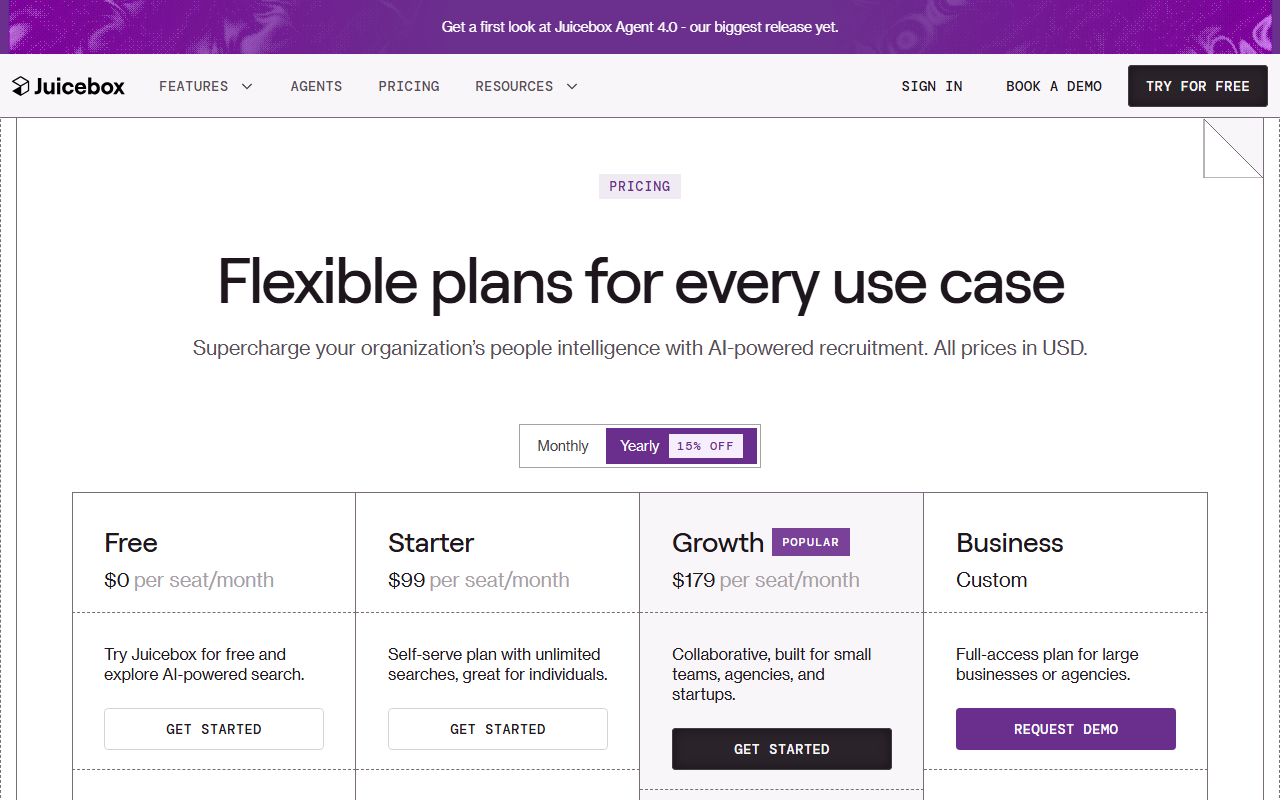 Juicebox's pricing page, captured 23 Aug 2026. Growth is the tier aimed at small teams and agencies; Business removes the credit caps entirely.
Juicebox is a sourcing tool, full stop. It finds and enriches candidate profiles; it does not replace an ATS, run interviews, or manage a pipeline past the export step. Whatever system already holds your candidates, Juicebox feeds it, it does not become it.
Spott wants to be your ATS, not sit beside it
Spott's AI-native ATS and CRM is built specifically for recruiting and staffing agencies, started in Leuven, Belgium in 2024 by three former McKinsey, BCG, and Bain consultants. Unlike Juicebox and Asendia AI, Spott wants to be the system of record, not a tool that feeds one. It ships native MCP servers for Claude and ChatGPT, letting an agency query its own candidate database from inside either assistant, a detail that matters more to HokAI's audience than most vendors' feature lists.
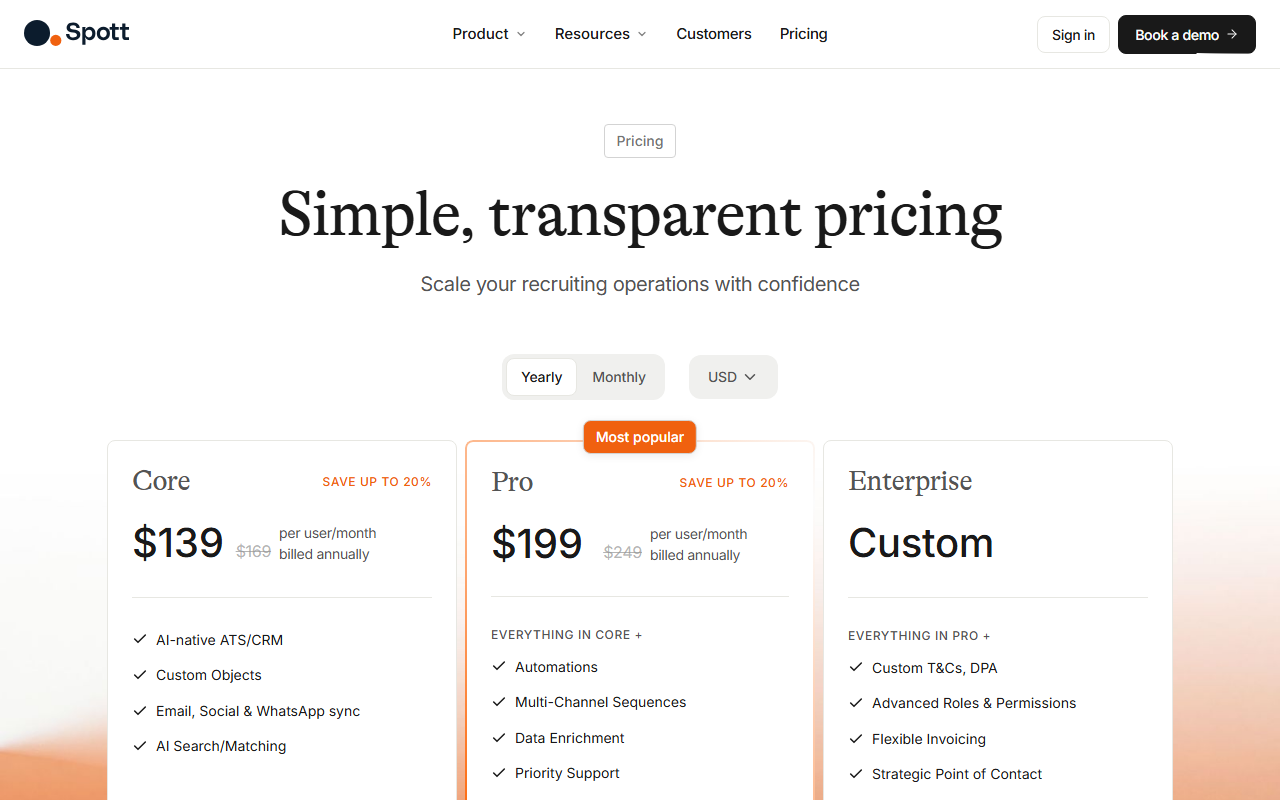 Spott's pricing page, captured 23 Aug 2026. The struck-through figures are the monthly-billed rate; the bold numbers are what annual billing actually charges.
Spott's own pricing page, checked the same day, lists Core at $139 per user per month billed annually (versus $169 billed monthly) and Pro, its most-popular tier, at $199 per user per month billed annually (versus $249 billed monthly). Enterprise is custom quote only. The caveat here is the size of the decision: adopting Spott means migrating your candidate data and your team's daily workflow into a one-year-old platform, not adding a feature on top of what you already run.
Mercor is not a corporate recruiting tool at all
Mercor does not belong in the same sentence as the other three, and that is exactly why it is worth naming. It is a marketplace that staffs vetted domain experts, in medicine, law, investment banking, and software engineering, to AI labs that need human evaluators for RLHF and benchmarking work, not a tool for filling a normal corporate role.
Its valuation talks jumped from $10 billion in October 2025 to a reported $20 billion by July 2026, per TechCrunch's reporting, alongside a claimed annualized revenue run rate crossing $2 billion. It also disclosed a data breach in April 2026 and faced lawsuits from contract workers over pay classification earlier in the year.
Both are worth reading about before treating the valuation headline as the whole story. If your open roles are software engineers or account executives rather than AI-lab evaluators, Mercor is the one name on this list to skip entirely.
Which one fits your bottleneck
| Your bottleneck | Pick | Price (checked 23 Aug 2026) | One caveat |
|---|---|---|---|
| High-volume sourcing, in-house TA team | Juicebox | $99-$179/seat/month, billed annually | Sourcing only; still need somewhere to track candidates once found |
| Screening volume drowning a staffing agency | Asendia AI | Not publicly listed; demo required | No public rate card to compare against, even roughly |
| Want AI matching built into the ATS/CRM itself | Spott | $139-$199/user/month, billed annually | Wants to replace your system of record, not sit beside it |
| Staffing vetted experts to an AI lab's RLHF pipeline | Mercor | Custom; contractors report $63-$120/hour | An April 2026 data breach and contractor lawsuits are worth reading first |
Juicebox vs. Spott: sourcing add-on or full AI-native ATS?
These are the two most people actually end up choosing between, because they solve adjacent problems with a similar sales pitch.
Pick Juicebox if you already have an ATS you are not trying to replace, and your bottleneck is finding qualified candidates faster than a Boolean search string allows. It is the lower-commitment choice: cancel it and you lose a search tool, not your candidate history.
Pick Spott's system-of-record approach if you are a recruiting or staffing agency and the actual bottleneck is fragmented tooling, one system for outreach, another for tracking, a spreadsheet for the rest, rather than sourcing volume specifically. Spott's pitch only makes sense if you are willing to migrate onto it as your system of record, which Juicebox never asks of you.
Neither is a corporate in-house TA team's first ATS. Both assume you already have workflows worth improving, not a hiring process built from scratch.
Who should skip this whole cohort
A team making one or two hires a year does not need any of these four. The setup and evaluation time alone costs more than the time it would save. And an enterprise organization already running Greenhouse, Workday, or iCIMS with dedicated implementation support should treat this list as a research note, not a shopping list.
All four of HokAI's picks are one to four years old. The switching cost of moving off an established ATS rarely clears the bar for what a point solution or a one-year-old platform can prove it saves.
A regulated employer hiring in the European Union has one more reason to slow down. The EU AI Act's Annex III lists recruitment and hiring decisions as high-risk AI use cases, and the full conformity obligations for that tier, risk management, bias testing, logging, human oversight, took effect on 2 August 2026.
None of the four vendors in this guide publish an EU AI Act compliance statement on their own site as of this run. That does not mean they are non-compliant. It means the burden is on you to ask, in writing, before a contract, not to assume the vendor has already handled it.
The turn
The obvious objection: Greenhouse, Workday, and iCIMS are all adding AI screening and sourcing features natively or through acquisition, so why take on a three-person, year-old vendor's platform risk when the incumbent is shipping the same capability anyway?
For Juicebox and Asendia AI, the answer is that most teams adopt them as point solutions bolted onto an existing ATS, not replacements for it. The platform risk is bounded to one workflow, sourcing or screening. If the vendor stumbles, the fallback is going back to manual search or human screening for that one function, not rebuilding a system of record.
Spott is the exception. It asks to become the system of record, which is why it is the one on this list that deserves the most scrutiny before a contract gets signed, not the one with the flashiest AI feature.
Whether any of these three actually get a team to rip out Greenhouse or Workday, instead of bolting on next to it, is the number worth watching over the next few quarters, not this year's valuation headline.
Frequently asked questions
What's the difference between Juicebox and Spott?
Juicebox is a sourcing tool that searches candidate profiles in plain English; it does not replace an applicant tracking system. Spott is a full AI-native ATS and CRM built for recruiting agencies, meant to become the system of record rather than sit beside one. Pick Juicebox if you already have an ATS you like, and Spott only if you are willing to migrate your candidate data onto a new platform.
Does Asendia AI publish its pricing?
No. As of 23 August 2026, Asendia AI's own site describes only a demo-based sales process for its Sarah screening agent, with no per-minute or subscription rate published. Third-party listing sites cite a $0.20-per-minute figure, but it could not be confirmed against Asendia AI's own pricing page for this guide.
Is Mercor a recruiting tool for a typical corporate hiring team?
No. Mercor is a marketplace that staffs vetted domain experts, in fields like medicine, law, and software engineering, to AI labs that need human evaluators for RLHF and benchmarking work. Its valuation talks reportedly reached $20 billion by July 2026, according to TechCrunch, but that has nothing to do with filling a standard corporate role.
What should a job seeker use instead of these employer-side tools?
Teal's free tier covers unlimited resume versions and application tracking with no card required, and is the strongest free starting point. Kickresume adds AI-written cover letters and a portfolio site for readers willing to pay for a subscription. Neither is built for a recruiter's workflow, and none of the tools in this guide's shortlist are built for a job seeker's.
Do any of these tools address the EU AI Act's high-risk rules for recruitment AI?
None of the four vendors covered here publish an EU AI Act compliance statement on their own site as of this guide's research date. The Act's high-risk obligations for recruitment AI, covering risk management, bias testing, and human oversight, took effect on 2 August 2026, so employers hiring in the EU should ask each vendor directly before signing.
Covered in this guide
- Asendia AI: Asendia AI is an AI recruiter that runs voice and video interviews around the clock, sources and screens candidates with its own multi-agent suite, then syncs ranked shortlists into your ATS.
- Juicebox: PeopleGPT, Juicebox's AI sourcing engine, is used by recruiting teams at Ramp and Perplexity to find candidates without Boolean search strings.
- Spott: AI-native ATS/CRM for recruiting agencies, backed by $3.2M in Y Combinator-linked seed funding, with vector-based candidate matching and official MCP servers for Claude and ChatGPT.
- Mercor: AI talent marketplace connecting 100,000+ domain experts with frontier AI labs for RLHF data. $10B valuation; used by the top 5 AI labs and 6 Mag 7 companies.
- Kickresume: AI resume and cover letter builder used by more than 8 million job seekers, pairing AI-assisted writing with ATS-friendly templates and a website builder.
- Teal: Teal is a free AI job search platform for job seekers, built by Teal Labs, founded in 2019, combining an unlimited resume builder and application tracker.
Sources
Still deciding?
This guide covers a handful of options. Smart Match checks every listing in the directory against how you actually work and what you can spend, then hands you the shortlist and the reason behind each pick.
Start Smart MatchRelated guides
- Best AI Tool for Resume Building in 2026: Five Options ComparedBuyer's guideHow to pick, across a category
- Kickresume vs Teal: Which Should You Use in 2026?ComparisonHead-to-head, with a verdict
- Which Claude Model Should You Use? Opus, Sonnet and Haiku by Job in 2026Buyer's guideHow to pick, across a category