What Adobe Firefly Is Actually For, Now It Runs 30 Models It Can't Fully Indemnify
Adobe Firefly is Adobe's generative AI suite for commercially safe image, video, and vector creation inside Photoshop, Illustrator, and Premiere Pro. Adobe indemnifies output from its own Firefly models by default, but excludes the 30-plus third-party models it added starting March 2026, restoring coverage only for select Google and OpenAI models under Enterprise contracts.
The short version
Adobe Firefly's revenue is growing fast, roughly 50 percent quarter over quarter, but that surge is freemium creators paying for credit packs, not agencies buying indemnification. Firefly's workspace now includes over 30 outside models Adobe did not build. Check which model made your image before you ship it to a client.
Adobe told investors on June 11, 2026, that Firefly's annual recurring revenue was approaching $300 million, up roughly 50 percent in a single quarter.
That jump did not come from big studios signing enterprise licenses. It came from Adobe pushing free and cheap accounts into millions of new hands, then converting a slice of them into paid credit-pack subscribers. For a freelancer or a small in-house design team who chose Adobe Firefly specifically because it promises commercially safe, indemnified output, that freemium surge matters less than what now sits inside the same workspace: more than 30 outside models Firefly did not build and, by default, does not indemnify.
Firefly's growth is coming from freemium creators, not agency retainers
Adobe's own numbers make the shift explicit. On that June call, ending ARR across the app, credit packs, and enterprise deals sat at just under $300 million exiting the second fiscal quarter, according to the company's own transcript. Executives credited what they called "personalized journeys for creators," the onboarding flow that steers free users toward paid credit packs, with driving roughly half of that quarter-over-quarter jump.
Zoom out and the pattern holds company-wide. Total AI-first recurring revenue, which folds this product in with AI features scattered across the rest of the design suite, tripled year over year to more than $500 million in the same quarter. None of that growth required a single new indemnification contract.
It required millions of casual users burning through 25 free credits, then paying $9.99 a month for 2,000 premium credits on the Standard plan, or $19.99 for 4,000 on Pro, per pricing tracked by CostBench in June. A Premium seat runs $199.99 a month for 50,000 credits, aimed at agencies doing high-volume production rather than the solo freelancer this piece is written for.
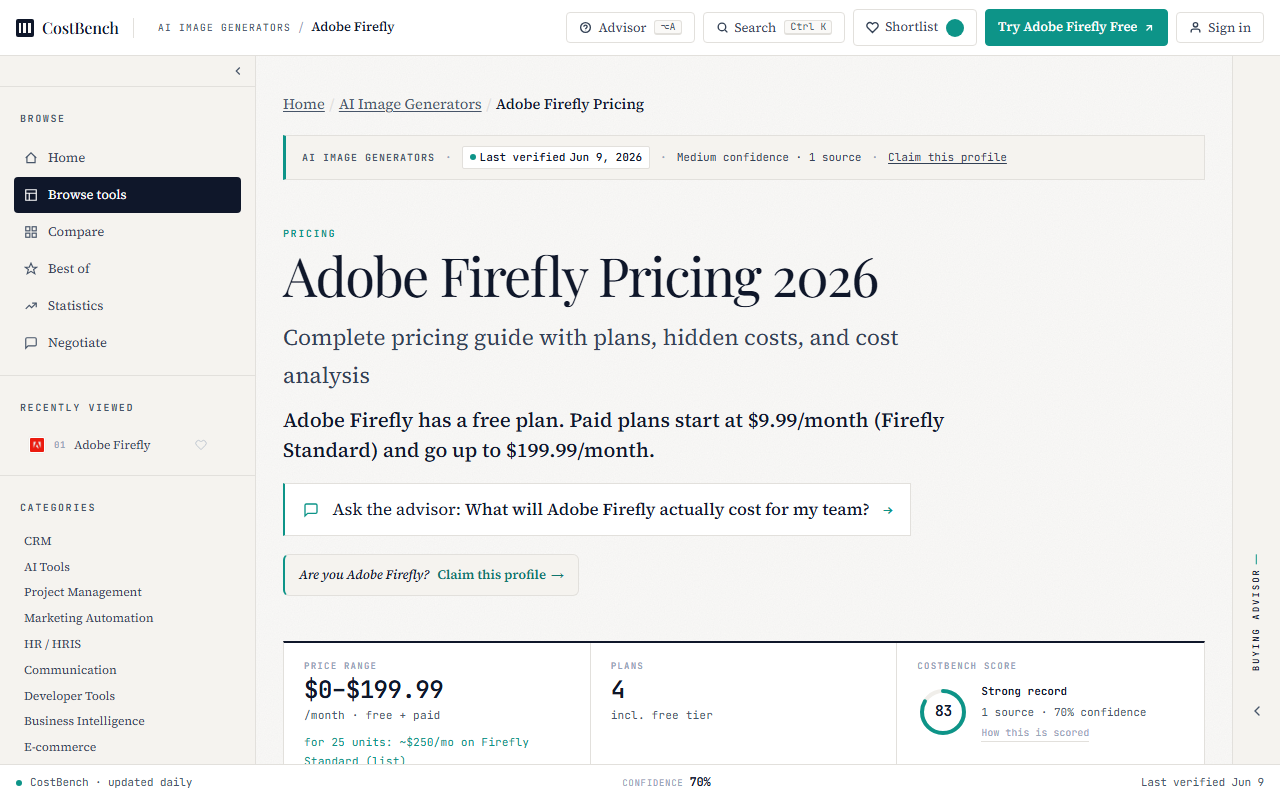 Firefly's plan and credit breakdown, tracked by pricing site CostBench and last verified 9 June 2026.
Midjourney, the generator most reviews still price this one against, charges a comparable $10 a month for its entry plan and has never made an indemnification claim at all. The freemium math behind the current growth spurt has almost nothing to do with the promise that built the brand.
The "commercially safe" claim only fully covers Adobe's own models
Here is the part the revenue numbers gloss over. Since a platform expansion on March 19, 2026, the workspace has given users access to more than 30 models "from across the industry," including two new releases from Google, Runway's Gen-4.5, and Kling's 2.5 Turbo, sitting alongside Adobe's own Image Model 4 and 4 Ultra.
Adobe's Creative Partner Models product description states that capabilities powered by outside models are excluded from indemnification by default. Coverage is restored only for models listed as Eligible Generative AI Features, and even then it is limited to specific media models from two named partners, made available through the enterprise production tier.
Read that closely and the gap is narrow on paper but wide in practice. A subscriber on the $9.99 to $19.99 tier driving the freemium growth gets none of that enterprise-only carve-out. Generate an image with either bundled partner model inside the same tab used for the native one, and the legal ground under that specific output has quietly changed. Nothing in the interface flags the switch.
Who gets full protection, and who steps outside it without noticing
Designers who stay inside the native models keep the protection intact. Image Model 4 Ultra handles the photorealistic portraits and product shots most commercial briefs actually need, and the indemnity applies to that output on any paid plan, not just enterprise. That covers a freelancer running client social ads, or a small agency using Generative Fill inside Photoshop.
The risk sits with power users chasing whatever performs best on a given brief. A designer who taps Ideogram for its stronger in-image typography, or falls back to Stability AI's open-weights output for a look the native model cannot match, already left the covered path and was never protected to begin with. The more dangerous case hides inside the same workspace: someone who assumes every option carries the same guarantee, because the picker sits one dropdown away from the flagship model with no separate warning attached.
The counterargument: this risk is still mostly theoretical
The fair pushback is that no publicized indemnification claim, against a native model or a partner's, has actually tested this distinction yet. Usage guidelines already forbid prompts intended to produce infringing content no matter which model generates the image. In practice, most output from any option in the workspace is unlikely to trigger a claim either way.
That is true, and it does not close the gap. A guideline the user has to remember and follow is a materially weaker protection than a contractual indemnity that applies automatically the moment output ships. The difference only shows up the day a claim actually lands, and by design it is opt-out by omission rather than flagged at the point of choice.
What to check before the next client deliverable
Anyone shipping commercial work should check which model generated the specific asset before it goes to a client, not just which app it came from. A June expansion now routes creative requests through OpenAI's chat assistant and its rival from Anthropic.
Fiscal third-quarter results land in September, the first period to fully reflect this partner lineup. Watch that report for whether the narrow carve-out widens to cover the rest of the lineup, or whether the safest claim in the marketing stays attached to a shrinking share of what actually gets generated.
Frequently asked questions
Does Adobe Firefly's indemnification cover every model available inside Firefly?
Adobe's Creative Partner Models terms exclude capabilities powered by non-Adobe models from Firefly's IP indemnification by default. Coverage is restored only for specific Google and OpenAI models, and only through Firefly Creative Production for Enterprise.
Which Firefly plan should a freelancer pick for commercially safe client work?
Firefly Standard at $9.99 a month and Pro at $19.99 a month both carry Adobe's indemnification for output from Adobe's own models, including Image Model 4 and 4 Ultra. The protection depends on which model generated the image inside Firefly, not which paid tier the account sits on.
Are Runway and Kling outputs generated inside Firefly covered by Adobe's guarantee?
Not by default. Runway's Gen-4.5 and Kling's 2.5 Turbo are two of the more than 30 partner models Adobe added to Firefly starting March 19, 2026, and Adobe's own product terms treat non-Adobe models as excluded from indemnification unless a customer holds an Enterprise contract with the specific carve-out.
How is Adobe Firefly performing financially in 2026?
Firefly's ending annual recurring revenue was approaching $300 million exiting Adobe's second fiscal quarter of 2026, up about 50 percent quarter over quarter, according to Adobe's June 11 earnings call. Adobe's broader AI-first ARR, which includes Firefly, tripled year over year to more than $500 million in the same period.
Can I use Adobe Firefly from inside ChatGPT or Claude now?
Adobe expanded Firefly's Creative Agent in June 2026 to work inside ChatGPT, Claude, Microsoft Copilot, Gemini, and Slack. Users can start a creative task, like a logo request, from one of those assistants and pull the result into an Adobe project.
Covered in this guide
- Adobe Firefly: Adobe Firefly generates commercially safe AI images and video inside Photoshop and Illustrator, trained exclusively on licensed content for full commercial-use IP indemnification.
- Midjourney: An independent research lab creating stunning AI-generated images from text prompts
- Google's Nano Banana 2 and Veo 3.1: Google (Alphabet, NASDAQ: GOOGL), founded 1998, serves 8B+ monthly Search users with Gemini 3.5, 190,820 employees, and $402.84B FY2025 revenue.
- Ideogram: AI image generator that actually gets text right, useful for anything combining words and visuals.
- Kling's 2.5 Turbo: Kuaishou's text-to-video platform with native 4K, lip-synced audio in 5 languages, and free daily credits. Used by 60M+ creators; plans from $6.99/month.
- OpenAI: OpenAI builds ChatGPT, the GPT-6 family (Astra, Sol, Luna), Codex and the OpenAI API. It reports 1.2B weekly ChatGPT users and an $852B valuation after its March 2026 round.
- Runway's Gen-4.5: AI to simulate the world through generative video and world models
- Stability AI: Enterprise-ready creative partner for multimodal AI media generation
Sources
Still deciding?
This guide covers a handful of options. Smart Match checks every listing in the directory against how you actually work and what you can spend, then hands you the shortlist and the reason behind each pick.
Start Smart MatchRelated guides
- 41 of 100 HokAI Guides Carry a Screenshot. All 106 Still Load.Inside HokAIHow the directory works, verified in the open
- Adobe Firefly or Gencraft: A 2026 Pricing and Feature ComparisonComparisonHead-to-head, with a verdict
- Adobe Firefly vs Topaz Photo AI: Which Should You Use in 2026?ComparisonHead-to-head, with a verdict
- The AI 80s Photo Trend: How to Make Yours (and Turn It Into a Video) in 2026AnalysisWhat changed and who it affects
- Best Agentic AI in 2026: Pick the Job, Not the GeneralistBuyer's guideHow to pick, across a category
- Best AI Chatbots in 2026: Pick by the Job, Not the LeaderboardUpdatedRechecked against current sources