Why 3,827 JSON-LD Blocks Sit Under Pages Google Won't Decorate
HokAI publishes structured data on 1,122 of its 1,133 sitemap pages, including 4,731 FAQ pairs and 1,122 breadcrumb trails that meet Google's stated field requirements. Since FAQ rich results ended on 7 May 2026, the payoff is machine readability rather than search decoration, verified by checking markup against visible text.
The short version
A crawl of all 1,133 hokai.io sitemap URLs on 23 August 2026 found 3,827 JSON-LD blocks across 13 schema.org types. Every block parsed. Google no longer draws FAQ or HowTo boxes, so the markup is written for parsers instead, and it has to match the visible page.
Open the page source on HokAI's Cursor listing and four blocks of JSON-LD arrive before the first sentence a person is meant to read.
They describe the product the page describes. A SoftwareApplication record with the offer and the category, a FAQPage holding the questions and their answers, a WebPage naming which sections can be read aloud, and a BreadcrumbList giving the path back to the catalogue.
On 23 August 2026 we fetched all 1,133 URLs in the sitemap with a Googlebot user agent and pulled every block of this kind out of the HTML. There are 3,827 of them, and most will never produce the decorated search result that structured data is famous for.
Disclosure: HokAI wrote this about HokAI.
We keep shipping them because the decoration was never the point. The markup is the only version of a HokAI page written for a parser instead of a reader, and the test that matters is whether a parser can rebuild the page's claims from it without guessing.
Four blocks under one listing
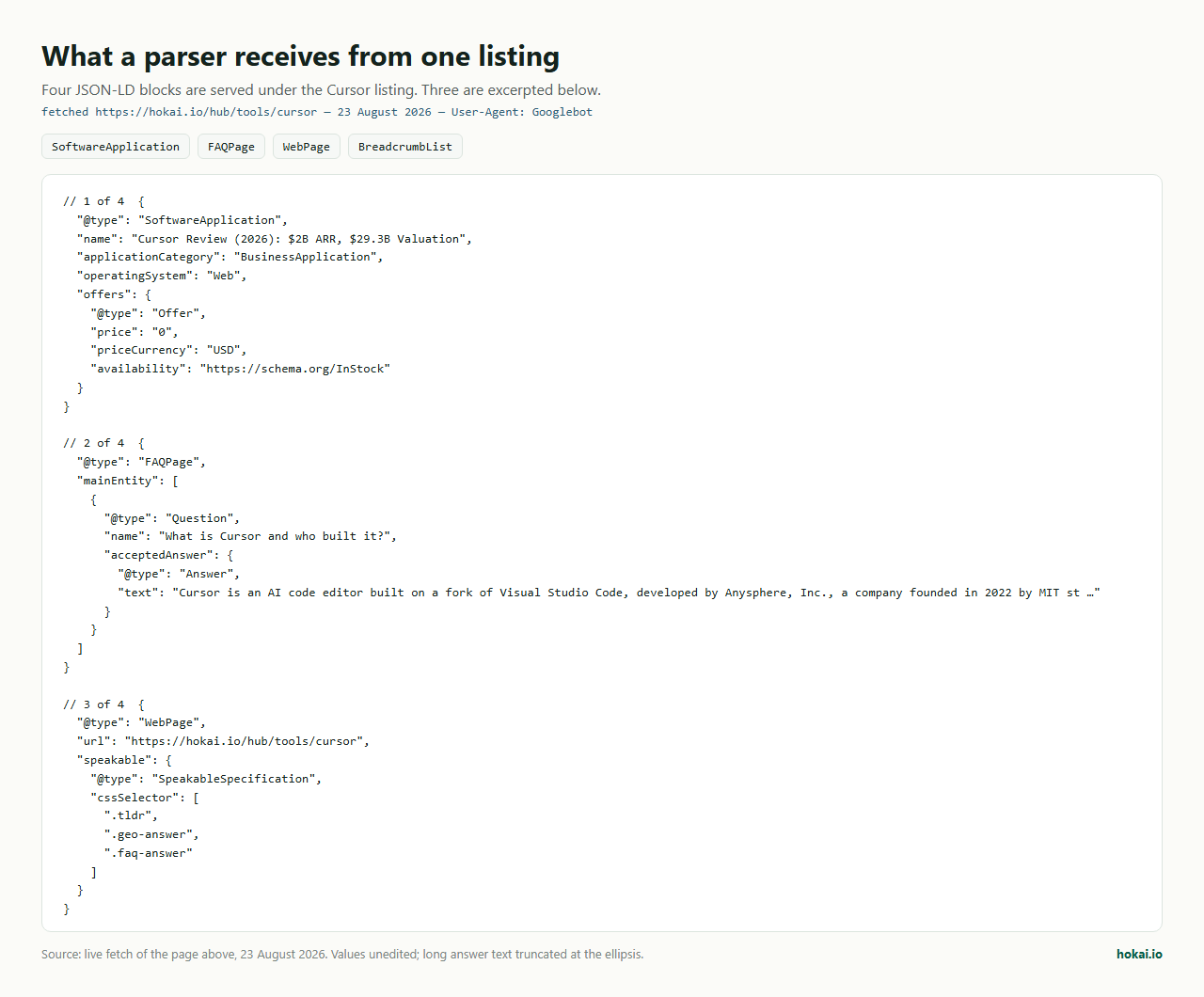
The four blocks under the Cursor listing, fetched with a Googlebot user agent on 23 August 2026. Values unedited, one long answer truncated.
The Cursor page carries the four described above. A company record is shorter: Anthropic ships three blocks, an Organization carrying founder, foundingDate, address and numberOfEmployees, then the FAQPage, then the breadcrumb. Claude Opus 5 also gets four, and its SoftwareApplication block adds softwareVersion, datePublished and a featureList that a tool page has no use for. Claude Code sits in the agents catalogue with three.
The pattern holds across the six page types in the directory: 452 tool pages, 102 models, 54 companies, 44 agents, 16 skills and 11 services. Each type declares the schema class that fits it rather than a single generic one. We wrote about why the six record types exist separately; the markup is where that decision becomes machine-readable.
Size varies more than you would expect. The heaviest payload on the site sits under Google's company page at 16.2 KB, which is 18.1% of that page's bytes. Across every page carrying any markup at all, the median share is 9.3%.
Thirteen types, and the job each one does
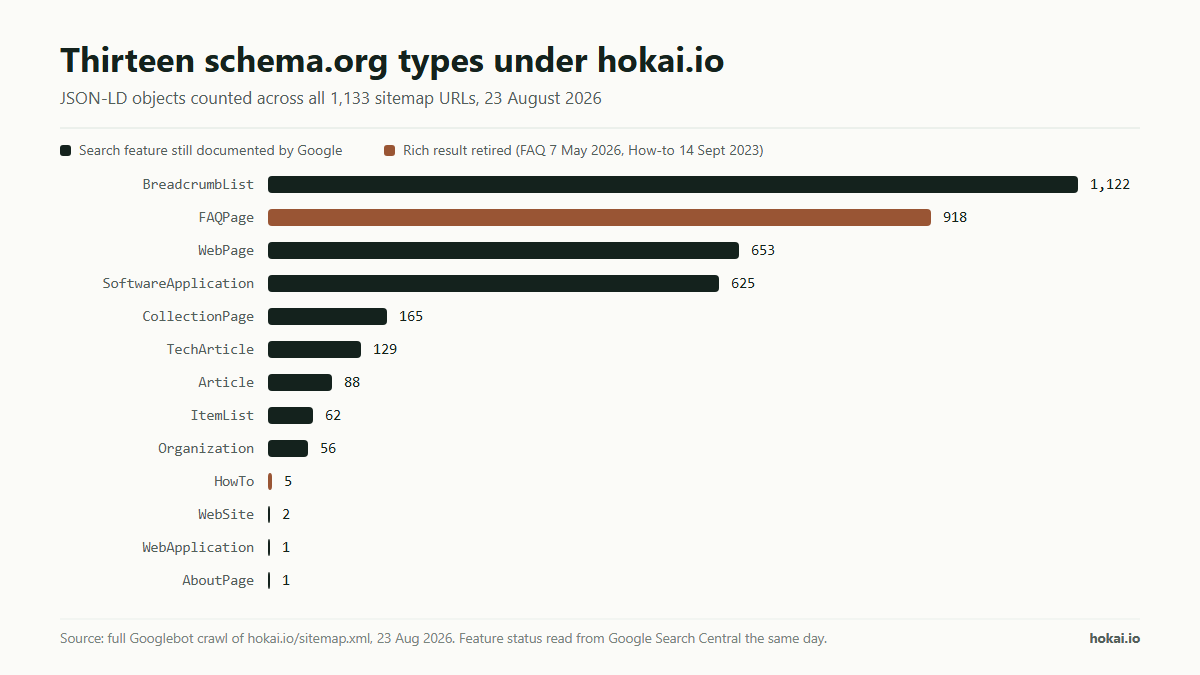
Every schema.org type served across hokai.io, counted from a full sitemap crawl on 23 August 2026.
Thirteen types cover the whole site. BreadcrumbList is the most common at 1,122 pages, because almost every page sits somewhere in a hierarchy. FAQPage follows at 918. SoftwareApplication covers 625 listings across tools, models, agents and services. CollectionPage handles the 165 index and facet pages, Article and TechArticle cover 88 guides and 129 documentation pages, and Organization appears 56 times.
Then there is the long tail: 5 HowTo blocks, 2 WebSite, 1 WebApplication on Smart Match, and 1 AboutPage. Ten pages in the sitemap carry no JSON-LD at all, which is the right answer for a cookie policy.
The boxes Google stopped drawing
Here is the part that makes the whole layer look like a bad investment.
Google's own documentation for FAQPage now records that the feature was removed. The rich result stopped appearing on 7 May 2026, the change was announced that month, and the documentation itself came down on 15 June 2026. Even before that, from September 2023, the box was shown only for what Google called well-known, authoritative government and health websites. HowTo went earlier: Google removed that documentation on 14 September 2023, noting the rich result was no longer shown on desktop or mobile.
Speakable is a third case. We declare it on 812 pages, pointing at three CSS selectors: .tldr, .geo-answer and .faq-answer. Google's documentation still labels the feature beta and limits it to news publishers and to users in the United States with English-set Google Home devices. We are neither of those things.
Two of our thirteen types have lost their search feature, and the others have not. Google's gallery of search appearances listed 29 features on 23 August 2026: breadcrumb, article and software app are all in it, and FAQ and How-to are not. Breadcrumb runs in every region and language where Search is available, on documentation last updated 10 December 2025.
The case for keeping 4,731 answers anyway
There are 4,731 question and answer pairs inside our FAQPage markup. Google will not draw a box around any of them.
They stay because search decoration is one consumer out of many, and the specification was never Google's to begin with. JSON-LD 1.1 is a W3C Recommendation published on 16 July 2020, described there as a format to serialize Linked Data and to build interoperable web services. schema.org, founded jointly by Google, Microsoft, Yahoo and Yandex, puts the case plainly in its own FAQ: because the markup is publicly accessible from your pages, other organizations may find new ways to make use of it.
The founders do not even consume it identically. Yandex's introduction to schema.org, read on 23 August 2026, describes the vocabulary as used with microdata rather than JSON-LD. Google's structured data introduction, read the same day, says it recommends JSON-LD and uses the data to understand the content of the page, which is a broader job than decorating a result.
So the audience is plural, partly undocumented, and changes without notice. Our call is that the only markup worth writing under those conditions is markup that is correct whoever shows up.
Three tests a machine can run on this page
Correct is measurable, and all three tests below ran on 23 August 2026.
The first is whether the blocks parse. Every one of the 3,827 blocks passed JSON.parse with zero failures. That sounds trivial until you consider that a single unescaped quote in a vendor's product description would break a block silently, and nothing on the rendered page would look wrong.
The second is whether required fields are present. All 4,731 FAQ pairs carry a Question with a name, an acceptedAnswer typed as Answer, and answer text. Google's breadcrumb documentation asks for an itemListElement of at least two ListItems, each with a position and a name: all 1,122 breadcrumb blocks meet it, with trails running 3 items deep on 837 pages, 4 on 240, 5 on 40 and the minimum 2 on the remaining 5.
The third test is the one that separates markup from decoration. Google's structured data policies say the data must be a true representation of the page content, and that you must not mark up content invisible to readers. So we sampled 180 pages, 120 listings and 60 guides, stripped every script and tag from the HTML, and checked whether each marked-up question also appeared in the text a visitor sees. There were 851 questions. All 851 were on the page.
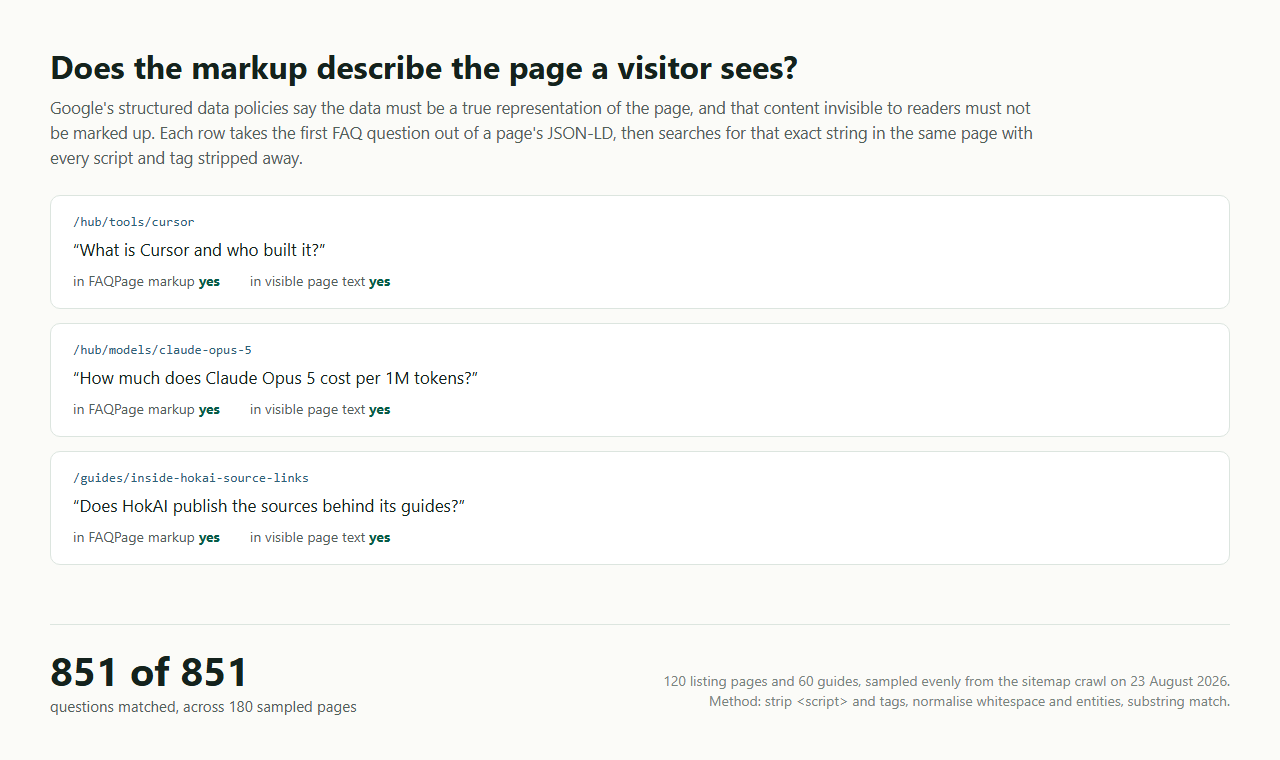
Three of the 180 sampled pages, and the run total. Questions pulled from the JSON-LD, then searched for in the same page with scripts and tags stripped, 23 August 2026.
What a guide's markup declares that its prose does not
Guides carry an Article block, and it holds something the prose cannot: a machine-readable bibliography. All 88 guide Article blocks include a citation array. Between them they hold 740 citation entries pointing at 648 distinct URLs, each one a CreativeWork with a name, a publisher and a link. The same blocks declare 138,947 words through wordCount.
That means the sources list under a HokAI guide is not only formatting. A parser that never renders our CSS can still retrieve what a piece was built from. It is the machine-readable half of an argument an earlier run made by hand, checking the citations under the guides section one at a time. Comparison pages rest on the same footing, with every value in the grid traceable to a record.
Who this layer isn't for
Anyone copying this to win search decorations will be disappointed, and should know that before spending a week on it. The FAQ box is gone. HowTo is gone. Speakable pays out only for United States news publishers with an audience on Google Home. If the goal is a bigger blue-and-grey ornament on a results page, BreadcrumbList is roughly the whole opportunity, and it takes an afternoon rather than a rebuild.
This layer is built for the other case: readers and developers who want to check a claim or reuse a record without scraping rendered HTML. If you want to browse rather than verify, the visible pages are the better experience, and the markup underneath is happily ignorable.
It is also worth being exact about what structured data can do. It makes a claim legible. It never makes a claim true. A page can publish flawless JSON-LD around a wrong price, and every test in this article would still pass, which is why verification of the underlying record is a separate discipline and a separate promise.
Our own directory entry is built by the same code path as every vendor's, and on 23 August 2026 it served an Organization block and a breadcrumb, with no exemption available for the site that wrote the crawler.
What would change our mind is simple to state: if the blocks stopped matching the visible page, the layer would become the thing Google's policy warns about, and we would rather remove it than serve two versions of the truth. That check is one script, and it runs against 1,133 public URLs that anyone can fetch.
Frequently asked questions
Which schema.org types does HokAI publish?
Thirteen, counted across all 1,133 sitemap URLs on 23 August 2026. BreadcrumbList appears on 1,122 pages and FAQPage on 918, followed by WebPage at 653 and SoftwareApplication at 625 for tool, model, agent and service listings. CollectionPage, TechArticle, Article, ItemList, Organization, HowTo, WebSite, WebApplication and AboutPage make up the rest.
Do FAQ rich results still appear in Google Search?
No. Google's documentation records that the FAQ rich result stopped appearing on 7 May 2026, and the documentation for the feature was removed on 15 June 2026. From September 2023 it had already been narrowed to what Google described as well-known, authoritative government and health websites. HowTo rich results went earlier, with that documentation removed on 14 September 2023.
Does adding structured data make a page rank higher?
Google's own introduction to structured data does not promise a ranking lift. It says the data helps Google understand the content of a page, and that a page must include all required properties before it is even eligible for an enhanced display. Eligibility is not the same as appearance, and several rich result types have since been retired entirely.
What is the difference between JSON-LD and microdata?
JSON-LD sits in a script tag and describes the page as a separate JSON object, while microdata is attached to HTML elements as attributes. Both can carry the schema.org vocabulary. Google recommends JSON-LD, and HokAI uses it everywhere; Yandex's introduction to schema.org, read on 23 August 2026, describes the vocabulary as used with microdata instead.
Can developers read HokAI listings from the markup instead of scraping?
Yes, and that is the layer's main job. Each listing carries a typed record with its category, offer and questions, and the 88 guide Article blocks hold 740 citation entries between them, pointing at 648 distinct URLs. Extracting the script tags of type application/ld+json gives structured records without parsing rendered HTML.
Covered in this guide
- directory entry: HokAI is an editor-curated, AI-only directory at hokai.io. Listing requires a flat submission fee; rankings cannot be bought. Every Pulse update is verified against a primary source.
- Anthropic: Anthropic, founded 2021 by 7 ex-OpenAI researchers, builds Claude and was valued near $965B after its May 2026 Series H round.
- Claude Code: Claude Code is Anthropic’s coding agent: newest Opus by default, auto mode since August 2026, in terminal, IDE, web and Slack. There is no free tier.
- Claude Opus 5: Anthropic's July 2026 flagship LLM, with a 1M token context window by default and a new xhigh reasoning-effort mode for long agentic runs.
- Cursor listing: Cursor is an AI code editor built on VS Code, widely adopted across large enterprise engineering teams, with Agent Mode, Tab completion, and Cloud Agents.
- Google's company page: Google (Alphabet, NASDAQ: GOOGL), founded 1998, serves 8B+ monthly Search users with Gemini 3.5, 190,820 employees, and $402.84B FY2025 revenue.
Sources
Still deciding?
This guide covers a handful of options. Smart Match checks every listing in the directory against how you actually work and what you can spend, then hands you the shortlist and the reason behind each pick.
Start Smart MatchRelated guides
- 41 of 100 HokAI Guides Carry a Screenshot. All 106 Still Load.Inside HokAIHow the directory works, verified in the open
- AI Development Services in 2026: Which Layer You Actually NeedBuyer's guideHow to pick, across a category
- Best AI Agents in 2026: Autonomy Level Matters More Than BenchmarksBuyer's guideHow to pick, across a category
- Best AI Chatbots in 2026: Pick by the Job, Not the LeaderboardUpdatedRechecked against current sources
- Best AI Coding Assistants in 2026: Pick the Job, Not the BrandBuyer's guideHow to pick, across a category
- Best AI Companies in 2026: Who Is Actually LeadingBuyer's guideHow to pick, across a category