Best AI for Therapists and Counselors in 2026: Scribes, BAAs and Client Consent
AI scribes for therapists listen to or take a summary of a session and draft the progress note in formats like SOAP, DAP or BIRP. The main options in 2026 are Upheal, Mentalyc, Heidi, Freed and JotPsych, ranging from $0 to $149 a month for a 25-client weekly caseload.
The short version
For most solo therapists, Upheal is the pick: $39 a month for unlimited notes, with audio deleted by default. Mentalyc suits group work and supervision, Heidi is the free way to try ambient notes, and JotPsych fits prescribers. Whatever you pick, a signed client consent form comes first.
Not sure which one fits you? Describe your situation and Smart Match names three tools.Find my AI tools
In this guide9 sections
A therapist seeing 25 clients a week writes about 108 progress notes a month, and on 26 November 2026 the price of having AI draft them ran from nothing to $149 a month. Five tools cover that range: Upheal, Mentalyc, Heidi, Freed and JotPsych.
Three things separate them: what happens to the session itself, what you pay at your real caseload, and whether the format you bill against is built in. Those three also decide what you must tell clients.
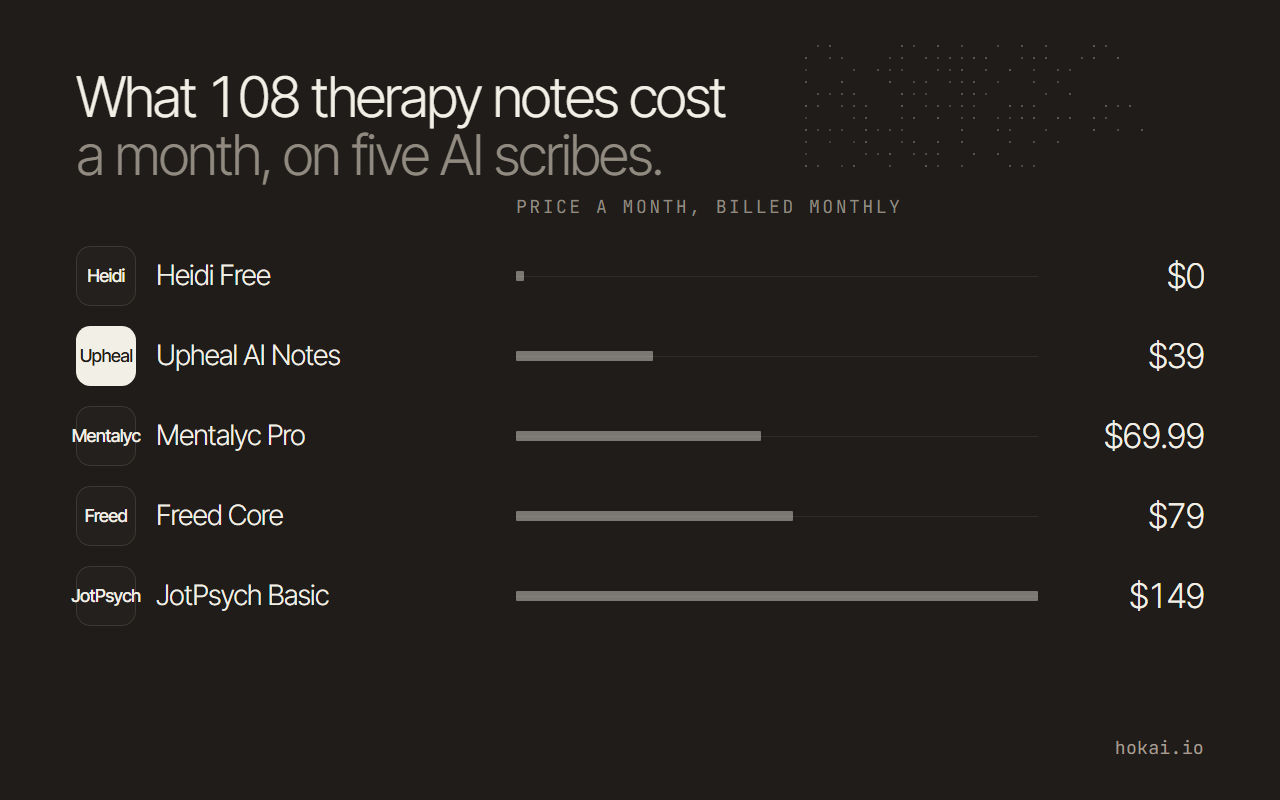 Hokai chart: the monthly price of about 108 notes on each scribe, read on the five vendors' own pricing pages on 26 November 2026. Annual plans are cheaper.
- Notes a month at 25 clients a week
- 108
- 25 x 52 / 12
- Upheal AI Notes, unlimited
- $39
- Pricing page, 26 Nov 2026
- Heidi Free, unlimited ambient documentation
- $0
- Pricing page, 26 Nov 2026
- Top Illinois fine per violation of its AI therapy law
- $10,000
- IDFPR, 4 Aug 2025
How to choose a therapy scribe: five questions to ask first
Ask these before you open a single trial. They work even if you ignore every pick below.
- Is the session recorded, transcribed live, or never recorded at all? Every tool here can also work from a summary you dictate or type after the client leaves. That is the most private option, and on Upheal's free plan it is the only one.
- Will the vendor sign a business associate agreement (BAA)? If you are a HIPAA covered entity, any vendor that handles client information is your business associate. All five offer one; how you get it differs.
- Does it write the format you bill against? SOAP, DAP and BIRP are the common three. A tool without BIRP built in means building that template yourself.
- Is it priced per note or per month? A note cap that fits 15 clients a week breaks at 25.
- Does it train on your sessions? The answers run from "never" to "de-identified notes, by default". Your consent form has to say which.
The shortlist: five scribes, one job each
| Tool | Best for | Monthly, billed monthly | The one caveat |
|---|---|---|---|
| Upheal | Solo therapists, couples work | $39 unlimited | Support starts with an AI bot |
| Mentalyc | Groups, supervisors, insurance billing | $19.99 to $119.99 by notes | Note caps on every solo plan |
| Heidi | Trying it free, practices outside the US | $0, or $150 | Keeps transcripts forever by default |
| Freed | Therapists beside physicians | $39 to $119 | Trains on de-identified notes |
| JotPsych | Psychiatric prescribers | $59 to $299 | An EHR, priced like one |
Upheal's AI Notes plan is one flat fee for unlimited sessions, it writes SOAP, DAP, BIRP, GIRP, PIRP, SIRP, PIE and EMDR notes, and it deletes session audio once the note exists unless you choose to keep it. Its free plan never expires but only accepts typed, dictated or uploaded material.
Mentalyc is built only for psychotherapy. Each note draws on the client's earlier notes and treatment-plan goals, Pro adds supervision notes, and the Super plan writes a separate note for every member of a group. Capterra showed 4.6 out of 5 from 88 reviews when read on 26 November 2026.
Heidi is a general medical scribe from Melbourne whose free plan has no documentation cap. Its library carries a DAP note for therapists and a BIRP note for psychologists, and it publishes prices in pounds, euros and Australian dollars.
Freed is a medical scribe that learns any template you upload. JotPsych began as a behavioral health scribe and now sells a full electronic health record (EHR) with e-prescribing for controlled substances.
Recorded, transcribed or dictated: what each tool keeps
Here is what each vendor's own security or privacy page says, read on 26 November 2026.
| Tool | Session audio | Transcript and note | Trains on sessions? |
|---|---|---|---|
| Upheal | Deleted once notes exist, by default | Kept; delete on demand | Only with therapist and client opt-in |
| Mentalyc | Deleted once the note is ready | Anonymised transcript kept until you delete | Never |
| Heidi | Not stored | Kept forever unless you change it | No sensitive health data |
| Freed | Deleted once the note is complete | Notes kept; 30-day auto-delete option | De-identified notes only |
| JotPsych | Destroyed when transcription ends | Optional redaction; you delete notes | Never |
Two rows deserve a second look. Heidi's privacy FAQ says accounts start on "never delete" for transcripts, with a setting that runs from 1 day upward, so change it before your first client. Freed's security page says its AI "is only trained on de-identified notes", which belongs in your consent form.
A general meeting recorder such as Otter is not a substitute: it is built for meeting transcripts and summaries, not SOAP, DAP or BIRP progress notes, as the AI meeting assistants guide explains.
If you would rather no microphone ever runs in the room, all five let you dictate or type a summary after the session instead. The note is thinner, but nothing the client said is captured.
What it costs at 25 clients a week
A full-time caseload of 25 sessions a week, over 52 weeks, is about 108 notes a month. Here is what that costs on each tool's cheapest plan that covers it, at monthly billing.
Read from each vendor's own pricing page.
Why each lands on that plan:
- Mentalyc: Basic stops at 100 notes, so 108 pushes you to Pro, which is $59.99 billed yearly
- Freed: Starter allows 40 notes, so Core is the real entry point
- JotPsych: Moonlighting includes 15 notes; unlimited starts on Basic, $135 billed annually
- Heidi: the free plan has no documentation cap, and Clinician is $110 a month billed yearly
Upheal's extras are optional: an AI Assistant Pro add-on for another $39, and EHR plans that charge $1 per session.
The gap is real money: $1,320 a year between Upheal and JotPsych for the same notes, before JotPsych's prescribing and billing features.
SOAP, DAP or BIRP: which formats each scribe writes
| Tool | SOAP and DAP | BIRP | Group and couples |
|---|---|---|---|
| Upheal | Yes, DAP on the free plan too | Paid plans | Couples and family; no per-member group |
| Mentalyc | Yes, every plan | Among 100+ templates | Per-member group notes on Super |
| Heidi | DAP template for therapists | Psychologist BIRP template | Not built in |
| Freed | Upload your own | No named template | Not built in |
| JotPsych | Upload your own | No named template | Not documented |
If you bill insurance in BIRP, Upheal and Mentalyc are the two that ship it ready. Freed and JotPsych will learn the format from a template you upload, so expect to correct the first notes by hand.
Mentalyc gates couples, family and child clients behind Pro. Upheal includes couples and family notes on its $39 plan, though family therapy is limited to SOAP and custom templates today.
HIPAA and the BAA: what each vendor actually signs
| Tool | How the BAA works | Audits listed |
|---|---|---|
| Upheal | Click-through at sign-up | SOC 2 Type II, PHIPA, GDPR |
| Mentalyc | Created at sign-up, in your profile | SOC 2 Type II, PHIPA |
| Heidi | Available to every covered entity | ISO 27001, SOC 2 Type 2 |
| Freed | Schedule A of the terms; signed copy on request | SOC 2 Type 2 |
| JotPsych | Standard for every customer | Subprocessors SOC 2 Type II |
One nuance: JotPsych's security page lists "SOC 2 Certified Vendors", meaning its subprocessors are audited, not JotPsych itself. Ask for its own report if your practice requires one.
The AI note is not a "psychotherapy note" in HIPAA's sense. Under 45 CFR 164.501, psychotherapy notes are your analysis of the session kept "separated from the rest of the individual's medical record", and the definition excludes symptoms, the treatment plan and progress. A DAP or BIRP note filed in the chart is part of the medical record, with the access rights that come with it.
That cuts both ways. Mentalyc says it keeps notes to what is clinically relevant so they are safe to share if a client requests records. Write your edits with that reader in mind.
What clients must consent to before you press record
HIPAA alone may not require client consent for a scribe covered by a BAA. Upheal asks for it anyway, and state law often goes further. Illinois's Wellness and Oversight for Psychological Resources Act, signed in August 2025, bans AI from therapeutic decision-making while allowing it for administrative and supplementary support, with fines of up to $10,000 per violation, according to the Illinois Department of Financial and Professional Regulation.
Recording law is the other layer. Several states require every party's consent to record a private conversation, covered in Hokai's guide to AI voice recorders and the law. A written consent form that names the tool settles both.
A consent form that holds up covers six things:
- The tool's name and that it is an AI scribe, not a person
- Whether the session is recorded, transcribed live or only summarised afterwards
- How long the audio, transcript and note are kept, matching the vendor's setting
- Whether de-identified data trains the vendor's AI, and how to opt out
- That the client can say no, with no effect on their care
- That you review and sign every note yourself
You do not have to write it from scratch. Mentalyc supplies a client AI consent template, Upheal collects consent in the app by email or during the call, and Heidi can prompt for consent before each session and record the answer.
Who should skip an AI scribe, and where the medical scribes win
Some practices should not use one at all. Heidi's own FAQ says it may not suit "extremely sensitive consultations" or cases where consent cannot be obtained. If a client declines, dictate a summary after that session or keep writing by hand.
Upheal's help centre also warns that its AI can invent content for note sections the session never covered, as Choosing Therapy reported in a review updated 11 November 2026. Every tool here needs a full read before you sign.
The medical scribes win in two places. Heidi is the only one whose free plan has no documentation cap, which makes it the cheapest way to find out whether ambient notes suit you before paying anyone. Freed suits a therapist inside a medical practice: physicians there may already use it, and its Premier plan suggests ICD-10 and CPT codes. Both are bought by individuals, unlike hospital scribes such as Abridge, covered in the guide to AI for doctors.
Upheal or Mentalyc: the head-to-head most therapists face
| Upheal AI Notes | Mentalyc Pro | |
|---|---|---|
| Monthly price | $39 | $69.99 |
| Notes included | Unlimited | 160 |
| Group notes per member | No | Super plan only |
| Supervision notes | No | Yes |
Pick Upheal if you are a solo therapist seeing individuals and couples, want one predictable bill, and might later move scheduling and claims into the same system. Pick Mentalyc if you supervise trainees or run groups: those two features are on its pricing page and not on Upheal's. Mentalyc users on Capterra also say the notes build on each other well, while a recurring complaint is copying notes into SimplePractice by hand.
To weigh these against your own EHR and state, Smart Match ranks the ambient AI scribes on Hokai.
If you prescribe, neither fits as well as JotPsych, whose top plan puts controlled-substance e-prescribing in the same chart as the note. And whichever you buy, have the consent form signed before the first recorded session: a client who says no costs you nothing, because every tool here also writes from a summary you dictate.
Frequently asked questions
Is it legal for a therapist to use an AI note taker?
In most of the US, yes, if the vendor signs a business associate agreement and you get the client's consent where state law requires it. Illinois's 2025 law allows AI for administrative and supplementary support but bans it from therapeutic decision-making. Recording laws in some states require every party's consent, so a signed consent form is the safe default.
Which AI scribe for therapists does not record the session?
All five main tools can work from a summary you dictate or type after the session instead of a recording. Upheal's free plan only works that way. When they do record, Upheal, Mentalyc, Freed and JotPsych delete the audio after the note is written, and Heidi does not store audio at all.
Is an AI-generated progress note a psychotherapy note under HIPAA?
Usually not. HIPAA defines psychotherapy notes as the clinician's analysis of the session kept separate from the medical record, and excludes symptoms, treatment plans and progress. A SOAP, DAP or BIRP note filed in the chart is part of the medical record.
What is the cheapest AI scribe for therapists?
Heidi's free plan includes unlimited ambient documentation, though it is a general medical scribe and keeps transcripts until you change its retention setting. Among therapy-built tools, Upheal's free plan works from dictated or typed summaries, and its paid AI Notes plan is $39 a month with no note cap.
Do AI therapy scribes train on client sessions?
It depends on the vendor. Mentalyc and JotPsych say they never train on session data, Heidi says it does not use sensitive health information, Upheal needs opt-in from both therapist and client, and Freed trains on de-identified notes. Say which applies in your consent form.
Covered in this guide
- Upheal: AI progress notes and an EHR for therapists: captures or dictates a session, drafts the note in 10+ formats, and deletes the audio by default.
- Heidi: Ambient AI scribe from Melbourne with a free plan of unlimited documentation; it says it supports over two million consults a week worldwide.
- Mentalyc: Therapy-only AI scribe: turns a session into an audit-ready note that builds on the client history, with per-member group notes. 30,000+ users, it says.
- Abridge: Enterprise ambient AI clinical scribe used at 300+ health systems. Converts doctor visits to Epic EHR notes in real time, saving 70+ hours/month per clinician.
- Freed: Ambient AI scribe sold straight to clinicians, with 17,000+ paying customers across 96 specialties at its 2025 Series A, therapists among them.
- JotPsych: Behavioral health AI scribe turned EHR, priced per clinician; it had processed over 1,000,000 patient encounters by its July 2025 seed round.
- Otter: AI Notetaker that builds your knowledge base with transcription, summaries, and AI Chat
Sources
Still deciding?
This guide covers a handful of options. Smart Match checks every listing in the directory against how you actually work and what you can spend, then hands you the shortlist and the reason behind each pick.
Find your tools