Best AI for Nonprofits in 2026: Grants, Donor CRMs and the Discounts Worth Claiming
The best AI for nonprofits in 2026 pairs a discounted general assistant with one specialist. Grantable and Instrumentl handle grant drafting and funder discovery, Bloomerang and Keela are donor CRMs with AI, and OpenAI, Anthropic, Google, Microsoft and Canva all sell or give their tools at nonprofit rates, with Claude Team and ChatGPT Business seats at $8 a month.
The short version
Claim the nonprofit rates first: Claude Team or ChatGPT Business at $8 a seat, Google's Gemini and Canva Pro free. Add Grantable for drafting grants, Instrumentl for a large pipeline, Bloomerang or Keela for donors. Check every figure and citation in an AI grant draft: NIH warns AI can fabricate citations.
Not sure which one fits you? Describe your situation and Smart Match names three tools.Find my AI tools
In this guide10 sections
A five-person nonprofit can put ChatGPT or Claude on every desk for $40 a month in November 2026, and Google gives its Gemini app to registered charities at no cost. The general assistant is now the cheap part, so start with one at the nonprofit rate. The money and the risk sit in the two jobs where a small team loses most of its hours: grants and donors.
That is where the specialist tools earn their price, and where an unchecked AI draft can cost a grant. A grant draft can state an outcome the program never measured or cite a study that does not exist, and since September 2025 the US National Institutes of Health has said it will not treat applications substantially written by AI as original. This guide is for the executive or development director deciding what to buy, what to claim free, and what to check before anything reaches a funder.
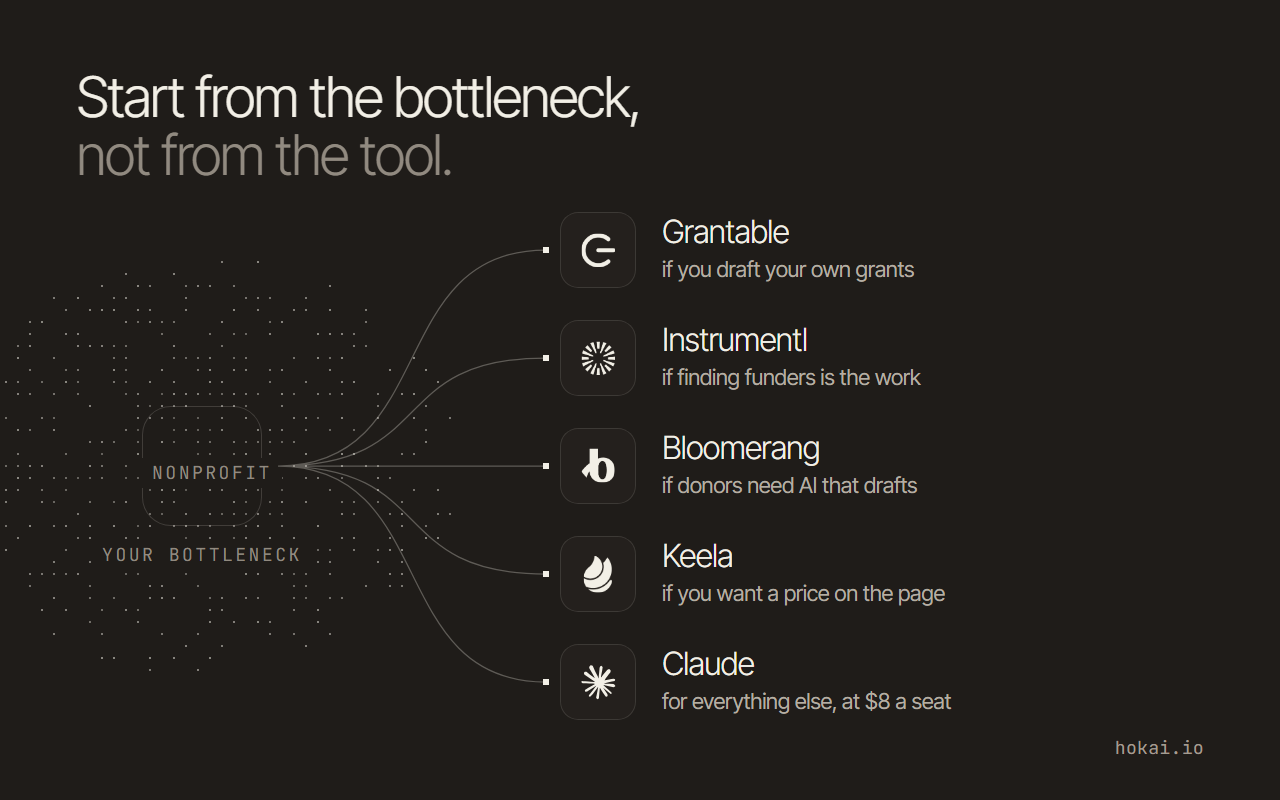 Hokai chart of which tool fits which bottleneck, from each vendor's pricing and product pages as checked on 29 November 2026.
- ChatGPT Business or Claude Team, per user a month for nonprofits
- $8
- OpenAI help centre and Claude, 29 Nov 2026
- Active grants in Grantable's free database, no account needed
- 51,328
- Hokai look, 29 Nov 2026
- Foundations that said they accept AI-written applications
- 10%
- Candid survey of 527 foundations, 2024
- Applications NIH accepts per lead investigator a year since September 2025
- 6
- NIH notice NOT-OD-25-132
How to choose: name the bottleneck first
Most nonprofits buying AI in 2026 need two things: one general assistant at the nonprofit rate, and at most one specialist for the job that eats the most staff time. Three questions settle which specialist.
- Is the hard part finding funders or writing to them? Discovery and drafting are different products, priced an order of magnitude apart.
- Do donor records live in a spreadsheet, or in a CRM that has stopped helping? A donor CRM pays off once the list is too big for one person to remember.
- Will the vendor say in writing whether donor and grant data trains its AI? Three of the four specialists below do. One does not.
If none of those is your problem, the discounted assistant is enough, and you can stop reading at the discounts section.
The shortlist: four specialists and what they say about your data
| Tool | The job | Price from | Trains AI on your data? |
|---|---|---|---|
| Grantable | Grant drafting and funder search | Free; $50 a month | No, per its privacy policy |
| Instrumentl | Grant discovery to post-award | $299 a month, annual | No third-party training |
| Bloomerang | Donor CRM, giving and volunteers | Quote; $125 on G2 | Never, per its AI page |
| Keela | Donor CRM priced by contacts | $164 a month | No statement published |
Prices are read on each vendor's own pages on 29 November 2026, except Bloomerang's, whose site prints none: the $125 figure is the CRM price Bloomerang itself supplies on its G2 listing. The four specialists sit in Hokai's AI writing assistants and revenue AI platforms lists.
Grants: Grantable to draft, Instrumentl to find and track
Grantable is the pick for a team that writes its own grants and has no grant staff. Its drafting desk reads a library of your past proposals, budgets and funder notes before it writes, so a new application starts from your wording rather than a pasted brief. A prospecting desk scores funders against your profile from their 990 filings, and an RFP checklist turns a funder's rules into boxes to tick.
Grantable says the free plan includes every feature, but it allows 5 chat messages a day. Starter costs $50 a month and Pro $150, and no plan charges per seat. Grantable routes work across Claude, GPT and Gemini, and its privacy policy, updated 22 October 2026, says your data does not train AI models.
We opened Grantable's free grants database on 29 November 2026 with no account. It listed 51,328 active grants from more than 190,000 funders, with browse filters from capacity building to faith-based grants. Matching against your own profile needs a sign-in.
Instrumentl is the heavier system, for a development team with a pipeline of applications. It matches projects to grants and to funder profiles built from 990 filings, tracks each one from prospect to award, and on the top plan follows spending against the grant budget. Its pricing page states SOC 2 Type II and US data storage.
The catch is price and gating. Discover, the entry plan, allows 3 users and leaves out AI drafting; Apply starts one plan up, on Pre-Award, for up to 5 users. Month-to-month billing costs more than annual on each self-serve plan, and there is no free plan, only a 14-day trial.
| Grantable | Instrumentl | |
|---|---|---|
| Entry price | Free, then $50 a month | $299 a month annual, $349 monthly |
| AI drafting | Every plan | From $499 a month |
| Users | No per-seat fees | 3, 5 or 15 by plan |
| Audit report | None published | SOC 2 Type II |
The fabricated-figures problem in AI grant drafts
The failure that matters in a grant draft is not bland prose. It is a number or a citation that sounds right and is not: a local poverty rate, a participant count or an outcome percentage that never came from your own records.
NIH said so plainly in notice NOT-OD-25-132 of 17 July 2025: AI use "may result in plagiarism, fabricated citations" or other research misconduct. From the 25 September 2025 receipt date, NIH does not treat applications substantially developed by AI as original ideas, may refer cases found after award to its Office of Research Integrity, and accepts at most 6 applications per lead investigator a year.
Private funders have not settled the question. In Candid's survey of 527 foundations, published 14 August 2024, 10% said they would accept applications with AI-written content, 23% said they would not, and 67% were undecided. Some of the yes group planned to ask applicants whether they used AI.
What that check looks like in practice:
- Trace each outcome figure to a program report, survey or database export you can hand the funder.
- Open every cited study or statistic; delete any you cannot find.
- Read the funder's guidelines for an AI policy before drafting, not after.
- Keep the drafting tool fed with your real reports, so it has true numbers to reuse instead of inventing new ones.
The tools differ on that last point. Instrumentl's Apply suggests each answer from your uploaded documents with a citation back to the source file, which makes a reviewer's job faster. Grantable's drafts work from your library, and a G2 reviewer in October 2026 valued keeping sources beside the draft so every claim traces back. A general chatbot with nothing uploaded has no source to cite, which is when invented figures appear.
Donor CRMs with AI: Bloomerang or Keela
Bloomerang is the stronger AI product. Penny, its AI fundraising partner, preps a fundraiser before a donor meeting, flags lapsing donors and drafts what to say next. Reports can be asked for in plain words, Smart Amounts adapt the suggested gift on donation forms, and an AI content assistant drafts emails. Its AI page says customer data never trains its models.
After buying InitLive in 2023 and Qgiv in 2024, Bloomerang runs donor records, online giving and volunteer shifts in one database with unlimited users. The drawback is the price: its own pricing page asks for a quote.
Keela publishes its price. Plans run by contact count, from $164 a month for up to 1,000 contacts to $438 for up to 10,000, on the lower of two price sets its page shows. Keela takes no fee on top of PayPal and Stripe's nonprofit processing rate of 2.2% plus 30 cents, and stores data in the United States, Canada or Australia to match where the charity is based.
Its AI is predictive only: Smart Ask suggests when to ask and how ready a donor is for a bigger gift, and Donor Score ranks giving potential. It does not draft. Keela also publishes no statement on whether donor data trains AI, and phone or chat support costs extra through Premium Care, from $200 a month.
| Bloomerang | Keela | |
|---|---|---|
| Price on own site | Quote only | From $164 a month |
| Generative AI | Penny, email drafts, reports | None; predictive asks |
| AI training stance | Never trains on data | Not published |
| Support included | Phone, email, live chat | Email, 9am to 5pm Pacific |
Nonprofit discounts on the general assistants
OpenAI, Anthropic, Google, Microsoft and Canva each print a nonprofit offer; OpenAI and Anthropic verify eligibility through Goodstack. These are the terms on their own pages.
| Assistant | Nonprofit offer | Price |
|---|---|---|
| ChatGPT Business | Standard seats | $8 a user a month, annual |
| Claude Team | 2 to 150 seats | $8 a user; $3 in lower-income countries |
| Google Workspace for Nonprofits | Gemini app and Notebook included | $0 |
| Microsoft 365 | Copilot Chat included; Copilot add-on | 15% off the add-on |
| Canva Nonprofits | Canva Pro, up to 50 users | Free |
ChatGPT Business Standard seats cost $8 a user a month billed annually or $10 monthly, per OpenAI's help centre. Premium seats get no discount, the API gets none, and Business carries no BAA for health data, which needs Enterprise at up to 75% off through sales. The plan differences are in our guide to ChatGPT plans.
Claude Team is $8 a user a month for verified nonprofits, or $3 for nonprofits in low- or middle-income countries, with a two-seat minimum. Anthropic adds connectors to Blackbaud, Candid and Benevity and a free AI Fluency for Nonprofits course. Our Claude, ChatGPT and Gemini comparison covers which writes better for which job.
Google's no-cost Workspace for Nonprofits plan, for up to 2,000 users, now includes the Gemini app and Gemini Notebook. Business Standard costs $3.50 a user a month for more AI inside Gmail and Docs. Microsoft includes Copilot Chat in every Microsoft 365 plan, takes 75% off Business Premium and 15% off the Microsoft Copilot add-on. Canva gives registered nonprofits Canva Pro free for up to 50 users.
What it costs a five-person nonprofit
Put the pieces side by side for a team of five and the specialists dominate the bill.
From each vendor's pricing page; Bloomerang's figure is the one it lists on G2.
Instrumentl's Discover plan allows only 3 users, so a team of five that wants AI drafting lands on Pre-Award. The Claude and ChatGPT bars are five seats each at the nonprofit rate, and Grantable's single fee covers the whole team because it has no seat fees.
A realistic small-nonprofit stack, one assistant plus Grantable plus Keela, comes to $254 a month. Swap Grantable for Instrumentl Pre-Award and the same stack costs $703.
Who should skip the specialists
The strongest case against buying any of the four is that the discounted assistant already does most of the writing. A Claude or ChatGPT seat at $8 drafts a needs statement or an appeal letter well enough, and Google's Gemini app costs nothing. For a nonprofit applying to three or four grants a year, a $299 discovery database is hard to justify.
That holds until either volume or accuracy matters. The specialists win on memory and sources: Grantable and Instrumentl keep your past proposals and cite or reuse them, which leaves less room for invented figures, and a donor CRM remembers who gave what when staff leave. A general chat window remembers neither unless you paste it in each time.
The other group that should wait is the very small nonprofit with a few hundred donors in a spreadsheet. Keela quotes custom prices below 250 contacts, and neither donor CRM has a free plan. Use the free assistant and Canva until the list outgrows one person.
What users report
Only Grantable could be tried without an account, so the rest of the outside evidence is reviews read on G2 on 29 November 2026.
- A grant administrator reviewing Grantable on 1 October 2026 liked keeping sources and notes beside the draft but called the customer service unfriendly.
- A development director reviewing Bloomerang on 15 October 2026 said its AI tools helped them explore donor data after a previous system that only stored records.
- A Keela reviewer on 25 September 2026, in a review G2 marks as incentivized, praised its email builder and automation but wanted a separate receipt per event campaign.
If the job is broader writing rather than grants, the AI writing assistants guide ranks the general tools, and Smart Match can shortlist one from a description of your team's work.
The decision, by bottleneck
Past the free and $8 offers, the specialist depends on the bottleneck. Writing your own grants with no grant staff: Grantable. A grant pipeline worth a full-time person: an Instrumentl trial, budgeted at Pre-Award. A donor list past a spreadsheet: Bloomerang if you want AI that drafts, Keela if you want a price on the page.
The question to watch in 2027 is how private foundations answer the AI question two-thirds of them had not decided in Candid's survey. When the large ones publish rules like NIH's, the tools that show the source behind each figure will be the ones a funder can trust.
Frequently asked questions
What is the best AI tool for grant writing?
For a small team that writes its own grants, Grantable is the best fit: it drafts from a library of your past proposals, scores funders from 990 filings, and starts free, with Starter at $50 a month. A development team with a large pipeline should trial Instrumentl, whose AI drafting starts at $499 a month and cites the source document behind each answer.
Can I use ChatGPT to write a grant proposal?
You can use it to draft, but check every figure and citation it produces, because a model with no source material will supply plausible numbers that are not yours. NIH warned in July 2025 that AI use may result in fabricated citations and does not treat applications substantially developed by AI as original. Read each funder's AI policy before you start.
Is there a free AI for nonprofits?
Yes. Google Workspace for Nonprofits costs nothing for up to 2,000 users and now includes the Gemini app and Gemini Notebook. Canva gives registered nonprofits Canva Pro free for up to 50 users, and Grantable has a free plan with 5 chat messages a day.
Do donor CRMs use donor data to train AI?
It depends on the vendor, so ask for it in writing. Bloomerang's AI page says customer data never trains its models, and Grantable and Instrumentl make similar statements for grant data. Keela publishes no statement either way.
How do nonprofits get the ChatGPT or Claude discount?
Both verify nonprofit status through Goodstack. ChatGPT Business Standard seats then cost $8 a user a month on annual billing, and Claude Team costs $8 a user a month for 2 to 150 seats, or $3 for nonprofits in low- or middle-income countries. Larger organizations get Enterprise discounts of up to 75% through each company's sales team.
Covered in this guide
- Grantable: AI grants workspace that scores funders against your mission and drafts proposals from past applications; its homepage claims 30,000+ grant seekers.
- Bloomerang: Donor management, fundraising and volunteer platform for nonprofits, with an AI partner called Penny that preps meetings and flags lapsing donors.
- Instrumentl: Grant prospecting and management platform with AI matching across 506K+ funder profiles and drafting that cites your own past proposals.
- Keela: Nonprofit CRM priced by contact count, with predictive Smart Ask insights on who to ask, how much and when; plans start at 1,000 contacts.
- Canva: Helps everyone design anything and publish it anywhere
- ChatGPT: ChatGPT is OpenAI's AI assistant, with 1.2 billion weekly users by OpenAI's count, the GPT-6 model family and plans that run from a free tier to a premium Pro tier.
- Claude: Claude is Anthropic's AI assistant, with a free tier, Pro, Max and Ultra personal plans, and Team and Enterprise seats. Opus access starts at Pro.
- Gemini: Google's multimodal AI assistant and model family, sold as a free app, tiered subscriptions and a pay-per-token API
- Microsoft Copilot: Microsoft's AI assistant across Windows, Edge, Word, Excel, Outlook and Teams, from a free tier to per-seat work plans on OpenAI's latest GPT-5 models.
Sources
Still deciding?
This guide covers a handful of options. Smart Match checks every listing in the directory against how you actually work and what you can spend, then hands you the shortlist and the reason behind each pick.
Find your tools