
Last updated: 2026-09-04
Exa is a neural web search API built for AI agents and RAG pipelines, encoding pages as vector embeddings instead of matching keywords. Exa Instant responds in under 200 milliseconds, and every result returns clean extracted text rather than raw HTML, cutting the token overhead for downstream LLM calls.
About Exa
Exa is an AI-native web search API built by Exa Labs (San Francisco, founded 2021) for large language models, autonomous agents, and retrieval-augmented generation pipelines. Harvard classmates Will Bryk (CEO) and Jeffrey Wang started the company roughly a year before ChatGPT launched, betting that AI needed a search engine built for machine consumption rather than human browsing.
The core mechanism is embeddings-based retrieval: Exa encodes every indexed page as a dense vector using its own trained neural networks, then runs nearest-neighbour lookups when a query arrives, surfacing pages whose vectors sit closest to the query. That captures conceptual proximity keyword search misses. Every request returns clean extracted text rather than raw HTML, cutting the token overhead of the downstream LLM call.
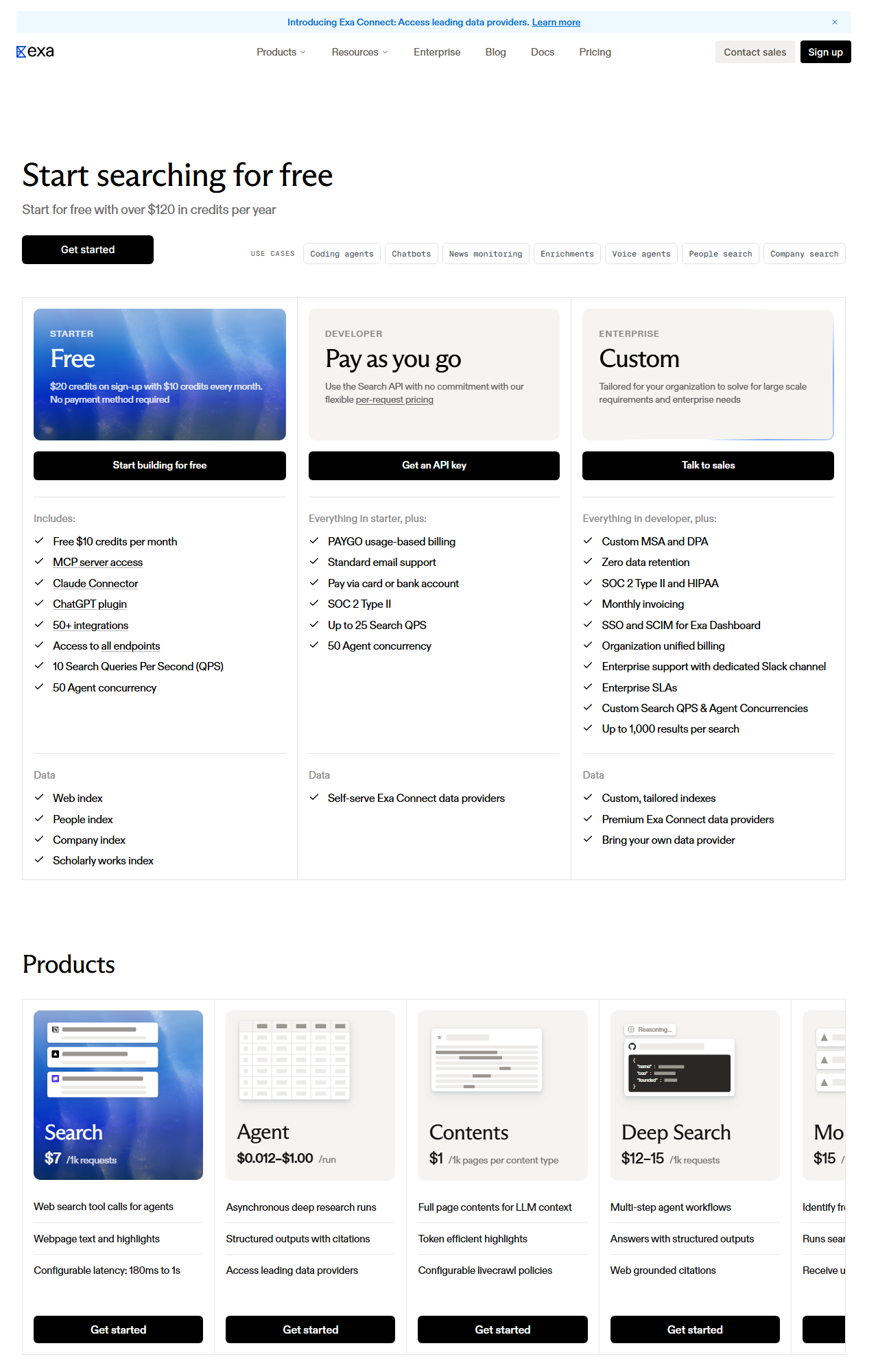
There are three account plans. Starter is free and needs no payment method: Exa gives $20 in credits on sign-up plus $10 in credits every month, which it markets as "over $120 in credits per year". It carries 10 Search QPS, 50 agent concurrency, access to every endpoint, MCP server access, a Claude Connector and a ChatGPT plugin, and all four indexes — web, people, company and scholarly works. Developer is pay-as-you-go with no commitment, adding usage-based billing, email support, payment by card or bank, and up to 25 Search QPS. Enterprise adds a custom MSA and DPA, zero data retention, HIPAA alongside SOC 2 Type II, SSO and SCIM, monthly invoicing, SLAs, a dedicated Slack channel, custom QPS and agent concurrency, up to 1,000 results per search, custom indexes and bring-your-own data provider.
Usage is priced per product rather than per seat. Search is $7 per 1,000 requests with configurable latency from 180ms to 1s; Answer is $5 per 1,000; Deep Search is $12 per 1,000 for deep-lite and deep, $15 per 1,000 for deep-reasoning; Monitors are $15 per 1,000; Contents is $1 per 1,000 pages per content type, and results beyond the first ten cost another $1 per 1,000. Agent runs are billed per run across five fixed effort modes from $0.012 (minimal) to $1.00 (xhigh), or metered at $0.10 per Agent Compute Unit with search tool calls at $0.005 and email and phone enrichment at $0.02 and $0.07.
Websets, Exa's curated-dataset product, is priced separately as a subscription: Starter at $49/month for 8,000 credits and 100 results per Webset, Pro at $449/month for 100,000 credits and 1,000 results per Webset, and a custom Enterprise tier reaching 5,000 results per Webset.
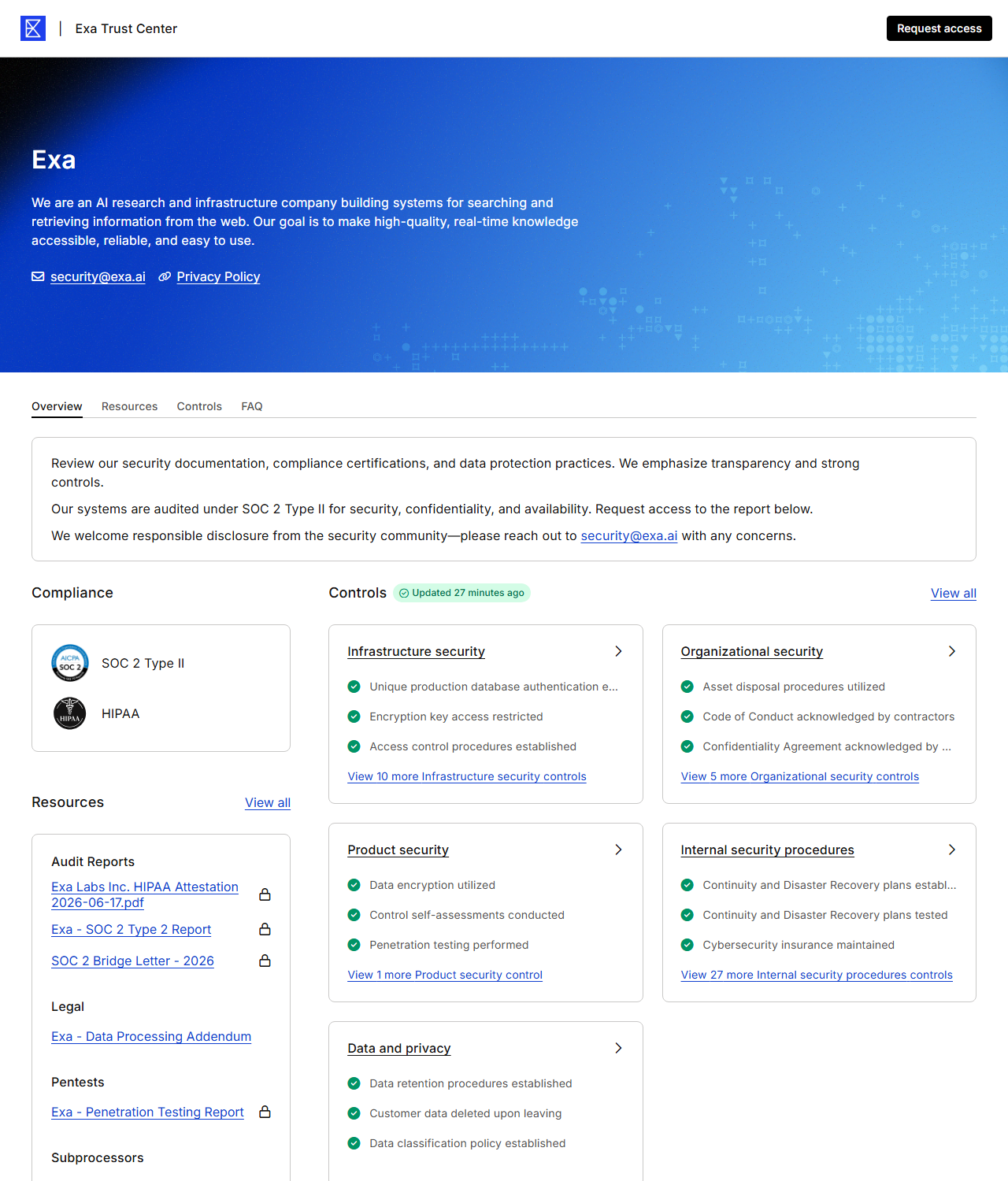
One thing to read before sending sensitive queries: Exa's privacy policy states that "Query Data is used to improve our products and technology, including by training and fine-tuning models". Exa also says it does not monitor queries for personal information and advises against submitting personal data through query fields. Zero data retention is available, but it is an Enterprise plan feature rather than a default. Exa publishes a Vanta trust centre carrying SOC 2 Type II, a HIPAA attestation dated 17 June 2026, a data processing addendum, a penetration testing report and a subprocessor list, all behind access request.
Screenshots
Pricing
Two separate pricing systems. The API is usage-priced with no subscription: Search $7 per 1,000 requests (plus $1 per 1,000 for results beyond the first ten), Answer $5 per 1,000, Deep Search $12 per 1,000 for deep-lite and deep and $15 per 1,000 for deep-reasoning, Monitors $15 per 1,000, and Contents $1 per 1,000 pages per content type — so a search that also pulls full page text runs about $8 per 1,000. 07 per phone enrichment.
The free Starter plan needs no payment method and gives $20 in credits on sign-up plus $10 in credits every month; Developer is the same pricing with pay-as-you-go billing and up to 25 Search QPS instead of 10. Websets is a separate subscription: $49/month for 8,000 credits (100 results per Webset, 2 team seats) or $449/month for 100,000 credits (1,000 results per Webset, 10 team seats), with a custom Enterprise tier. Enterprise API pricing is custom and is where zero data retention, HIPAA, SSO/SCIM and custom QPS live.
| Tier | Monthly price | What it includes |
|---|---|---|
| Starter (Free) | Free | |
| Websets Starter | $49/mo | |
| Websets Pro | $449/mo | |
| Developer (Pay as you go) | Custom | |
| Enterprise | Custom |
Feature Comparison by Tier
| Feature | Starter (Free) | Websets Starter | Websets Pro | Enterprise | Developer (Pay as you go) |
|---|---|---|---|---|---|
| Price | $0 — $20 credits on sign-up, $10 credits every month | $49/month | $449/month | Custom | Usage only, no commitment |
| Payment method required | No | Yes | Yes (free trial offered) | Monthly invoicing | Card or bank account |
| Search rate limit | 10 Search QPS | — | — | Custom Search QPS | Up to 25 Search QPS |
| Agent concurrency | 50 | — | — | Custom | 50 |
| Credits / results | All endpoints, all four indexes | 8,000 credits/mo, 100 results per Webset, 2 seats | 100,000 credits/mo, 1,000 results per Webset, 10 seats | Up to 1,000 results per search, 5,000 per Webset | All endpoints, all four indexes |
| Zero data retention | — | — | — | ✓ | — |
| Compliance | — | — | — | SOC 2 Type II and HIPAA, custom MSA and DPA | SOC 2 Type II |
| SSO / SCIM | — | — | — | ✓ | — |
| Support | — | Standard | Standard | Dedicated Slack channel and SLAs | Standard email |
| MCP server, Claude Connector, ChatGPT plugin | ✓ | — | — | ✓ | ✓ |
| Exa Connect data providers | — | — | — | Premium providers, bring your own | Self-serve |
Key Features
- Neural semantic search: Every indexed page is encoded as a vector embedding, so a query is matched by meaning rather than keyword overlap. Exa runs its own index rather than reselling Google or Bing results, and search latency is configurable from 180ms to 1s depending on how much depth the caller wants.
- Four indexes, not one web crawl: Web, people, company and scholarly-works indexes are all available on the free Starter plan. Agents query a pre-filtered vertical instead of sifting generic open-web results, and Enterprise can add custom tailored indexes or bring its own data provider.
- Contents: clean text instead of HTML: Returns parsed page text, query-relevant highlights and AI summaries at $1 per 1,000 pages per content type, removing the scraping layer and the markup that would otherwise consume LLM context. Livecrawl policies are configurable per request.
- Agent: per-run deep research: Asynchronous multi-step research runs with structured outputs and citations, billed per run across five effort modes from $0.012 to $1.00, or metered by Agent Compute Unit. Free and Developer plans both allow 50 concurrent agents.
- MCP server, Claude Connector and ChatGPT plugin: A free Model Context Protocol server plus a Claude Connector, a ChatGPT plugin and 50+ integrations, all included on the free tier, so Claude, Cursor, VS Code and similar tools reach Exa search without custom API glue.
- Monitors and Exa Connect: Monitors ($15 per 1,000) run saved searches on a schedule and surface what is new, and Exa Connect routes requests to third-party data providers — self-serve on Developer, premium providers on Enterprise.
Pros
- The free Starter plan is genuinely usable for evaluation and needs no payment method: $20 in credits on sign-up plus $10 every month, with access to every endpoint, all four indexes, 10 Search QPS and 50 agent concurrency rather than a crippled preview
- Ships a free official MCP server, a Claude Connector and a ChatGPT plugin, so Claude, Cursor and VS Code reach Exa without a custom REST wrapper — and those integrations are on the free tier, not gated behind a paid plan
- Pricing is per-request and published per product, so cost can be modelled before writing code: $7 per 1,000 searches, $1 per 1,000 pages of content, and a per-run agent price you pick by effort level rather than discover after the fact
- Runs its own neural index rather than reselling a third-party search engine, and offers people, company and scholarly-works indexes alongside the open web for knowledge-intensive agents
Cons
- Exa's privacy policy states that "Query Data is used to improve our products and technology, including by training and fine-tuning models". Zero data retention exists but is an Enterprise plan feature, so on Starter and Developer the queries an agent sends are training input by default
- Content extraction is billed on top of search — $1 per 1,000 pages per content type, and another $1 per 1,000 for results past the first ten — so a search that returns full text and a summary costs materially more than the headline $7 per 1,000
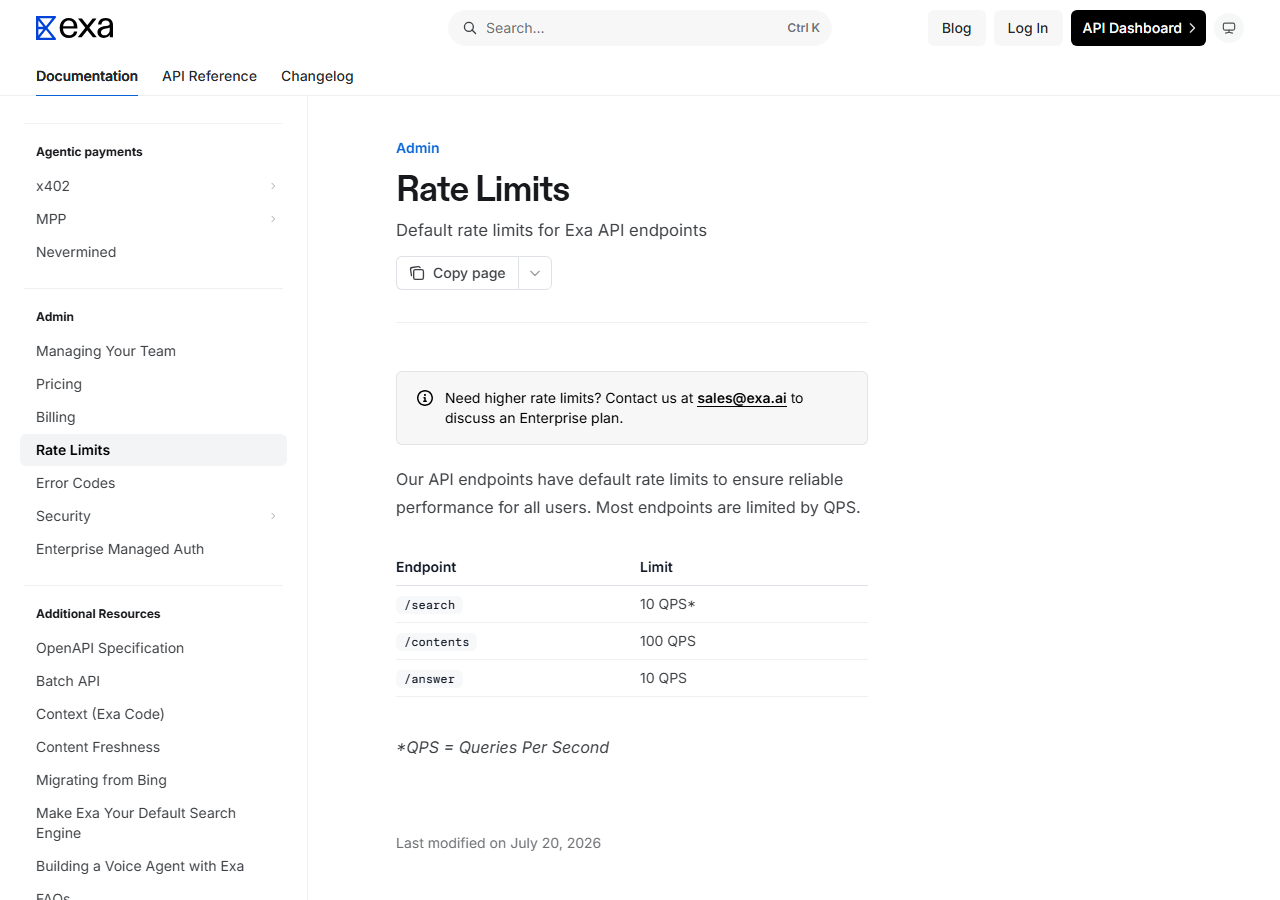
- Default rate limit is 10 Search QPS. Pay-as-you-go raises it to 25, but anything beyond that needs an Enterprise conversation, so a high-concurrency pipeline still has to build queuing and retry logic or talk to sales
- It is an API, not a product: there is no interface for a non-technical team. The one no-code surface, Websets, is a separate $49-to-$449/month subscription rather than part of the API plan
Product Information
- Cloud
- Yes
- Self-Hosted
- No
- On-Premise
- No
- Languages
- English, Spanish, French, German, Japanese, Chinese, Portuguese, Arabic
- Training
- Documentation (exa.ai/docs), Python SDK examples, JavaScript SDK examples, Community Discord
Data Handling
- Training-data policy
- Exa's privacy policy states that "Query Data is used to improve our products and technology, including by training and fine-tuning models" — so on the Starter and Developer plans, queries are training input by default. Zero data retention is offered, but Exa's pricing page lists it as an Enterprise plan feature alongside a custom MSA and DPA, not as a default or a self-serve toggle. The privacy policy also says Exa does not monitor queries for personal information and advises users not to submit personal data through query fields, directing them to designated contact methods instead. No fixed retention period is published; the trust centre lists "Data retention procedures established" and "Customer data deleted upon leaving" as continuously monitored controls, and names a subprocessor list and a data processing addendum among its published resources. California residents are pointed to a Delete Act disclosure for consumer data requests.
- Compliance
- SOC 2 Type II and HIPAA · both listed on Exa's public Vanta trust centre at trust.exa.ai. Published artefacts include an Exa Labs Inc. HIPAA Attestation dated 2026-06-17 · the SOC 2 Type 2 report · a 2026 SOC 2 bridge letter · a data processing addendum · a penetration testing report and a subprocessor list — the audit reports and pentest are behind an access request. HIPAA appears as an Enterprise plan line alongside SOC 2 Type II on Exa's pricing page. Monitored controls include data encryption · restricted encryption key access · penetration testing performed · data retention procedures established and customer data deleted upon leaving.
Frequently Asked Questions
How much do you pay for Exa?
Standard search runs $7 per 1K requests, a price bump from $5 that took effect in March 2026. Multi-step Agentic and Deep Research calls cost $12 per 1K, and Deep Reasoning tops out at $15 per 1K. Extracting clean page text adds another $1 per 1K, so a full-page fetch lands around $8 per 1K in total. The Websets dataset product starts separately at $49 a month for 8,000 credits, and Enterprise plans are quoted directly by the sales team.
What do you get on Exa's free tier?
The free tier bundles 1,000 searches a month with $10 in starter API credits, and nothing is required at signup beyond an email address. It covers neural search, keyword search, and content extraction, enough to fully evaluate the API before any bill arrives. Once the monthly allowance runs out, usage shifts to standard per-request pricing.
What should you use instead of Exa?
Tavily is the closest agent-first competitor, with tighter out-of-the-box LangChain and LlamaIndex integration though a lower WebWalker score. Serper returns parsed Google SERP data at $0.30 per 1K queries, the cheapest option for high-volume keyword search without semantic ranking. Brave Search API runs its own independent web index and suits privacy-sensitive use cases in healthcare or legal. Perplexity Sonar returns a pre-synthesized, cited answer in one call, useful when the reasoning should happen inside the search layer instead of a custom agent.
What separates Exa from Tavily?
On the WebWalker multi-hop retrieval benchmark, Exa scores 81% versus Tavily's 71%, a gap that compounds across agent workflows needing multiple hops of evidence. Exa's MCP server gives it a native edge for Claude, Cursor, and VS Code users, while Tavily integrates more tightly with LangChain and LlamaIndex out of the box. Tavily was acquired by the AI cloud company Nebius in February 2026, while Exa has raised its funding independently. Semantic research and multi-hop workflows favor Exa; teams already building on LangChain or watching per-query cost closely tend to stick with Tavily.
How long does it take to get going with Exa?
You can be running your first query within minutes: create an Exa account, grab an API key from the account dashboard, and skip entering any card details to start. From there, install the official SDK, npm install exa-js for Node or pip install exa-py for Python, and call the search endpoint with a query plus contents: { text: true } for semantically ranked results and extracted page text in one request. To skip the API entirely, install Exa's free MCP server in Claude Desktop or Cursor and query it straight from the assistant.
Top Alternatives
- Perplexity AI: Perplexity answers a question directly with citations in a conversational interface; Exa returns structured, programmatic search results built for an AI agent to consume. Pick Perplexity when a person is reading the answer, Exa when a program is.
- Algolia: Algolia indexes and searches your own content at millisecond speed and is the right answer for site or in-app search. Exa searches the open web for research and agent grounding, and cannot search a dataset you have not published.
- You.com: You.com sells both a consumer assistant and a search API for LLM grounding, so it is the closer head-to-head on the API side. Exa's differentiator is running its own neural index with dedicated people, company and scholarly-works verticals, plus per-run agent pricing; check both against your own retrieval evaluation rather than a published benchmark, since each vendor's numbers come from its own testing.
HokAI guides covering Exa
- Best AI Search & Retrieval Infrastructure Tools in 2026: AI search and retrieval infrastructure is four purchases, not one: web search, document parsing, vector storage, and agent memory. Compare eight tools by layer.
- Four Lanes, 95 Guides, and Not One Outside Its Band: HokAI sorts its guides into four lanes: comparison, buyer's guide, news analysis and Inside HokAI. All 95 sit inside the word band their own lane declares.
- How HokAI Verifies a Listing Before It Goes Live: We pulled all 656 HokAI listing records from the public API on 18 August 2026 and counted the receipts: 39,161 fields and dated check stamps you can audit.
- Algolia and You.com Both Call Themselves AI Search Infrastructure. They Aren't Rivals.: Algolia and You.com both market themselves as AI search infrastructure in 2026, but Algolia indexes data you own while You.com searches the live web for agents.
- Context.dev vs You.com: Which Should You Use in 2026?: Both now sell web search and page extraction in 2026. Context.dev bundles brand data for $25/month; You.com alone has a published search-accuracy benchmark.
- The AI Tool Ecosystem in 2026: Buy the Meter, Not the Category: Four meters set your AI infrastructure bill: tokens, machine seconds, vendor credits, seats. Modal, Replicate, E2B and Together AI priced August 2026.