
Last updated: 2026-09-27
H6 is a Malta-built accounts payable automation platform whose policy engine, according to its own case study, matches more than 40,000 invoices a month for the My Convenience retail network. AI reads each invoice, then versioned rules approved by the finance team decide coding, matching, approval and posting, with each outcome logged against its policy version.
About H6
H6 is an accounts payable (AP) automation and finance governance platform from H6, a company founded in 2025 in Sliema, Malta, by Benji Borg (CEO) and Mauro Pirrone (CTO). No funding round has been disclosed, and the vendor describes its method as US patent pending. Earlier versions of its website pitched the product as a set of domain-specific AI agents; the current site recasts it as a policy engine, and that shift is the clearest guide to how it now works.
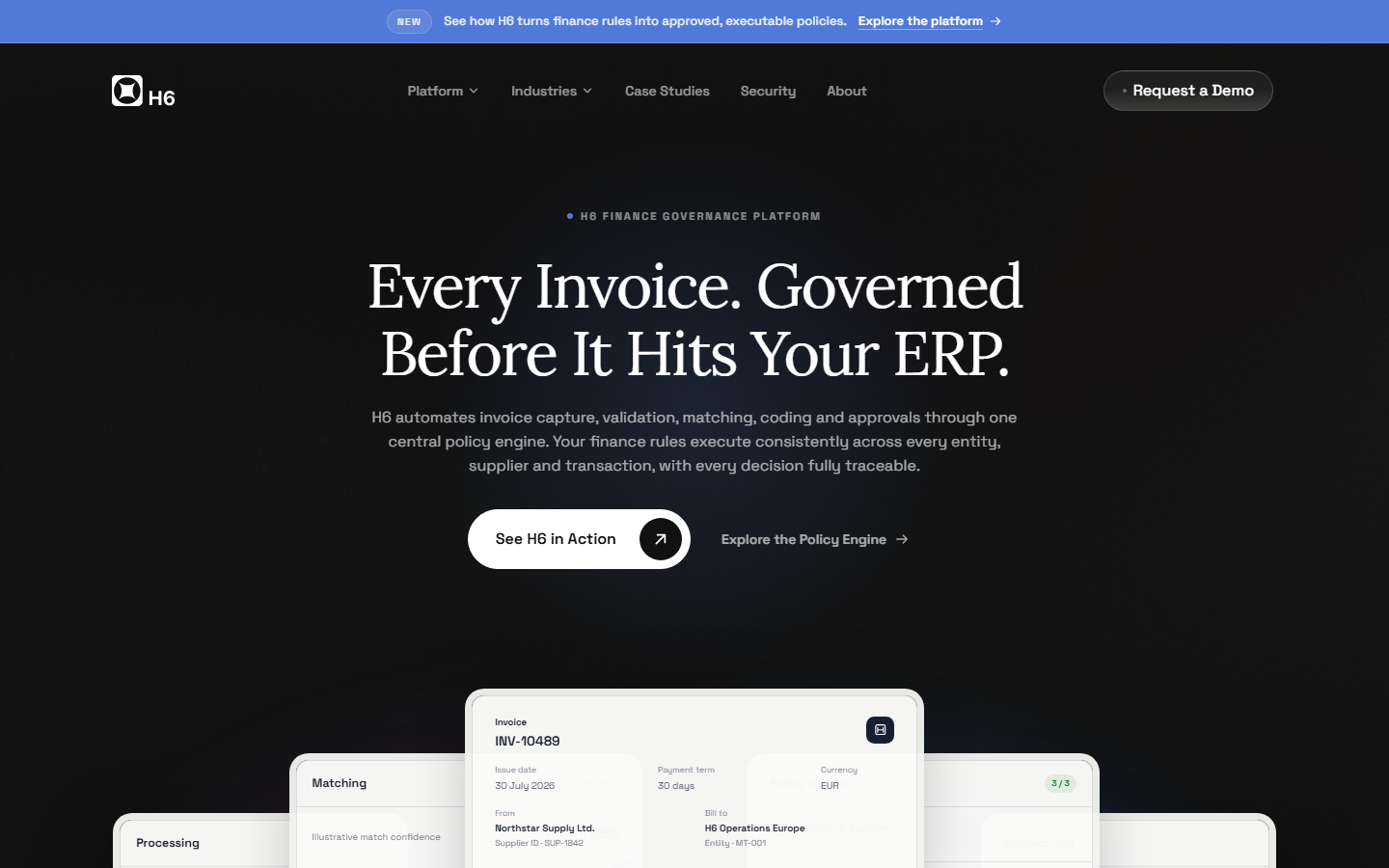
An invoice moves through five stages: intake, AI capture of the document's facts, supplier and legal-entity lookup alongside the matching purchase order and goods receipt, policy checks, and finally posting to the ERP (enterprise resource planning system) or routing to a person. The AI layer reads documents and helps draft rules, while the checks themselves run from rules the finance team has signed off. It competes for the same AP budget as Vic.ai, although the two start from opposite ideas about how much the software should decide on its own, a trade-off HokAI's agentic AI governance piece frames from the risk team's side.
Its named customers are Maltese groups, among them the hotel groups AX Group and G3 Group, the My Convenience store network, the single-property Grand Hotel in Gozo and the care operator CareMalta. The platform is hosted on Microsoft Azure. That customer list points to the natural buyer: a group with several legal entities, many suppliers and purchase-order-backed buying, where a controller currently carries the approval rules in their head or in a spreadsheet.
H6 is delivered as a hosted web platform, and the vendor lists no desktop or mobile apps. Readers still deciding whether they need a full AP platform can start with HokAI's guide to AI financial assistants and the back-office agents roundup, browse peers in the business operations category, the wider agents and automation group, the finance tools category or the business-ops guide hub, or, if only the capture step is needed, try Veryfi, an OCR API built for invoices and receipts, its per-page-priced rival Mindee, or the options in the document-parsing comparison.
Screenshots
Pricing
Quote-only. ai is password-protected and no list prices or plans are public as of September 2026, so cost is set after a demo and, where offered, a proof of concept run on your own invoices. The vendor agrees integration scope per connected system, so ask whether connector work is billed on top of the subscription.
H6 sits with the paid-only tools in the directory.
Key Features
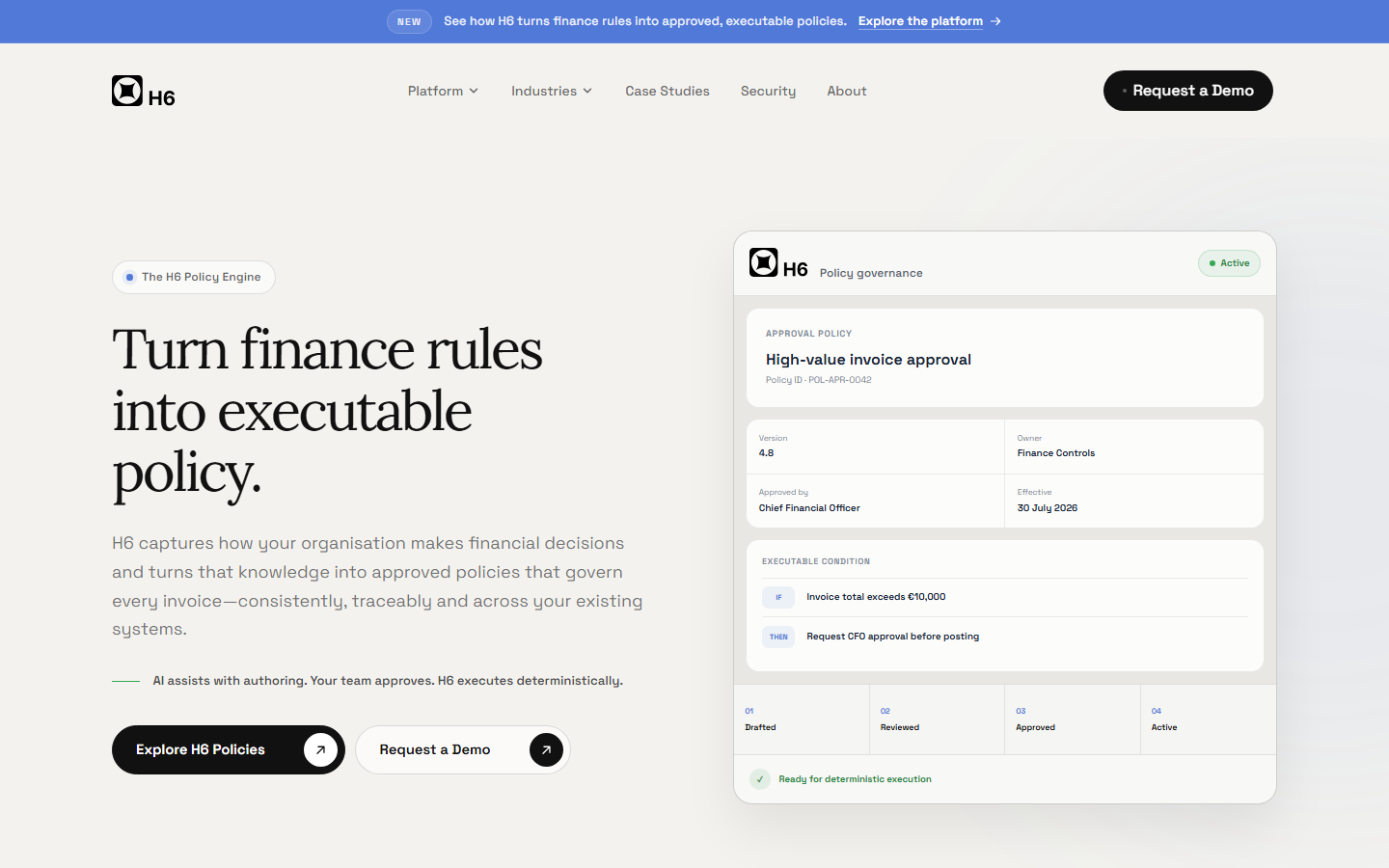
- Versioned finance policies: Rules such as an approval threshold are stored as numbered policy versions with a named owner, approver and effective date, and superseded versions stay on record.
- Seven live policy families: Data capture, party lookup, classification, validation, matching, approval and ERP posting each run as a separate policy the finance team can edit and re-approve.
- Field-level invoice capture: The AI layer extracts supplier, invoice number, dates, currency, tax, totals and line items, and keeps the source location and a confidence value for every field.
- Category-aware PO matching: Invoice lines are matched to purchase orders and goods receipts with tolerances set per spend category, so weighted or refrigerated food lines can carry their own approved variance.
- Explained exception routing: An invoice that fails a check goes to the assigned reviewer together with the failure reason, the supporting records and the policy version that stopped it.
- Several intake channels: Invoices arrive by email, Azure Blob or AWS S3 storage, API, CSV or XML file exchange, ERP connectors or manual upload.
- Named ERP and PMS connectors: The integration page lists SAP, Microsoft Dynamics 365, Oracle NetSuite, Oracle, Sage, Xero, Zoho, QuickBooks, Odoo, Coupa, Shireburn and the hotel PMS Protel, with scope confirmed per project.
- Scoped access and audit log: Role-based access can be set per organisation, legal entity, department and function, and each user action, policy run and ERP posting is logged.
Pros
- The one public outcome figure is strong for a first deployment: a MeetInc news report says The Grand Hotel in Gozo reached 92% touchless invoice processing in its first month, a figure supplied by the vendor and the hotel.
- Its case studies come from messy, multi-entity buyers rather than tidy demos, including a retail network that mixes owned and franchised stores and a care operator spread across 15 locations in Malta and Gozo.
- Keeping rules outside the ERP lets a group with several ledgers or legal entities maintain one set of approval and coding logic instead of configuring each system separately.
Cons
- Pricing sits behind a password, so there is no way to budget or compare cost before a sales call.
- No SOC 2 report or ISO 27001 certificate is published yet; the security page says ISO 27001 is in progress, which can stall procurement at banks and other regulated buyers.
- All four detailed case studies come from Malta or Gozo, and every result is vendor-supplied, with no reviews yet on G2, Capterra or Trustpilot.
- Budget checks and vendor statement reconciliation are still marked coming soon, so teams that want spend control at the approval step need another tool for now.
- H6 publishes no API documentation, developer portal or MCP (Model Context Protocol) server, so every integration is scoped with H6 rather than self-served.
Frequently Asked Questions
How much do you pay for H6?
H6 does not publish prices: its pricing page is locked behind a password that the sales team hands out. Expect a quote after a demo, and ask directly how invoice volume, the number of legal entities and custom connector work change it. Because the vendor agrees integration scope system by system, get implementation costs in writing next to the subscription figure.
Does H6 have a free plan?
H6 offers no free plan, free trial or self-serve signup; access starts with a demo request. The closest thing to a trial is the proof of concept H6 offers on a buyer's own documents, systems and matching rules.
Which tools compete with H6 in 2026?
Vic.ai is the nearest like-for-like choice, an established AP platform that learns invoice coding from history instead of asking you to write rules. If you only need invoice data pulled out of PDFs and scans into your own workflow, Veryfi or Mindee do that step with public pricing, and small businesses that mainly need bookkeeping are better served by [Kick](/hub/tools/kick). Groups whose ERP already includes AI invoice features should test those first, since H6 earns its place mainly through the rule and audit layer.
Is H6 better than Vic.ai?
It depends on who you have to convince. Vic.ai says its Autopilot skips data entry and coding review whenever every invoice field is predicted at 95% or higher confidence, learning from historical transactions, while H6 codes and matches from rules a person has signed off. Vic.ai has the longer track record and a far larger customer base; H6 case studies so far are all Maltese. For a multi-entity group answering to auditors H6 is the better fit, and for high volume with a proven vendor Vic.ai is the safer pick.
How do you set up H6?
After a demo request, H6 scopes which ERP, procurement or property-management systems to connect and how invoices will arrive, whether by email, an Azure Blob or [AWS](/hub/companies/amazon-web-services) S3 bucket, API or file drop. Your team then writes down its existing approval thresholds, coding rules and match tolerances so they can be turned into policies and signed off. The Grand Hotel in Gozo, the vendor's first client, was processing invoices within its first month, though that timeline is vendor-reported.
Top Alternatives
- Vic.ai: Pick Vic.ai if you want coding learned from past invoices with no rules to write; pick H6 when auditors need every coding and approval decision tied to a signed-off rule.
- Veryfi: Pick Veryfi if your developers only need invoice fields read by an OCR API inside your own workflow; pick H6 if you want matching, approvals and ERP posting handled for you.
- Mindee: Pick Mindee if you want published per-page pricing and a trial for the extraction step alone; pick H6 when the approval logic, not the reading, is the bottleneck.