Anthropic Taught Claude to Fill Carts. It Skipped the Register on Purpose.
Claude's Commerce Agents blueprint, released September 2, 2026, is open-source code for a shopper agent (search, compare, cart, order support) and a merchant agent (inventory, pricing, marketing drafts), deployed via the Claude API, Bedrock, Foundry or Vertex AI. Anthropic supplies no payment or checkout layer; partners like Visa and Mastercard handle that.
The short version
Anthropic's September 2026 Commerce Agents blueprint gives retailers free, open-source code to build shopping and merchant agents on Claude, deployable through the Claude API or major clouds. It skips payment, catalog and advertising entirely. The reported 35% larger carts and 60% higher purchase completion are Anthropic's own figures, not an independent benchmark.
Want this decided for your own case? Find your tools with Smart Match, starting from this guide's question.
On September 2, 2026, Anthropic gave any retailer free code to run a shopping agent and a merchant agent on Claude, and it left out the one piece most people expected: payment.
The release, called the Commerce Agents blueprint, is open source on GitHub and ships with a plugin for Claude Code. An engineering team can wire it into an existing storefront in days instead of months.
Anthropic named Shopify, Priceline, Visa, Mastercard and Accenture as early partners, timed nine weeks ahead of the U.S. holiday shopping season. For a small commerce or retail-tech team, the real question isn't whether Claude can do this job. It's whether Anthropic's own numbers are the ones to trust before spending a sprint on it.
What Anthropic actually shipped, and why Claude now has three jobs
The blueprint splits into two roles. A shopper agent searches a catalog, compares products, builds a cart inside the conversation and hands it off to checkout; it also answers order-status, return and refund questions.
A merchant agent works the back office. It flags inventory problems, recommends discounts from sales history and drafts marketing campaigns, though Anthropic says operational changes still need a human's approval before they go live. Reference implementations ship for retail, travel, telecom and ticketing, and the code deploys through the Claude API, Amazon Bedrock, Microsoft Foundry or Google Cloud Vertex AI, according to Anthropic's own announcement.
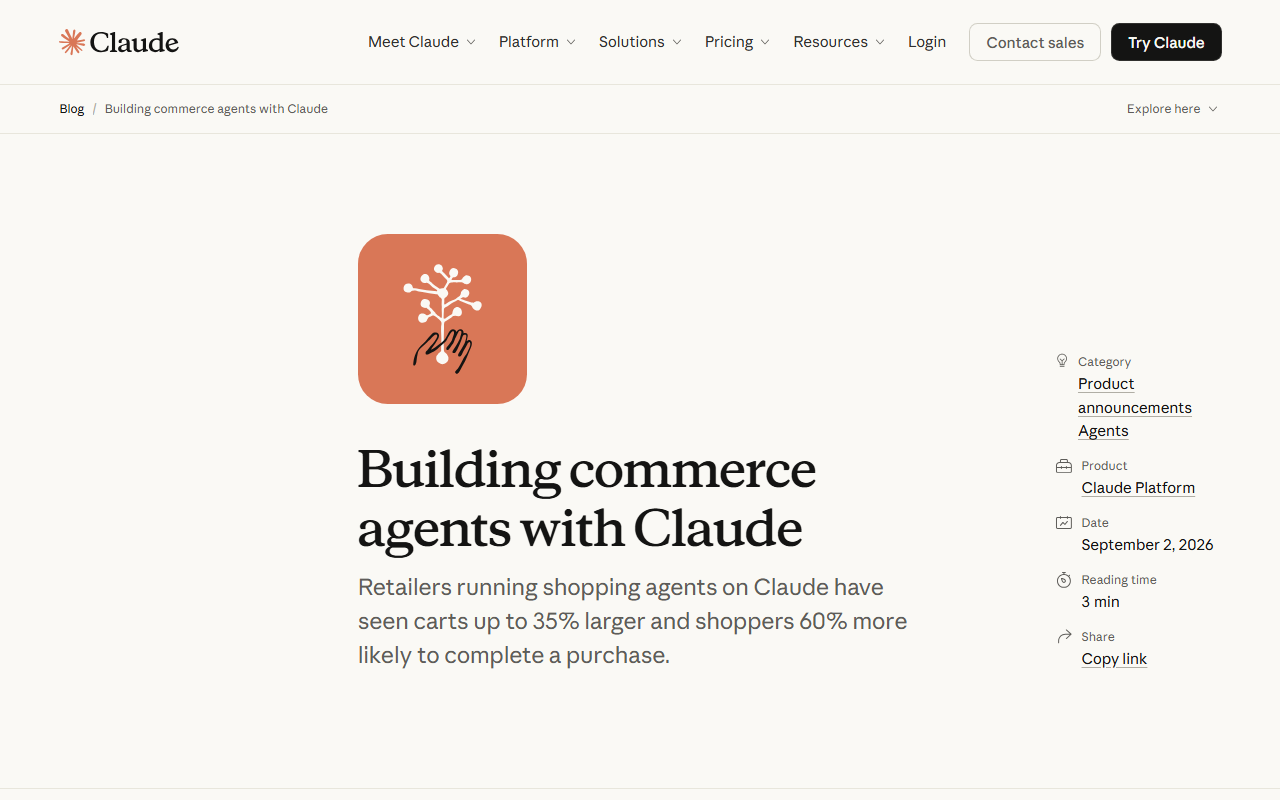 Anthropic's own announcement, captured 4 September 2026. The 35%/60% figures shown here are the company's own, discussed further below.
That announcement makes plain what buying Claude actually means in 2026, and it isn't one decision. Anthropic charges $17 to $20 a month for the chat app, up to $125 for a premium team seat, according to its current pricing page.
Claude Code rides free on top of any paid plan, drawing from the same usage pool. Heavier teams bill it separately through pay-as-you-go API credits instead. The commerce blueprint has no price tag at all. It's a GitHub repository, not a subscription tier, and whatever it costs a retailer shows up as cloud usage, not a Claude invoice. Three different products, three different ways of paying for them, one brand name over all of it.
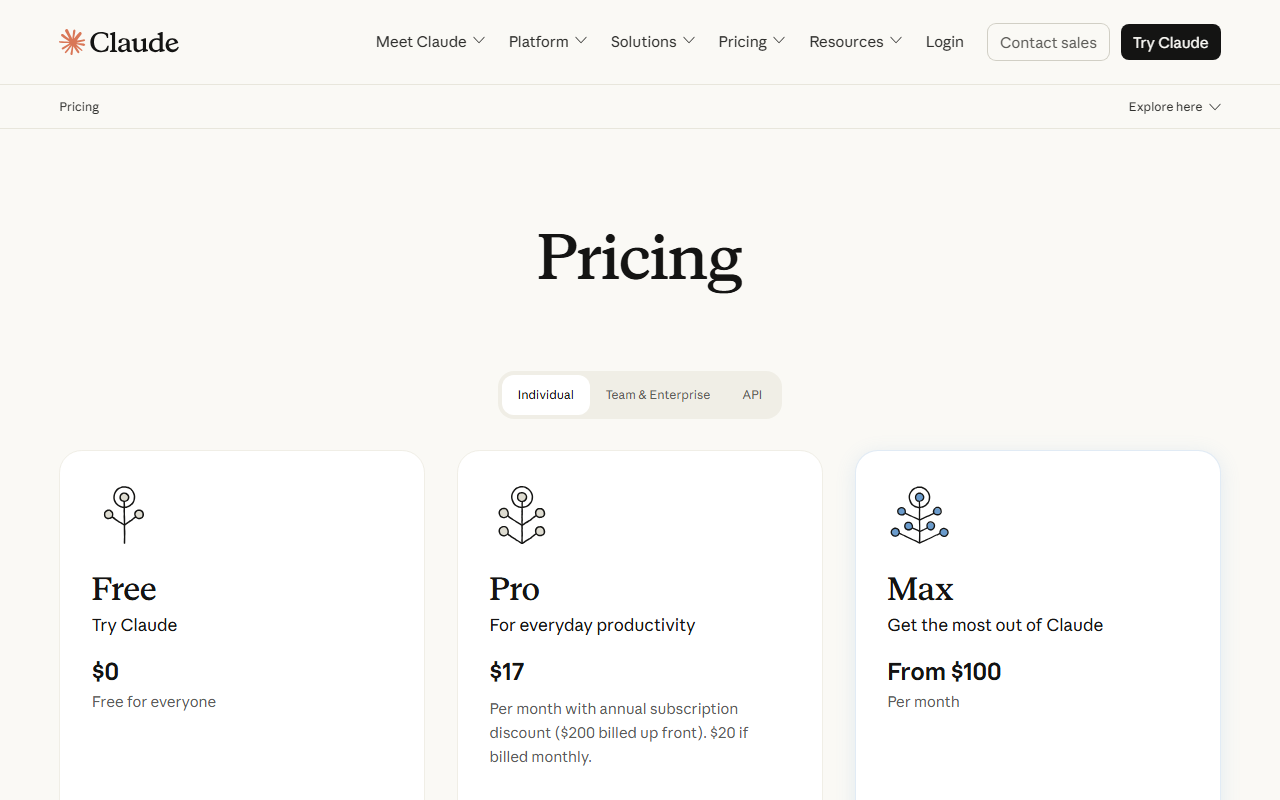 Claude's pricing page, captured 4 September 2026. The commerce blueprint doesn't appear here because it isn't a plan; it's free code that bills as cloud usage instead.
Who this actually helps
An engineering team that already wanted to prototype a shopping agent gets a running start. The harnesses, guardrails and prompt patterns that took the reference implementations months to build now ship as a starting point instead of a research project. That costs nothing to try.
It also means Anthropic is repeating a decision OpenAI made the hard way. OpenAI's own Instant Checkout let ChatGPT complete a purchase directly inside the chat window, starting in September 2025.
By March 2026, OpenAI repositioned it. A purchase now routes through the merchant's own app instead of resolving inside ChatGPT, a change the company tied to how often tax, inventory and pricing data need updates that only a merchant's own system keeps current. Anthropic's blueprint never puts Claude between the shopper and the checkout page at all. It hands the pattern to the retailer's engineers and gets out of the way.
If your team isn't sure yet whether it needs an agent this specific, or something closer to a general recommendation engine, that's worth running through Smart Match before it's a question about which blueprint to fork.
Who this hurts
The shopper agent's support function, answering questions about an order, a return or a refund, is the entire product that Parahelp, Pylon and Sierra already sell, priced per resolution or per seat. Folding that function into a free code template from the model vendor itself is a direct threat to point solutions built on exactly that job.
It's a familiar squeeze. The same thing hit customer-support vendors once when general-purpose assistants started answering the same tickets without a dedicated contract.
The merchant agent's marketing-draft feature lands on the same ground Revnu already occupies: an autonomous system built specifically to generate and run marketing campaigns for a growth team. Revnu still does more around that one job than a blueprint's single feature does. But "more than a checkbox in someone else's template" is a narrower moat than it was on September 1.
The turn: the numbers are Anthropic's own
Anthropic's headline claim is that retailers running shopping agents on Claude have seen carts grow as much as 35% larger, with shoppers 60% more likely to complete a purchase. No retailer is named next to that number, and no outside auditor checked it.
PYMNTS reported plainly that these are "the company's own reported figures rather than an independently verified benchmark." That framing matters more here than in most vendor announcements, because the number is the entire pitch to a retailer deciding whether an engineering sprint is worth it.
The skepticism has company. A PYMNTS Intelligence survey found 43% of retailers are already piloting autonomous AI shopping tools. A separate PYMNTS Intelligence figure put consumer unease at 95%, the share of shoppers who report at least one concern about agentic commerce, with only 5% reporting none.
Retailers are moving faster than their own customers are comfortable with. Anthropic's blueprint doesn't touch that gap. It ships no payment protocol, no product catalog and no advertising layer of its own, leaving the parts shoppers actually distrust to the partners, Visa and Mastercard among them, that already carry that trust.
What to watch
Watch whether any of the five named partners publishes its own measured before-and-after numbers before Black Friday, November 27, 2026. If none does, the 35% and 60% figures will still belong to Anthropic alone eight weeks after the announcement, at the exact moment retailers most need proof that isn't self-reported.
Anthropic solved the engineering problem in one release. Whether it solved the trust problem depends on whether a single retailer says these numbers out loud before the last shipping deadline of December.
Frequently asked questions
What is Claude actually used for in 2026?
Claude is really three separate products under one brand: a consumer chat app for writing and research, Claude Code for software engineering work, and, as of September 2026, an open-source blueprint that lets retailers build shopping and merchant agents on the same models. Each has its own pricing and its own buying decision.
What are Anthropic's new Commerce Agents for Claude?
Released September 2, 2026, the Commerce Agents blueprint is open-source code for two agent types: a shopper agent that searches a catalog, builds a cart and answers order questions, and a merchant agent that flags inventory issues, recommends pricing and drafts marketing campaigns. It ships with a Claude Code plugin and deploys through the Claude API, Amazon Bedrock, Microsoft Foundry or Google Cloud Vertex AI.
Does Claude handle payment or checkout for retailers?
No. Anthropic's blueprint explicitly leaves out a payment protocol, a product catalog and an advertising layer, handing the cart off to the retailer's existing checkout instead. That mirrors a lesson OpenAI already learned: its own Instant Checkout tried resolving purchases directly inside ChatGPT starting in September 2025, then by March 2026 rerouted purchases through each merchant's own app instead.
Is Claude Code included with a Claude subscription?
Yes. Claude Code is bundled at no extra charge with any paid Claude plan, from the $17-20 monthly Pro tier up to Team and Enterprise seats, and draws from the same usage allocation as chat. Teams with heavier coding workloads can instead buy pay-as-you-go API credits through a Console account.
Are Anthropic's commerce agent results independently verified?
No. Anthropic's claim that shopping-agent carts grow up to 35% larger, with shoppers 60% more likely to complete a purchase, comes with no named retailer and no outside audit attached. PYMNTS reported these are the company's own figures rather than an independently verified benchmark, and separate PYMNTS Intelligence research found 95% of consumers report at least one concern about agentic commerce.
Covered in this guide
- Claude: Claude is Anthropic's AI assistant, with a free tier, paid personal plans, and Team and Enterprise seats. Opus access starts at the first paid plan.
- OpenAI: ChatGPT is OpenAI's AI assistant, with 1.2 billion weekly users by OpenAI's count, the GPT-6 model family and plans that run from a free tier to a premium Pro tier.
- Anthropic: Anthropic is a Public Benefit Corporation started by 7 ex-OpenAI researchers. It builds the Claude model family and counts Amazon and Google among its largest backers.
- Claude Code: Anthropic's agent for the terminal, IDEs, desktop, web and mobile that edits files, runs tests and opens pull requests. There is no free plan.
- Parahelp: AI support agent from an 11-person YC-backed team that resolves complex tickets end-to-end via email, chat, and Slack for Perplexity, Framer, and Replit.
- Pylon: Pylon is a B2B customer support platform where AI agents pre-investigate every ticket across Slack, email, and chat; trusted by 1,500+ companies.
- Revnu: Y Combinator-backed AI growth agent that runs outbound, ads on Google, LinkedIn, Reddit, X and Microsoft, and SEO pages for software startups, with drafts held for approval.
- Sierra: Enterprise AI agent platform from Bret Taylor valued at $15.8B in 2026, used by 40% of the Fortune 50 for customer service across chat, voice, and email.
Sources
Still deciding?
This guide covers a handful of options. Smart Match checks every listing in the directory against how you actually work and what you can spend, then hands you the shortlist and the reason behind each pick.
Find your toolsRelated guides
- The AI 80s Photo Trend: How to Make Yours (and Turn It Into a Video) in 2026AnalysisWhat changed and who it affects
- Apollo.io Alternatives in 2026: Pick by the Job You Hired Apollo ForBuyer's guideHow to pick, across a category
- Attio vs HubSpot in 2026: Which CRM for a Startup?ComparisonHead-to-head, with a verdict
- Best Agentic AI in 2026: Pick the Job, Not the GeneralistBuyer's guideHow to pick, across a category
- Best AI Agent Builders in 2026: Automate, Build or Self-HostBuyer's guideHow to pick, across a category
- Best AI App Builder in 2026: Pick by What You're BuildingBuyer's guideHow to pick, across a category