Genspark Just Shipped a $179 Hardware Recorder and a Free Office Suite
Genspark is an AI agent platform, founded in 2023, that in July and August 2026 expanded beyond research reports and slide generation into hardware (the $179 SecondBrain Note recorder), persistent memory (SecondBrain), and a free, open-source, Apache 2.0 licensed office suite called GenOffice covering documents, spreadsheets, slides and PDFs.
The short version
Genspark built its reputation on fast AI research reports and slide decks. In six weeks it also launched a $179 hardware recorder, a persistent memory system, and a free open-source office suite challenging Word and Excel. The expansion looks well funded, but Genspark's Trustpilot score, near 1.5 out of 5 over billing complaints, predates every new product.
On August 3, 2026, Genspark shipped GenOffice, a free alternative to Word and Excel, six weeks after launching a $179 hardware voice recorder.
Genspark built its name on turning a prompt into a slide deck or a cited research report in minutes. In the six weeks since July 20, it has also become a company that manufactures hardware, sells team chat for AI agents and humans, and gives away office software.
For anyone already deciding whether to fold three or four subscriptions into one Genspark plan, that expansion changes the question. It is no longer whether the original agent is good. It is whether the platform underneath it can support everything it now claims to do.
What actually changed
The company unveiled AI Workspace 6.0 in Tokyo on July 21, 2026, backed by a $100 million, three-year investment in Japan, according to a press release distributed the same day. The centerpiece is SecondBrain, a persistent memory layer that stores context from email, meetings and documents so a user stops re-explaining themselves to the agent. Alongside it shipped GenTeam, a Slack-style channel where AI agents and humans work side by side, and GenMail, an email client that drafts replies in a user's own writing voice.
The same launch introduced Genspark's first hardware product. SecondBrain Note is a card-thin recorder that weighs 26 grams and records up to 35 hours continuously. It costs $199, discounted to $179 at launch, and ships with a magnetic wallet case that doubles as a phone stand. Founder Eric Jing described it as the start of a hardware line, with more devices already in development. Free-tier users get 300 minutes of transcription a month; paid subscribers, who already pay $24.99 or $249.99 a month for the platform, get unlimited transcription.
Then, on August 3, came the open-source office suite: documents, spreadsheets, slides and a PDF editor, released under an Apache license for macOS and Windows. Core editing is free. AI features inside the documents run on Genspark's existing credit system, and the company is explicit that this suite is still an alpha release, not positioned as a like-for-like swap for the office software most businesses already run daily.
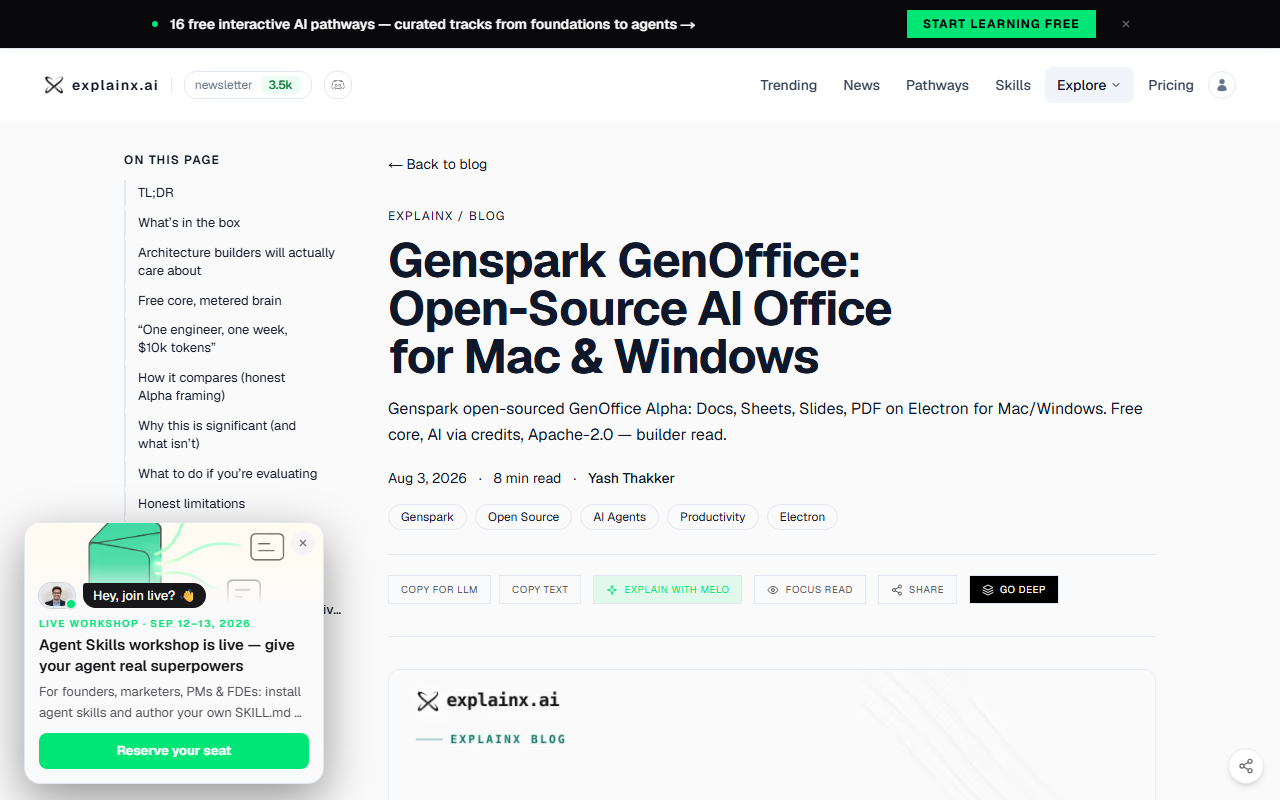 Independent coverage of the GenOffice Alpha launch, captured 23 Aug 2026. The same week also carried the $179 hardware recorder into general availability.
Who this helps
The clearest winner is you, if you already trust Genspark's credit system and mostly want fewer logins rather than more capability. Add meeting capture, shared email drafting and a document editor to a workflow already built around Sparkpages and AI-generated slides, and there is no longer a separate tab needed for Manus, a dedicated notetaker like Otter, or a traditional office app.
The investor case looks stronger than the product case right now. Genspark says it reached $250 million in annualized revenue within 12 months and now serves more than 7,000 business clients, backed by $645 million in total funding at a $2.6 billion valuation, according to the same release. Whatever the billing complaints below say about the existing product, someone with a large checkbook is betting the bundle works.
Who this hurts
Point tools built for one job now compete on Genspark's home turf without having asked for the fight. Gamma built its business on AI-generated slide decks; the new suite now offers a free, credit-gated version of the same job inside software that also handles spreadsheets and documents. tl;dv and Fathom built theirs on turning meetings into notes through software; the $179 recorder tries to do the same thing with an object that never has to be reminded to hit record.
Microsoft Copilot sits in an odd spot of its own. Microsoft signed a partnership on April 29, 2026 to put Genspark's agents inside its own Office apps, and is now watching the same company ship a free open-source clone of them.
The group most exposed, though, is Genspark's own existing customer base. Trustpilot lists the company at roughly 1.5 out of 5 across about 127 reviews, with the majority of complaints citing credits debited on failed tasks, non-consensual annual billing, and slow support. Those reviews predate every product named above. Each new surface runs on the same credit ledger the reviews are already complaining about.
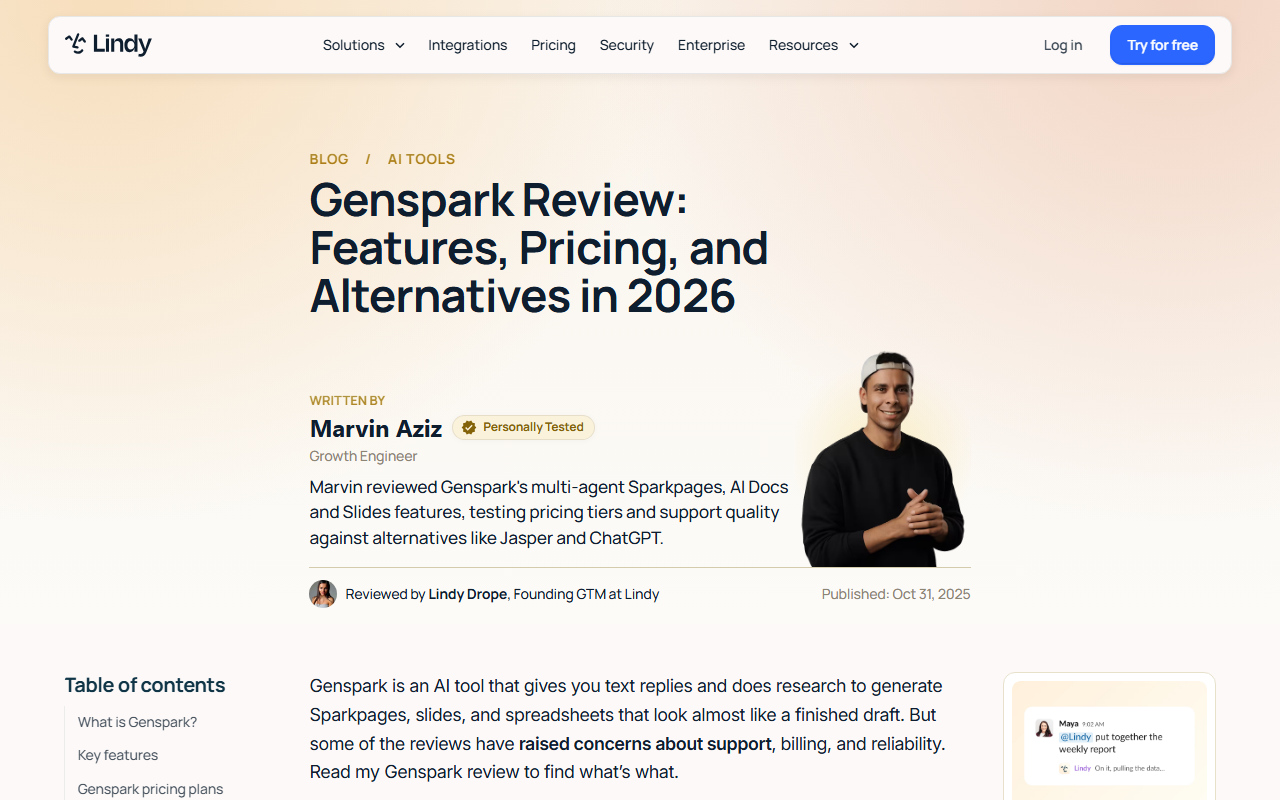 A review from October 2025, captured 23 Aug 2026, nearly a year before Workspace 6.0, GenOffice or the SecondBrain Note recorder existed, already flagging the same complaints.
The case this isn't reckless
The obvious rebuttal is that breadth might be the entire strategy, not a distraction from it. Perplexity and Manus have both stayed narrower: one mostly answers questions with citations, the other concentrates on autonomous browser and API tasks rather than office software.
Genspark, by contrast, is betting that the winning AI platform looks less like a search engine and more like an operating layer that touches email, meetings, documents and hardware at once. A $2.6 billion valuation and a nine-figure Japan investment suggest that bet has real backers, not just a marketing plan.
That argument is reasonable. It does not fix the underlying problem. A platform strategy and a billing-trust problem are different failures, and stacking four new products on top of a shaky credit system does not resolve complaints about the credit system. It just gives it four more places to go wrong.
What would prove this wrong
Two things would flip this verdict. If the office suite moves out of alpha with a named enterprise customer running it as a daily replacement for Word or Excel by early 2027, it has become real rather than a headline. And if the Trustpilot score climbs meaningfully, past 3.0, over the next two quarters, the billing complaints were a fixable growing pain rather than a structural feature of the credit model. Neither has happened yet.
For now, the honest read is to keep using Genspark for the job it earned its reputation on: fast research reports and slide decks. Treat the memory system, the email client and the office suite as a bet worth watching before a subscription worth trusting, and keep ChatGPT or a dedicated notetaker on hand as the fallback if the bundle has not held together by the time that verdict is due.
Frequently asked questions
What is Genspark actually used for?
Genspark is an AI agent platform that turns a prompt into a Sparkpage research report, a slide deck, a spreadsheet, or a working app. Its Call For Me feature places real outbound phone calls for tasks like appointment booking. As of August 2026 it also includes a persistent memory layer, a Slack-style team chat for agents and humans, and an email client, well past its original research-and-slides use case.
What is SecondBrain Note and what does it cost?
SecondBrain Note is Genspark's first hardware product, a card-thin AI voice recorder that weighs 26 grams and records up to 35 hours continuously. It costs $199, discounted to $179 at launch, and turns recorded meetings into transcripts and summaries inside Genspark's SecondBrain memory system. Free-tier users get 300 minutes of transcription monthly, while Plus and Pro subscribers get unlimited transcription.
What is GenOffice, and is it really free?
GenOffice is an open-source office suite from Genspark, covering Docs, Sheets, Slides and a PDF editor, released August 3, 2026 under an Apache 2.0 license for macOS and Windows. Core editing is free with no subscription required. AI features inside the documents draw on Genspark's paid credit system, and the company describes the suite as still in Alpha rather than a finished Word or Excel replacement.
Is Genspark reliable enough to depend on?
Genspark's Trustpilot score sits at roughly 1.5 out of 5 across about 127 reviews, with recurring complaints about credits debited on failed tasks and non-consensual annual billing. Those complaints predate the SecondBrain, GenTeam, GenMail and GenOffice launches, so every new product runs on the same credit system reviewers already distrust. The free tier limits the exposure for light use, but a business betting its documents and meeting notes on the platform should weigh the billing history first.
How does Genspark's hardware and office push compare to Manus and Perplexity?
Manus and Perplexity have both stayed narrower: Perplexity focuses on cited search answers, and Manus concentrates on autonomous browser and API tasks rather than office software or hardware. Genspark is betting instead on a full operating layer spanning documents, meetings, email and a physical recorder. That bet is backed by a reported $2.6 billion valuation, but it has not yet been tested against Genspark's existing billing complaints.
Covered in this guide
- Genspark: Genspark is an AI super agent that runs 8+ LLMs and 80+ tools to build slides, research reports, and apps, with a free daily-credit tier and paid Plus/Pro plans.
- Manus: Autonomous AI agent that plans and executes multi-step work from one prompt: research, documents, apps and video. The September 2026 release adds Cascade, Automations and Studio. Free tier available.
- ChatGPT: ChatGPT is OpenAI's AI assistant, with 1.2 billion weekly users by OpenAI's count, the GPT-6 model family and plans that run from a free tier to a premium Pro tier.
- Fathom: AI notetaking for meetings - summarize conversations to focus on what matters
- Gamma: AI-powered presentation maker & website builder for visual storytelling
- Microsoft Copilot: Your everyday AI companion powered by GPT-5.6 (preferred model July 2026), GPT-4o, and GPT-5 for productivity, creativity, and intelligent assistance
- Perplexity: Perplexity AI searches the live web and returns cited, source-backed answers, used by 45 million monthly users with plans starting free.
- tl;dv: AI meeting notetaker turning every meeting into insights across your entire company
Sources
Still deciding?
This guide covers a handful of options. Smart Match checks every listing in the directory against how you actually work and what you can spend, then hands you the shortlist and the reason behind each pick.
Start Smart MatchRelated guides
- The AI 80s Photo Trend: How to Make Yours (and Turn It Into a Video) in 2026AnalysisWhat changed and who it affects
- The AI Tools That Do One Microsoft Copilot Job, CheaperBuyer's guideHow to pick, across a category
- Algolia and You.com Both Call Themselves AI Search Infrastructure. They Aren't Rivals.ComparisonHead-to-head, with a verdict
- Arc Browser Hasn't Shipped a Feature in 449 Days. Cloudflare Just Showed Why.AnalysisWhat changed and who it affects
- Best Agentic AI in 2026: Pick the Job, Not the GeneralistBuyer's guideHow to pick, across a category
- Best AI Assistant Apps for Android in 2026, Now That Google Assistant Is DeadBuyer's guideHow to pick, across a category