
Last updated: 2026-09-07
Stable Audio is Stability AI's generative audio model family, generating tracks up to 6 minutes 20 seconds long from a shared latent diffusion architecture. Three of its four model sizes ship as open weights for self-hosting; the fourth, Large, runs through the API or an Enterprise license instead.
About Stable Audio
Stable Audio is Stability AI's generative audio model family, released as Stable Audio 3.0 in 2026. It's a family of fast latent diffusion models (Small, Medium, Large) for variable-length audio generation and editing, built on a novel semantic-acoustic autoencoder (SAME, Semantically-Aligned Music Autoencoder) with adversarial post-training for accelerated inference.
Model family (2026): - Stable Audio 3.0 Small SFX: Sound effects generation on-device (mobile phones, consumer laptops). Open weights. - Stable Audio 3.0 Small: Full music composition on-device (up to 2 minutes). Open weights. Only model capable of full music composition on-device. - Stable Audio 3.0 Medium: Higher musicality (structure, melodic coherence, phrasing), track length up to 6:20. Open weights. - Stable Audio 3.0 Large: Most advanced musicality, low-latency high-volume generation for music platforms/creative apps. API + self-hosted enterprise only.
Key capabilities: - Variable-length generation up to 6+ minutes (per-second granularity) - Full song composition with complex musical structure (up to 6:20) - Inpainting for targeted audio editing and continuation - Sound effects generation (SFX models) - On-device/offline generation (Small/Medium open weights) - Adversarial post-training: <2s on H200 GPU, few seconds on MacBook Pro M4 - Trained on fully licensed + Creative Commons data - Open weights for Small SFX, Small, Medium (Hugging Face) - Large via Stability AI API + self-hosted enterprise
Licensing: - Stability AI Community License: You own outputs, commercialize freely (for orgs <$1M revenue) - Enterprise License: For orgs >$1M revenue, includes legal indemnification, white-glove support, fine-tuning, self-hosting, custom infrastructure - No commercial restrictions on open-weight models
Deployment: - API: https://api.stability.ai (Stable Audio 3.0 Large) - Self-hosted: Enterprise license (weights + inference pipeline) - Open weights: Small SFX, Small, Medium on Hugging Face - Platform integrations: ComfyUI, other platforms
Technical architecture: - Fast latent diffusion models (latent diffusion in compact semantic-acoustic latent space) - SAME (Semantically-Aligned Music Autoencoder) for compact latent representation - Adversarial post-training for accelerated inference + improved fidelity - Variable-length generation via semantic-acoustic autoencoder - Inpainting support for targeted editing/continuation
Performance: - <2s on H200 GPU, few seconds on MacBook Pro M4 - Small SFX/Small optimized for mobile/consumer hardware - Medium/Large for higher musicality and longer tracks - Inference: few steps via adversarial post-training
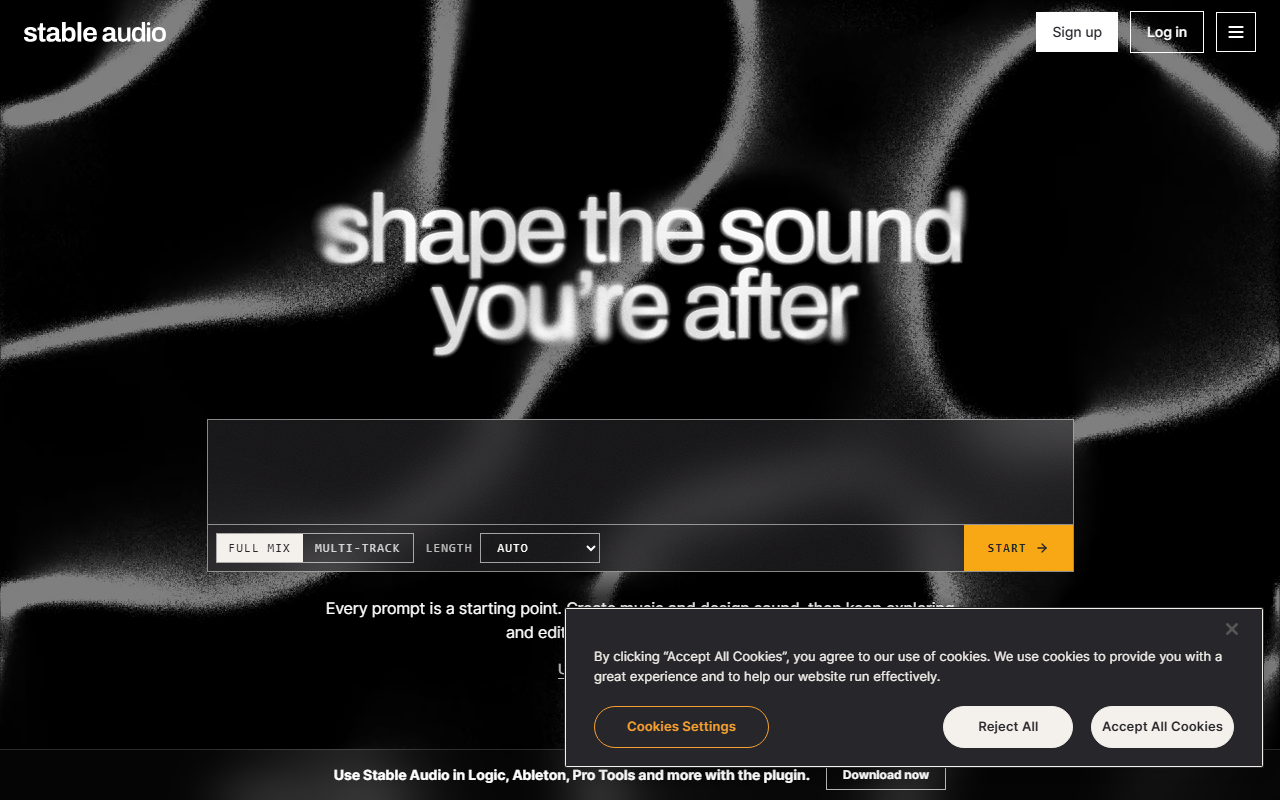
Pricing (2026): - Open weights (Small SFX, Small, Medium): Free to download, self-host - API (Large): Usage-based via Stability AI API (per-second/generation) - Enterprise: Custom pricing (> $1M revenue orgs), includes indemnification, white-glove support, fine-tuning, self-hosting, SLA - Stable Audio App: Web app for direct generation
Target audience: - Music producers & composers needing full-track generation - Sound designers for SFX - Game/audio developers needing on-device audio - Enterprises needing indemnified audio generation - Researchers building on open-weight audio models - Content creators needing royalty-free music/SFX
Screenshots
Pricing
The three smaller model sizes cost nothing to run yourself once downloaded. API access to the Large model bills by usage through Stability AI's API. Enterprise tier is custom-priced for orgs over $1M in annual revenue and includes indemnification, white-glove support, fine-tuning, and self-hosting.
The Stable Audio web app is a separate access point for direct generation.
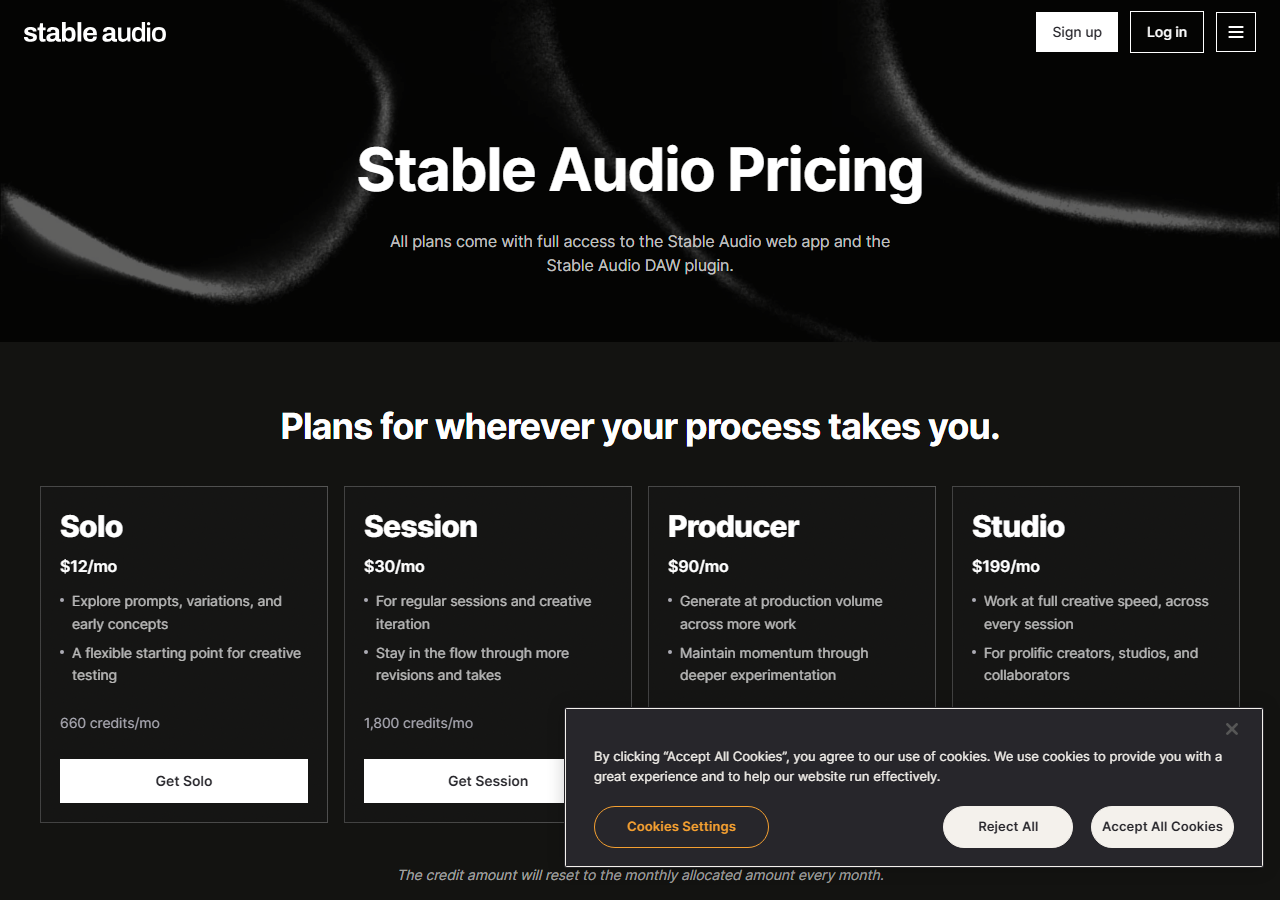
| Tier | Monthly price | What it includes |
|---|---|---|
| Free (open weights) | Free | |
| Solo | $12/mo | |
| Session | $30/mo | |
| Producer | $90/mo | |
| Studio | $199/mo | |
| Enterprise | Custom |
Feature Comparison by Tier
| Feature | Solo | Session | Producer | Studio |
|---|---|---|---|---|
| Credits per month | 660 | 1,800 | 6,000 | 14,000 |
| Monthly price | $12 | $30 | $90 | $199 |
| Web app + DAW plugin access | ✓ | ✓ | ✓ | ✓ |
| Commercial license on generated audio | ✓ | ✓ | ✓ | ✓ |
| Unused credits roll over | — | — | — | — |
Key Features
- Full Song Generation up to 6+ Minutes: Variable-length generation up to 6:20 with complex musical structure, one of the first model families to generate full tracks with coherent structure at this length.
- Open Weights (Small/Medium) + On-Device: Small SFX, Small, and Medium ship as open weights on Hugging Face. Small runs full music composition on mobile or consumer hardware offline.
- Fully Licensed Training Data + Commercial License: Trained on fully licensed + CC data. Community License: own outputs, commercialize freely (<$1M revenue). Enterprise: indemnification, fine-tuning, self-hosting.
- Inpainting & Variable-Length Generation: Per-second granularity generation up to 6+ minutes. Inpainting for targeted editing/continuation of existing audio.
- Adversarial Post-Training for Speed: Reduced inference steps via adversarial post-training: <2s on H200, few seconds on MacBook Pro M4. Production-ready inference speeds.
Pros
- Open weights for 3 of the 4 models (Small SFX, Small, Medium), so they run locally, offline, for free.
- First model family with full on-device music composition (Small) plus SFX on mobile.
- Fully licensed training data means no copyright risk, and commercial use is allowed.
- Variable-length generation up to 6+ minutes with real musical coherence (structure, melody, phrasing).
- Inpainting for editing and continuation is a rare capability for an audio generator.
- Adversarial post-training keeps inference fast, so generation doesn't feel like a long batch job.
- Enterprise license bundles legal indemnification, which most open-weight audio tools skip entirely.
Cons
- The best-quality Large model is API or Enterprise-only, not available as open weights.
- Enterprise licensing costs aren't published; you have to contact sales for a quote.
- The hosted web app is subscription-only; there's no metered pay-as-you-go option outside the API for casual use.
- Small and Medium trail Large on quality, the usual trade-off for on-device models.
- There's no free tier for the Large model; high-volume use requires Enterprise.
- The SFX model is separate from the music models, so it's a different download and deployment.
- Inpainting is limited to continuation and editing, not full remix or rearrangement.
- There's no real-time streaming generation, only batch generation.
- Suno and Udio still lead on pure music generation quality for casual users.
- The free hosted-app plan's monthly credit allowance isn't published the way the paid tiers' are.
Data Handling
- Training-data policy
- Trains on user Inputs and Outputs for R&D and model improvement by default; opt-out is available from Account Settings under Stability's privacy center.
Frequently Asked Questions
How much does Stable Audio cost?
Cost depends on how you use it. Run Small SFX, Small, or Medium on your own machine and it's free indefinitely. Prefer a browser or DAW workflow instead, and Stability charges $12 to $199 a month across four tiers, Solo through Studio, based on how many credits you need. Building it into your own product means paying per generation through the API, and a revenue-qualified Enterprise contract covers everything else.
What do you get free with Stable Audio?
Self-hosting the Small SFX, Small, and Medium open-weight models costs nothing beyond your own hardware, with commercial use allowed under the Community License for organizations under $1M in annual revenue. The hosted web app also has a free plan that renews monthly, though Stability doesn't publish how many credits it includes.
What should you use instead of Stable Audio?
Suno and Udio handle cloud-based song generation with an easier interface but no open weights, inpainting, or dedicated SFX tools. ElevenLabs fits voice cloning and text-to-speech better than music. Riffusion is built for real-time streaming experiments rather than production-ready tracks.
What separates Stable Audio from Suno?
Suno is a closed, cloud-only service built for full songs with vocals and no self-hosting path. Stable Audio's smaller models are open weights you run yourself, plus dedicated sound-effects and inpainting tools Suno skips, though its interface is rougher and it has no built-in lyric-and-vocal songwriting flow.
What does it take to start using Stable Audio?
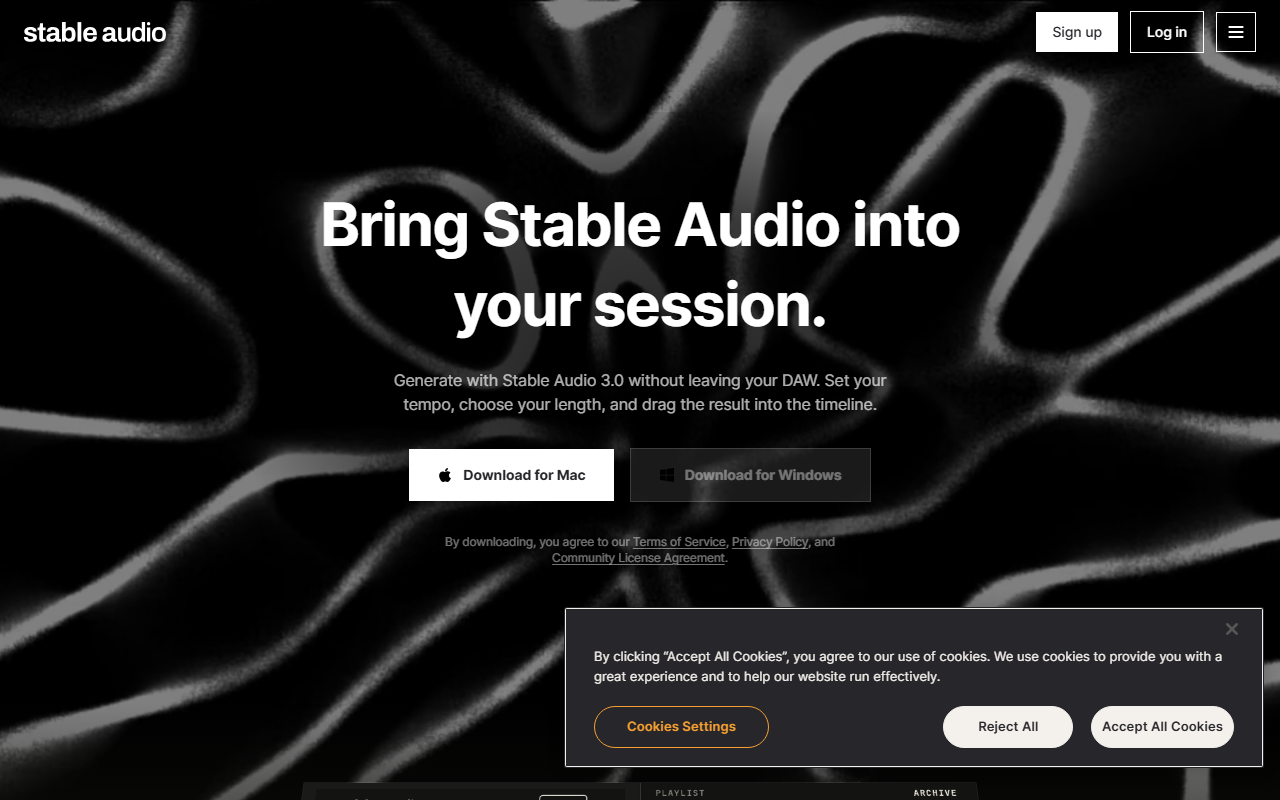
Download the Small, Small SFX, or Medium weights from Hugging Face to self-host: a MacBook Pro M4 or a consumer GPU handles Small, while Medium wants a higher-end GPU. To skip the setup, the hosted web app runs on a monthly subscription instead, and the DAW plugin downloads free for Mac or Windows.
Top Alternatives
- Suno: Suno is the simpler pick for someone who just wants a finished song with vocals typed in from a text prompt; Stable Audio suits a producer who wants sound design, stems, or a model they can run and fine-tune on their own hardware.
- Udio: Udio and Stable Audio split on the same open-weights line as Suno: Udio stays closed and cloud-only with stronger vocal and lyric coherence, while Stable Audio trades some of that polish for open weights and on-device control.
- ElevenLabs: ElevenLabs is built for dedicated text-to-speech, voice cloning, and voice design rather than music; Stable Audio covers music and sound-effect generation instead, with open weights ElevenLabs doesn't offer.
- Riffusion: Real-time, generative streaming experiments are Riffusion's focus, prioritizing open research over a polished final track; Stable Audio aims the other direction, toward production-ready output backed by an Enterprise license and indemnification for commercial use.
HokAI guides covering Stable Audio
- Fully Autonomous vs. Assisted AI Content Tools: How to Choose: Balzac and NeuronWriter both use AI to write content, but only one lets a human read it first. A Semrush study says that gap matters more than it looks.
- Best AI Song Generators in 2026: Suno v6, Udio and What Actually Ships a File: Suno retired every model for a licensed v6 lineup on Sept 9, 2026, and Udio still cannot export songs. Which AI song generator actually fits your workflow?
- The Top AI Tools in 2026: How to Actually Choose One: ChatGPT, Claude, Cursor, Gemini, and Perplexity all cap out near $200 a month in 2026. A practical framework for matching the right AI tool to your actual job.