
Last updated: 2026-09-04
Google Flow Music is an AI music generation platform from Google DeepMind that turns natural-language prompts into complete songs. Its Lyria 3 Pro model produces full tracks up to 3 minutes long, directed through a conversational Gemini Producer agent instead of manual composition tools, with every output SynthID-watermarked for AI-generated verification.
About Google Flow Music
Google Flow Music is Google's AI music creation platform, the third identity of a product that began as Riffusion (an open-source project in December 2022), became ProducerAI in July 2025, and was acquired by Google in February 2026. It is now powered by Lyria 3.5, which Google calls "our latest frontier music model", and generates full-length songs with rich musicality and dynamic vocals rather than short clips.
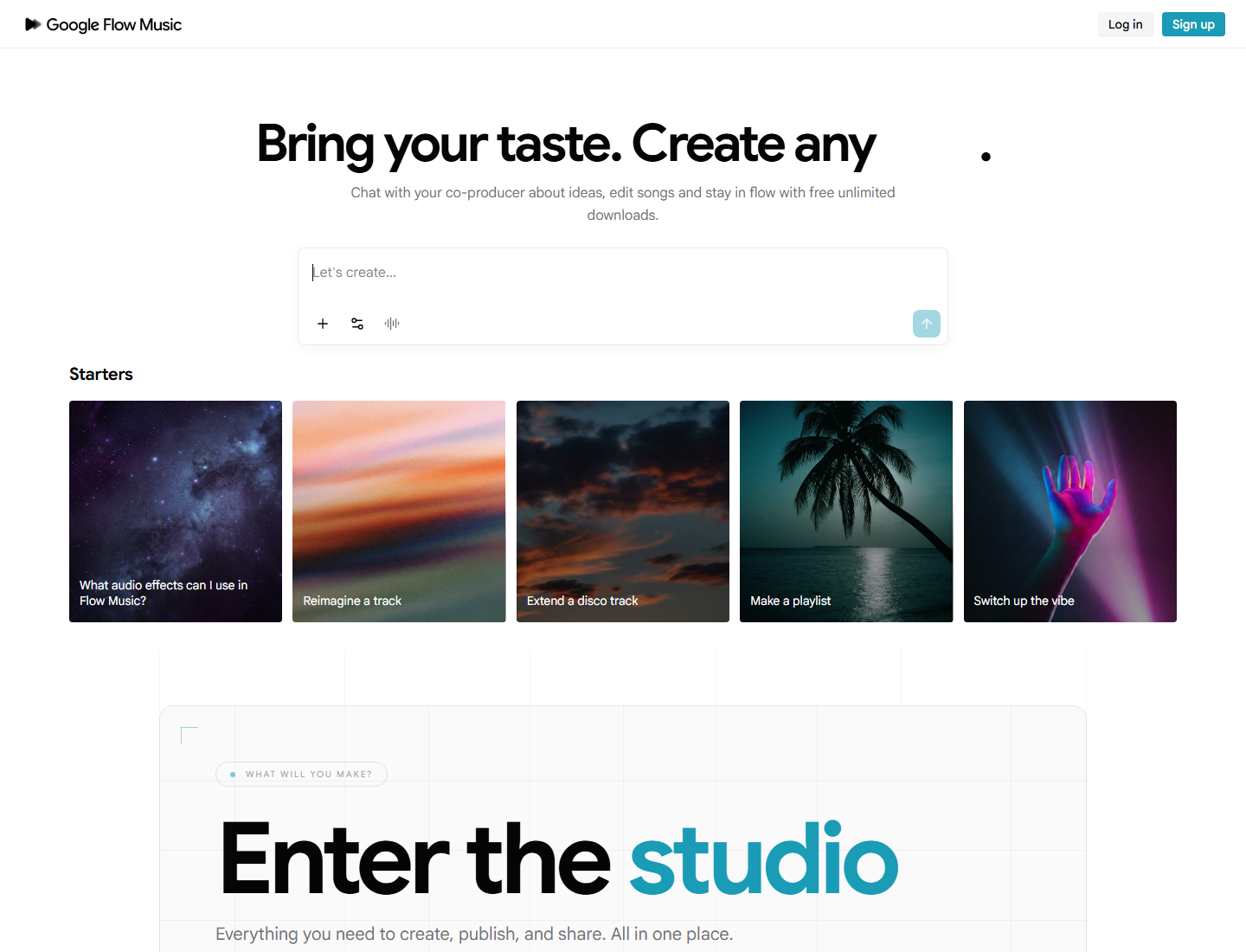
The core experience is conversational. Rather than turning knobs or working a piano roll, you chat with a co-producer agent "just like you're in a studio" and go deep on any detail from there — reworking a section, changing a beat drop, rewriting or translating lyrics, extending a passage. The starter prompts on the site give the flavour: reimagine a track, extend a disco track, switch up the vibe, make a playlist.
Beyond generation, Flow Music has become a place to publish rather than only to create. The studio covers playlists, publishing your songs, following artists and a daily discovery feed, plus stem splitting and downloads in mp3, wav and m4a — Google advertises "free unlimited downloads" on the landing page. Music videos are generated with the latest Veo video model, where you control the characters, aesthetics and every detail without a camera crew.
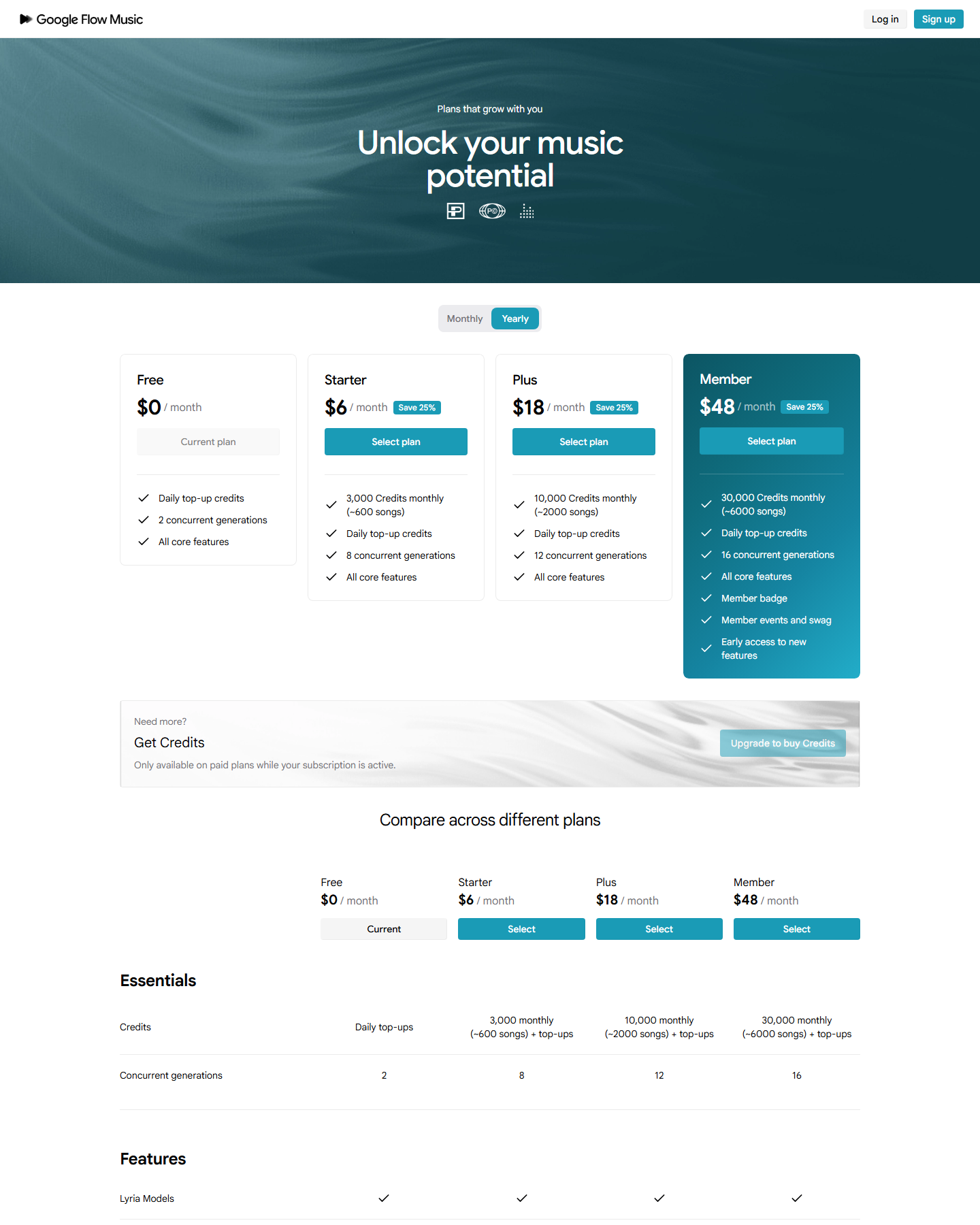
Pricing is credit-based across four plans. Free gives daily top-up credits, 2 concurrent generations and all core features. Billed yearly, Starter is $6/month for 3,000 credits a month (about 600 songs) and 8 concurrent generations; Plus is $18/month for 10,000 credits (about 2,000 songs) and 12 concurrent generations; Member is $48/month for 30,000 credits (about 6,000 songs) and 16 concurrent generations, plus a member badge, exclusive events, exclusive merch and early feature access. Every paid tier carries a Save 25% badge against monthly billing, and every tier including Free receives daily top-up credits. Extra credits can be bought, but only on a paid plan while the subscription is active.
One gap worth knowing: Flow Music publishes no product-specific legal terms. Both the Privacy and Terms links in its own footer resolve to Google's blanket policies at policies.google.com, so questions a musician actually cares about — who owns a generated track, whether it can be used commercially, whether your prompts and uploads train the model, and how to opt out — are not answered by a Flow Music document.
Screenshots
Pricing
Four plans, credit-based, with a Monthly/Yearly toggle. Billed yearly (each paid tier badged Save 25%): Free at $0/month with daily top-up credits, 2 concurrent generations and all core features; Starter at $6/month for 3,000 credits monthly (~600 songs), daily top-up credits and 8 concurrent generations; Plus at $18/month for 10,000 credits monthly (~2,000 songs), daily top-up credits and 12 concurrent generations; Member at $48/month for 30,000 credits monthly (~6,000 songs), daily top-up credits, 16 concurrent generations, a member badge, exclusive events, exclusive merch and early feature access. The Save 25% badge implies monthly-billing rates of roughly $8, $24 and $64 for Starter, Plus and Member.
Additional credits can be purchased as top-ups, but Google states this is "only available on paid plans while your subscription is active". Google AI Plus, Pro and Ultra subscribers receive Flow Music credits matched to their subscription tier. Downloads in mp3, wav and m4a are advertised as free and unlimited.
| Tier | Monthly price | What it includes |
|---|---|---|
| Free | Free | $0/month. |
| Starter | $6/mo | $6/month billed yearly (Save 25%; about $8/month billed monthly). |
| Plus | $18/mo | $18/month billed yearly (Save 25%; about $24/month billed monthly). |
| Member | $48/mo | $48/month billed yearly (Save 25%; about $64/month billed monthly). |
Feature Comparison by Tier
| Feature | Free | Starter | Plus | Member |
|---|---|---|---|---|
| Price (billed yearly) | $0/month | $6/month | $18/month | $48/month |
| Yearly saving | — | Save 25% | Save 25% | Save 25% |
| Monthly credits | Daily top-ups only | 3,000 (~600 songs) + top-ups | 10,000 (~2,000 songs) + top-ups | 30,000 (~6,000 songs) + top-ups |
| Daily top-up credits | ✓ | ✓ | ✓ | ✓ |
| Concurrent generations | 2 | 8 | 12 | 16 |
| All core features | ✓ | ✓ | ✓ | ✓ |
| Lyria models | ✓ | ✓ | ✓ | ✓ |
| Downloads (mp3, wav, m4a) and stem split | ✓ | ✓ | ✓ | ✓ |
| Buy extra credits | — (paid plans only, while active) | ✓ | ✓ | ✓ |
| Member badge, exclusive events and merch | — | — | — | ✓ |
| Early feature access | — | — | — | ✓ |
Key Features
- Lyria 3.5 full-length song generation: Google calls Lyria 3.5 "our latest frontier music model" and pitches it on full-length songs with rich musicality and dynamic vocals rather than the short clips earlier Lyria versions produced.
- Conversational Producer agent: Chat with a co-producer "just like you're in a studio": describe what you want changed in plain language and go deep on any detail, with no music-theory knowledge or DAW skills required.
- Veo-powered AI music videos: Music videos are generated with the latest Veo video model, where you control the characters, aesthetics and every detail — Google's framing is "no camera crew needed".
- Stem split and free unlimited downloads: Tracks can be split into stems and downloaded as mp3, wav or m4a; the landing page advertises "free unlimited downloads", so the credit system meters generation rather than export.
- Publishing, playlists and discovery: Flow Music is a place to release as well as create: build playlists, publish your songs, follow artists and get a daily discovery feed, all inside the same product.
- Concurrency scales with the plan: Concurrent generations are the practical throughput limit and rise from 2 on Free to 8 on Starter, 12 on Plus and 16 on Member — the difference between iterating one idea at a time and exploring a batch.
Pros
- Full-length songs on Lyria 3.5 with conversational direction, so a usable track can come out of plain-language instructions without any music theory or DAW skill
- Downloads are free and unlimited in mp3, wav and m4a, and stem splitting is included — the credits meter generation rather than taxing you again on export
- The free tier is a real product, not a teaser: daily top-up credits, 2 concurrent generations and all core features, with no card required to start
- It is a release surface as well as a studio — playlists, publishing, artist follows and a discovery feed — and Google AI Plus, Pro and Ultra subscribers get Flow Music credits folded into a subscription they may already hold
Cons
- No product-specific legal terms at all. Both the Privacy and Terms links in Flow Music's own footer redirect to Google's blanket policies at policies.google.com, so ownership of a generated track, commercial-use rights, and whether your prompts and uploads train the model are not answered by any Flow Music document
- Credit top-ups are locked to an active paid subscription — Google states they are "only available on paid plans while your subscription is active" — so a free user who runs dry waits for the daily allowance rather than paying to continue
- Concurrency, not just credits, is what the plan buys: 2 simultaneous generations on Free and 8 on Starter make batch exploration slow until the $18 or $48 tiers
- Android is still absent; the product ships on web and iOS only, while Suno and Udio both have Android apps
- Monthly credit allotments do not roll over, so a producer with uneven output pays for the peak month every month or tops up
Data Handling
- Training-data policy
- Flow Music publishes no product-specific privacy notice or terms of service. Both the Privacy and Terms links in its own footer resolve to Google's blanket policies at policies.google.com/privacy and policies.google.com/terms, which do not address music generation, prompt and upload handling, or ownership of a generated track. As a result there is no Flow Music document stating whether user prompts, uploads or generated music are used to train Google's models, whether an opt-out exists, how long audio is retained, or what commercial rights a subscriber holds over the output — questions that matter more here than in most categories, because the output is intended for release. Anyone planning commercial use should get those answers in writing before building on it. SynthID watermarking of generated media is Google's stated practice across its generative products, but Flow Music's own pages do not claim it.
- Compliance
- None specific to Flow Music. The product inherits Google's general Privacy Policy and Terms of Service; SynthID watermarking of Google-generated media is a Google-wide practice but is not stated on Flow Music's own pages.
Frequently Asked Questions
What does Google Flow Music actually cost?
Google Flow Music offers a free tier plus three paid plans: Starter at $6/month annual ($7.99 monthly) for 3,000 credits (about 600 songs), Plus at $18/month annual ($24.99 monthly) for 10,000 credits, and Member at $48/month annual ($64 monthly) for 30,000 credits. Credits reset monthly with no rollover. Google AI Plus, Pro, and Ultra subscribers get Starter, Plus, and Member tier credits bundled into their existing subscription.
What do you get on Google Flow Music's free tier?
A Google account is all the free tier asks for, with no card involved. It carries a starting credit allocation for song generation, smaller than any paid plan, plus full access to the Gemini Producer agent for composing and editing. Higher-concurrency generation and member-exclusive features stay behind the paid plans.
What should you use instead of Google Flow Music?
Suno and Udio sit nearest. Suno holds the largest community library and strong lyric generation, but has no granular section editing and trails Lyria 3 Pro on complex arrangements. Udio's licensing deals with Universal Music Group and Warner Music Group let it generate in real artists' styles with permission, which Google Flow Music does not do.
Google Flow Music or Suno: which should you pick?
Both platforms lead the 2026 AI music field, and they diverge on capability. Lyria 3 Pro's hierarchical attention holds together better on complex, multi-instrument arrangements, while Suno stays stronger on straightforward pop vocals. Google Flow Music also generates AI music videos through Gemini Omni Flash, which Suno does not, though Suno ships an Android app that Google Flow Music lacks.
How do you set up Google Flow Music?
Sign in at flowmusic.app with a Google account, since the free tier asks for no payment. Describe the song to the Gemini Producer agent in plain language, covering genre, mood, tempo, and any lyrics, and it returns a full track. Refine individual sections with natural-language edits from there, or export the song as it stands.
Top Alternatives
- Suno: Suno brings the large established community and easier lyric control; Google Flow Music answers with granular section editing and Lyria 3 Pro audio quality.
- Udio: Udio holds UMG and WMG licensed artist-style generation, while Google Flow Music leans on Google ecosystem integration and the Gemini production agent.
- Midjourney: Midjourney generates images, whereas Google Flow Music generates original audio tracks and AI music videos under conversational direction.
- Riffusion: Riffusion became Google Flow Music in April 2026 through Google's acquisition, the same product with Lyria 3 Pro in place of the original Stable Diffusion model.