
Last updated: 2026-09-16
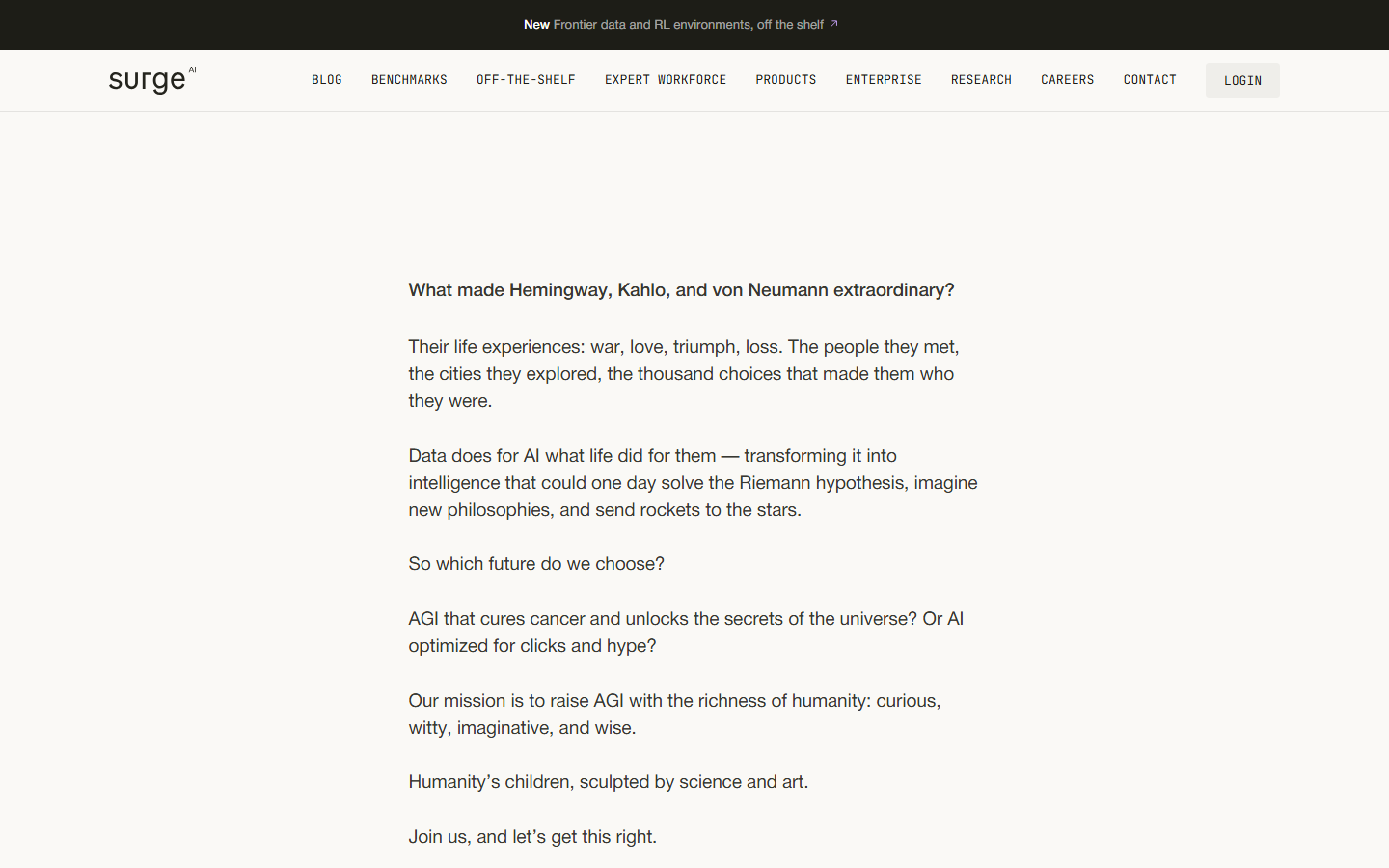
Surge AI is a human-annotation and RLHF platform used by Anthropic, OpenAI, and Google to train frontier models. It states its expert network spans 200,000+ PhD holders across 500+ disciplines and 80+ languages, distinguishing it from bulk crowd-labeling platforms like Appen. It built OpenAI's GSM8K math benchmark and, in 2026, Meta's AdvancedIF instruction-following benchmark.
About Surge AI
Surge AI is a human data labeling and RLHF platform built by Edwin Chen in San Francisco in 2020. The company supplies expert-annotated training data and reinforcement learning from human feedback services to leading AI labs, including Anthropic, OpenAI, Google, Meta, Microsoft, and Amazon. Its named clients concentrate among the largest US labs rather than the wider frontier-model field that also trains models at Mistral AI, xAI and Cohere. Without external investment, Surge reached $1.2 billion in annual revenue by 2024, one of the fastest bootstrapped companies in history to hit that milestone with fewer than 110 employees.
Engineers design annotation tasks through a drag-and-drop web interface or the Python SDK (pip install surge-api), setting skill requirements such as native-speaker linguists or PhD-level STEM researchers. Surge's own site states its expert network spans over 200,000 PhD holders across 500+ academic disciplines and 80+ languages. Quality is tracked through gold-standard accuracy scores, inter-annotator agreement metrics, and per-worker trust ratings, with low-quality labels automatically reassigned. The platform runs on the web and via API only, with no desktop or mobile apps.
Surge specializes in the hardest tier of RLHF work: preference ranking, red-teaming, reward model training, and safety annotation for large language models. It built GSM8K, the 8,500-question math reasoning benchmark OpenAI paid $1.2 million for, and in 2026 partnered with Meta Superintelligence Labs on AdvancedIF, a 1,600-prompt instruction-following benchmark with expert-written scoring rubrics; the study found frontier models failing 22-30% of complex instruction-following tasks. This focus on expert, domain-specific annotators, rather than generic crowd workers, is what separates Surge from bulk platforms like Appen and puts it alongside data-infrastructure peers such as Hugging Face and Databricks in HokAI's data science and ML tools category. The labs it serves ship widely used model families — Anthropic's Claude Opus 5 and Claude Sonnet 5, OpenAI's GPT-5 — that depend on large-scale RLHF for alignment and instruction-following.
As of September 2026, Surge remains fully independent: no external funding round has closed. Talks that began in July 2025 reportedly value the company between $15 billion and $25 billion, structured to include both new capital and a secondary sale of existing shares, according to Bloomberg.
Screenshots
Pricing
Custom enterprise pricing only. No public tiers, no free tier, no self-serve signup. Pricing is determined by task complexity, required domain expertise, language requirements, annotation speed, and volume.
Flat per-label fee with no platform setup costs. ai for a quote; Mercor runs a marketplace-based alternative if a per-expert rate card is preferred over a managed per-label engagement.
Key Features
- RLHF Pipeline Support: Runs full RLHF pipelines including preference ranking, demonstration data collection, and reward model training for foundation model labs building conversational assistants.
- Expert Annotator Matching: Engineers specify skill requirements such as native-Spanish legal specialists or PhD-level mathematicians, matched against a large vetted global annotator network spanning dozens of languages and academic disciplines.
- Real-Time Quality Monitoring: Dashboards track gold-standard accuracy, inter-annotator agreement scores, and per-worker trust ratings continuously, with low-quality labels auto-reassigned to higher-rated workers.
- Python SDK and REST API: The surge-api Python library (pip install surge-api) lets engineers create projects, bulk-upload tasks via CSV, retrieve results programmatically, and integrate annotation into ML training pipelines.
- Safety Annotation and Red-Teaming: Supports safety evaluation workflows including toxicity filtering, harmful content labeling, and adversarial red-team data generation, used for large language model safety training.
- Instruction-Following Research: Working with Meta Superintelligence Labs, Surge produced AdvancedIF: a rubric-based study finding that frontier models fail 22-30% of complex instruction-following tests, and that scoring rubrics used as reinforcement-learning reward signals lift accuracy by 13%.
Pros
- Proven at frontier scale: Anthropic, OpenAI, Google, and Meta all route their most demanding RLHF tasks through Surge, making it the best-validated option for production-grade AI training data.
- Expert annotator pool spans dozens of languages and PhD-level specialists, delivering annotation quality that generic crowd platforms like Mechanical Turk cannot match.
- Flat per-label fee structure with no platform setup costs or seat fees, which simplifies cost modeling once a contract is in place for high-volume annotation work.
- Grew to frontier-lab scale on its own capital rather than venture funding, which reviewers cite as evidence of operational discipline over investor-driven growth pressure.
Cons
- No public pricing: all quotes are custom enterprise agreements, making budget comparison against Mercor or Labelbox impossible without going through a full sales process.
- No free trial or self-serve tier: teams cannot test the platform independently; onboarding requires direct contact with sales, adding weeks to procurement cycles.
- Selective annotator vetting means task coverage for very niche domains or underrepresented languages may be limited compared to larger bulk crowd-labeling platforms like Appen.
- Scale AI's Meta-linked ownership tie-up shifted some clients toward Surge, but Surge faces a similar vendor-lock-in question as its own valuation talks progress.
Data Handling
- Training-data policy
- Does not retain or train on client datasets; all annotation work processed under NDA with strict data isolation per client project.
- Compliance
- GDPR
Frequently Asked Questions
How much does Surge AI cost in 2026?
Surge AI publishes no price list; every engagement is a custom enterprise contract priced by task complexity, language coverage, required annotator expertise, and data volume. Billing runs as a flat per-label fee with no separate platform or seat costs. There is no self-serve checkout, so a quote requires contacting Surge's sales team directly at surgehq.ai.
Does Surge AI have a free plan?
No. Surge AI has no free tier, trial, or self-serve signup; every account begins with a sales conversation, an NDA, and a security questionnaire. Teams with a small budget typically start on Label Studio, a free self-hosted annotation tool, then move to Surge once volume justifies an enterprise contract.
What are Surge AI's closest competitors?
Mercor is the closest match on model: think of it as a staffing marketplace for the same frontier-lab RLHF work, whereas Surge runs the annotation platform itself. Labelbox is the strongest pick for regulated industries, carrying SOC 2, HIPAA, and ISO 27001 certifications Surge doesn't publish. Appen suits lower-complexity, high-volume labeling where Surge's expert vetting isn't needed, and Prolific fits small research budgets with self-serve academic crowdsourcing.
What separates Surge AI from Scale AI?
Both run on custom enterprise pricing with no public tiers, but Scale AI's Meta ownership tie-up pushed data-neutrality-conscious labs like Google and Microsoft toward Surge instead. Surge's more curated annotator pool is generally regarded as stronger for preference-ranking and alignment work, while Scale AI's larger operation covers higher-volume computer-vision labeling better.
What does it take to start using Surge AI?
Start by contacting Surge's sales team through surgehq.ai; there is no signup form. A discovery call defines the task type, required expertise, data volume, and timeline before a custom quote is issued. Once under contract, engineers access the platform through the web dashboard or the surge-api Python SDK.
Top Alternatives
- Hugging Face: Hugging Face gives away free pre-labeled public datasets and open-source model tooling; Surge AI instead sells expert-vetted human annotators for frontier RLHF work.
- Databricks: Databricks runs the unified lakehouse for training-data pipelines and ML engineering at scale; Surge AI is the human-labeling layer feeding quality RLHF data into that pipeline.
- Mercor: Mercor connects AI labs directly to individual freelance domain experts on a marketplace model; Surge instead runs a fully managed annotation platform, from task tooling through quality scoring.
HokAI guides covering Surge AI
- The Best AI Tools for Data Science in 2026: Two Different Buys, Not One List: Data science and AI analytics tools get lumped into one list, but they solve different problems. See the real split, six vetted picks, and 2026 pricing.