
Last updated: 2026-09-17
Huggle is an AI workspace that turns one written request into an editable artifact across eight categories: code, images, video, documents, spreadsheets, presentations, LaTeX papers, and databases. Its agent follows a Request, Build, Deliver workflow, researching the topic and drafting the file before handing back something to revise, rather than raw chat text.
About Huggle
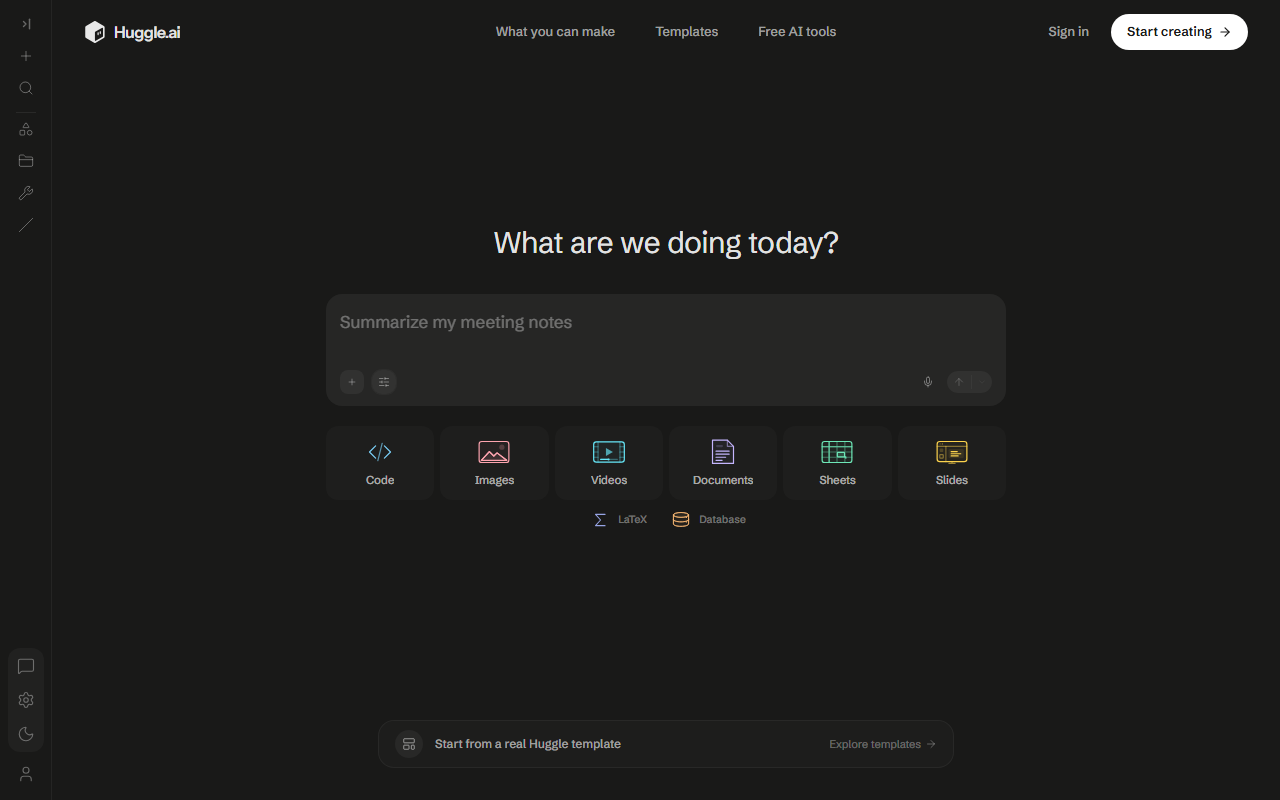
Huggle is an AI workspace that turns a plain-language request into a finished, editable work product instead of a chat transcript. The product's own tagline describes it as "finished work, not raw output": rather than pasting AI text into a separate word processor or slide tool, users describe an outcome, optionally attach notes or a template, and Huggle researches, plans, and writes the actual file. Its request composer offers eight starting categories: Code, Images, Video, Documents, Sheets, Slides, LaTeX, and Database. A free plan needs no credit card to start.
The workflow runs in three stages the product calls Request, Build, and Deliver. During Build, an agent researches the topic (the vendor's own example shows it pulling regional gym referral benchmarks for a growth proposal), drafts the artifact, and hands back a working file rather than raw generated text. Within Build, a request can choose a quicker draft or a deeper pass, named Flash and Max, and every paid plan bundles multiple frontier AI models rather than billing per vendor, a different approach from single-model tools like Gamma.
Huggle targets students and researchers writing papers and reports, consultants building proposals and strategy documents, marketers assembling decks and campaigns, and operators running databases and financial models. Its ready-made template library covers six of the eight categories, documents, spreadsheets, presentations, websites, LaTeX, and databases, from a SaaS cash-flow model and a freelance invoice tracker to a startup pitch deck and an undergraduate thesis; Code, Images, and Video are generated from a blank request rather than a template. Beyond the core workspace, Huggle also publishes a free bank of 11 citation generators (APA, MLA, IEEE, and others) plus standalone thesis-statement and abstract tools.
Pricing spans a free plan and four paid tiers, each pairing a monthly rate with a discounted annual rate and a bundled usage-credit allowance that grows tier by tier; exact rates and credit amounts are covered in the pricing FAQ below. The product is web-only at the time of this review.
Huggle positions itself against presentation-first tools like Gamma, arguing that a usable first artifact beats raw model output copied into a separate editor. Among broader autonomous agents, Genspark takes an open-ended research-agent approach. Manus leans toward long-horizon autonomous execution rather than a defined file. Huggle also overlaps at the edges with app builders such as Lovable, since websites and apps are among its eight artifact categories. It sits in HokAI's Agents and Automation directory group.
Screenshots
Pricing
Free needs no card and includes a starter usage allowance. The four paid tiers are Flash, Starter, Pro, and Ultra: Flash launches at $10/month (list price $25), Starter runs $20/month or $200/year and carries $35 of monthly credit (marked Popular), Pro runs $40/month or $400/year with $60 of monthly credit, and Ultra runs $100/month or $1,000/year with $120 of monthly credit. Every paid tier bundles multiple frontier AI models, with a Flash option for speed and a Max option for depth chosen per request.
| Tier | Monthly price | What it includes |
|---|---|---|
| Free | Free | |
| Flash | $10/mo | |
| Starter | $20/mo | |
| Pro | $40/mo | |
| Ultra | $100/mo |
Key Features
- Eight-category artifact generation: The request composer starts a Code, Image, Video, Document, Sheet, Slide, LaTeX, or Database artifact from one written request instead of chat text.
- Three-stage Request, Build, Deliver workflow: An agent researches the topic, plans the structure, and writes the file before handing back an editable artifact rather than raw model output.
- Flash and Max generation speeds: Every request can run on the faster Flash tier or the deeper Max tier, selectable per request rather than locked to the subscription plan.
- In-place revision before export: Finished artifacts stay editable in the workspace so structure, content, and formatting can be revised before exporting, sharing, or publishing.
- Multi-format export: Documents export to PDF, DOCX, Google Docs, or Markdown directly from the workspace.
- Template library for six categories: Ready-made templates cover websites, documents, spreadsheets, presentations, LaTeX, and databases, including a SaaS cash-flow model and a startup pitch deck.
- Database views for structured work: Generated databases include Kanban and grid views for use cases like a CRM, content calendar, or applicant tracker.
- Free citation and LaTeX utilities: A separate free tools page offers 11 citation-style generators (APA, MLA, Chicago, IEEE, Harvard, and others), a LaTeX table generator, and a BibTeX generator with no account required.
Pros
- A no-card-required free tier makes it inexpensive to trial before committing to a paid credit plan.
- One credit pool covers all eight artifact categories, so switching from a deck to a spreadsheet or an image mid-project does not require a second subscription.
- Access to multiple frontier AI models is bundled into every paid plan instead of billed per model vendor, unlike tools that charge separately for GPT- or Claude-class access.
Cons
- No public API or MCP server was found, so Huggle cannot be wired into an existing agent pipeline or automation tool the way API-first competitors can.
- No SOC 2, GDPR, HIPAA, or ISO 27001 attestation is published, which limits its fit for procurement-heavy enterprise buyers.
- No independent review coverage on G2, Trustpilot, or Product Hunt was found as of September 2026, so quality and reliability claims rest on the vendor's own marketing pages.
- Web-only; no desktop or mobile app was found, so there is no offline editing.
Frequently Asked Questions
What are Huggle's pricing plans in 2026?
Pricing starts at Free with a limited allowance, then climbs through four paid plans. Flash costs $10 a month, a launch discount off the $25 list price. Starter is $20 a month, or $200 billed yearly, and comes with $35 in monthly credit. Pro sits at $40 a month ($400 yearly) with $60 of credit, and Ultra tops out at $100 a month ($1,000 yearly) with $120 of credit included.
Does Huggle have a free plan?
Yes. The Free plan needs no credit card and gives a starter usage allowance across every artifact category: documents, spreadsheets, presentations, websites, LaTeX, databases, images, video, and code. It is meant for trying the product before committing to a paid credit allowance.
What are Huggle's closest competitors?
Gamma and Tome cover AI-generated slide decks rather than a full mixed-format workspace. Genspark and Manus lean toward a broader autonomous research agent rather than editable document, deck, and spreadsheet output. Lovable is built around a functioning web app rather than a document or presentation.
How does Huggle compare to Gamma in 2026?
Gamma focuses on presentations and simple web pages with fast, template-driven layouts. Huggle covers a wider set of artifact categories (spreadsheets, LaTeX research papers, code, and structured databases in addition to decks and documents) and adds a research step before drafting, but it has no independent review coverage yet, while Gamma is a more established, widely reviewed product.
How do you get started with Huggle?
Create a free account, no credit card needed, describe the outcome you want in plain language, and optionally attach notes, data, or a template. The agent researches the topic, drafts the artifact, and hands back an editable file you can revise before exporting to PDF, DOCX, Google Docs, or Markdown.
Top Alternatives
- Gamma: Pick Gamma for fast AI-generated slide decks and simple web pages; choose Huggle when the project also needs spreadsheets, LaTeX papers, or a database in the same workspace.
- Genspark: Choose Genspark when the job calls for a broad autonomous research agent; pick Huggle when the output itself needs to be an editable document, deck, or spreadsheet.
- Manus: Pick Manus for open-ended, long-horizon autonomous tasks; choose Huggle for a defined document, presentation, or spreadsheet meant to be edited afterward.
- Lovable: Choose Lovable when the goal is a working web app; pick Huggle when the goal is a document, deck, spreadsheet, or research paper instead.
- Tome: Pick Tome for a narrative, AI-generated presentation deck; choose Huggle when the deliverable also needs to span spreadsheets, code, images, or a database.