
Veo 3.1 is Google DeepMind's flagship video model, generating clips up to 8 seconds long and replacing Veo 3 as the default engine across the Gemini app, API, Vertex AI and Flow. It bills per second rather than per token, with a lower-cost Fast tier and an even cheaper Lite tier added in 2026.
Veo 3.1 is Google DeepMind's video generation model, released October 15, 2025, producing 4, 6 or 8-second clips with native synchronized dialogue, sound effects and ambient audio at up to 4K resolution. Its Ingredients-to-Video feature holds a character or object consistent across reference images.
Provider: Google DeepMind · Family: Veo 3
More about Google DeepMind on HokAI
Input modalities: text, image · Output: video, audio
About Veo 3.1
Google DeepMind released Veo 3.1 on October 15, 2025 as a direct upgrade to Veo 3, which had launched that May. It runs on a latent diffusion transformer architecture: a video and audio encoder compresses raw footage into a shared latent space, and a transformer-based denoising network reconstructs it from noise during generation. Google has not disclosed a parameter count for any Veo model. Veo 3.1 sits at the top of the current Veo line, above two lower-cost siblings built on the same base, Veo 3.1 Fast and Veo 3.1 Lite.
Google DeepMind's own comparison claims put Veo 3.1 ahead of rival video models on the MovieGenBench and VBench evaluations for overall human preference, text alignment and visual quality. Independent trackers complicate that picture: Kuaishou's Kling v3 sat atop the Artificial Analysis Video Arena leaderboard as autumn 2026 opened, with Alibaba's Happy Horse 1.0 and ByteDance's Seedance 2.0 Fast close behind, and reviewers commonly summarize the field as Sora 2 winning on physics simulation, Veo 3.1 winning on rendering quality and native audio, and Kling 3.0 winning on price-to-quality ratio. No lab publishes a single numeric score for video models that lines up with LLM benchmarks like MMLU or SWE-bench, so none is reported here.
Each generation call produces one clip of 4, 6 or 8 seconds, set through the API's duration parameter. Google's own documentation requires the longest duration setting whenever a request uses video Extension, reference images, or steps up past the base resolution tier, and Extension itself is restricted to the base tier only. The native ceiling is 8 seconds per call, but Flow's Extend tool can chain further continuations onto the tail frame of an existing clip, and multiple third-party Veo 3.1 guides describe reaching well over a minute of continuous footage this way; Google does not publish an official maximum chain length.
Veo 3.1 accepts text prompts and images as input. An image can set the starting frame, the ending frame through the lastFrame parameter for interpolation between two shots, or one of several reference images through referenceImages, Google's Ingredients-to-Video feature, to hold a character, object or style consistent across a scene. Output is a single video file with native audio built in: dialogue, sound effects and ambient noise generated to match on-screen action and lip movement rather than layered on afterward. Flow adds scene extension, camera controls, outpainting and object insertion or removal on top of the base model. There is no tool-calling, code execution or text chat mode; Veo is a video generation endpoint, not a conversational model, and Google's own model reference caps prompt text at 1,024 tokens.
Google charges by the second of finished video rather than by token, split across the Standard, Fast and Lite tiers by resolution and rendering speed; the exact per-second rates are in the pricing section below. There is no free tier on the paid API itself. A separate consumer allowance inside Google Vids, which Google introduced in spring 2026 alongside a soundtrack feature built on Lyria, its own music-generation model, hands any Google account a modest number of complimentary Veo 3.1 generations every month, though that allowance never extends to API or Vertex AI usage.
Veo 3.1 (model ID veo-3.1-generate-preview) and Veo 3.1 Fast (veo-3.1-fast-generate-preview) are both still labeled preview in Google's own API reference, even though both are billed and generally accessible. They're reachable through the Gemini API, Google AI Studio, and Vertex AI for enterprise customers, plus the consumer-facing Gemini app, Flow, Vids and Workspace. There is no self-hosted or open-weight distribution; every request runs on Google's infrastructure, and every output carries an invisible SynthID watermark that survives cropping, compression and re-encoding, checkable through Google's own verification tool.
Content filters block prompts depicting real public figures without consent, along with violence, sexual content, hate speech and the other categories covered by Google's Generative AI Prohibited Use Policy. Likeness use is meant to be consent-based, so guidance for prompts referencing real faces, logos, news footage or branded audio recommends substituting fictionalized or generic elements. For any of its paid AI services, Google says it will not use customer content to improve its models by default, a policy that covers Veo along with its other generative products, and that abuse-monitoring logs plus generated video files are each kept for only a short, limited window before deletion.
Veo 3.1 fits teams that need synchronized dialogue and sound effects built into the generation itself rather than added in post, and that need a consistent character or product across several shots via reference images. It is a weaker fit for anyone needing more than a single short clip of native footage, exact physics fidelity, where reviewers rate Sora 2 ahead, the lowest possible cost per clip, where Chinese rivals now undercut it, or open-weight self-hosting, since no Veo tier has an open release.
Veo debuted at Google I/O in May 2024 with high-definition output; Veo 2 followed that December with 4K and improved physics understanding; Veo 3 arrived in May 2025 as the first version with native synchronized audio, which Google DeepMind CEO Demis Hassabis described as AI video's exit from the silent film era. Veo 3.1 shipped that October with richer audio and the current Ingredients-to-Video, Frames-to-Video and Extend toolset. Google broadened 4K output and added native vertical generation to the Gemini API early in 2026, and Veo 3.1 Lite followed a few months later as the cheapest tier yet. As of this writing Google has not announced a Veo 4: its newer multimodal creation work is branded Gemini Omni, whose first version, Gemini Omni Flash, shipped as a related but separately branded product.
Screenshots
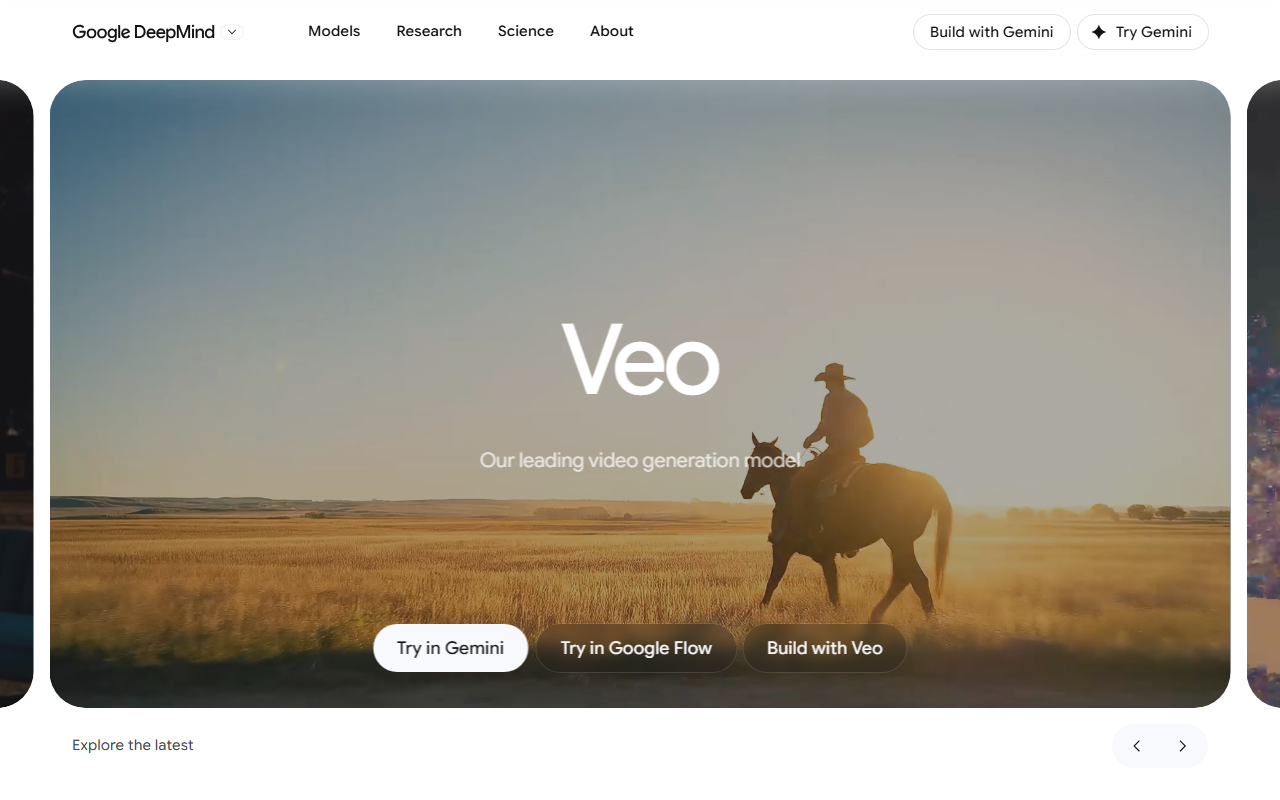
Pricing
Billed per second of output, not per token, split across three tiers by resolution and rendering speed (see the table below for exact rates). No free tier on the paid API. Google Vids, a separate consumer surface launched 2026-04-02, gives any Google account 10 free Veo 3.1 generations per month; that allowance does not apply to API or Vertex AI billing. Source: Google's Gemini API pricing page, verified 2026-09-26.
| Tier | Rate |
|---|---|
| Veo 3.1 Standard | 720p/1080p $0.40/sec, 4K $0.60/sec. Audio included. |
| Veo 3.1 Fast | 720p $0.10/sec, 1080p $0.12/sec, 4K $0.30/sec. |
| Veo 3.1 Lite | 720p $0.05/sec, 1080p $0.08/sec, no 4K. |
Key Features
- Native Audio Generation: Generates synchronized dialogue, sound effects and ambient noise in the same pass as the video, matching lip movement and on-screen action rather than adding a separate audio track.
- Ingredients to Video: Accepts several reference images to hold a character, product or visual style consistent across a generation, via the referenceImages API parameter.
- Frames to Video and Extend: Interpolates between a starting and ending frame with the lastFrame parameter, or chains additional footage onto an existing clip's tail frame through Flow's Extend tool.
- Up to 4K Output, Landscape or Vertical: Renders in either landscape or native vertical aspect ratio at the top resolution tier, useful for Shorts and Reels without a separate upscale pass.
- SynthID Watermarking: Every output carries an invisible, compression-resistant SynthID watermark that can be checked through Google's verification tool.
Pros
- Bundles native synchronized audio into the same generation pass as the video, with no separate voiceover or sound-effects step.
- Ingredients-to-Video keeps a character or product consistent across several reference images in one call.
- Ships in three priced tiers, Standard, Fast and Lite, so cost can be matched to the job and the required resolution.
Cons
- Every generation caps out quickly; longer footage requires chaining separate calls through Flow's Extend tool.
- The higher resolution tiers, Extension and reference images all force the same longer fixed duration, and Extension itself only renders at the base tier.
- No open-weight or self-hosted release exists at any tier; every request runs on Google's own infrastructure.
- Neither a seed nor a negativePrompt parameter is documented for Veo 3.1, unlike the original Veo 3 API.
Frequently Asked Questions
How much does Veo 3.1 cost per second of video?
On the Gemini API and Vertex AI, Google bills per second of output rather than per token: the Standard tier costs $0.40 per second at 720p or 1080p and $0.60 per second at 4K, with audio included in that price. Veo 3.1 Fast drops to $0.10 per second at 720p, $0.12 at 1080p or $0.30 at 4K, and Veo 3.1 Lite is the cheapest at $0.05 per second at 720p or $0.08 at 1080p, with no 4K tier. There's no free tier on the paid API, though Google Vids gives any Google account 10 free generations a month outside of API billing.
Is Veo 3.1 better than Sora 2 or Kling?
It depends on the axis. Google DeepMind's own materials credit Veo 3.1 with the top score on the MovieGenBench and VBench evaluations for preference, alignment and visual quality, and testers widely call its audio the strongest of the three labs. Yet on the Artificial Analysis Video Arena leaderboard, Kuaishou's Kling v3 held the top spot heading into autumn 2026, and the community consensus rates Sora 2 stronger on physics and Kling plus ByteDance's Seedance stronger on value for money. No single model wins every category.
Is Veo 3.1 open source, and where can you access it?
No. Veo 3.1 is fully proprietary and closed-weight, with no self-hosted or downloadable version at any tier. You can reach it through the consumer Gemini app, Flow and Vids, or as a developer through Google AI Studio, the Gemini API and Vertex AI for enterprise accounts; both API model IDs, veo-3.1-generate-preview and veo-3.1-fast-generate-preview, are still labeled preview as of this writing.
Does Google train on the videos and images you generate with Veo 3.1?
Not on paid usage. Google states that content submitted through its paid AI services, including prompts, uploaded images and generated output, is not used to improve its models by default. It keeps a short abuse-monitoring log purely to check for Prohibited Use Policy violations, and finished video files sit on its servers for only a couple of days before automatic deletion if you never download them.
Who should use Veo 3.1, and who should look elsewhere?
It suits teams that want synchronized dialogue and sound effects generated in the same pass as the video, and that need a character, product or style held consistent across shots via reference images. It's the wrong pick if you need a single continuous shot longer than the native limit, the rock-bottom cost per clip that some Chinese rivals now offer, physics-accurate simulation, or any form of self-hosting, since no open-weight release exists.