What Parcel Perform Is Actually For
Parcel Perform is a Singapore-founded delivery-experience platform serving 3,000-plus e-commerce brands across 1,100-plus carriers, including Nespresso and TikTok Shop. Its AI Decision Intelligence engine automates shipment alerts and returns nudges, and its AI Commerce Visibility module, launched October 29, 2025, tracks brand mentions across ChatGPT, Gemini, Perplexity and five other AI platform
The short version
Buy Parcel Perform once carrier count and support-ticket volume have outgrown spreadsheets, not before. It fits large, multi-carrier e-commerce operations willing to accept quote-based pricing and a multi-month rollout in exchange for automated exception handling and, since October 2025, visibility into how AI shopping assistants describe the brand.
On October 29, 2025, Parcel Perform's CEO announced that 39 percent of consumers now use AI to research products before buying, and that his logistics company had built a tool to track it.
That tool, AI Commerce Visibility, is not really a tracking feature. It is the clearest signal yet of what Parcel Perform actually sells underneath the carrier dashboards: enterprise-priced intelligence software built for brands complicated enough to need it. For an operations lead deciding whether to buy in, the launch answers a question the marketing rarely states outright: exactly who this company is for, and who it quietly is not.
What AI Commerce Visibility actually tracks
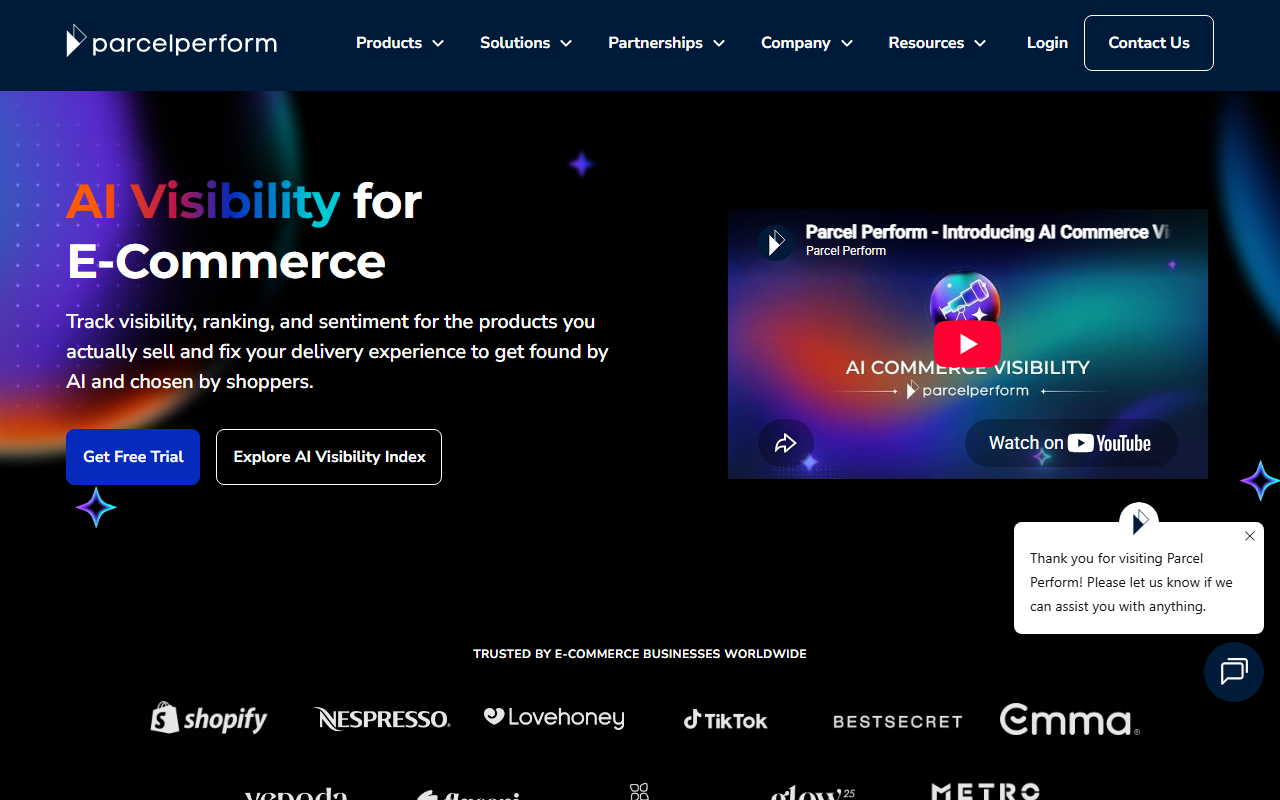 Parcel Perform's AI Commerce Visibility page, captured 20 Aug 2026. The module launched October 29, 2025 and tracks brand visibility across eight AI shopping platforms.
According to the product page, the new module scores a brand across four dimensions: visibility, product ranking, channel attribution, and trust signals, then benchmarks the result against named competitors. The system runs 100 to 200 prompts per brand automatically during setup, refreshing weekly to match how often large language models update their answers. Coverage spans eight platforms, ChatGPT, Gemini, Perplexity, Google AI Overviews, Claude, Microsoft Copilot, DeepSeek, and Grok, according to the October 29, 2025 press release announcing the launch.
Pricing breaks from the rest of the product line on purpose. The core platform, tracking 1,100-plus carriers across 3,000-plus brands including Nespresso and TikTok Shop, is quote-only, with no public tiers, priced by shipment volume. The AI visibility module instead runs on usage-based credits, sold per prompt with no monthly subscription and no paywalls by feature, region, or platform. That is a self-serve pricing model bolted onto an enterprise sales motion. Whether it stays that way once the credits start meaning real revenue is worth watching.
Parcel Perform fits a specific kind of buyer
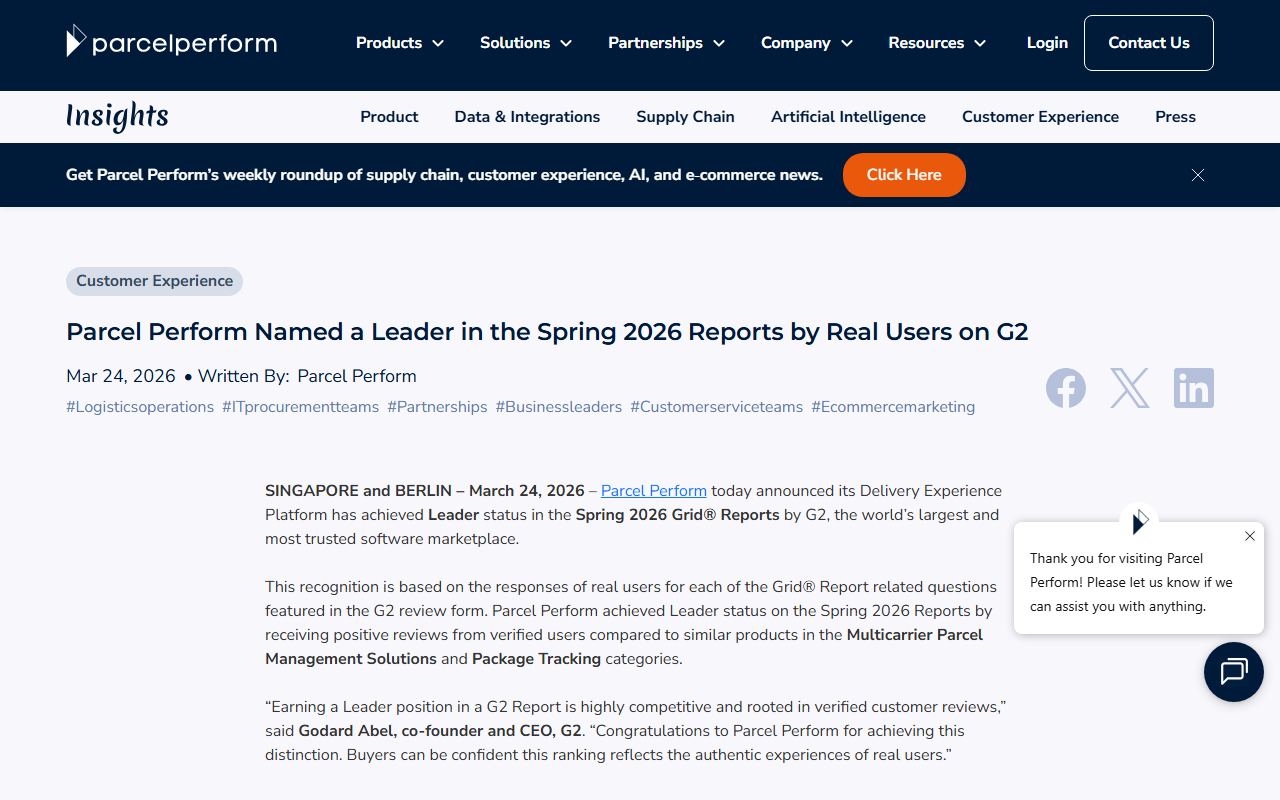 Parcel Perform's G2 Leader announcement, captured 20 Aug 2026 and dated 24 Mar 2026 on the page itself.
The company earned G2 leader status in spring 2026 for both multicarrier parcel management and package tracking, according to its own summary of the Grid report results. In the multicarrier category specifically, 100 percent of surveyed users rated the product 4 or 5 stars, giving it a perfect net promoter score, and 98 percent said they would recommend it. Those numbers describe a specific customer: a brand running enough carriers, across enough countries, that a human ops team reading spreadsheets can no longer keep up.
That is the brand this was built for. Founded in Singapore in 2016 and backed by $21.1 million in funding, the company built its AI Navigator chat interface specifically so operations and CX staff can query shipment data in plain English instead of writing SQL, a feature it says cuts analysis time by up to 90 percent.
For a brand shipping through 1,100-plus carriers in 36-plus languages, that is not a nice extra. It is the difference between a support team answering "where is my order" tickets by hand and one that gets ahead of the exception before the customer notices.
Small, single-carrier brands should look elsewhere
The same G2 data that makes the platform look strong also explains its most consistent complaint. Implementation runs about 2.4 months on average, according to G2 figures cited by competitive-analysis site ClickPost, and one verified reviewer flagged the quote-based pricing directly, saying they disliked "the cost, when the solution is tailor-made." Another reviewer noted limitations in the returns feature, though they attributed it to their own "complex return policies" rather than a product gap.
Run a single-carrier DTC brand and want a branded tracking page live this week, on a price you can see before you talk to sales? This is the wrong door. AfterShip offers self-serve setup measured in days rather than months, a transparent tiered pricing page, and tracking across 1,200-plus carriers, per its own comparison of the category. Narvar competes for the same enterprise buyer, but shares the multi-month, consultative implementation model, so switching from one to the other mostly trades vendors, not timelines.
The pricing pattern no other vendor names either
Opaque pricing is not unique to this one company. It is how enterprise vertical AI sells. Vic.ai, which automates accounts payable for enterprise finance teams, publishes no price list either, according to its own FAQ page, despite claiming 97 to 99 percent accuracy on invoice data extraction.
Tractian, an industrial predictive-maintenance platform, quotes every deployment individually too. Its own case studies report a Sherwin-Williams plant avoiding 564 hours of unplanned downtime and Ingredion saving $1 million at a single site, numbers real enough to justify a sales call but not a rate card. Zentio, a factory production-planning tool, follows the same script: a free proof-of-value period, then a quote.
None of these vendors are hiding anything. They are pricing outcomes they cannot standardize, because a 40-carrier retailer and a 4-carrier one do not cost the same to onboard. The AI visibility credits break that pattern: it is the only product here sold like software instead of like a consulting engagement. The instinct behind it is not new either. Marketers already use tools like Surfer SEO to check whether their pages get cited in AI Overviews. This is the same play, aimed at product listings instead of blog posts.
The case that this is premature
The obvious objection: a 39 percent adoption stat from a company's own chief executive, in a release announcing that same company's new product, is not independent evidence that enterprise buyers are ready to pay for AI-shopping visibility.
No outside study accompanies the figure in the materials, and neither AfterShip nor Narvar had launched a comparable product as of this writing. It is possible the new module is a retention feature dressed as a category, something existing customers get access to so their renewal feels like it is buying more than carrier tracking.
That is a fair read, and it does not change the underlying finding. The core platform is still built for, and priced for, complex multi-carrier operations. Watch whether AfterShip or Narvar ship a directly competing product by the middle of 2026. If neither does, that supports the retention-feature reading. If both do within a few months of each other, this becomes table stakes faster than the pricing model suggests, and the credit-based sale turns out to be an early entry into a fight it will not get to have alone.
The next real test is not whether ChatGPT recommends a checkout flow in Singapore or Ohio. It is whether the AI visibility module shows up as its own line item on a 2027 renewal invoice, or quietly folds into the same unpriced quote everything else here already lives inside.
Frequently asked questions
What is Parcel Perform used for?
Parcel Perform is an AI-powered delivery experience platform for e-commerce brands, tracking shipments across 1,100-plus carriers from checkout through returns. It automates exception alerts, delivery date predictions, and carrier performance benchmarking for operations and CX teams. As of October 2025, it also monitors how a brand appears in AI shopping assistants like ChatGPT and Gemini.
How much does Parcel Perform cost?
The core platform has no public pricing; it is quoted per brand based on shipment volume and selected modules. Its newer AI Commerce Visibility feature is priced differently, on usage-based credits sold per prompt with no monthly subscription. Neither model publishes a rate card, so getting an exact number requires a sales call.
What is AI Commerce Visibility?
AI Commerce Visibility is a Parcel Perform module launched October 29, 2025 that tracks how a brand and its products appear across eight AI platforms, including ChatGPT, Gemini, Perplexity, and Claude. It scores visibility, product ranking, and sentiment, then benchmarks the results against named competitors. Data refreshes weekly using 100 to 200 automatically generated prompts per brand.
Is Parcel Perform a good fit for a small DTC brand?
Usually not. G2 data cited by ClickPost puts average implementation at about 2.4 months, and pricing is quote-only rather than published, which suits a brand with the internal resources to run a multi-month enterprise sale. A single-carrier brand wanting a live tracking page in days is generally better served by AfterShip's self-serve, transparently priced setup.
How long does Parcel Perform take to implement?
Average implementation runs about 2.4 months, according to G2 figures reported by ClickPost's competitive analysis. Individual components move faster: Parcel Perform states its tracking pages can go live in under two weeks and its checkout delivery-date widget in under one week. The longer average reflects the full platform rollout across carriers, returns, and analytics.
Covered in this guide
- Parcel Perform: AI delivery experience platform for e-commerce brands, tracking 1,100+ carriers and serving 3,000+ customers with post-purchase intelligence.
- Surfer SEO: Boost visibility in Google, ChatGPT, and beyond with data-driven content optimization
- Tractian: AI predictive maintenance platform pairing wireless vibration sensors with CMMS work orders, used by 1,500+ manufacturers to cut downtime up to 43%.
- Vic.ai: AI-powered accounts payable automation for 10,000+ customers. Processes 500M+ invoices with 99% accuracy.
- Zentio: Berlin's Zentio runs five AI agents that plan, reschedule and analyze factory production in real time, already scheduling 970+ machines a day.
Sources
Still deciding?
This guide covers a handful of options. Smart Match checks every listing in the directory against how you actually work and what you can spend, then hands you the shortlist and the reason behind each pick.
Start Smart MatchRelated guides
- Best AI Agents for Business Ops in 2026: Buy the Job, Not the PlatformBuyer's guideHow to pick, across a category
- Best AI Search Visibility Tools in 2026: What Actually Separates ThemBuyer's guideHow to pick, across a category
- AI Keyword Research Tools in 2026: Nine Picks, Sorted by JobBuyer's guideHow to pick, across a category
- Is Budy Worth It If You Already Pay for Notion?ComparisonHead-to-head, with a verdict
- Balzac vs SachaSoft: Two Different Jobs, Not One ChoiceComparisonHead-to-head, with a verdict
- How to Build an AI Content Workflow: From Brief to Published PostBuyer's guideHow to pick, across a category