Blink vs Chattee: Which Should You Use in 2026?
Blink is a full-stack AI app builder with a permanent free tier (5 credits a day) whose code export is paid-only, starting at $25 a month. Chattee is a prompt-to-app builder priced from 19 euros a month with code export included on every tier, and markets GDPR-friendly hosting in Germany, a claim Blink does not make about hosting location.
The short version
Blink and Chattee both turn a prompt into a full-stack app, but they gate the two things builders care about first in opposite order. Blink's free tier never expires; its code export starts at $25 a month. Chattee charges from day one but includes code export on every tier, including its free trial.
Blink offers a free plan with no time limit, while Chattee's cheapest tier costs 19 euros a month and is the only one of the two that includes code export from day one. Both platforms turn a written prompt into a working full-stack app, complete with a database and login, in minutes.
The difference that actually matters shows up only once you try to leave. Blink locks code export behind its $25-a-month Starter plan, while Chattee includes it on every tier it sells, including the free trial. For a two-person agency signing a client contract that names where data lives, or a solo founder who wants to test an idea without a credit card, that gating order decides which platform to open first.
The verdict
Pick Chattee's Lite tier, at 19 euros a month, if you need to name a hosting country in a data processing agreement or want to own your exported code from the first payment. Pick Blink's free plan if you want to test the AI model quality and build speed for nothing before spending a cent, and you are willing to pay $25 a month the moment you need to take the code with you.
Neither answer is universal. A team building a client-facing tool that never leaves Blink's own hosting has no reason to pay for Chattee's export guarantee. A non-technical founder validating a rough idea for a weekend does not need Chattee's approval-workflow logic, and would rather spend nothing on Lovable or a comparable prompt-to-app tool than commit to a monthly fee before knowing if the idea works.
Teams already sold on a visual-first workflow rather than a prompt-first one should also look at Builder.io. It pairs a design-tool editor with AI generation on top of an existing codebase, instead of starting from a blank prompt.
What it actually costs
Blink's five tiers run from free to enterprise scale. The Free plan gives 5 credits a day, capped at 30 a month, plus a live URL, SSL and a CDN, according to Blink's own FAQ. Starter costs $25 a month ($21 billed annually) with 100 credits plus the daily 5; Pro is $50 a month ($42 annual) with 200 credits; Max starts at $200 a month ($167 annual) with 800-plus credits. A Team plan begins at $40 per seat a month for shared credit pools, per Blink's pricing page.
Chattee prices in euros and skips a permanent free tier, offering a full-featured free trial instead. Lite costs 19 euros a month for 100 build credits, one workspace, two projects and 2GB of storage. Pro, its most popular tier, runs 49 euros a month for 250 credits and five custom domains. Business costs 99 euros a month for 600 credits and ten team seats. Enterprise pricing is custom, with SSO, a dedicated account manager and a 99.9% SLA, according to Chattee's pricing page.
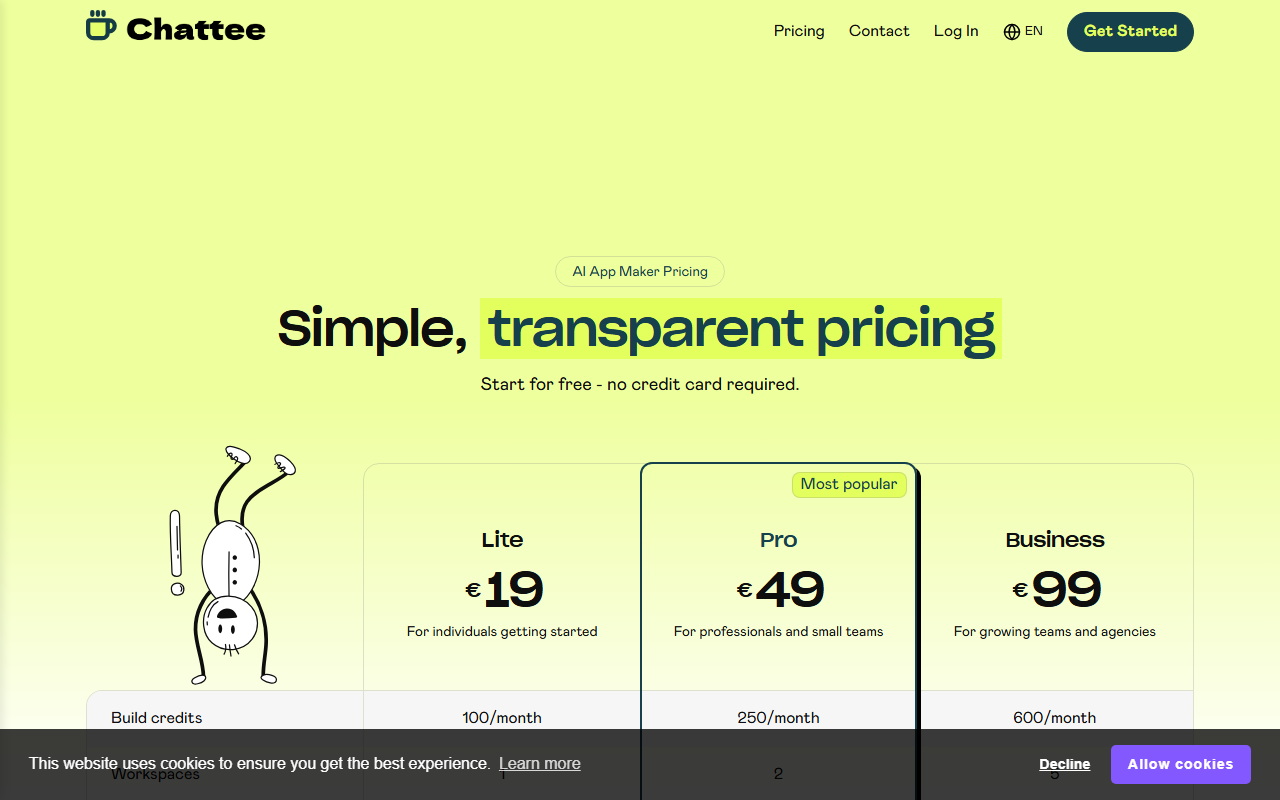 Chattee's pricing page, captured 18 Aug 2026. Code export is not called out on this screen, but is listed as included further down each tier's feature list.
Blink's own pricing page could not be captured for this piece: it currently serves a regional "Invite-Only Access" gate rather than its public pricing content, so the numbers above are quoted from Blink's FAQ and pricing documentation instead of shown here.
The hidden cost is not the sticker price so much as what a credit actually buys. Blink's $25 Starter tier and Chattee's 19-euro Lite tier both bundle 100 monthly build credits, in their respective currencies. What separates them is one extra thing a Lite-tier credit buys that a Starter-tier credit does not: the ability to walk away with your code.
Where the AI model breadth goes
Blink's AI Gateway is the platform's headline feature. It gives every app access to more than 200 frontier models through one unified API, including Claude Opus, GPT-5, Gemini 3 Pro, Grok 4 and DeepSeek, per Blink's own homepage. Blink Claw, an always-on agent mode, keeps working on a task after you close the tab. Blink also lists more than 3,000 third-party integrations, covering tools like Stripe, Slack and Notion.
None of that model choice is available inside Chattee. Its documentation does not publish a model list or a gateway feature; it focuses on what the generated app does, not which model generated it. A builder who wants to swap Claude for GPT-5 mid-project, or route different features to different models, has that option in one platform and not the other. A builder who has never needed to think about which model wrote their app will not notice the gap either way.
Where the workflow depth goes
Chattee's feature list reads differently from Blink's. It leads with multi-role permissions, conditional logic, approval workflows and external API integrations, aimed at internal business software rather than consumer apps. Chattee's own site markets white-label deployment for agencies and freelancers doing client work, and positions itself for business teams that want internal tools without waiting on an IT queue.
Blink covers some of the same ground through its integration count, but it does not name approval-chain or multi-role permission handling as a dedicated feature the way Chattee does. A team building an expense-approval tool with three sign-off levels finds that logic named explicitly in Chattee's marketing. The same team building the same tool in Blink would construct the permission logic through prompts rather than a documented, pre-built feature.
Who owns the code, and when
This is the axis the two platforms disagree on the most. Blink's free plan has no code export option at all, according to Blink's pricing page: only the Starter, Pro and Max tiers include it. Once you are on a paid tier, Blink exports plain React and TypeScript that you own outright, with full commercial rights, deployable to Vercel, Netlify, AWS or Fly.io, or pushed straight to GitHub.
Chattee includes code export on every tier it sells, Lite included, and even during its free trial. Chattee's own pricing page lists "code export included" as a line item on Lite, Pro and Business alike, and its marketing repeats that exported code carries no vendor lock-in and can run on a customer's own servers.
The practical difference: a Chattee user can walk away with a working codebase on day one, having paid nothing beyond that first Lite invoice. A Blink user building on the free plan has no export path until they commit at least $25 a month, and even then waits for that plan to actually take effect rather than exporting mid-trial.
The compliance claim, and what it isn't
Chattee markets itself as "GDPR-Friendly, Hosted in Germany," a line it repeats across its own site, including on pages describing apps for handling client pricing data. Blink's FAQ states plainly that "Blink is GDPR compliant" and that all data is encrypted in transit and at rest, but it does not name a hosting region or cloud provider anywhere in its public documentation.
For a team that has to write an actual country into a data processing agreement, Chattee's claim gives them something concrete to put on the form. Blink's statement does not, not necessarily because Blink is less compliant, but because it has not published where its servers sit.
The honest objection here is that neither claim is backed by a published, independently audited certification. Chattee's own copy is marketing language, not a SOC 2 report or an ISO 27001 certificate, and its own site tells readers to verify each platform's hosting and compliance details for their own needs. Blink's GDPR statement carries the same weakness: a line in a FAQ is not an audit. Judged strictly, both vendors are asking to be trusted on this point, and neither has earned more of that trust than the other.
That objection is fair, and it matters less than it sounds for the decision most readers are actually making. A data processing agreement usually asks for a country, not a certificate number. One of these two vendors hands a reader that answer today. The other does not.
What switching actually costs
Moving off either platform is not free, even with code in hand. Blink's exported apps are plain React and TypeScript, and Blink's documentation says the code can be edited in any editor, deployed on Vercel, Netlify, AWS or Fly.io, or pushed to GitHub, with any npm package installable afterward. That is a genuinely portable stack, once you have paid to reach it.
Chattee's export promise is similar in spirit: full source code, deployable on a customer's own servers or cloud infrastructure, described by Chattee as carrying no vendor lock-in. Neither vendor publishes a migration guide beyond the export button itself, so budget engineering time to wire up hosting, environment variables and any third-party keys the exported app depended on, whichever platform you started on.
If the export step itself is what you are optimizing for, it is worth comparing both against a third option. Replit also ships an export path but starts from a code-editor-first workflow rather than a pure prompt box. v0 leans toward design-first generation before the backend is wired up.
Six months from now, this comparison rests on one gap each vendor could close overnight. If Blink puts code export behind a lower tier or its free plan, the ownership argument for Chattee weakens. If Chattee publishes an actual security certification instead of a hosting-location claim, its compliance edge stops being just better copywriting.
Until one of those happens, the platform that lets you leave for free is not the same platform that lets you start for free. A reader has to decide which of those two guarantees matters first.
Frequently asked questions
Is Blink or Chattee cheaper?
It depends on what you need from the first payment. Blink is cheaper to start, with a free plan that has no time limit, capped at 5 credits a day. Chattee has no permanent free tier, only a free trial, but its cheapest paid tier, Lite at 19 euros a month, includes code export that Blink withholds until its $25 a month Starter plan.
Does Blink let you export your code for free?
No. Blink's free plan does not include code export; only the Starter ($25/month), Pro ($50/month) and Max ($200-plus/month) tiers do, according to Blink's own pricing page. Free-tier users can build and host an app on Blink's domain, but cannot take the code elsewhere without upgrading.
Is Chattee GDPR compliant?
Chattee markets itself as GDPR-Friendly and Hosted in Germany across its own site. That is a marketing claim, not a published SOC 2 or ISO 27001 certificate, and Chattee's own content advises checking each platform's hosting and compliance details independently. Blink separately states in its FAQ that it is GDPR compliant, without naming a hosting region.
Can Blink and Chattee build the same kind of app?
Mostly yes: both generate a full-stack app with a database, authentication and hosting from a natural-language prompt. Blink leans toward apps that benefit from AI model choice, through its 200-plus-model gateway. Chattee leans toward internal business tools with multi-role permissions and approval workflows, which Blink does not name as a dedicated feature.
What happens if I outgrow either platform?
Both let paying customers export their generated code: Blink as plain React and TypeScript deployable to Vercel, Netlify, AWS or Fly.io, and Chattee as source code deployable to a customer's own servers. Neither publishes a full migration guide beyond the export step, so plan for engineering time to reconnect hosting, environment variables and third-party API keys after leaving.
Covered in this guide
- Blink: Full-stack AI app builder that deploys SaaS, dashboards, and mobile apps from plain English prompts. Free tier includes 10 credits/month.
- Chattee: AI app builder that turns plain-English prompts into a working full-stack web app, generating the frontend, backend, database, and login system automatically.
- Builder.io: AI product development platform that converts Figma designs and prompts into production-ready code
- Lovable: Build something lovable. Create apps and websites by chatting with AI.
- Replit: Cloud coding environment where you describe an app in plain English and AI builds and deploys it.
- v0: AI-powered full-stack app builder that turns natural language prompts into production-ready code
Sources
Still deciding?
This guide covers a handful of options. Smart Match checks every listing in the directory against how you actually work and what you can spend, then hands you the shortlist and the reason behind each pick.
Start Smart MatchRelated guides
- 10Web vs Blink: WordPress Site or SaaS App in 2026?ComparisonHead-to-head, with a verdict
- AI App Builders That Actually Publish Their Prices (2026)Buyer's guideHow to pick, across a category
- AI Development Services in 2026: Which Layer You Actually NeedBuyer's guideHow to pick, across a category
- Best AI App Builder in 2026: Pick by What You're BuildingBuyer's guideHow to pick, across a category
- The Best AI for Designing UI in 2026, and When Figma Still WinsBuyer's guideHow to pick, across a category
- Best AI Website Design Tools in 2026: Framer, Durable, 10Web and the Line Between ThemBuyer's guideHow to pick, across a category