Best AI Fraud Detection Tools (2026): 9 Picks by Where Fraud Hits
AI fraud detection tools score payments, sign-ups, logins or bank transfers for signs of fraud and return a decision or risk signals. The right one depends on where losses happen: Stripe Radar for Stripe payments, SEON, Sift or Castle for accounts, Signifyd for guaranteed ecommerce orders, Sardine or Feedzai for banks.
The short version
On Stripe, start with Stripe Radar: Lite costs nothing extra. Fake sign-ups and bonus abuse point to SEON from $699 a month, or self-serve Castle. Signifyd repays fraud chargebacks on orders it approves. Banks look at Sardine and Feedzai, and bot-heavy platforms at Arkose Labs.
Not sure which one fits you? Describe your situation and Smart Match names three tools.Find my AI tools
In this guide10 sections
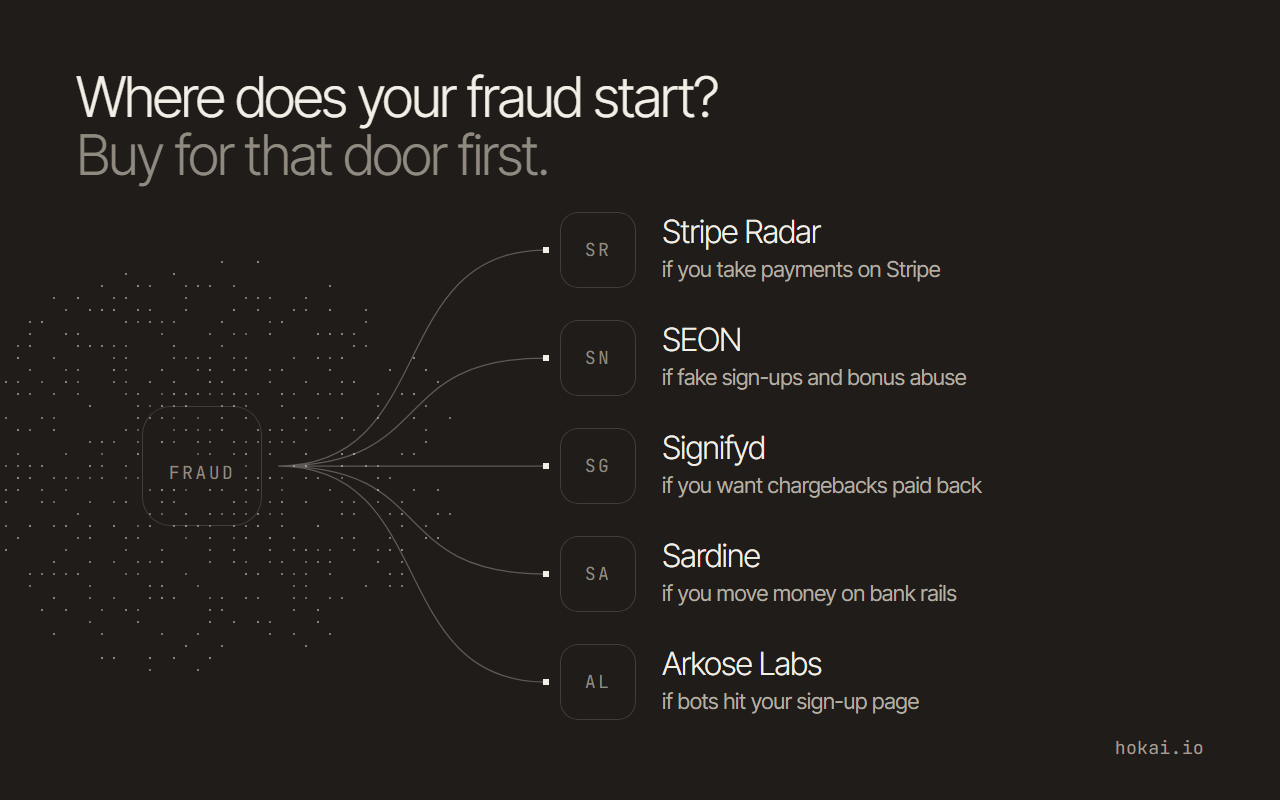 Hokai chart: five doors fraud comes through and the tool this guide picks for each, based on vendor pages read 22 November 2026.
Stripe's own Radar page puts the chance at 92% that a card paying a Stripe merchant has already been seen somewhere on Stripe's network. A tool you add on top starts without that history. So if you take payments on Stripe, Stripe Radar is where to start, and for a small store it may be all you need.
The trouble is that payment fraud is only one of the doors. Fake sign-ups, bonus farming, hijacked logins, bots that send thousands of paid verification texts and scams on instant bank transfers each need a different signal, and the nine tools below were built for different doors. This guide sorts them by where the loss happens, prices them with the figures each vendor publishes, and says who should skip the category altogether.
- Radar Lite on Stripe's standard pricing
- $0
- Card payments and card testing
- SEON Starter a month
- $699
- 2,500 fraud checks included
- Castle Pro a month
- $200
- 40,000 risk checks of usage
- Tools on this list with a free plan for new accounts outside Stripe
- 2 of 9
- Castle and Fingerprint
Start with where the money leaves, not with the vendor
Every fraud tool scores something. The question is what. A payment screen sees a card, an amount and a device at checkout; it never sees the other accounts the same person opened last week. An account tool sees sign-ups and logins and knows nothing about the chargeback that lands two months later.
Five questions settle most decisions:
- Where is the loss today? Payments, accounts, promotions, bank transfers or bots.
- Who carries a wrong approval? You, or a vendor that guarantees it.
- Can you explain a block? Regulated firms must.
- How is it billed? Per transaction, per check, per call or by quote.
- Decision or signal? An approve-or-decline answer, or raw flags for your own rules.
The first question matters most: name the biggest loss in money, not in alert volume. The second decides the price band, because a vendor that repays chargebacks on orders it approved prices that risk into its fee. The third rules out black-box scores for banks and regulated fintechs, which must say why a customer was stopped.
Billing can surprise you. Per-call pricing rises during a bot attack, exactly when traffic is least worth paying for. And some products return a device ID and a list of risk flags rather than a verdict, which suits a team that writes its own rules and frustrates one that does not.
Identity document checks for onboarding, often called KYC (know your customer), are a separate purchase. Several vendors here sell one too, but none is ranked on it; pair any pick with a dedicated KYC tool if your regulator requires one. Harmful posts and uploads belong to our content moderation guide, which reaches the same conclusion: fake accounts and payment fraud are their own buying decision.
The shortlist: nine tools, each for one door
The table maps the commonest loss to the tool built for it, with the cheapest published way in. "Quote" means the vendor publishes no price.
| Where fraud hits | Pick | Price from | The catch |
|---|---|---|---|
| Card payments on Stripe | Stripe Radar | $0 (Lite) | Stripe flows only below enterprise |
| Sign-ups, bonuses, payments | SEON | $699 a month | 2,500 checks, then a quote |
| Accounts and payments, one score | Sift | Quote | Demo-led sale |
| Ecommerce chargebacks | Signifyd | Quote, Shopify trial | Retail checkout only |
| Bank rails, scams, AML | Sardine | Quote | Heavy for a small app |
| Bank and processor fraud and AML | Feedzai | Quote | Long setup outside banking |
| Bots and fake accounts at scale | Arkose Labs | Quote | Changes often need Arkose's team |
| Self-serve login and sign-up abuse | Castle | $0, Pro $200 a month | Mobile SDKs need Enterprise |
| Device ID for your own rules | Fingerprint | $0, Pro Plus $99 a month | Signals, not decisions |
If none of those rows describes you cleanly, Smart Match can check your situation against every fraud listing on Hokai and return up to three picks with reasons.
Payments: Radar if you are on Stripe, Signifyd if you want the risk gone
Radar Lite screens card payments and card testing at no extra charge on Stripe's standard pricing. The paid plans, from Stripe's pricing page, each include 200 screened transactions a month:
| Plan | Monthly | Each extra screen | Adds |
|---|---|---|---|
| Radar Standard | $10 | $0.05 | All payment methods, analytics |
| Radar Plus | $14 | $0.07 | Custom rules, 0 to 99 score, 3D Secure |
| Radar Pro | $20 | $0.09 | Abuse signals, 400 abuse events |
Plus is where rules become yours: you can backtest them against past payments before switching them on. Pro adds the account abuse signals, covering multi-accounting at sign-up, free-trial cycling, account sharing and bots, billed per abuse event once the included 400 are used.
The complaint to know about comes from users. Reviewers on G2, read on 22 November 2026, describe the model blocking genuine payments too aggressively for new accounts after a first chargeback. Stripe says Radar can also score payments processed elsewhere, but only through its sales team.
Signifyd answers a different question. It approves or declines each online order and repays the fraud chargeback on any order it approved, so a wrong approval becomes its cost. The Complete Chargeback Protection plan extends that to non-fraud chargebacks. Signifyd prints no prices; Shopify stores get a 14-day trial, and one App Store reviewer reports a June 2026 bill about 30% higher than usual after non-Shopify orders stopped being filtered out. Riskified and Forter, which also sell ecommerce fraud decisioning aimed at chargebacks, are the quotes to set beside it.
Accounts and sign-ups: SEON, Sift and Castle
Account fraud starts before any payment. SEON checks the email and phone number typed into a sign-up form against their history across online services, then adds device and IP signals; its homepage counts over 1,100 first-party signals. Each AI score lists the signals that drove it, which matters when you must explain a block.
SEON publishes its entry price: Starter is $699 a month for 2,500 checks, 10 users and 50 rules, about 28 cents a check. Online gambling operators use it for bonus abuse, with Lottoland as a published case.
Sift puts sign-up, login and payment under one Sift Score per user, and its Global Profile carries a user's history from a network Sift sizes at more than 34,000 sites and apps. That suits marketplaces, delivery and subscription apps, where one bad actor turns up as a fake account, then a stolen card, then a hijacked login.
Sift now sells AI agents that suggest a decision on a case and explain it in plain language, plus an MCP server so an outside assistant can query a user's history. It publishes no price.
Castle is the self-serve option. It returns a bot score, an abuse score and an account takeover score for each event, flags residential proxies and VPNs, and can spot a user on a phone call during login, a sign of a coached scam.
You can sign up without a sales call. The Free plan covers roughly 1,000 risk checks for evaluation, and Castle's Pro plan bundles 40,000 at $200 a month before per-request billing starts. Its weak spots are plain on its own pages: iOS and Android SDKs are Enterprise only, and its trust page lists no security certification.
Bots and fake accounts at scale: Arkose Labs, with Fingerprint underneath
Arkose Labs is built for platforms where bots are the main cost: credential stuffing, mass fake sign-ups and SMS toll fraud, where automated requests run up paid verification texts. Bot Manager judges each session from risk signals and sends only suspect traffic a challenge that changes as attackers adapt.
Its newer Agent Trust Manager labels visiting AI agents as self-disclosing good, non-disclosing good or malicious, and lets you allow, monitor or block each one at each step. Arkose's Q3 2026 report says 97.7% of legitimate agent sessions carried no verified disclosure.
Two G2 reviewers point at the cost of that depth. One found customising the challenge experience took a lot of back-and-forth with Arkose; another cannot force a challenge for an IP address without opening a ticket with Arkose's security operations team.
Fingerprint sits a layer lower. It gives each browser or phone a stable visitor ID that holds through incognito mode and VPNs, plus Smart Signals for emulators, tampering and bots, and returns no decision at all. Your code writes the rule. The Free plan covers 1,000 calls a month and Pro Plus is $99 for 20,000 calls, then $4 per 1,000. Two G2 reviewers warn that per-call billing climbs when bots hammer the site, so restrict which sites and apps may call it from day one.
Banks and fintechs: Sardine and Feedzai
Money movement changes the problem. A scam in which the account holder is talked into sending money passes every card check, because the real customer is on the real device. Sardine reads behaviour for signs of that coaching and scores transfers on rails such as ACH, RTP, FedNow and Zelle as well as cards.
Sardine runs anti-money-laundering (AML) monitoring and sanctions screening on the same platform, and its Sonar consortium shares anonymised risk signals between member institutions. Sardine says it has raised $170 million, and Forrester named it a Leader in financial crime management in Q3 2026.
Feedzai is the established bank choice. Its homepage claims 1 billion consumers covered and $19 trillion in payments secured a year, and a tier-1 bank customer reported 62% more fraud detected and 73% fewer false positives than with its previous system. Its new agent, Farol, works on rules and alerts and drafts suspicious activity reports. A non-bank customer on G2 notes that setup took longer because its models and documentation lean toward banking.
Two other bank-focused vendors appear in published roundups for this search and are not ranked here. NICE Actimize says it monitors more than 5 billion transactions a day for financial institutions, and DataVisor sells fraud and AML tools for banks, credit unions and fintechs, including ACH, wire and real-time payment fraud.
What it costs at 5,000 checks a month
Most of the category sells by quote, so the only honest sums are for the four tools with public prices. The figures below price 5,000 checks in one month on each published plan, from the vendors' own pricing pages read on 22 November 2026.
| Tool and plan | Included | Price for 5,000 checks |
|---|---|---|
| Stripe Radar Standard | 200 transactions, then $0.05 | $250 |
| Stripe Radar Pro | 200 transactions, then $0.09 | $452 plus abuse events |
| SEON Starter | 2,500 checks | Above the cap: quote |
| Castle Pro | 40,000 risk checks | $200 |
| Fingerprint Pro Plus | 20,000 calls | $99 |
The Radar rows are the monthly fee plus 4,800 screens at the per-transaction rate in the plan table above. They are not like-for-like with the rest. Radar scores a payment; Castle scores an account event; Fingerprint returns a device ID with no decision attached. Treat the table as the price of each tool's own unit, not as a ranking.
From each vendor's own pricing page.
Who should skip a fraud platform for now
A small store on Stripe with a low chargeback rate should probably buy nothing. Radar Lite already screens every card payment at no extra cost, and a dedicated platform at $699 a month or a sales-led quote will not pay for itself until losses are larger than the fee.
The second group is teams with no one to run the tool. SEON's own customers on G2 ask for easier backtesting, Sardine's describe a hard first few weeks with many rules, and one Arkose reviewer must open a ticket to change a challenge rule. These products repay an analyst's time; without one, a guarantee vendor or Radar's defaults will do more.
The last group is anyone shopping for identity document checks or moderation. Those are different products with their own guides, and buying a fraud platform for them leaves the original problem in place.
One thing you can check without signing up
Only one product here can be exercised with no account. On 22 November 2026 we opened Fingerprint's public demo page twice in Chrome on Windows: both visits returned the same visitor ID with a confidence score of 1, and the page listed Smart Signals for the session, including incognito and VPN flags. The other eight sell through a demo, a Shopify install or a signed-up account, so this guide relies on their own pages and dated user reviews rather than a test.
How the picks were made
The lineup starts from the products that published roundups for this search rank most often, then adds the account and bot tools those roundups leave out. Each pick's facts come from its own pricing, product and trust pages, read on 22 November 2026, plus one independent listing per product on G2 or the Shopify App Store. Every pick has a full record on Hokai, filed in AI security tools, where the plan tables and user complaints are kept current.
- Free way in
- Radar Lite on Stripe, Castle Free, Fingerprint Free
- Published monthly price
- Radar, SEON, Castle, Fingerprint
- Chargeback guarantee
- Signifyd
- Built for banks
- Sardine, Feedzai
- AI agent traffic policy
- Arkose Labs, Castle, Fingerprint
The next shift is already visible on these vendors' pages: Arkose, Castle, Fingerprint and Radar all now sort AI agents from scripts, and Radar Pro sells a signal for compute abuse in usage-billed products. Fraud tools priced per check were built for humans at keyboards; the ones that can tell a customer's shopping agent from a bot farm will set the 2027 shortlist.
Frequently asked questions
Is Stripe Radar enough for a small online store?
Often, yes. Radar Lite screens card payments and card testing at no extra charge on Stripe's standard pricing, and paid plans from $10 a month add custom rules and more payment methods. A dedicated platform makes sense once fraud reaches sign-ups and logins or your losses outgrow the fee.
Which fraud detection tools publish their prices?
Of the nine in this guide, four do: Stripe Radar, SEON, Castle and Fingerprint, according to their pricing pages read on 22 November 2026. Sift, Signifyd, Sardine, Feedzai and Arkose Labs sell by quote after a demo.
What is the difference between a fraud screen and a chargeback guarantee?
A screen such as Stripe Radar or SEON scores each payment and leaves any chargeback with you. A guarantee vendor such as Signifyd approves or declines the order and repays the fraud chargeback on orders it approved, so it carries the cost of its own mistakes.
How do I stop fake accounts and bonus abuse?
Use a tool that scores the sign-up itself rather than the payment. SEON checks the email and phone history behind each sign-up and links accounts that share devices, Castle scores sign-up abuse through a self-serve API, and Arkose Labs suits large platforms facing bot farms.
Do these tools verify ID documents?
That is a separate purchase. Some vendors here, including Sardine and SEON, sell identity checks alongside fraud scoring, but this guide ranks fraud detection only, so pair your pick with a dedicated identity verification tool if your onboarding requires one.
Covered in this guide
- Arkose Labs: Bot and fake-account defence for sign-up, login and checkout that reads 225+ risk signals and now sorts AI agent traffic into good and malicious.
- Castle: Self-serve API that scores sign-ups, logins and transactions for bots, account takeover and abuse, from a free plan with 1,000 Risk API calls.
- Feedzai: Bank-grade fraud, scam and AML platform that Feedzai says processes 140 billion events a year, now with an AI agent, Farol, for fraud analysts.
- Fingerprint: Device intelligence API that gives each browser or phone a stable visitor ID plus 100+ Smart Signals for bots, VPNs and tampering; used by 6,000+ companies.
- Sardine: Fraud, scam and AML platform for banks and fintechs that reads device and behaviour signals across cards and bank rails; backed by $170 million.
- SEON: Fraud prevention and AML platform that scores sign-ups, logins and payments from 1,100+ device, IP, email and phone signals, with rules you can read.
- Sift: AI fraud decisioning for payments, logins and sign-ups, scoring each event in under 150 ms against a network of 1 trillion events a year.
- Signifyd: Ecommerce fraud protection that approves or declines each order in real time and reimburses fraud chargebacks on approved orders, using 25,000+ data features.
- Stripe Radar: Stripe's machine-learning fraud screen for online payments, trained on more than 70 trillion data points from the Stripe network, with optional abuse signals.
Sources
Still deciding?
This guide covers a handful of options. Smart Match checks every listing in the directory against how you actually work and what you can spend, then hands you the shortlist and the reason behind each pick.
Find your tools