Best AI content moderation tools (2026): pick by what your users post
AI content moderation tools score user posts, images, video and audio for policy violations such as hate, harassment, nudity, violence and child sexual abuse material. They come as classifier APIs, which return scores your code acts on, and platforms, which add review queues, appeals and regulatory reporting on top.
The short version
Start with the free OpenAI Moderation API for text and photos, then add Sightengine or Deploy (formerly Hive) when video and live streams arrive. Add Safer by Thorn before strangers can upload images, Checkstep when EU appeal and reporting rules bite, and ToxMod only if users talk in voice chat.
Not sure which one fits you? Describe your situation and Smart Match names three tools.Find my AI tools
In this guide14 sections
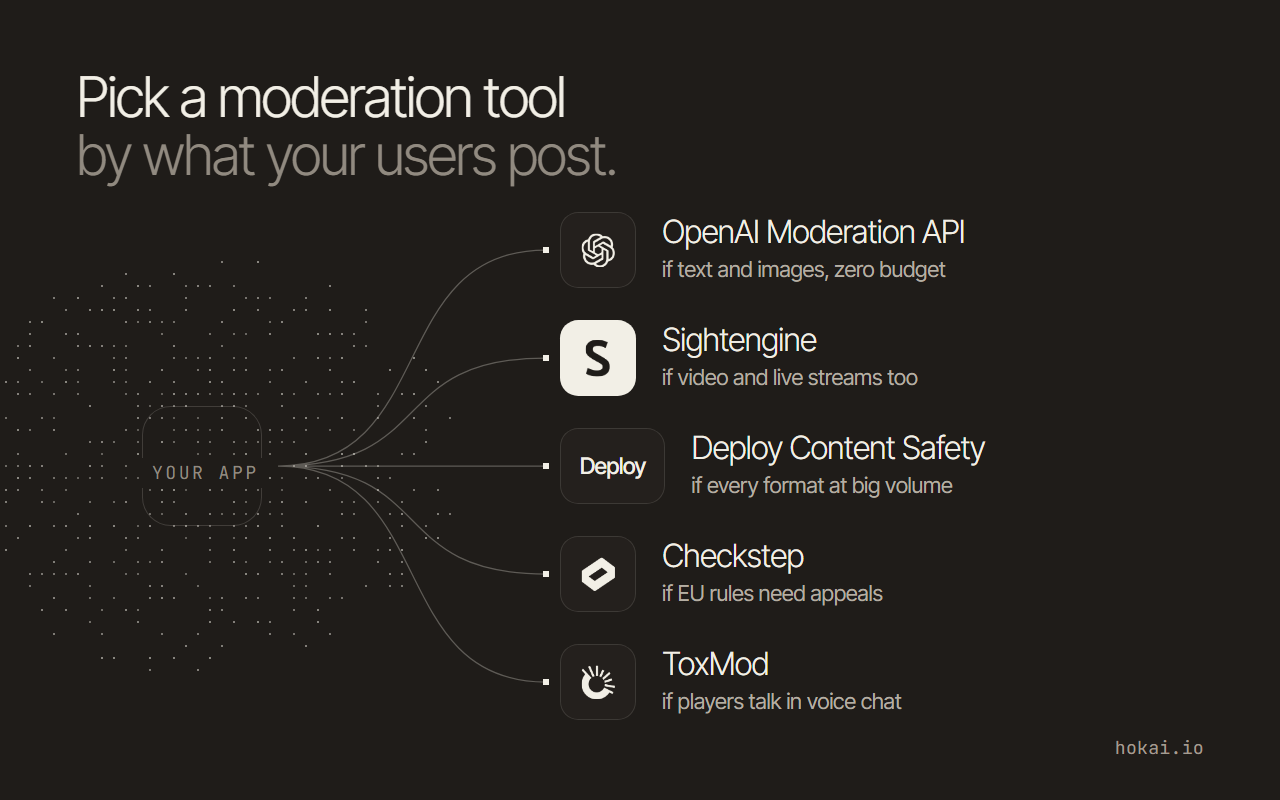 Hokai chart of which moderation tool fits which platform, from each vendor's own pages as checked on 22 November 2026.
For most new apps the right start is the free OpenAI Moderation API as a first filter, then Sightengine once video, live streams or a published monthly bill matter. OpenAI charges nothing per call, while Deploy, the company that called itself Hive until late 2026, lists $3.00 per 1,000 images on its own pricing page. Both are sold as "AI content moderation".
There are two kinds of product under this label, and buyers mix them up. Classifier APIs score each item and leave the rules, queues and appeals to you; platforms wrap those scores in review tools and legal paperwork. The questions below settle which kind you need, then which vendor, and the costs are worked out for a million images.
- OpenAI Moderation API, per call
- $0
- Text and images only
- Azure AI Content Safety, per 1,000 images
- $0.75
- East US, Standard tier
- Verified CSAM hashes in Safer Match
- 153.9M+
- Thorn's own count
- Last day of Google's Perspective API
- 31 Dec 2026
- No migration help
How to choose: five questions that decide it
Settle these first. The answers hold even if you never open a vendor page.
| Question | If yes | Why it matters |
|---|---|---|
| Do users post video, live streams or voice? | Sightengine, Deploy or ToxMod | OpenAI and Azure stop at text and images |
| Will a small team, not engineers, act on scores? | A platform such as Checkstep | Queues, appeals and audit logs come built in |
| Does EU or UK law apply to you? | Checkstep | The DSA and Online Safety Act need appeals and reports |
| Can strangers upload images or send messages? | Safer by Thorn | Several general APIs exclude child abuse material |
| Must you see the bill before a sales call? | OpenAI, Sightengine, Azure or ToxMod | Five of the nine publish at least some prices |
The EU Digital Services Act and the UK Online Safety Act both require you to tell users which rule they broke, offer a human-reviewed appeal and publish transparency reports. That is software, not a model.
Two neighbouring purchases are out of scope here. Guardrails that check what your own AI chatbot says belong with the tools in the AI governance and security guide, and fake accounts and payment fraud are a separate buying decision. This guide covers what your users post.
The shortlist: nine tools and the job each one wins
| Your need | Pick | Price, as published | The catch |
|---|---|---|---|
| Free first filter | OpenAI Moderation API | Free | No audio, video or custom rules |
| Published plans, live video | Sightengine | Free, then $29 or $99 a month | Classifiers only, no review queue |
| Every format at volume | Deploy Content Safety | $3.00 per 1,000 images | Self-serve capped at 100 a day |
| Severity levels on Azure | Azure AI Content Safety | $0.75 per 1,000 images | Docs exclude CSAM detection |
| EU compliance, small team | Checkstep | Quote after demo | No self-serve trial |
| Case management at scale | Cinder | Quote after demo | Bring your own detection |
| Organised abuse, huge platform | ActiveFence | Quote after demo | Built for the very largest |
| Live voice chat | ToxMod | Free pilot, then $5,000 a month | Voice only |
| Child sexual abuse material | Safer by Thorn | Quote | Does nothing else |
A free first layer: OpenAI Moderation API
Start here if your users post text and photos. OpenAI's moderation guide says the endpoint is free to use, and its omni-moderation-latest model scores text and images up to 20MB across 13 categories, from harassment and hate to self-harm, sexual content involving minors and graphic violence. Harassment and hate are scored on text only.
It has limits a growing platform hits quickly. There is no audio or video input, no way to add your own category such as spam or scams, and OpenAI warns that category scores can be recalibrated over time, so a threshold you tuned last quarter may drift. OpenAI also tells developers never to send suspected child abuse material to this model; approved organisations can apply for its separate CSAM Image Classifier, which is also free.
Published prices and live streams: Sightengine
Sightengine is the pick when you need more than text and images and want to know the bill in advance. The French company says it launched its first moderation API in 2013. Its pricing page lists three self-serve plans, and Pro is the first with live-stream and audio moderation and videos up to 500MB.
| Plan | Monthly price | Included operations |
|---|---|---|
| Free | $0 | 2,000 (at most 500 a day) |
| Starter | $29 | 10,000 |
| Pro | $99 | 40,000 |
Each extra operation on a paid plan costs $0.002, which is $2.00 per 1,000.
Read the unit carefully. One model on one image is one operation, so running nudity and weapons checks on the same photo uses two. Starter is also limited to one request a second and one video job at a time. Sightengine sells scores, not a moderation desk: there is no review queue, appeals flow or legal reporting.
Every format at volume: Deploy Content Safety, formerly Hive
If you knew this vendor as Hive, it is the same product. Hive's blog post "Hive is now Deploy" says existing accounts and logins carry over, its Moderation Dashboard is now called Arbiter, and its CSAM Detection API is "powered by Thorn". The company says it has more than 20 proprietary models and serves billions of pieces of content a day.
Deploy covers images, sampled video frames, text, audio and text inside images under one account. Reported customers have included Reddit, Giphy and BeReal, according to its Wikipedia entry. The self-serve rates are $3.00 per 1,000 image requests and $0.50 per 1,000 text requests, but a self-serve key stops at 100 requests a day per model. Video, audio, OCR and CSAM detection are priced by sales.
Severity levels on Azure: Azure AI Content Safety
Microsoft's service suits teams already on Azure. Its Analyze text and Analyze image calls score four categories, hate, sexual, violence and self-harm, and return a severity level for each instead of a flag, so a game chat can allow mild violence and block graphic violence. Azure's retail price list shows $0.375 per 1,000 text records and $0.75 per 1,000 images in East US, and a free tier of 5,000 of each a month.
Two lines in Microsoft's own overview should stop some buyers. The service "can't" be used to detect child exploitation images, and two preview features, rapid custom categories and groundedness detection, retire on 30 April 2027. A text record is up to 1,000 characters, so a 7,500-character post bills as eight.
Compliance and review queues: Checkstep and Cinder
Once a European regulator can ask you why a post came down, the scores matter less than the paper trail. Checkstep records the rule broken on every action, runs a human-reviewed appeal and files statements of reasons to the EU DSA Transparency Database automatically, according to its homepage. It reads text, images, video and audio, says it processes 100+ languages natively, and pulls in partner models: voice from Modulate and OpenAI's CSAM Image Classifier.
Checkstep also announced in November 2026 that it had acquired the trust and safety business of Unitary, a fellow UK vendor, with Unitary's customers keeping their contracts. Its security statement names EY as the firm that audited its SOC 2 Type II report. Prices are not published.
Cinder solves the other half. Its record describes one system for policy, cases and AI agents, used by trust and safety teams at OpenAI, Spotify and Midjourney, and sold through a required demo. It is the choice for a team that already has detection and is drowning in review work, not for a first moderation tool.
Organised abuse at the largest platforms: ActiveFence
ActiveFence is now the name of one product rather than a company. The firm renamed itself Alice in 2026, and Alice's own site says ActiveFence remains the name of its trust and safety offering for user-generated content. SiliconANGLE reported a $140 million round led by Apax Digital Funds, taking total funding to $280 million.
What you buy is detection plus intelligence: enforcement across more than 20 abuse areas, threat feeds, deep and dark web monitoring, and analysts who investigate networks for you. That fits the largest social networks facing extremist groups or exploitation rings. Most platforms do not need it, and nothing can be tried or priced without a sales cycle.
Live voice chat: ToxMod
Text moderation misses most of what happens in a multiplayer lobby. ToxMod, from Modulate, listens to live voice and flags harassment, hate, threats and grooming, reading tone and escalation as well as words. Modulate's privacy page says much of the first pass runs on the player's device and live voice data is deleted after 35 days by default. Activision appears among its customers.
Unusually for this field, ToxMod publishes prices on its own pricing page.
| Tier | Monthly price | Voice hours included |
|---|---|---|
| Starter | $0 | 1,500, granted once |
| Epic | $5,000 | 50,000 a month |
| Legendary | $10,000 | 100,000 a month |
| Mythic | $20,000 | 200,000 a month |
The jump from a one-time pilot to the first paid tier is the main thing an indie studio should plan around.
Child safety: the layer the others build on
If strangers can upload images to your service, you need a child sexual abuse material check, and several general tools say they do not provide one. Azure's overview excludes it. OpenAI routes it to a separate, approval-only classifier. Safer by Thorn is the specialist: Safer Match compares uploads with more than 153.9M verified CSAM hashes, including altered copies, and Safer Predict classifies new images, video and chat for grooming and sextortion.
Thorn's customer page quotes trust and safety staff at Slack and MediaLab, and Deploy builds its own CSAM API on Thorn's technology. The self-hosted Safer Enterprise package connects to a platform's NCMEC or RCMP reporting account. Thorn does not publish prices.
What a million images costs at list price
This is the sum most buyers do on the back of an envelope, so here it is at the prices each vendor published on 22 November 2026, for one moderation check per image.
Read from each vendor's own pricing page or price list on 22 November 2026.
| Tool | One million images | How it is billed |
|---|---|---|
| OpenAI Moderation API | $0 | Free endpoint |
| Azure AI Content Safety | $750 | $0.75 per 1,000, East US |
| Amazon Rekognition | $1,000 | $0.001 each, first million |
| Sightengine Pro | $2,019 | $99 for 40,000, then $0.002 each |
| Deploy Content Safety | $3,000 | Self-serve rate; volume needs sales |
Two cautions. Deploy's self-serve rate comes with a 100-a-day cap, so a million images a month is a sales conversation at a price it does not publish. And a list published by Mixpeek, read the same day, puts Azure and Google Cloud Vision at $1.50 per 1,000 images; Azure's own retail price list shows $0.75 for East US, half that.
What we saw in two public demos on 22 November
Two of these vendors let anyone run their image model without an account, so we did.
- On 22 November 2026, Deploy's visual moderation demo, opened with no account, loaded a sample image and returned 71 class scores, led by general_suggestive and yes_male_shirtless at 1.00, with yes_middle_finger at 0.02.
- On 22 November 2026, Sightengine's moderation demo, also with no account, scored its preloaded photo None at 99% on the nudity scale, with Sea, lake, pool at 60% as context and Bikini at 0%.
The difference in shape matters more than the numbers. Deploy hands back a long list of fine-grained classes to map onto your rules; Sightengine groups them into an intensity scale per topic. Neither demo accepts the content a real platform worries about, so treat them as a look at the output format, not an accuracy test.
The case for not buying a moderation tool yet
The strongest case against this whole category is that a small community does not need one. A forum with a few hundred posts a day and two volunteer moderators gets more from clear rules, a report button and the free OpenAI endpoint than from any contract here. Paying $5,000 a month for voice coverage, or sitting through three demos, makes no sense before the abuse exists.
The second case is lock-in to a model you do not control. Google's Perspective API, a free toxicity scorer many publishers built on, stops working after 31 December 2026, and its site says there is no direct migration support. Any free classifier can go the same way, so keep your thresholds and rules in your own code, where switching vendor means changing one call.
Amazon Rekognition deserves a correction rather than a slot. Several rival lists say AWS closed its video moderation to new customers.
AWS's own notice says only Streaming Video and Bulk Image Analysis closed to new customers on 30 April 2026, and that other Rekognition features are unaffected; per-image moderation is still $0.001 for the first million. Hokai has no Rekognition record yet, so it is named here without a link. Stream, the chat SDK vendor, also sells moderation for apps built on its chat and is left out for the same reason.
What changed in this market in 2026
- ActiveFence becomes Alice 2026The UGC product keeps the ActiveFence name.
- Rekognition cutoff 30 Apr 2026Streaming video and bulk image analysis closed to new AWS customers.
- Hive becomes Deploy Late 2026Moderation Dashboard renamed Arbiter; logins carry over.
- Checkstep buys Unitary's T&S business Nov 2026Unitary customers keep contracts and moderators.
- Perspective API ends 31 Dec 2026Google's free toxicity API stops serving.
Three of the best-known names in older roundups, Hive, ActiveFence and Unitary, now sit under a different name or owner. If a list you are reading still uses all three as independent vendors, it was written before this year.
The next change to watch is the 30 April 2027 retirement of Azure's preview features, and whether the platforms keep adding partner classifiers the way Checkstep added OpenAI's. If you are unsure which layer you need, Smart Match checks every tool on Hokai against a plain description of your platform. If voice chat and EU appeals are not on your roadmap for 2027, you need nothing beyond the first two tools in the table; add Safer the day strangers can upload images.
Frequently asked questions
What is the best free AI content moderation tool?
The OpenAI Moderation API is free to use and scores text and images across 13 harm categories with its omni-moderation-latest model. Sightengine also has a free plan of 2,000 operations a month, which adds video. Azure AI Content Safety gives 5,000 text records and 5,000 images free each month.
Is Hive Moderation still available?
Yes, under a new name. Hive renamed itself Deploy in late 2026, and its moderation models now sit in Deploy's Content Safety suite. Existing Hive accounts and logins still work, and the Moderation Dashboard is now called Arbiter.
Which content moderation tools detect CSAM?
Safer by Thorn is the specialist, with hash matching and classifiers for new material and grooming text. Deploy's CSAM Detection API is built on Thorn's technology, and OpenAI offers a free CSAM Image Classifier to approved organisations. Azure AI Content Safety's own documentation says it cannot be used for this.
Do I need a moderation platform or just an API?
An API is enough if your engineers will write the rules and build the review queue. You need a platform such as Checkstep when a small team must handle appeals, keep an audit trail and file EU Digital Services Act statements of reasons.
What replaces Google's Perspective API?
Perspective stops serving after 31 December 2026 and Google offers no migration help. For toxicity scoring on text, the OpenAI Moderation API is a free replacement, and Azure AI Content Safety adds severity levels per category if you need graded thresholds.
Covered in this guide
- ActiveFence: Alice's trust and safety service for user-generated content, pairing AI detection across 20+ abuse areas with threat intelligence and analyst teams.
- Azure AI Content Safety: Microsoft's moderation API scores text and images for hate, sexual content, violence and self-harm on severity levels, trained on 8 languages.
- Checkstep: AI content moderation platform with review queues, appeals and EU DSA reporting built in, moderating text, images, video and audio in 100+ languages.
- Cinder: Cinder gives trust and safety teams at OpenAI, Spotify, and Midjourney one platform for policy, cases, and AI agents across 400M+ daily safety events.
- Deploy Content Safety: Content moderation APIs from Deploy, the company formerly called Hive, scoring images, video, text and audio from a portfolio of 20+ in-house models.
- OpenAI Moderation API: OpenAI's free moderation endpoint: the omni-moderation-latest model flags text and images across 13 harm categories, with no per-call charge.
- Safer by Thorn: Child-safety detection from the nonprofit Thorn: hash matching against 153.9M+ verified CSAM hashes plus AI classifiers for new images, video and text.
- Sightengine: Developer API for moderating images, video, live streams, text and audio, with 150+ image moderation classes and published monthly plans.
- ToxMod: Modulate's real-time voice chat moderation for games and social apps, with plans from a free Starter tier to 200,000 voice hours a month.
Sources
Still deciding?
This guide covers a handful of options. Smart Match checks every listing in the directory against how you actually work and what you can spend, then hands you the shortlist and the reason behind each pick.
Find your tools