Last updated: 2026-09-04
Kinect is a YC Spring 2026 AI shopping assistant and adaptive-storefront platform built for Shopify and Shopify Plus stores. In beta, product pages that adapted per visitor drove a 24% jump in time-on-page engagement. Kinect also structures brand catalogs for outside AI shopping agents such as ChatGPT and Gemini.
About Kinect
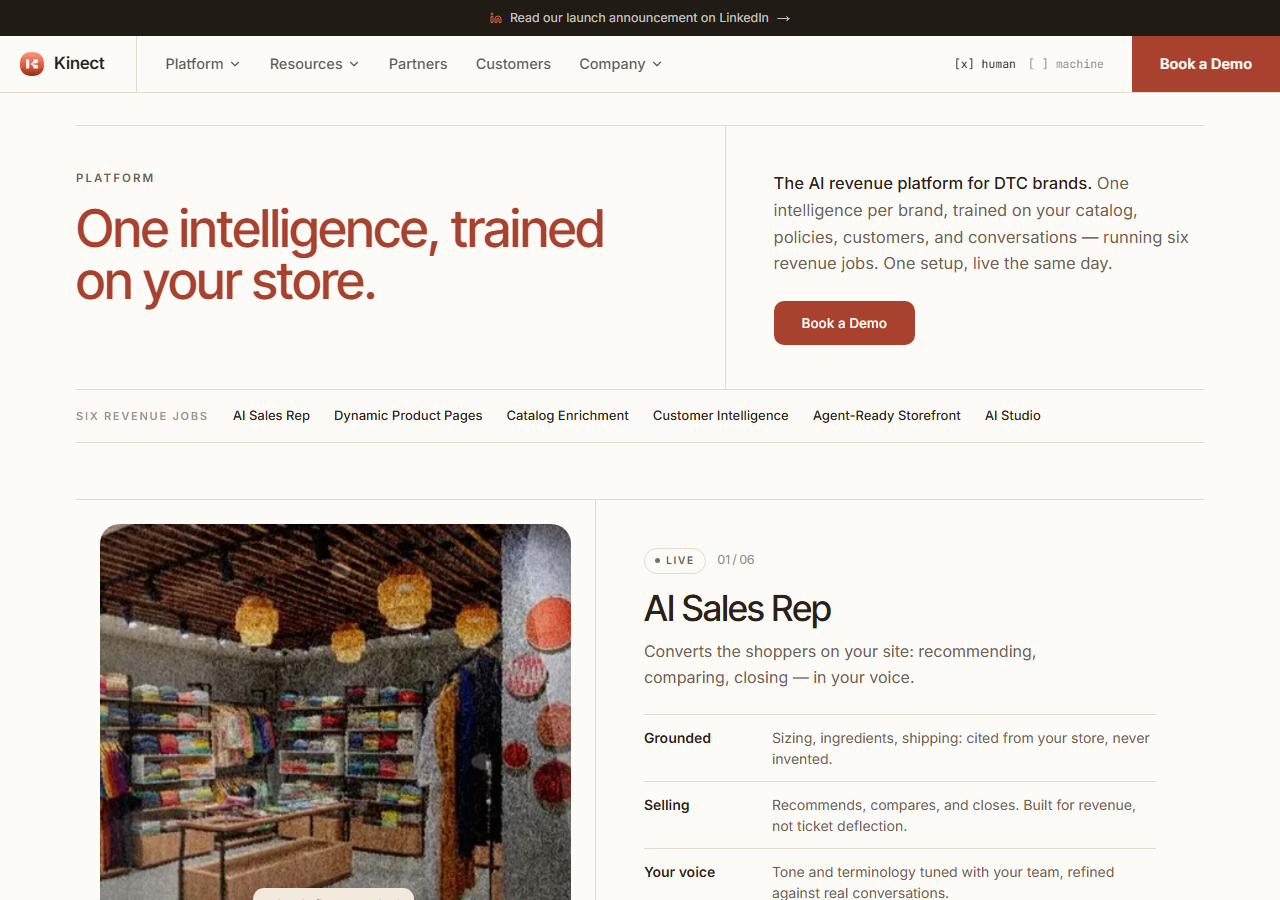
Kinect is an AI revenue platform founded in Spring 2026 by Kratik Agrawal (CEO) and Varun Kandula (CTO), backed by Y Combinator. It builds one intelligence layer per brand, trained on the store's catalog, policies, customers, and conversations, then runs six "revenue jobs" on top of it: an AI Sales Rep that converts shoppers on-site, Dynamic Product Pages that surface the two or three questions a given kind of shopper actually has, Catalog Enrichment, Customer Intelligence, an Agent-Ready Storefront that makes the catalog legible to outside AI shopping agents, and AI Studio for on-brand product imagery and copy.
The AI Sales Rep is grounded in the brand's full catalog and policies, tuned to the brand's voice during onboarding, and deliberately does not handle customer support — order, return, and status questions route to the brand's existing helpdesk instead. Dynamic Product Pages read what kind of shopper is on a page (a fit-checker, a gift buyer) from context like traffic source and behavior, not individual tracking; Kinect is explicit that this is customer-type capture, not personalization, and that it adds no new cookies to the store.
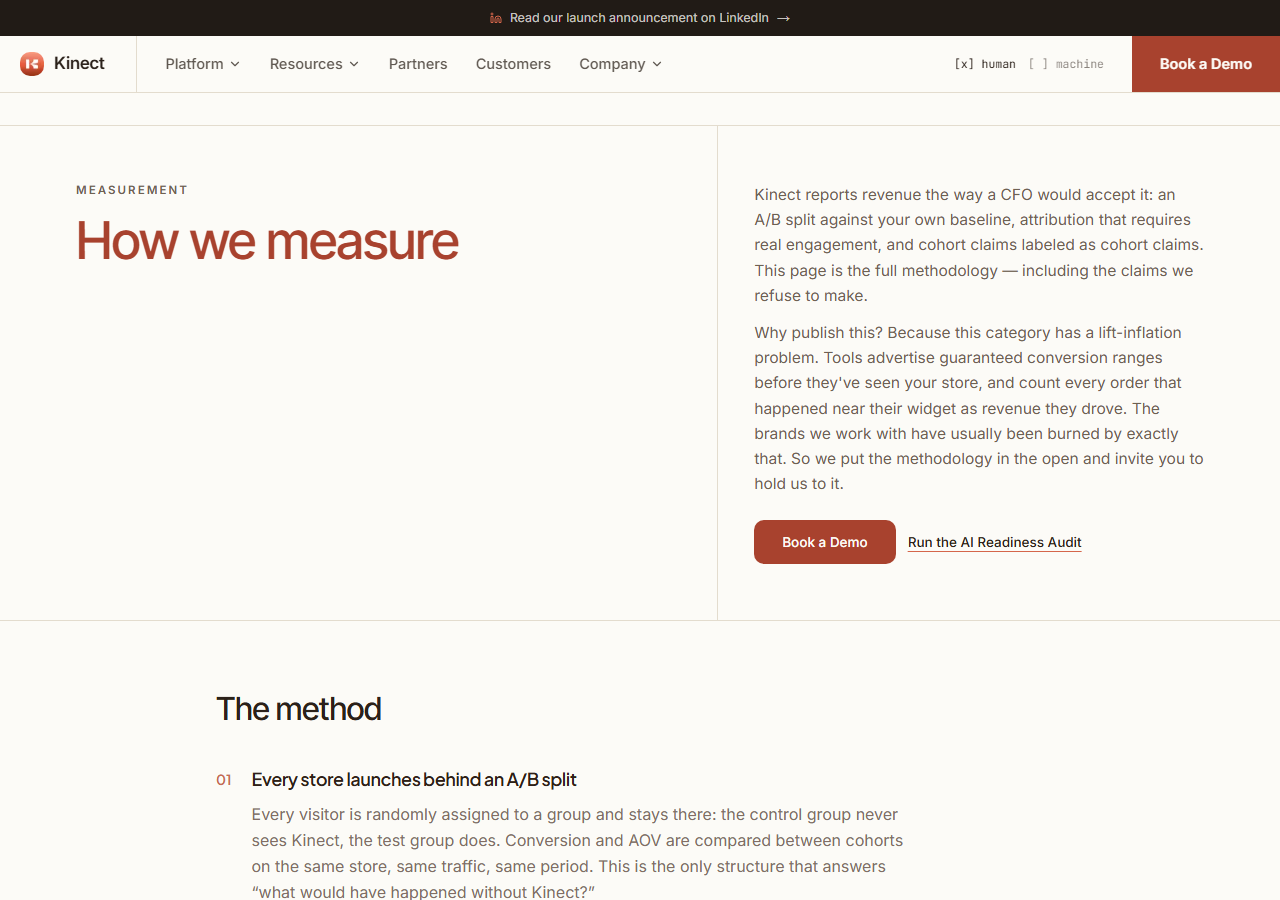
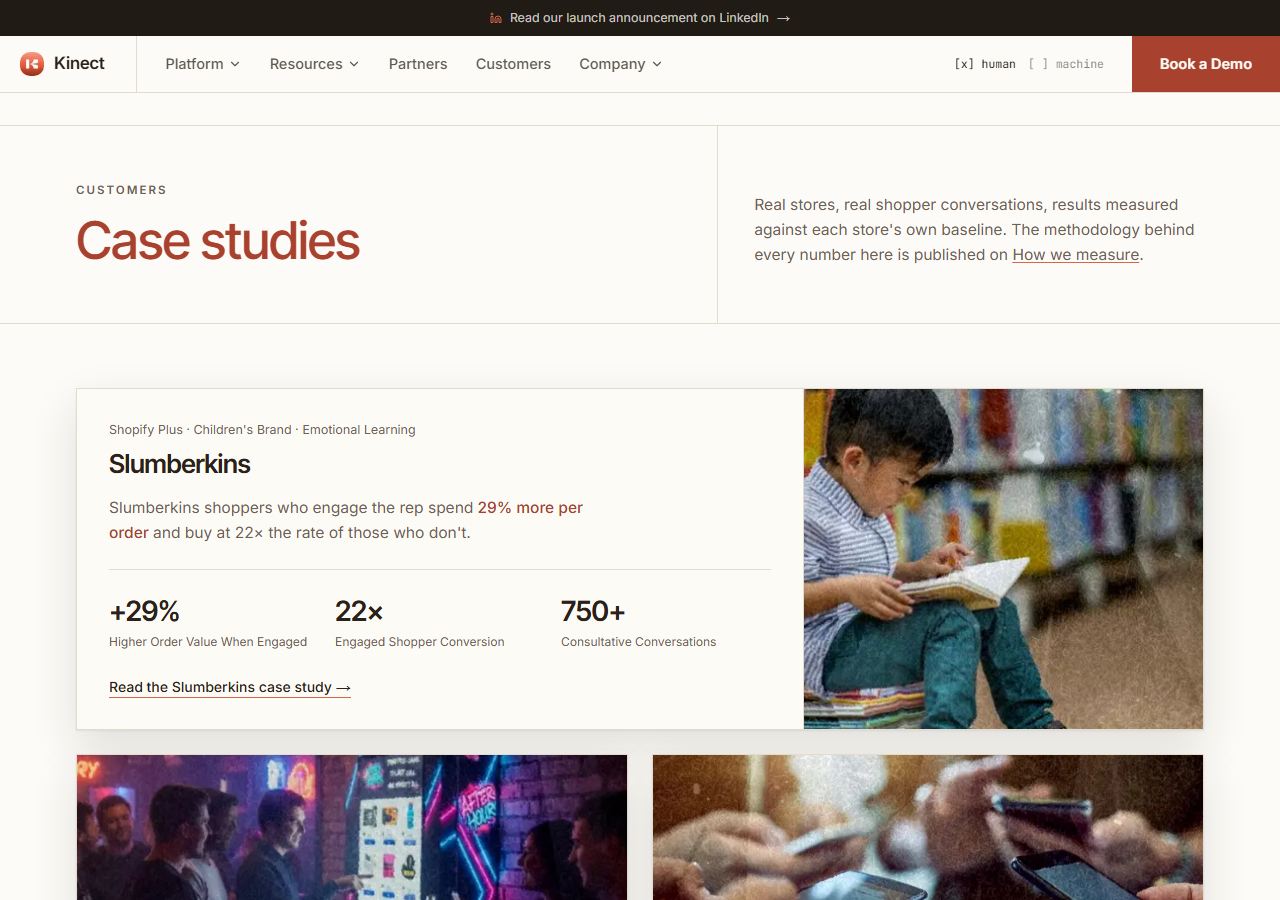
Kinect publishes its measurement methodology rather than advertising a guaranteed lift range, a practice it calls out competitors for lacking: every store launches behind an A/B split against its own baseline, and an order only counts as Kinect-attributed if the shopper engaged before buying. Published, cohort-labeled figures: 3-6% more revenue across live stores measured against their own baseline, 6-21% of shoppers who engage with the assistant go on to purchase, and 24% more time on page when the assistant is present. Case studies on individual stores report much higher engaged-shopper multiples (5.8x to 22x), but Kinect labels these as engaged-cohort behavior, not store-wide causal lift.
Kinect is live on 10+ D2C brands including Bloom, VTM Vending, A.L.C., Sousa, Slumberkins, and Loosey Goosey, all on Shopify or Shopify Plus, which is the only platform with a live theme-extension integration today. WooCommerce, Salesforce Commerce Cloud, Adobe Commerce, and headless storefronts are supported through a hosted chat API and React SDK, scoped with the Kinect team at kickoff, but no non-Shopify store is live yet. Kinect's underlying model is not publicly disclosed; the shopping assistant is tuned on each merchant's catalog data and brand voice during onboarding, and the company runs as a closed-source, cloud-only platform with read-only agent capabilities and no published compliance certifications, as of September 2026.
Screenshots
Pricing
Pricing not publicly listed as of May 2026. Demo call required. White-glove onboarding included.
Targets Shopify and Shopify Plus merchants. ai.
Feature Comparison by Tier
| Feature | Growth |
|---|---|
| Price | Custom, scoped per store on a demo call; no published tiers or self-serve checkout. |
| Core capability | One intelligence layer running six "revenue jobs": AI Sales Rep, Dynamic Product Pages, Catalog Enrichment, Customer Intelligence, Agent-Ready Storefront, AI Studio. |
| Platforms | Shopify and Shopify Plus live today via native theme extension. WooCommerce, Salesforce Commerce Cloud, Adobe Commerce, and headless storefronts supported via hosted API + React SDK, scoped at kickoff — no live non-Shopify customers yet. |
| Customer support | Does not handle support by design; order, return, and status questions route to the brand's existing helpdesk (e.g. Gorgias). |
| Time to live | Same-day kickoff to go-live; the Kinect team, not the merchant's developers, does the integration. |
| Measurement | Publishes methodology at trykinect.ai/how-we-measure. Published figures: 3-6% more store revenue (own-baseline A/B), 6-21% of engaged shoppers convert, 24% more time on page. |
| Partner program | 12% revenue share for agencies referring clients, for as long as the client stays; no fee, certification, or minimum. |
Key Features
- AI Sales Rep: Lives on every store page, grounded in the brand's full catalog and policies. Asks one or two clarifying questions instead of a wall of results, compares products honestly, and moves shoppers toward checkout — it deliberately does not handle customer support, which routes to the brand's existing helpdesk.
- Dynamic Product Pages: Surfaces the two or three questions a given kind of shopper actually has (fit, deadlines, pairings) as one-tap chips on the product page. Kinect calls this customer-type capture rather than personalization: it reads context like traffic source and behavior, not individual shopper profiles.
- Customer Intelligence: Reads every on-site conversation and the journeys shoppers take, then delivers a digest of restock flags, missing product info, and unanswered questions the team can act on — data standard analytics tools do not capture.
- Agent-Ready Storefront & Catalog Enrichment: Normalizes and enriches the catalog (fit, fabric, occasion, pairings) then distributes it to ChatGPT, Google Shopping and AI results, Perplexity, and Gemini, so external AI shopping agents can read, quote, and recommend the brand's products accurately.
- AI Studio: Generates on-brand product photography and copy at scale from the brand's existing catalog and imagery style, without a photo shoot.
- White-Glove Same-Day Onboarding: The Kinect team, including the founders, handles catalog ingestion, voice tuning, and integration directly — kickoff and go-live happen the same day, and merchants do not touch code.
Pros
- Publishes its full measurement methodology (A/B split against each store's own baseline, engagement-gated attribution) and explicitly refuses to advertise guaranteed lift ranges, a category habit it calls out by name.
- No replatforming required and no code needed from merchants, compared to enterprise personalization tools like Nosto or Bloomreach that often require weeks of technical integration.
- Founders bring direct domain expertise: Kratik Agrawal worked on Google's ads team and led Conversational Intelligence at Reevo; Varun Kandula built data infrastructure at MongoDB and ran his own e-commerce store.
Cons
- Live deployments are Shopify and Shopify Plus only; WooCommerce, Salesforce Commerce Cloud, Adobe Commerce, and headless storefronts are supported via a hosted API and SDK but have no live customers yet, so non-Shopify merchants are early adopters of that path.
- Pricing is not published and requires a demo call, which slows self-serve evaluation by e-commerce teams that compare tools independently before engaging sales.
- Case-study results are reported per-store as engaged-cohort multiples (5.8x-22x) rather than a single company-wide lift figure, which is more honest but makes it harder to quickly size the expected impact for a merchant that hasn't run its own A/B test yet.
Product Information
- Cloud
- Yes
- Self-Hosted
- No
- On-Premise
- No
- Languages
- English
- Training
- White-Glove Onboarding, Weekly Tuning, Slack Support
Data Handling
- Training-data policy
- Kinect's own FAQ states it "adds no new cookies to the store" and "works from first-party, anonymized data, collected in a way that conforms to privacy rules," with shoppers who block cookies or browse privately getting the same experience. No dedicated public privacy policy, DPA, or trust-center page was found on trykinect.ai as of September 2026, and no compliance certifications (SOC 2, GDPR attestation, etc.) are published.
Frequently Asked Questions
What are Kinect's pricing plans in 2026?
Kinect does not publish pricing. The platform runs on a white-glove model: teams book a demo call with the founders at trykinect.ai, who scope setup to the store's traffic, conversion rate, and catalog size. There is no published price list or self-serve checkout, and every engagement includes dedicated onboarding support.
Does Kinect have a free plan?
No, and there is no trial either. Merchants reach Kinect by requesting access at trykinect.ai, and pricing only comes up after that conversation. White-glove onboarding stands in for an evaluation period, so budget for a paid engagement from the first day.
What are Kinect's closest competitors?
Kinect names its own closest comparisons as Rep AI, Alhena, Gorgias, Intercom Fin, Zowie, Siena, Tidio, and Ada — most of which center on support-ticket resolution with selling as an added layer. The closest hokai-listed alternatives are Intercom for full-stack customer messaging, Ada for a broader customer-service AI agent, and HubSpot for full-funnel CRM and marketing beyond a single storefront. Kinect's differentiator across all of them is that it deliberately does not do customer support — it stays focused on pre-purchase conversion and routes support questions to the brand's existing helpdesk.
Kinect or Intercom: which should you pick?
Intercom is a full-stack customer messaging platform for support tickets, product tours, and outbound campaigns, priced from $29 a month for small teams. Kinect is a narrower e-commerce conversion tool that reshapes product pages in real time and deploys a shopping assistant to convert anonymous visitors. Intercom's chatbot reacts to questions a user asks; Kinect's assistant proactively adapts pages based on ad source, scroll, and search behavior.
How long does it take to get going with Kinect?
Setup is measured in days, and most of them are Kinect's rather than yours. It opens with a demo at trykinect.ai where the founders review store traffic, conversion rate, and catalogue size, then they connect the Shopify catalogue and tune the assistant to your brand voice and the objections your buyers actually raise. Installation is a JavaScript layer on the storefront, so your developers are not in the critical path.
Top Alternatives
- Intercom: Pick Kinect for adaptive e-commerce conversion; pick Intercom for full-stack customer messaging.
- Ada: Pick Kinect for e-commerce conversion on the product page; pick Ada for a broader customer-service AI agent across support channels.
- HubSpot: Pick Kinect for e-commerce conversion; pick HubSpot for full-funnel CRM.