
Last updated: 2026-09-04
Coram AI, founded in 2022, is a physical security platform that layers real-time AI detection onto a customer's existing IP camera network instead of requiring proprietary hardware like Verkada's. It combines weapon detection, natural-language video search, and access control in one dashboard for schools, hospitals, and enterprise security teams.
About Coram AI
Coram AI is an AI-native physical security platform founded in 2022 by Ashesh Jain (CEO, Cornell CS PhD, ex-Lyft Autonomy director) and Peter Ondruska (CTO, Oxford robotics PhD, co-founder of Blue Vision Labs, acquired by Lyft). Based in Sunnyvale, California, the company has raised $30M in total funding including a $13.8M Series A led by Battery Ventures in January 2025. Coram solves a core gap in physical security: traditional camera systems record everything but can act on nothing, so most incidents are only discovered hours later through manual footage review. Coram turns existing IP cameras into an AI-driven system that detects threats in real time and lets teams find footage in seconds.
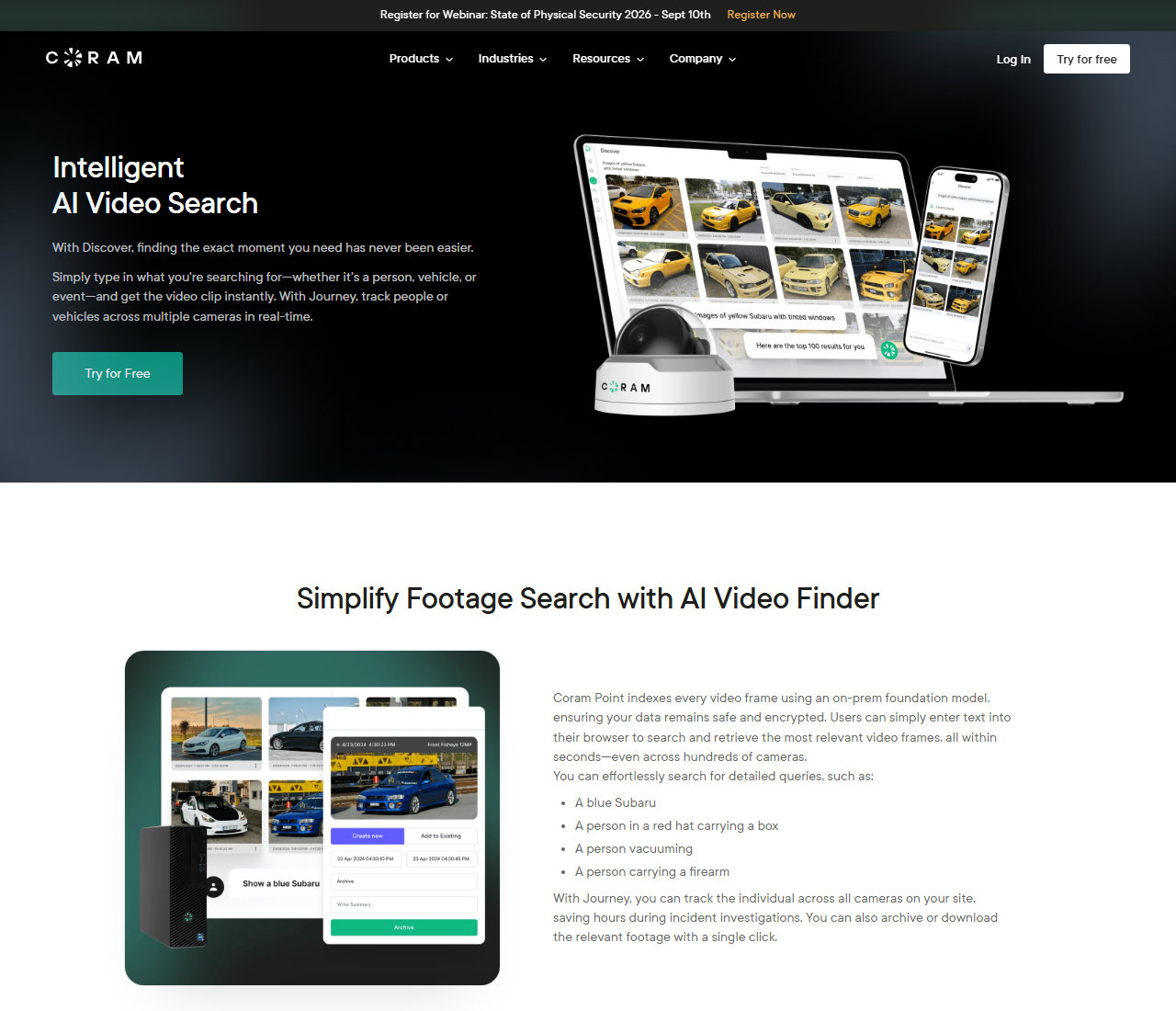
The deployment shape is the thing to understand before pricing. Every order ships a Coram Point, an on-premises bridge appliance that connects to the cameras and indexes every video frame with an on-prem foundation model, plus access to the Coram cloud dashboard. Coram states the Point is bought outright and once, not leased, and that you keep it at the end of a contract. Search ("Discover") runs in plain English — Coram's own examples include "a blue Subaru" and "a person in a red hat carrying a box" — and Coram says results come back in seconds "even across hundreds of cameras". A companion feature, Journey, tracks one person or vehicle across every camera on a site.
The hardware-agnostic model is the primary differentiator over camera-first competitors such as Verkada and Rhombus, which require proprietary hardware. Coram connects to 1,000+ IP camera models over ONVIF, and positions itself as the way to close an NDAA or FCC compliance gap at the software layer rather than through a phased camera swap. If a buyer has no IP cameras, Coram says it supplies 5MP NDAA-compliant cameras free with the software subscription, and that those cameras stay with the customer if the licence is not renewed.
The platform now spans more than video. Access control (door readers, tailgating detection), an Emergency Management System with panic buttons and reunification for schools and hospitals, Guest Management, facial recognition, license plate reading and Deep Investigation agents that generate incident reports all sit on the same dashboard. Coram serves K-12 districts, healthcare, government, warehousing, banking and multi-site enterprises.
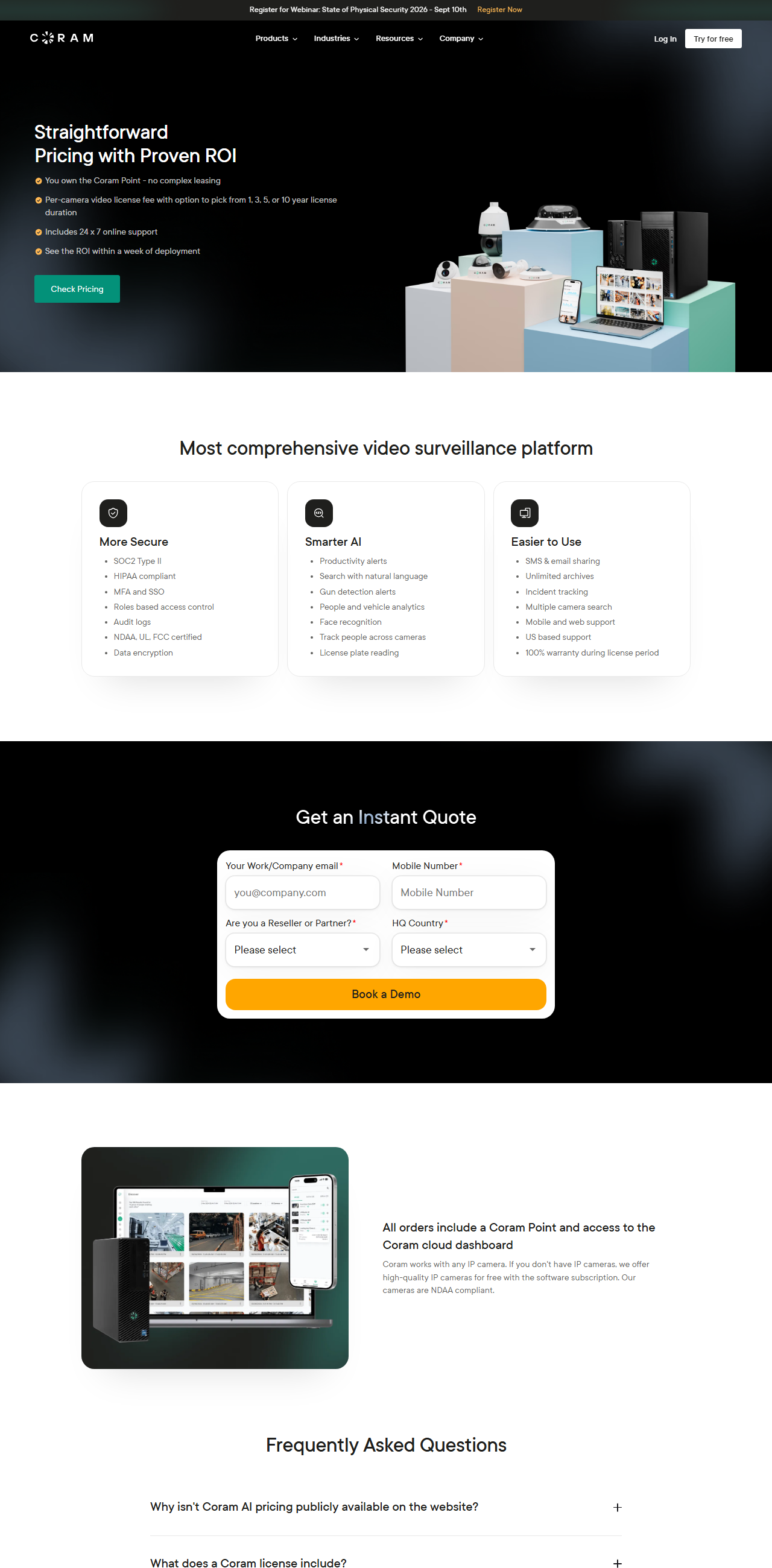
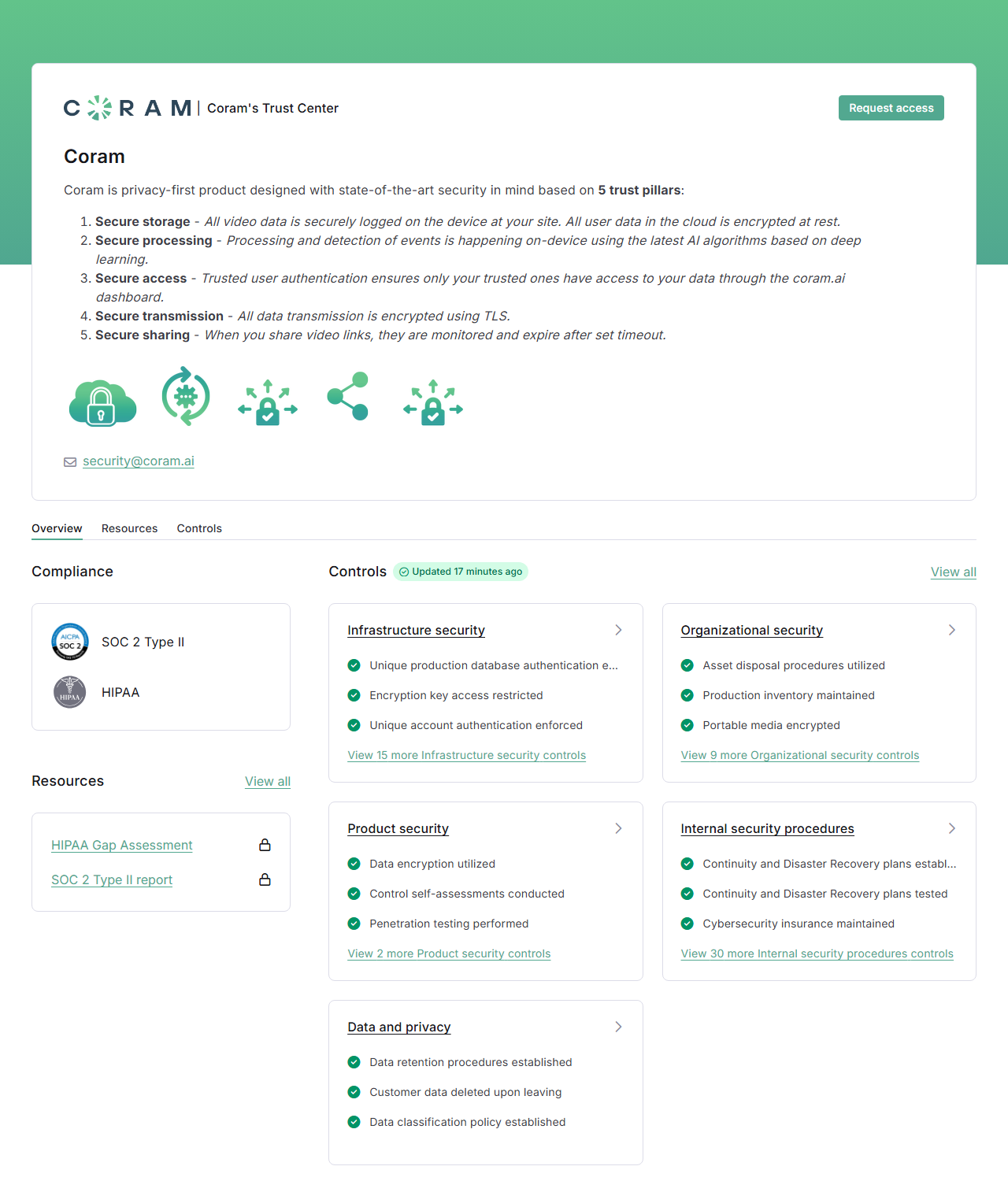
Pricing is not published. Coram charges a per-camera video licence fee over a 1, 3, 5 or 10 year term, includes 24x7 US-based online support and unlimited user seats, and issues a quote only after a form or demo call — there is no self-serve free trial despite the "Try for free" button, which opens the demo request. Coram holds SOC 2 Type II and a HIPAA gap assessment on a public Vanta trust centre, and its pricing page also claims NDAA, UL and FCC certification, MFA and SSO, role-based access control and audit logs.
Screenshots
Pricing
No public pricing. Coram charges a per-camera video licence fee, and the buyer picks a 1, 3, 5 or 10 year licence duration. Every order also includes a Coram Point on-prem appliance, which Coram says is purchased upfront and owned outright rather than leased, plus the Coram cloud dashboard with unlimited user seats.
A licence includes 24x7 US-based online support and a 100% hardware warranty for the licence period. If a buyer has no IP cameras, Coram supplies 5MP NDAA-compliant cameras free with the software subscription and says the customer keeps them, and the Coram Point, if the licence is not renewed. Coram states the quote depends on the number of locations, the type of camera and the days of storage retained.
There is no self-serve free trial: the "Try for free" button opens the demo/quote request form.
Feature Comparison by Tier
| Feature | Per-camera video licence (quote only) |
|---|---|
| Price | Not published — quote after a form or demo call |
| Licence term | 1, 3, 5 or 10 years, buyer's choice |
| Billing unit | Per camera; quote also varies by number of locations, camera type and days of storage |
| User seats | Unlimited on the Coram cloud dashboard |
| On-prem appliance | Coram Point included with every order, purchased upfront and owned outright — not leased |
| Cameras | Works with 1,000+ IP camera models over ONVIF; 5MP NDAA-compliant cameras supplied free if you have none |
| End of contract | Customer keeps the Coram Point and the free cameras if the licence is not renewed |
| Support | 24x7 US-based online support, 100% hardware warranty during the licence period |
| Free tier / trial | None — the "Try for free" button opens the demo/quote form |
Key Features
- Plain-English video search across hundreds of cameras: "Discover" indexes every frame on the on-prem Coram Point using a foundation model, so a text query such as "a blue Subaru" or "a person carrying a firearm" returns clips in seconds — Coram states this holds "even across hundreds of cameras".
- Journey cross-camera tracking: Follows one person or vehicle across every camera on a site in real time, so an investigation that would mean opening feeds one at a time becomes a single timeline; footage can be archived or downloaded in one click.
- Gun detection and safety alerts: Detects firearms, tailgating, dock delays and productivity or compliance events, and pushes alerts to mobile, SMS and email. Weapon detection is a named use case on Coram's own site rather than a generic anomaly model.
- Hardware-agnostic: 1,000+ IP camera models over ONVIF: The Coram Point bridges to 1,000+ existing IP camera models via ONVIF, so an NDAA or FCC compliance gap can be closed at the software layer without a rip-and-replace. Buyers without IP cameras get 5MP NDAA-compliant cameras free with the subscription.
- Access control, guest management and EMS on one dashboard: Door readers pair each access event with video, and the Emergency Management System adds panic buttons, lockdown and reunification for schools and hospitals. Coram claims compatibility with "99% of the existing access control infrastructure".
- Unlimited user seats and unlimited archives: The Coram cloud dashboard carries unlimited user seats within a licence, with unlimited archives, incident tracking, SMS and email sharing, and mobile plus web access — so cost scales with cameras, not with how many people log in.
Pros
- 4.9/5 on G2 from 189 reviews; the recurring themes in that corpus are ease of use, setup measured in hours rather than days, and support quality
- Camera-agnostic by design: the Coram Point bridges 1,000+ IP camera models over ONVIF, so an NDAA or FCC compliance gap is closed at the software layer instead of through a hardware refresh, and buyers without IP cameras are given NDAA-compliant 5MP cameras free with the subscription
- Unusually buyer-friendly contract mechanics for this category: the Coram Point is bought once and owned outright rather than leased, user seats are unlimited, and Coram says the customer keeps both the Point and the free cameras if the licence is not renewed
Cons
- No published pricing and no self-serve trial. The "Try for free" button opens a demo/quote form, so every cost conversation starts with sales and a per-camera figure cannot be sanity-checked before a call
- Cost is driven by three variables Coram names but does not price — number of locations, camera type, and days of storage — so a long retention requirement can move the quote substantially with no public reference point
- The buying decision is partly a hardware decision: every order ships a Coram Point appliance per site, which is an upfront capital line on top of the software licence and adds an on-premises box to maintain
Product Information
- Cloud
- Yes
- Self-Hosted
- No
- On-Premise
- Yes
- Languages
- English
- Training
- Demo call, Documentation, On-site setup support
Data Handling
- Training-data policy
- Coram's privacy policy contains no statement that customer video is used to train AI models, and explicitly says that for Google Workspace directory data "Coram does not use it to develop, improve, or train generalized artificial intelligence or machine learning models". Retention is contractual rather than a fixed day count: service data is kept "for the duration of the customer's business relationship", guest data "for the duration of the organization's active subscription" and is deleted on request, and Google Workspace directory data is deleted within 60 days of disconnecting the integration. Data is stored on U.S. servers and U.S. third-party cloud services, with Amazon Web Services named as the primary subprocessor. The trust centre lists "Data retention procedures established" and "Customer data deleted upon leaving" as monitored controls. Guest photographs are "used solely for visual identification by authorized personnel" with no facial recognition, biometric analysis or facial geometry extraction performed on them.
- Compliance
- SOC 2 Type II and HIPAA (both listed on Coram's public Vanta trust centre at security.coram.ai · with a HIPAA Gap Assessment and SOC 2 Type II report behind access request). Coram's pricing page additionally claims NDAA · UL and FCC certification · MFA and SSO · role-based access control · audit logs and data encryption. Trust-centre controls include penetration testing performed · encryption key access restricted · and portable media encrypted.
Frequently Asked Questions
How much do you pay for Coram AI?
Coram AI has no published price list. The vendor issues a custom quote based on camera count, door count for access control, and user seats for its emergency management module; weapon detection and EMS panic buttons are billed as add-ons above the base fee. Multi-year contracts of up to 10 years are available for enterprise and government buyers.
Can you use Coram AI without paying?
Coram AI does not offer a permanent free tier; every deployment eventually moves to a custom-quoted paid plan. It does offer a free trial with no credit card required, during which Coram's team validates camera compatibility and demonstrates the AI detection features live on the buyer's own site.
What should you use instead of Coram AI?
Verkada and Rhombus are Coram's two closest competitors, and both take the opposite approach: a fully proprietary camera lineup instead of layering AI onto hardware a buyer already owns. Verkada suits organizations starting a security system from zero cameras that want single-vendor support; Coram suits anyone with existing ONVIF or NDAA-compliant cameras who wants to avoid a full hardware refresh.
Coram AI or Verkada: which should you pick?
Verkada charges $199 to $1,799 per camera in mandatory annual licenses on top of its own proprietary hardware, while Coram works with cameras a buyer already owns and prices access separately by camera, door, or user. Coram's natural-language search and emergency management module go beyond Verkada's core video feed, but Verkada's plug-and-play setup can be faster for a team starting with zero existing cameras.
How long does it take to get going with Coram AI?
Most sites see AI detection features live within the trial period itself, well before any contract is signed. Start with Coram's free trial, where the team confirms your existing IP cameras are ONVIF or NDAA compliant, then walks through camera, door, and EMS-seat counts to scope a custom quote.
Top Alternatives
- Ambient.ai: Ambient.ai is the closest peer — computer vision layered on existing enterprise cameras, aimed at large corporate security operations centres and a broad library of threat signatures. Coram is the better fit where the buyer also wants access control, panic buttons and guest management on the same dashboard, and where an on-prem appliance you own outright is preferred to a purely cloud analytics layer.
- Overview AI: Overview AI is edge vision for the production line — on-device GPU cameras catching manufacturing defects — not a security platform. Pick Overview AI for quality inspection on a factory floor, and Coram when the question is who entered, what happened, and where the footage is.
- GeoEvident: GeoEvident works on imagery you already have, identifying where a photo was taken for investigation and verification work. Coram is a live monitoring system for cameras you operate. They meet only in the investigation step, and neither replaces the other.
HokAI guides covering Coram AI
- Coram AI Bet $35 Million That Buyers Won't Replace Their Cameras: Coram AI raised $35M betting buyers will pay for AI on cameras they already own, not new hardware. Here's who its pitch actually serves, and who loses.