BetterSelf Check vs. Dreambeans: Both Are "Free" AI Self-Tools in 2026, But They Aren't Substitutes
BetterSelf Check is a free, no-account web platform offering six two-minute AI-generated self-assessments with no data retained between sessions. Dreambeans, a Google Labs mobile app launched June 3, 2026, analyzes Gmail, Calendar, Photos, YouTube and Search history overnight to generate illustrated personal stories, opened to free US access on August 28, 2026.
The short version
BetterSelf Check and Dreambeans are both free AI self-insight tools as of September 2026, but that's where the similarity ends. BetterSelf Check is a two-minute, anonymous quiz that stores nothing. Dreambeans mines five Google data sources overnight, and its free access is a new, unofficial test wave Google's own pages haven't confirmed yet.
Want this decided for your own case? Find your tools with Smart Match, starting from this guide's question.
On August 28, 2026, Google dropped the price of trying Dreambeans to zero, and that single change is the only reason this comparison makes sense at all.
Before that date, BetterSelf Check and Dreambeans were not really comparable. One is a free, anonymous wellness quiz that has never asked for an email address. The other is a Google Labs app that reads a user's Gmail, Calendar, Photos, YouTube history and search activity to write an illustrated story about their life, and until late August it required a paid Google AI Ultra or AI Pro subscription just to try it.
Now both are free to access. That makes "free" a wash and surfaces the question that actually matters: what does each one do with what you give it, and how much are you giving it.
BetterSelf Check Stores Nothing
BetterSelf Check is 6 self-contained quizzes: Connection Fit, Personal Battery Meter, Quick Boost Finder, Sleep Snapshot, Body Age Estimator and Affirmations Now. Each takes under 2 minutes. A user answers a short set of questions, an AI model generates a short, personalized read on the spot, and that is the entire interaction.
There is no login, no email capture and no saved history. The site's own about page states its model in five words: "No costs. No logins." Responses exist only for the length of that session; nothing about the person who took the quiz is retained afterward, which is also why the platform cannot show anyone how their answers changed over time.
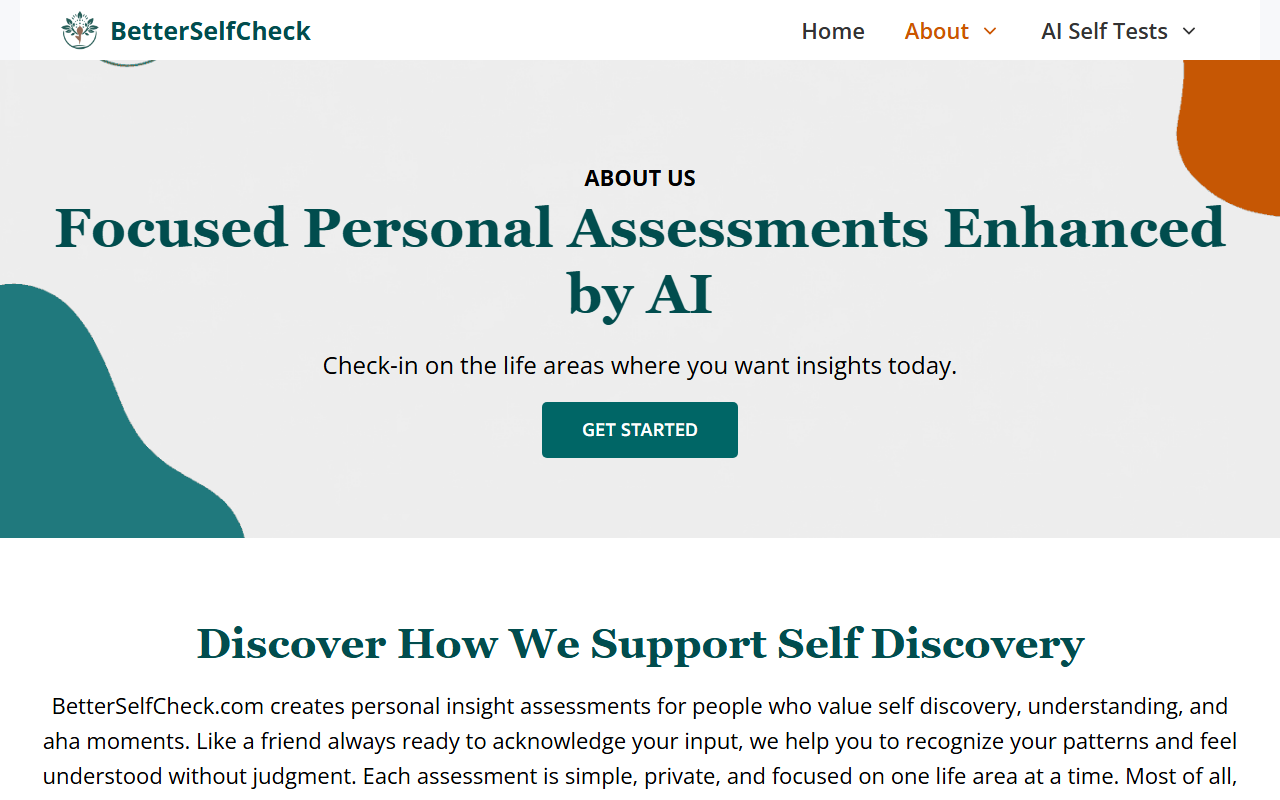 BetterSelf Check's own pitch, captured September 1, 2026: no cost, no account, one check-in at a time.
That zero-footprint design is also the product's ceiling. With no account and no stored results, the platform cannot build a longitudinal picture of a user the way a habit tracker does, and its 6-assessment catalog has not grown since HokAI first reviewed it in March 2026.
What Dreambeans Actually Does
Dreambeans is a different kind of product. It launched June 3, 2026 from Google Labs, the division behind NotebookLM, running on the same Personal Intelligence context system that personalizes the Gemini app. Instead of a quiz, it works overnight, scanning whichever of those 5 sources a user connects, looking for patterns such as a delivery receipt next to a calendar event, then delivering 10 to 14 illustrated stories the next morning, drawn with an image model called Nano Banana 2.
At launch, only AI Ultra subscribers could use it. Eligibility expanded to AI Pro subscribers in early August, according to 9to5Google's reporting, before opening to any free US Google Account on August 28.
The app also carries 2 smaller features. Ask Anything opens a conversational follow-up inside a single story, so a story about an upcoming hike can be pushed for trail conditions without leaving the app. Each story also carries a one-tap action, like pulling up a ticket or a trailer, and a Tune Your Feed control that accepts thumbs-down feedback to steer future mornings.
The Eligibility Page Hasn't Caught Up
Here is the part that complicates a clean "both are free now" verdict. Google's own product pages have not been updated to reflect that expansion. As of this writing, the official Dreambeans landing page at labs.google still states plainly that the app "is currently available to eligible Google AI Pro subscribers (18+) in the US," with a waitlist link for everyone else.
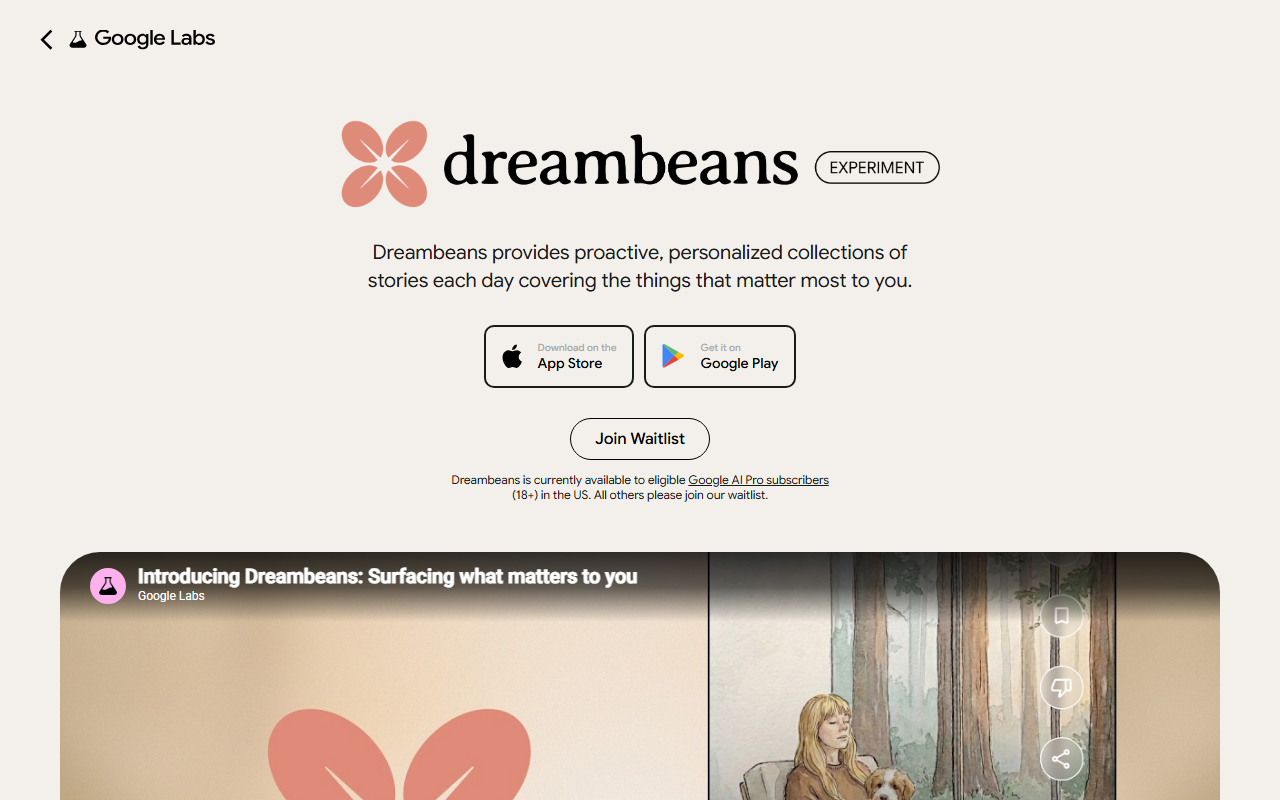 Captured September 1, 2026, 4 days after 9to5Google reported the free test wave: the official page has not been updated to match.
So a reader who clicks through from the company's own site today, rather than from a news report, will likely still hit a paywall or a waitlist form. The free tier is real, per 9to5Google's sourcing, but the documentation has not caught up with its own rollout, and the outlet itself frames the change as a test rather than a settled policy: "It remains to be seen how Dreambeans will graduate from Google Labs."
That gap is not unusual for a product still labeled an experiment. A page updates on its own schedule, a press cycle moves faster, and the two rarely line up during a rollout. The practical result for a reader today is simple: check the access screen directly rather than trusting either the news coverage or the marketing page to be current.
That matters because of what the paid tiers cost before this test wave. AI Ultra runs $19.99 a month in the US with multi-month and annual discounts, and AI Pro sits below it as a separate paid plan. A reader who tried it in June or July, when Ultra was the only door in, was paying for a bundle of AI features and getting story generation as one small piece of it, not paying for the app on its own.
The Real Trade Isn't Price, It's Data
Even once a reader gets in for free, the two products ask for opposite things. BetterSelf Check takes 6 answers per session and forgets them. Connecting to Dreambeans requires linking at least one data source, and its whole premise depends on cross-referencing several of them at once to notice patterns a single source would miss.
That is not a new trade in AI products. Rewind AI runs a more extreme version of the same exchange, continuously capturing everything a user sees, says or hears on their device to make it searchable later, rather than pulling from 5 specific apps once a day.
It sits between a session-only quiz and a full recording of a user's life, and where a given reader is comfortable on that spectrum is the actual decision, not the sticker price. That decision will keep coming up: more products are built on exactly this trade every quarter, not fewer.
There are per-source controls: each of the 5 connections can be toggled independently, and a separate delete option clears stored data without touching Personal Intelligence settings elsewhere in the account. BetterSelf Check has nothing to toggle, because it never had anything to store in the first place.
Two Categories Wearing the Same Label
Both products end up filed under the same loose banner, AI tools for understanding yourself, which is why they get compared at all. In practice they belong to different categories that just happen to share a shelf: BetterSelf Check is a self-assessment quiz, closer to a magazine personality test with an AI writer, while Dreambeans is an ambient personalization feed, closer to a recommendation engine that happens to narrate itself as stories.
That distinction is not academic. A quiz product's failure mode is being shallow or repetitive; a personalization feed's failure mode is getting something wrong about a user's actual life, or making a call the user did not ask it to make about what deserves their attention. The two products are not competing for the same 2 minutes of a reader's day so much as they are competing for two different kinds of trust.
A reader who has never used either product can test that distinction directly. Trying the quiz costs 2 minutes and reveals nothing about anyone. Trying the story feed costs an account connection and a night of data processing before the first result even appears.
Who Should Use Which
For a reader who wants a 2-minute gut check on one specific thing, mood, sleep, energy, and does not want an account anywhere, BetterSelf Check's no-data model has no real competitor in this comparison. It also has no growth story: the same 6 assessments have shipped since launch, with nothing announced to suggest more are coming.
The strongest case against that verdict is that the free test wave genuinely lowers the cost of trying the more ambitious product, so why not use both? That is fair for a reader already deep in Gmail, Calendar and Photos who wants a passive daily recap of their own week.
It is a weaker case for anyone outside the US, since the app stays US-only on Android and iOS with no international date announced. It is weaker still for anyone unwilling to hand a Labs experiment years of email and photo access for a feature that could still be pulled, repriced or folded into another product before it leaves beta.
Readers unsure which category of tool actually matches how they want to spend two minutes a day can skip guessing from a features list: HokAI's Smart Match matches a stated need to a tool directly, and the broader emerging AI software directory covers both categories these two products sit in.
What Would Change This
2 things would move this comparison. If Google commits Dreambeans to a permanent, unlimited free tier and updates its own pages to say so, the "both free" framing becomes real instead of a 4-day gap between a news report and a product page. And if BetterSelf Check ever adds accounts or saved history, the one advantage it holds over every data-hungry personalization app, namely that it has nothing to leak because it stores nothing, goes with it.
Frequently asked questions
Is BetterSelf Check actually free, or is there a hidden paid tier?
BetterSelf Check has no paid tier at all. All six assessments, covering friendship style, energy, sleep, motivation, body age estimation and affirmations, are free with no login and no credit system, according to the platform's own about page.
Do I need a Google AI Ultra or AI Pro subscription to use Dreambeans?
As of Google's own labs.google page, checked September 1, 2026, Dreambeans still lists Google AI Pro as the required subscription for US users 18 and older, with a waitlist for everyone else. 9to5Google reported on August 28, 2026 that Google had separately opened a free test tier for any US Google Account, so the requirement can depend on which access path a user finds.
What Google data does Dreambeans actually use?
Dreambeans can connect to Gmail, Calendar, Photos, YouTube and Search history, and a user must enable at least one of the five for the app to work. Each connection can be toggled independently, and Google provides a separate option to delete stored data at any time.
Can I see my past results on either app?
Not on BetterSelf Check. Responses are used only to generate that session's result and nothing is saved between visits, so there is no history to review. Dreambeans keeps a personal library of saved stories and lets users tune future stories with feedback, though Google has not published how long that data is retained.
Is Dreambeans available outside the United States?
Not yet. Dreambeans remains limited to US-based Android and iOS users 18 and older, and Google has not announced a date for expanding to other countries.
Covered in this guide
- BetterSelf Check: Free AI-powered personality assessments that take under 2 minutes each, with instant custom insights and no sign-up required.
- Dreambeans: Google Labs app turning Gmail, Calendar, Photos and YouTube data into illustrated daily stories, for Google AI Ultra subscribers since June 2026.
- Rewind AI: Discontinued December 2025. Rewind captured, searched and recalled everything you saw, said or heard on a Mac, until Meta acquired Limitless and switched it off.
Sources
Still deciding?
This guide covers a handful of options. Smart Match checks every listing in the directory against how you actually work and what you can spend, then hands you the shortlist and the reason behind each pick.
Find your tools